
Before I wrote this article, I pulled the New Zealand search data for the exact keyword it targets.
Here’s what came back.
“How to increase website traffic” gets 30 searches a month in New Zealand.
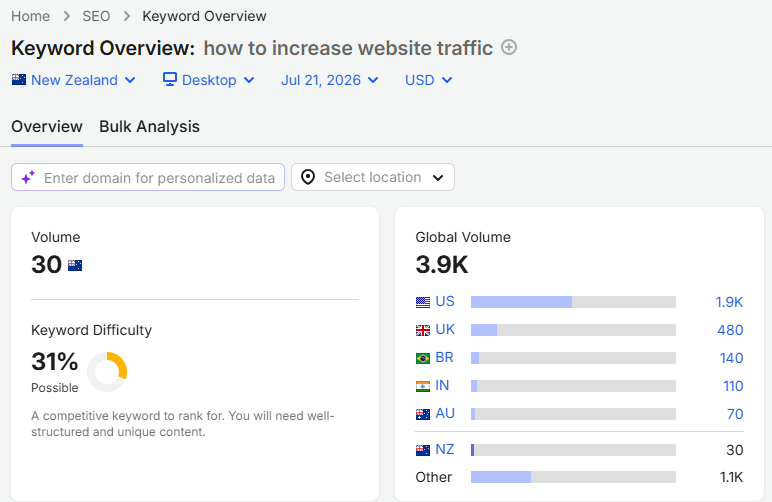
The same keyword gets 1,900 a month in the United States. The UK does 480. Brazil does 140. India does 110. Australia does 70. Globally it’s 3,900.
Thirty. That’s the total monthly demand in this country for one of the most commercially valuable keywords in marketing.
I’m opening with that because almost every guide you’ll read on this topic was written for the American market.
The advice inside them — target high-volume keywords, publish three times a week, build a content machine — is calibrated for a country with more than 60 times our search demand on this exact keyword.
Follow it here and you’ll spend twelve months building something for an audience that doesn’t exist at that scale.
New Zealand needs a different approach. Smaller, sharper, and done in a specific order. That’s what this guide is.
I’ve spent ten years doing SEO, mostly in brutally competitive international markets.
I grew one site from zero to around 1,500 organic visitors a day inside twelve months. Another to 5,000+ daily visitors with peaks over 10,000. A YouTube channel from nothing to three million views.
The tactics below are the ones that work here.
Why your website traffic is so low
Before the fixes, the diagnosis. In my experience there are five reasons a New Zealand business website gets no traffic, and they’re almost always in this order.
1. Google doesn’t know your pages exist. Not indexed, blocked by a stray noindex tag, or buried so deep in your site structure that nothing links to them. This is more common than people think and it’s the fastest thing to fix.
2. You’re targeting keywords nobody in New Zealand searches. Or, more painfully, keywords 40,000 international sites are already fighting over.
3. You have five pages. A homepage, an about page, a services page, a contact page and a gallery. There is almost nothing for Google to rank. You cannot get traffic for searches you have no page for.
4. Your pages exist but they’re thin. Three hundred words of “we pride ourselves on quality workmanship” doesn’t compete with a competitor who actually answered the question.
5. Nobody links to you and nobody’s heard of you. No backlinks, no citations, no reviews, no brand searches. Google has no reason to trust you over the established player.
Most businesses I look at have four of the five. The good news is that all five are fixable, and the first two are fixable in a fortnight.

The six places website traffic actually comes from
You can’t increase something you can’t see. Every visitor to your site arrives through one of six doors:
- Organic search — someone Googled something and clicked your result. Slowest to build, cheapest to maintain, compounds forever.
- Direct — they typed your URL or used a bookmark. This is your brand strength made visible.
- Referral — they clicked a link on another website. Directories, partner sites, press coverage.
- Organic social — Facebook, Instagram, LinkedIn, TikTok. Fast to start, dies the moment you stop.
- Email — your list. The only audience you actually own.
- Paid — Google Ads, Meta ads. Instant, and it stops the second the card declines.
Open Google Analytics 4 right now and look at your traffic acquisition report. If 90% of your traffic sits in one channel, you have a fragility problem regardless of how healthy the number looks.
Most NZ small businesses I audit are almost entirely direct traffic — people who already know them. That’s not growth. That’s existing customers finding the phone number.
The honest maths on New Zealand search volume
This is the section no other guide will give you, so read it twice.
When I ran keyword research for this article, Google Keyword Planner returned 614 keyword variations for the New Zealand market. Here’s the distribution:
- Almost every single one sat in the 10–100 searches per month bracket
- A large chunk sat at 0–10
- Not one broke 100
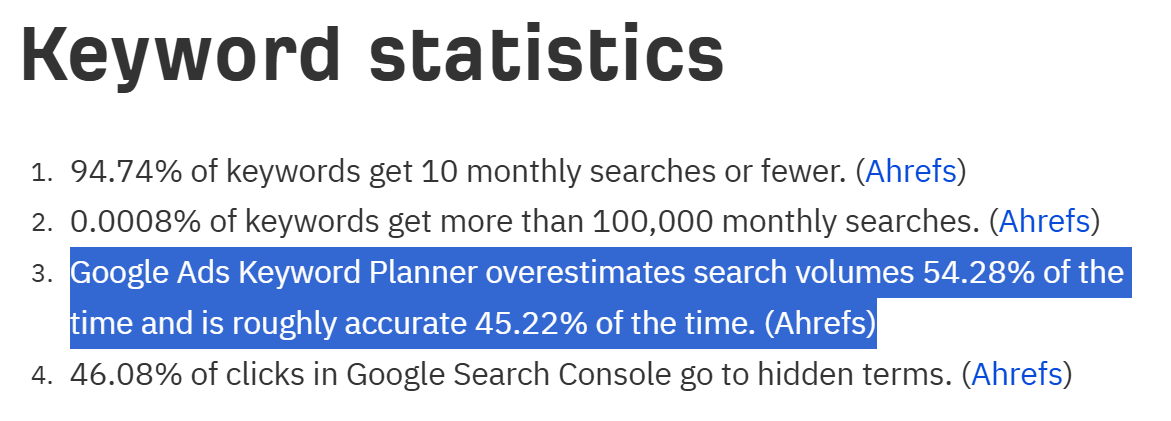
SEMrush put the primary keyword at 30 a month. AnswerThePublic said 10. Keyword Planner said somewhere between 10 and 100. The tools disagree because at these volumes they’re all estimating from tiny samples.
So what does ranking #1 in New Zealand actually get you?
Backlinko’s analysis of four million Google results found the top organic position takes around 27.6% of clicks. Apply that honestly:
- A 30/month keyword at #1 ≈ 8 visits a month
- A 100/month keyword at #1 ≈ 28 visits a month
Eight visits. That’s the prize for beating Backlinko and Ahrefs on a keyword.
This is where most NZ businesses give up, and it’s exactly the wrong conclusion. Here’s the reframe:
One keyword is never the strategy. The cluster is.
Those 614 keywords aren’t 614 articles. Most of them resolve to the same search results page, which means one genuinely good article can rank for hundreds of them. Ten searches here, twenty there, thirty somewhere else. Individually pathetic. Collectively, that’s a few hundred visits a month from a single page.

And the second reframe: intent beats volume, and it isn’t close.
“How to increase website traffic” has a cost-per-click of up to NZ$16.71 at the top of the page. Advertisers pay nearly seventeen dollars for one click on an informational query. They do that because those searchers turn into customers.
Meanwhile a keyword like “auckland plumber” might do 50 searches a month. Fifty. But every one of those people has water on the floor and a credit card in their hand. Twelve of those beats twelve hundred readers of a listicle.

The practical rule for New Zealand: stop asking “how much volume does this have” and start asking “how much is one of these people worth to me.”
If your average customer is worth $3,000, a keyword doing 20 searches a month that converts twice a year has paid for itself many times over. Run that number for your own business before you pick a single keyword. Most people never do.
The order to do this in
Here’s the actual problem with every other guide on this topic. They hand you between 12 and 39 tactics in a flat list and walk away.
I looked at eleven of the top-ranking articles for this keyword while researching this piece. Not one of them tells you what to do first.
So you read the list, feel motivated, start a TikTok account, post twice, get 40 views, and conclude SEO doesn’t work — while your website still isn’t indexed properly.
Order of operations matters more than tactic count. Here’s mine.
| Phase | Timeframe | Focus | Why here |
|---|---|---|---|
| 1. Foundation | Weeks 1–2 | Tracking, technical fixes, Google Business Profile | Nothing else works if Google can’t crawl you, and you can’t improve what you don’t measure |
| 2. Winnable searches | Weeks 3–6 | NZ keyword research, service and location pages, on-page | Fastest realistic wins available to a NZ business |
| 3. Content that compounds | Weeks 7–12 | Topic clusters, customer questions, refreshing, internal links | Builds the topical depth that makes everything else rank easier |
| 4. Authority | Ongoing from week 4 | Citations, reviews, digital PR, links | Slowest to build, so start early and never stop |
| 5. Other channels | Ongoing from week 8 | Email, social, video, communities | Reduces dependence on Google |
| 6. Paid | Any time, if budget allows | Google Ads, retargeting | Buys traffic while the organic work matures |
Work top to bottom. Don’t jump to phase five because it’s more fun than phase one. It is more fun. It also won’t work yet.
Phase 1: Fix the foundation (weeks 1–2)
1. Set up proper tracking before you change anything
You need a baseline. Without one you’re guessing for the next six months.
Install Google Analytics 4 and Google Search Console. Both free, both take under an hour, and Search Console is the single most underrated tool available to a small business — it tells you exactly which searches you’re already appearing for.
In GA4, set up conversion tracking as key events. Form submissions, phone taps, quote requests, purchases. If you only track sessions you’ll end up optimising for the wrong number.

Action tip: In Search Console, open Performance and sort by Impressions with a filter for position 8–20. Those are keywords you’re nearly ranking for. Improving a page from position 11 to position 6 is far easier than ranking a new page from scratch, and it’s the fastest traffic win available to almost anyone reading this.
2. Make sure Google can actually crawl and index your site
Run through a proper technical SEO checklist, but at minimum:
- Check Search Console’s Pages report for anything marked “Crawled – currently not indexed” or “Excluded by noindex tag”
- Confirm your XML sitemap is submitted and current
- Check your robots.txt isn’t blocking anything important
- Fix broken internal links and redirect chains
- Confirm one canonical version of your site (https, and either www or non-www, not both)
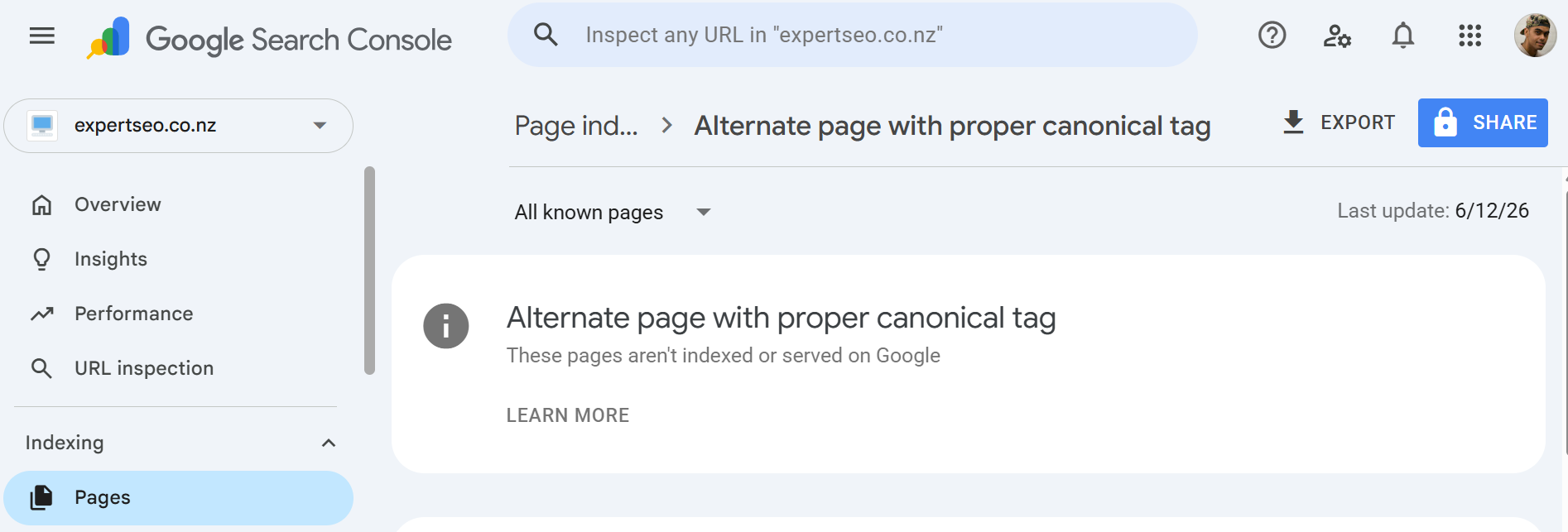
I’ve seen NZ businesses spend thousands on content while a stray noindex tag from their web developer’s staging site kept half their pages out of Google. Check first.
3. Fix page speed and mobile
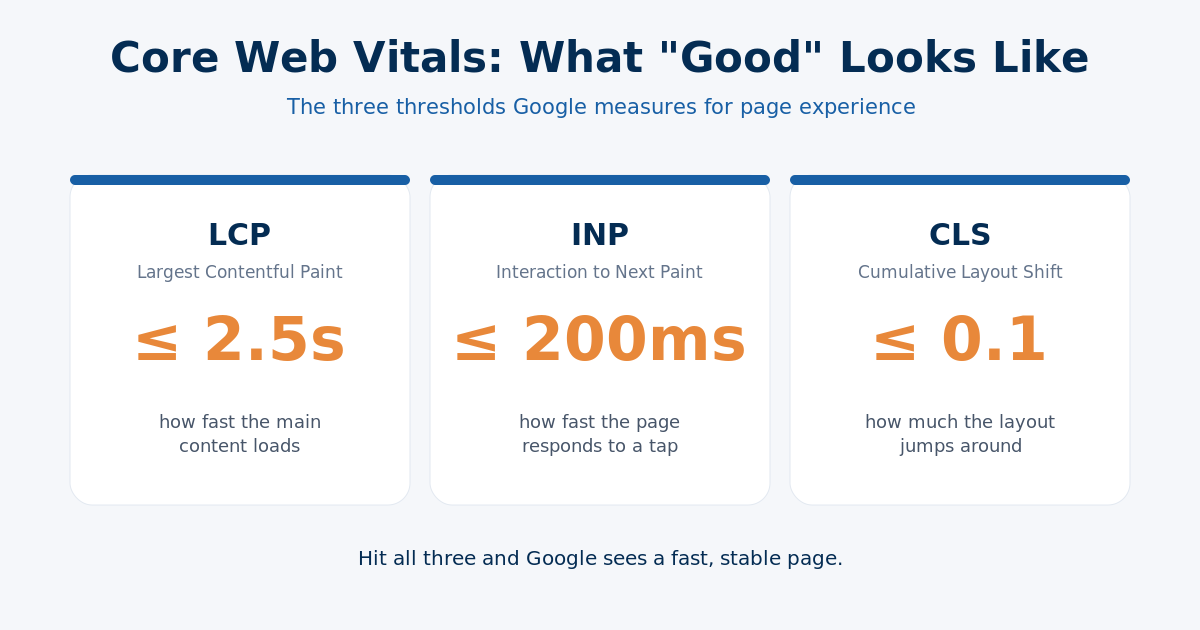
Google’s Core Web Vitals thresholds are published and specific:
- Largest Contentful Paint (LCP): under 2.5 seconds
- Interaction to Next Paint (INP): under 200 milliseconds
- Cumulative Layout Shift (CLS): under 0.1
Run your site through PageSpeed Insights and fix what it flags. In my experience the biggest wins for New Zealand small business sites, in order, are: compressing oversized images, removing unused plugins, enabling caching, and choosing hosting with a server closer to your users. A surprising number of NZ sites are hosted in the US for no reason.
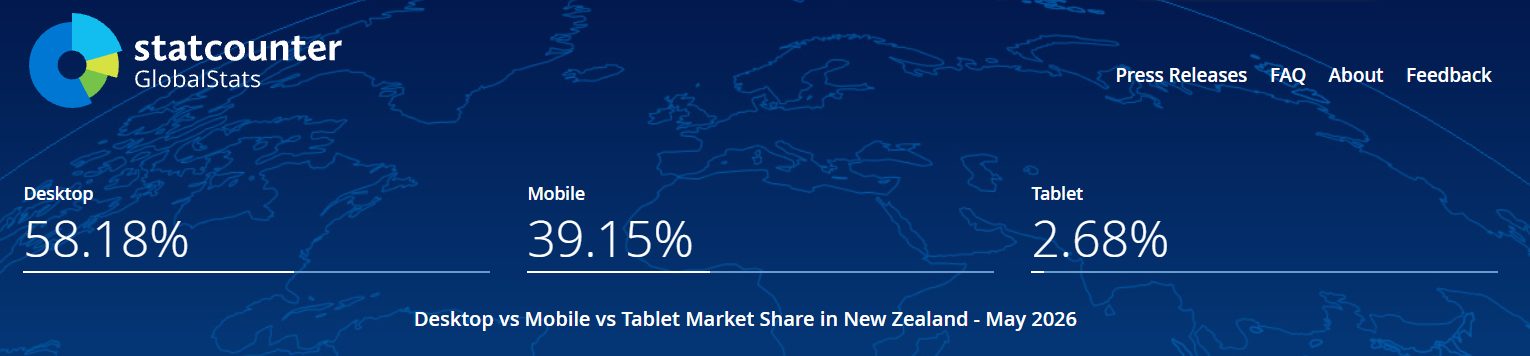
More detail on page speed and mobile SEO if you want to go deeper.
4. Claim and optimise your Google Business Profile
If you serve customers in a physical location or a defined area, this is the highest-return hour you will spend all year.
The local map pack sits above the organic results. For “plumber Hamilton” style searches, the three businesses in that pack take around 42% of all clicks — most of them before anyone scrolls far enough to see position one organic.
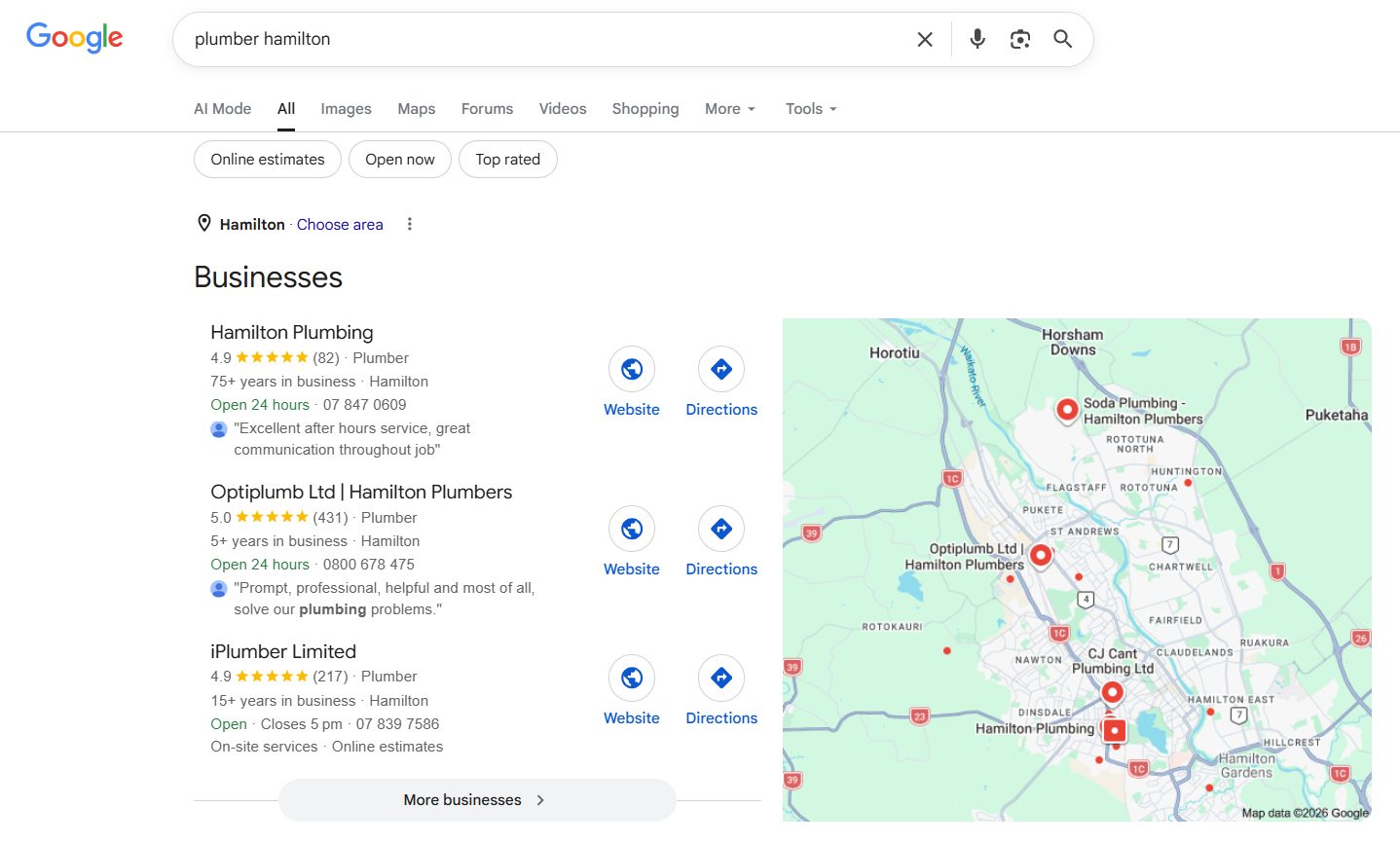
Do all of it:
- Complete every field. Categories, services, hours, service areas, attributes
- Upload real photos of real work, regularly. Not stock images
- Post updates weekly
- Answer the Q&A section yourself
- Get reviews consistently and reply to every one
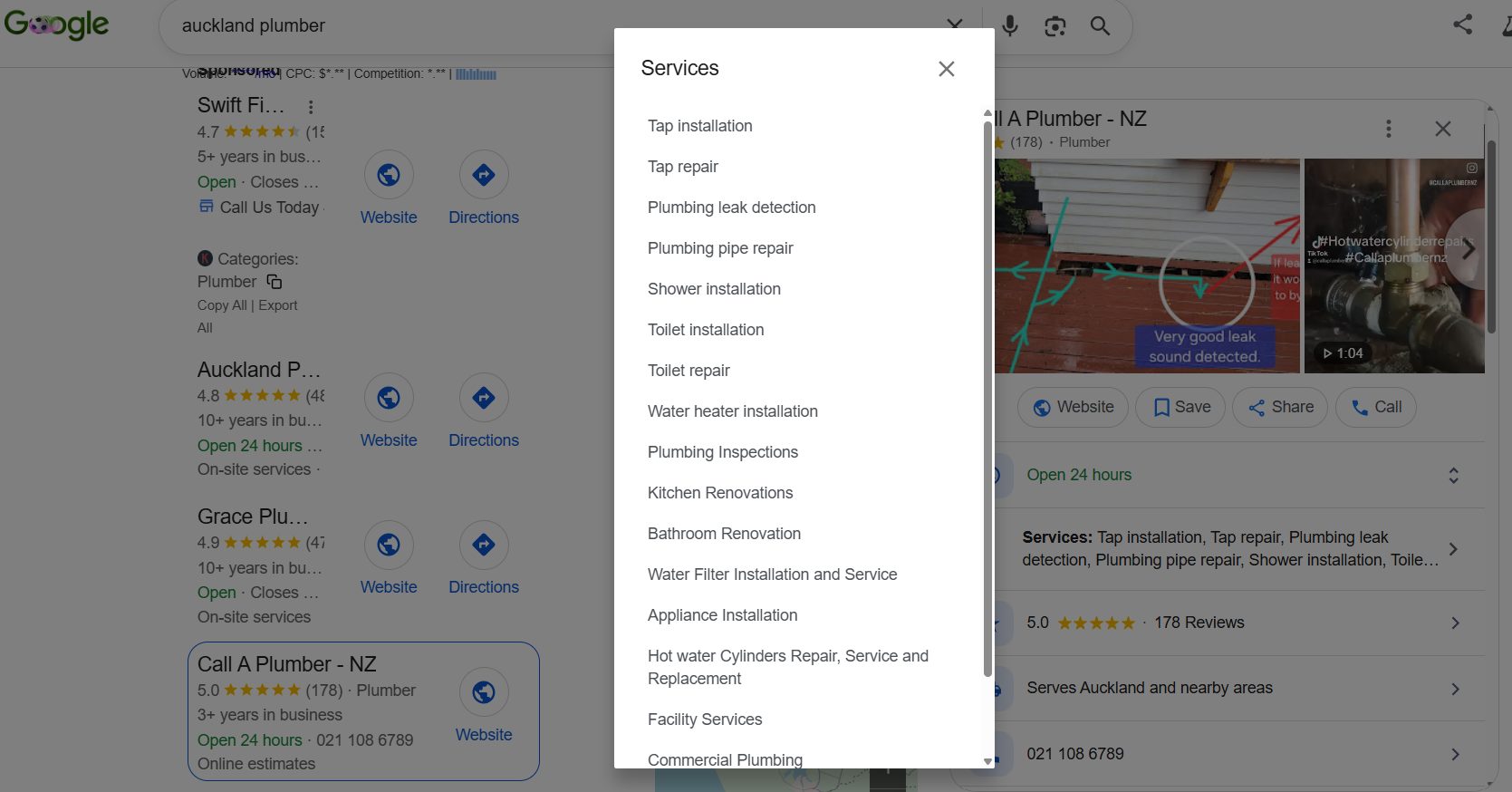

Full detail: optimising your Google Business Profile and how the Google map pack actually works.
Action tip: Ask your next five happy customers for a Google review by text, with a direct link, the same day you finish the job. Not a week later. Google reviews influence both rankings and click-through rate, and the same-day ask converts several times better than the delayed one.

Phase 2: Win the searches you can actually win (weeks 3–6)
5. Do keyword research for the New Zealand market specifically
This is where NZ businesses go wrong most often. They use a US-oriented guide, find a keyword with 5,000 monthly searches, and never check that the volume is almost entirely American.
Set your country to New Zealand in every tool, every time.
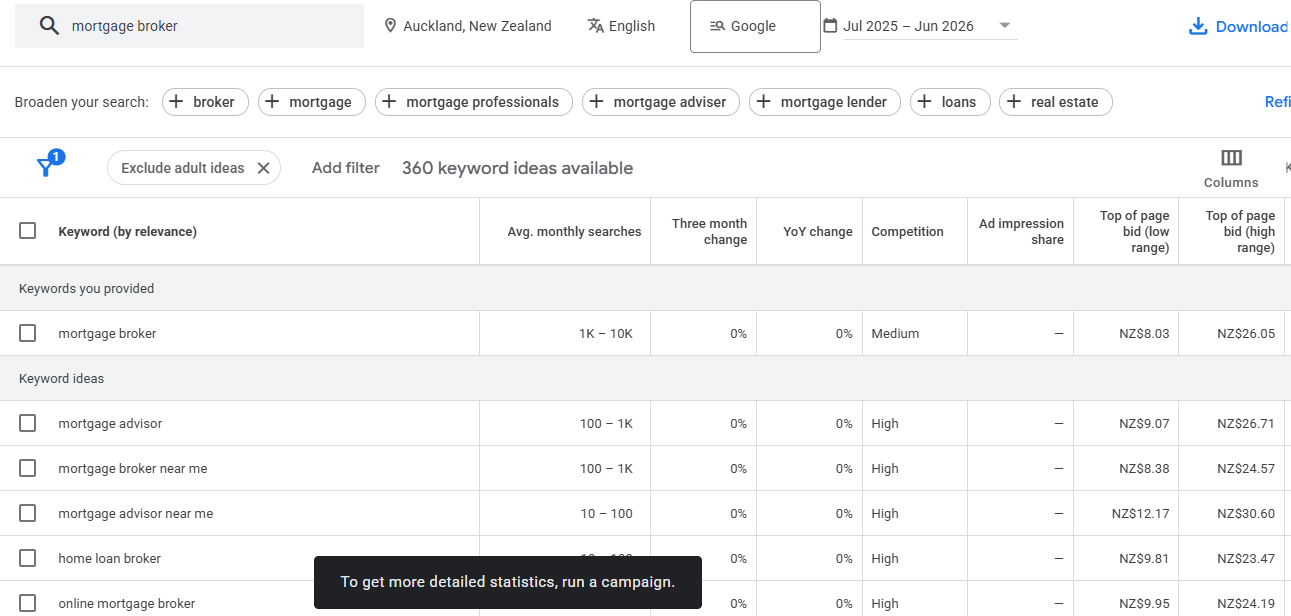
Then judge keywords on three things:
- Commercial intent — would this person buy?
- Realistic difficulty — can you actually rank inside twelve months?
- Value per customer — what’s one conversion worth?
Volume comes fourth. In New Zealand it always comes fourth.
Start with Google Keyword Planner since it’s free, cross-check in a paid tool if you have one, and work through a proper keyword research checklist so you’re not just collecting words.
Understand search intent before you write anything. Google the keyword. If the top ten results are all product pages, a blog post will not rank there no matter how good it is.
6. Target service + location, and go long-tail
The two highest-return keyword patterns for New Zealand businesses:
Service + location. “Emergency electrician Tauranga.” “SEO Services Auckland.” “Family lawyer Christchurch.” Low volume, brutal intent, and you’re competing against local businesses rather than international content mills.
Long-tail questions. “How much does a builder charge per hour NZ.” “Do I need consent for a deck NZ.” Longer, more specific, easier to rank for, and they catch people earlier in the process.
Both are winnable. Both convert. Neither shows up impressively in a keyword tool.
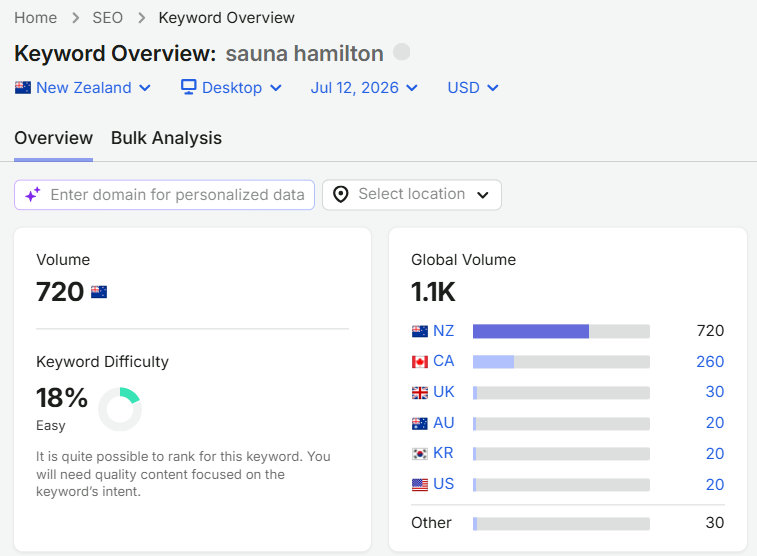
If you operate in multiple towns, build genuine location pages — not the same page with the city name swapped out. Google has been demoting those for years. Different local examples, different projects, different photos, genuinely different content.
More on the types of keywords worth targeting.
7. Get the on-page basics right
Unglamorous, fast, and it works.
- Title tags — primary keyword near the front, under about 60 characters, written to earn a click rather than just describe
- Meta descriptions — not a ranking factor, absolutely a click-through-rate factor
- Headings — one H1, logical H2s and H3s that actually describe the sections
- Internal links — 3–5 relevant links from every new page to related pages
- Image alt text — describe the image honestly, don’t stuff keywords
- Schema markup — LocalBusiness, FAQ, Service, Review. Helps both Google and AI systems understand what you are
Work through an on-page SEO checklist for each page rather than trying to hold it in your head.
Action tip: Take your five most important pages. Rewrite every title tag to lead with the keyword and include something a competitor’s title doesn’t — a price, a timeframe, a guarantee, a location. Titles are the single cheapest lever on this entire list.
Phase 3: Build content that compounds (weeks 7–12)
8. Build topic clusters, not random blog posts
Publishing disconnected articles whenever inspiration strikes doesn’t build authority. It builds a pile.
The approach that works: pick a topic you want to be known for, write one comprehensive pillar page, then write supporting articles around it that each cover one subtopic in depth. Link them all to the pillar and to each other.
This is how topic clusters work, and it’s why a site with 30 tightly connected articles on one subject outranks a site with 200 articles on everything.
For a NZ business, pick one thing. Be the most useful resource in the country on it.
9. Answer the questions your customers actually ask
The fastest content strategy available to any business: write down every question a customer has asked you in the last three months. Answer each one properly on your website.
That list is free keyword research, it’s pre-validated by real humans, and it targets exactly the long-tail searches you can rank for.
Add the questions Google gives you for nothing:
- Type your keyword into Google and read the People Also Ask box
- Scroll to the bottom for related searches
- Search your topic on Reddit and see what people are genuinely confused about
Use a content brief for anything substantial so the article covers the topic properly rather than skimming it.
10. Refresh what you already have
This is consistently the highest-return content activity and almost nobody does it.
Find pages that have slipped in rankings or that were written years ago. Update the statistics, add sections covering what’s changed, remove what’s dated, improve the formatting, add internal links, republish.
An existing page has history, links and Google’s trust already. Improving it is dramatically easier than ranking something new. In Search Console, sort by pages that lost impressions over the last six months versus the six before — that’s your refresh list, prioritised for you.
More on why fresh content matters.
Not sure which phase you’re actually in?
I’ll run a free SEO audit on your site and tell you specifically what’s holding your traffic back — no pitch, no obligation. Get your free SEO audit.
Phase 4: Build authority (ongoing, start week 4)
11. Get listed properly in New Zealand directories
Consistent business listings — name, address, phone, identical everywhere — help Google confirm you’re a real business at a real address.
Start with the NZ-relevant ones: Yellow, Localist, Finda and Neighbourly, plus your industry association and your chamber of commerce. Then any legitimate local directory for your town.
The rule that matters: exact consistency. “Suite 2, 14 Victoria St” on one and “14 Victoria Street” on another creates ambiguity you don’t want.

More on local citations.
12. Earn backlinks that mean something
Backlinks remain one of Google’s strongest signals, and this is where most NZ small businesses are genuinely behind.
What works here, in rough order of effort-to-reward:
- Local sponsorships. Sponsor a school gala, a sports club, a community event. These are real relationships that produce real .nz links, and your competitors aren’t doing it
- Supplier and partner pages. Ask suppliers whose products you stock to list you as a stockist
- Digital PR. NZ media outlets need local expert comment constantly. Being a quotable source is a repeatable link source
- Genuinely useful resources. A calculator, a template, an original piece of NZ data. Things people cite because they’re useful
- Guest posts on relevant NZ industry sites
What doesn’t work: buying links in bulk, directory blasts, private blog networks. Google is better at detecting these than the people selling them will tell you.
You need fewer than you think.
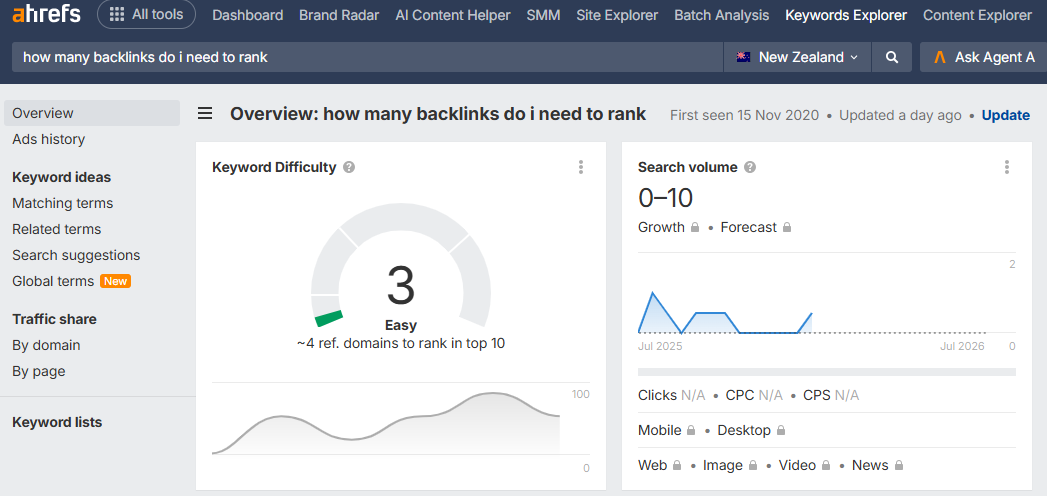
See how many backlinks you actually need to rank — in most NZ niches the answer is a lot lower than the international guides suggest, because your competition is lower too.
More detail on link building.
Phase 5: Traffic beyond Google (ongoing, from week 8)
13. Build an email list
Email is the only audience you own. No algorithm change takes it away.
Offer something genuinely worth an email address — a checklist, a pricing guide, a template — and send something useful consistently. A list of 500 engaged NZ subscribers will out-perform 5,000 social followers every time.
14. Be realistic about social media
Organic reach on Facebook and Instagram for business pages is poor and getting worse. Social can absolutely drive traffic, but it stops the day you stop posting. It does not compound the way search does.
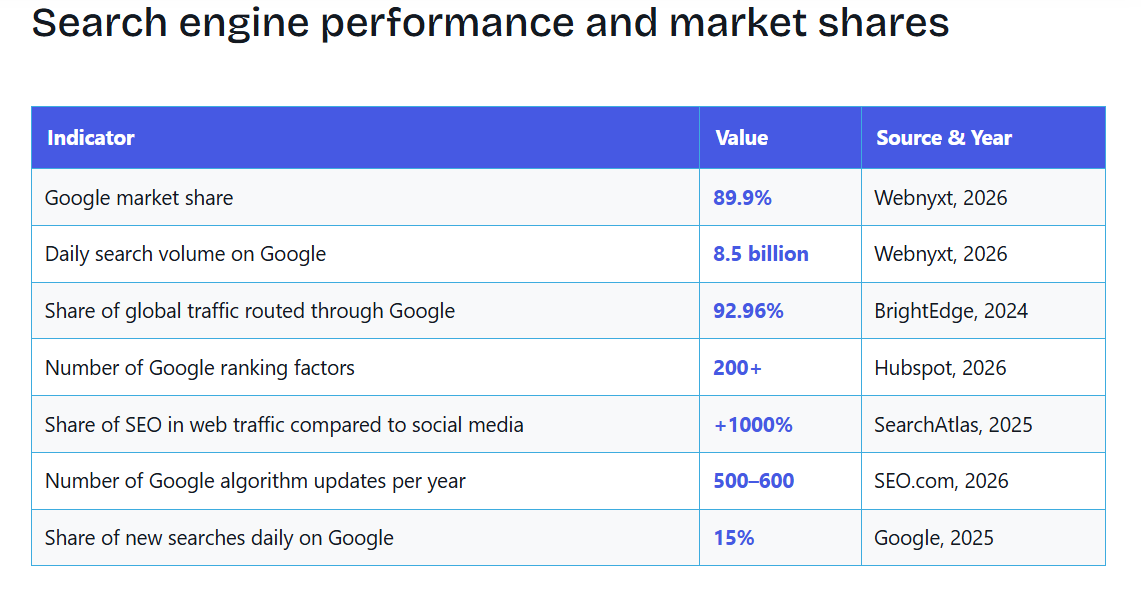
Pick one platform where your customers actually are. For most NZ trades and local services that’s Facebook. For B2B and professional services it’s LinkedIn. For anything visual or under-35, Instagram or TikTok.
One platform done properly beats five done badly.
15. Use video where it makes sense
There’s a video carousel sitting on the search results for this exact keyword, which tells you Google wants video for these queries.
I grew a YouTube channel from zero to over three million views and 30,000 subscribers, and the thing I’d tell any business owner is that YouTube is a search engine before it’s a social network. People search it for “how to” content constantly, competition is far lower than Google’s, and videos rank in Google results too.
16. Show up where your customers are already talking
Reddit, Facebook groups, industry forums, Neighbourly. There’s a “Discussions and forums” block on this keyword’s search results — Google is actively surfacing community content.
The rule: be useful for months before you ever link to yourself. Answer questions properly. Drop the link only when it genuinely helps. Anything else gets you removed and does more brand damage than the traffic was worth.
Phase 6: Paid traffic, when it makes sense
Paid ads buy you traffic today while the organic work matures. That’s the correct way to think about them — a bridge, not a strategy.
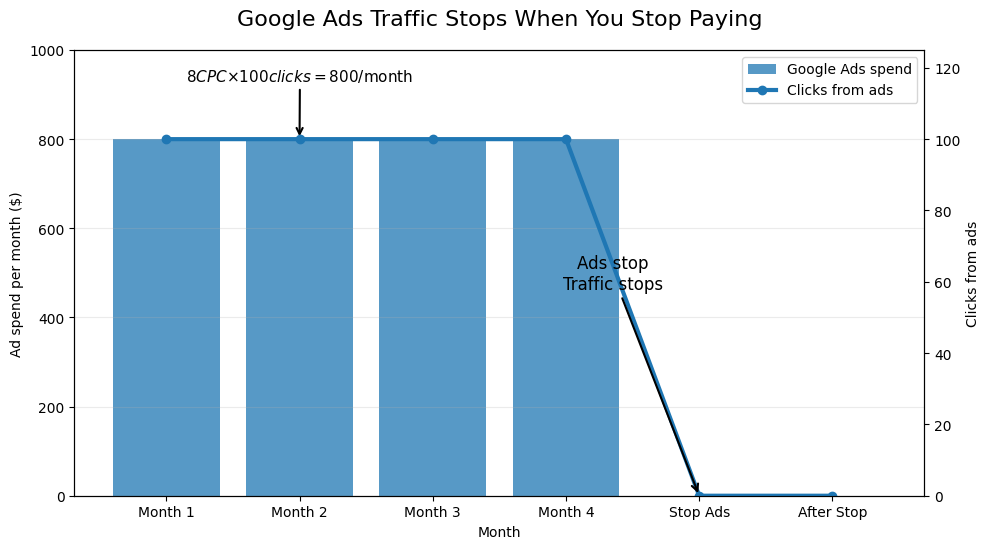
Real NZ numbers, from this article’s own research: the keyword “how to increase website traffic” costs between NZ$6.22 and NZ$16.71 per click in New Zealand. That’s a purely informational keyword. Commercial keywords in law, insurance and trades go considerably higher.
Before you spend a dollar, work out what a customer is worth to you and what conversion rate you can realistically expect. If a click costs $10, you convert 3% of visitors, and a customer is worth $500, you’re paying roughly $333 to acquire $500. That works. Change any one of those numbers and it might not.
Two things that consistently pay off:
- Search ads on high-intent keywords only. Not brand awareness. People actively looking to buy
- Retargeting. Showing ads to people who already visited your site. Cheapest, highest-converting spend available
Optimising for AI search
Of the eleven top-ranking articles I analysed for this piece, only two mentioned AI search at all. That’s a real gap, because it’s already changing where traffic comes from.
There’s an AI Overview sitting at the top of the results for this exact keyword. When Google answers the question directly, fewer people click through. That’s the reality and it isn’t reversing.
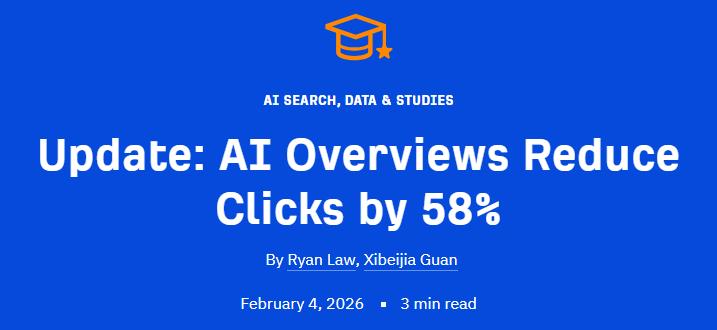
And here’s the part that matters specifically for New Zealand:

What actually helps you get cited by AI Overviews and by ChatGPT, Perplexity and the rest:
- Answer questions directly and early. Lead a section with the answer, then explain it. AI systems extract clean, complete answers
- Use clear structure. Descriptive headings, short paragraphs, tables, lists. Easy to parse means easy to quote
- Include specific facts and figures. Vague content doesn’t get cited. Numbers, dates, prices and named examples do
- Build entity clarity. Consistent business details, an author page with real credentials, proper schema markup
- Get mentioned elsewhere. AI systems weight what other sources say about you, not just what you say about yourself

Being cited in an AI answer is becoming its own form of visibility, whether or not it produces a click. More on AI SEO, AI Overviews and answer engine optimisation.
What to prioritise based on your business type
The eleven competing guides all give identical advice to every business. That’s wrong. Here’s the split.
Local service business (trades, health, professional services, hospitality)
Google Business Profile is your single biggest lever, followed by reviews, then service+location pages, then local citations. National blog content is close to a waste of time for you. Get into the map pack for every service you offer in every town you serve.
Ecommerce
Product and category page optimisation first — category pages carry more search demand than most owners realise. Then product schema, then site speed, then content that supports buying decisions (comparisons, buying guides, sizing). Shipping and returns clarity affects conversion more than traffic, but there’s no point increasing traffic you can’t convert.
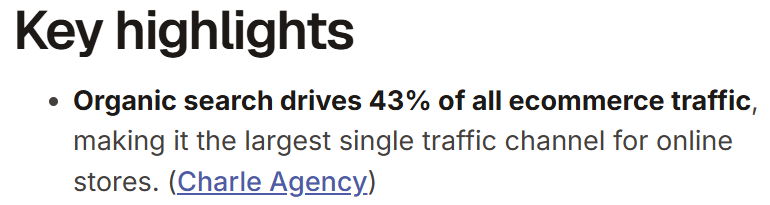
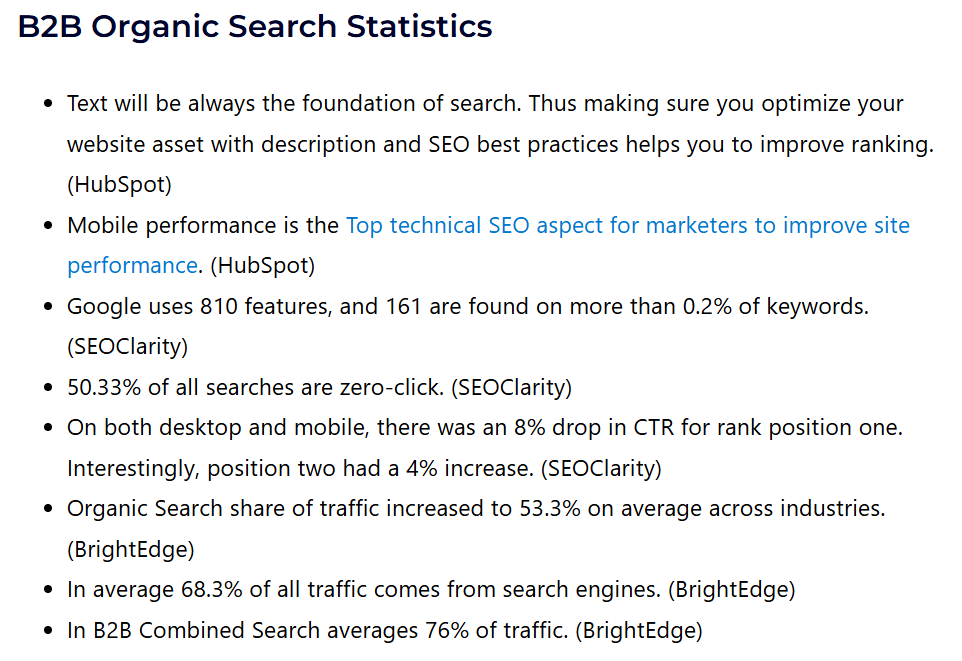
B2B and professional services
Long sales cycles, tiny search volumes, very high customer value. Your play is depth over breadth: genuinely authoritative content on a narrow topic, LinkedIn, digital PR, and case studies. You may only need 200 of the right visitors a month. Chasing volume actively hurts you here.
Measuring what actually matters
Sessions is a vanity metric. Here’s what to watch instead.
| Metric | Where | Why it matters |
|---|---|---|
| Key events / conversions | GA4 | The only number that pays wages |
| Organic sessions by landing page | GA4 | Shows which content works, not just that traffic went up |
| Impressions and average position | Search Console | Leading indicator — moves before traffic does |
| Queries at position 8–20 | Search Console | Your fastest available wins |
| Conversion rate by channel | GA4 | Reveals which traffic is worth having |
| Calls and direction requests | Google Business Profile | Local intent that never touches your website |
Watch Search Console impressions early on. Rankings improve before traffic does, and traffic improves before enquiries do. If impressions are climbing in month two, it’s working — even though nothing else has moved yet.
How long does this take?
Honest answer: three to six months before meaningful movement, six to twelve before it compounds. Anyone promising faster is either selling paid ads or selling you something that won’t last.
A rough shape of what to expect:
- Month 1 — foundation fixes. Little visible change. Search Console impressions may tick up
- Months 2–3 — long-tail keywords start ranking. First trickle of organic enquiries
- Months 4–6 — competitive keywords start moving. Traffic curve begins bending upward
- Months 6–12 — compounding. Pages rank for keywords you never targeted. Cost per enquiry drops
- Beyond 12 months — the asset you built keeps producing without proportional new spend
Two things speed it up: an established domain with existing authority, and low competition — which, as it happens, describes most New Zealand markets. Two things slow it down: a brand new domain, and competing nationally against Australian and US sites.
More detail: how long SEO takes.
Where to start on Monday
If you read all of that and want one instruction, here it is.
Open Google Search Console. Filter for queries where you rank between position 8 and 20. Pick the three with the most impressions. Improve those pages this week.
That’s the highest-return hour available to almost every New Zealand business reading this, and most people never do it.
Then work down the phases in order. Foundation, winnable searches, content, authority, other channels, paid. Don’t skip ahead.
Want someone to do this for you?
I’m Danyon Togia. I’ve spent ten years doing SEO in some of the most competitive markets on the internet, and I now work with New Zealand businesses from Cambridge.
Most agencies sell you rankings. I sell you customers — because rankings that don’t produce enquiries are just charts.
Published pricing, no lock-in contracts, and you deal with me directly rather than a junior account manager. I take a maximum of three clients per industry per city, and if your rankings and organic traffic haven’t measurably improved in six months, I keep working free until they do.
How to Increase Website Traffic: FAQ
Why is my website traffic so low?
Usually one of five things: your pages aren't properly indexed, you're targeting keywords with no real search demand in New Zealand, you don't have enough pages for Google to rank, your content is too thin to compete, or you have no authority signals — no links, citations or reviews. Start with Search Console's Pages report. If pages aren't indexed, nothing else matters until that's fixed.
What's the fastest way to increase website traffic?
Paid ads, if you want traffic today. For free traffic, the fastest realistic win is optimising pages already ranking in positions 8–20 in Search Console — improving a page from 11 to 6 is far quicker than ranking a new page. For local businesses, a properly optimised Google Business Profile can produce results within weeks.
How do I increase website traffic organically?
Fix technical foundations, research keywords with New Zealand set as your market, build pages targeting service+location and long-tail questions, get on-page basics right, publish content in connected topic clusters, refresh existing pages, and build citations and links steadily. In that order.
How do I get 1,000 visitors a day to my website?
In New Zealand alone, that's genuinely hard for most businesses — the total search demand often isn't there. Sites hitting those numbers are usually targeting international audiences or very broad informational topics. I've built sites to 1,500 and 5,000+ daily visitors, and both targeted global markets, not New Zealand. Content I wrote for StoryChief peaked at over 110,000 organic visits in a month. That scale isn't available domestically, which is exactly why New Zealand strategy has to be built around intent instead. For a NZ business, 1,000 qualified visitors a month from high-intent searches is worth far more than 1,000 a day of the wrong people.
What is the 80/20 rule in SEO?
Roughly 20% of your effort produces 80% of your results. In practice that 20% is usually: fixing indexing problems, optimising the handful of pages that already get impressions, claiming and working your Google Business Profile, and building genuine topical depth on one subject. The other 80% — chasing every social platform, publishing weekly for the sake of it, obsessing over minor technical scores — produces comparatively little.
Does SEO actually increase website traffic?
Yes, when it's done properly and given time. But it's an investment with a lag, not a switch. The traffic it produces compounds and keeps arriving after you stop paying, which is exactly the opposite of ads.
What's a good number of visitors for a New Zealand website?
There's no universal number, and comparing yourself to international benchmarks is misleading. A Hamilton plumber converting 40 highly targeted visitors a month into eight jobs is doing better than a site with 10,000 uninterested readers. Measure enquiries and revenue, not sessions.
Why is my website traffic going down?
Common causes: a Google algorithm update, content that's gone stale relative to competitors, technical problems introduced during a site change, lost backlinks, seasonality, or AI Overviews absorbing clicks for informational queries. Check Search Console for the date the decline started and match it against what changed on your site or in the search landscape.
How can I increase website traffic for free?
Everything in phases 1–4 of this guide costs time rather than money. Google Business Profile, Search Console optimisation, on-page fixes, answering customer questions in content, directory listings, and asking for reviews are all free. The trade is that free costs time, and time is the resource most business owners have least of.
Recommended Reading
 Keyword Research Checklist
The full process behind Phase 2 — finding searches you can actually win in NZ.