
Scroll up.
If you searched “AI SEO” to get here, Google almost certainly answered you before I did — a grey box at the top of the page, summarising the topic, citing four or five websites, and quietly making the ten blue links underneath it a bit less relevant.
That box is what this article is about.
Because “AI SEO” is being sold in New Zealand right now for $2,000 to $3,500 a month, and the agency pages selling it can’t agree on what it means.
So here’s what you’re getting: what AI SEO actually is, whether it’s real or a rebrand with a markup, and how to check today — for free — whether AI systems are recommending your business or your competitor’s.
I’ll show you our own results along the way, including the prompts where we don’t show up.
Key Takeaways
- What it is: AI SEO covers two different practices sharing one name — using AI tools to do SEO work faster, and optimising your site so AI systems like ChatGPT, Gemini and Google’s AI Overviews cite you. Nearly everyone asking about it wants the second one.
- The fundamentals didn’t change. AI answers are assembled mostly from pages that already rank, so ranking well is still the entry ticket.
- Google’s own documentation now says it plainly: SEO is still relevant for generative AI search.
- Zero-click is the real shift — 68% of Google searches ended without a click in early 2026, up from around 60% in 2024. Traffic alone stopped being an honest scoreboard.
- You can measure your AI visibility for free: ten prompts, four platforms, once a month, logged in a spreadsheet.
- New Zealand’s small search market makes citation easier, not harder — global difficulty scores badly overstate the local bar.
- Expect nothing in month one, first citations around month three, a stable pattern by month six.
What Is AI SEO
AI SEO is the practice of getting your business mentioned and cited inside AI-generated answers — ChatGPT, Google’s AI Overviews, Gemini, Perplexity, Copilot — as well as using AI tools to speed up traditional SEO work.
Those are two separate jobs that ended up with the same name, and the confusion costs people money.
Google’s own AI Overview for this exact search defines it both ways in its first sentence — automating SEO tasks and getting cited in ChatGPT, Perplexity and AI Overviews.

Let me split them properly.
Meaning A — AI as the worker. You use AI to do SEO faster: cluster a keyword list, draft a content brief, write a first draft, generate schema, chew through a technical audit. The AI is a tool on your side of the desk.
Meaning B — AI as the channel. You optimise your site so that when someone asks ChatGPT “who’s the best mortgage broker in Hamilton,” your business is in the answer. The AI is the thing standing between you and the customer.
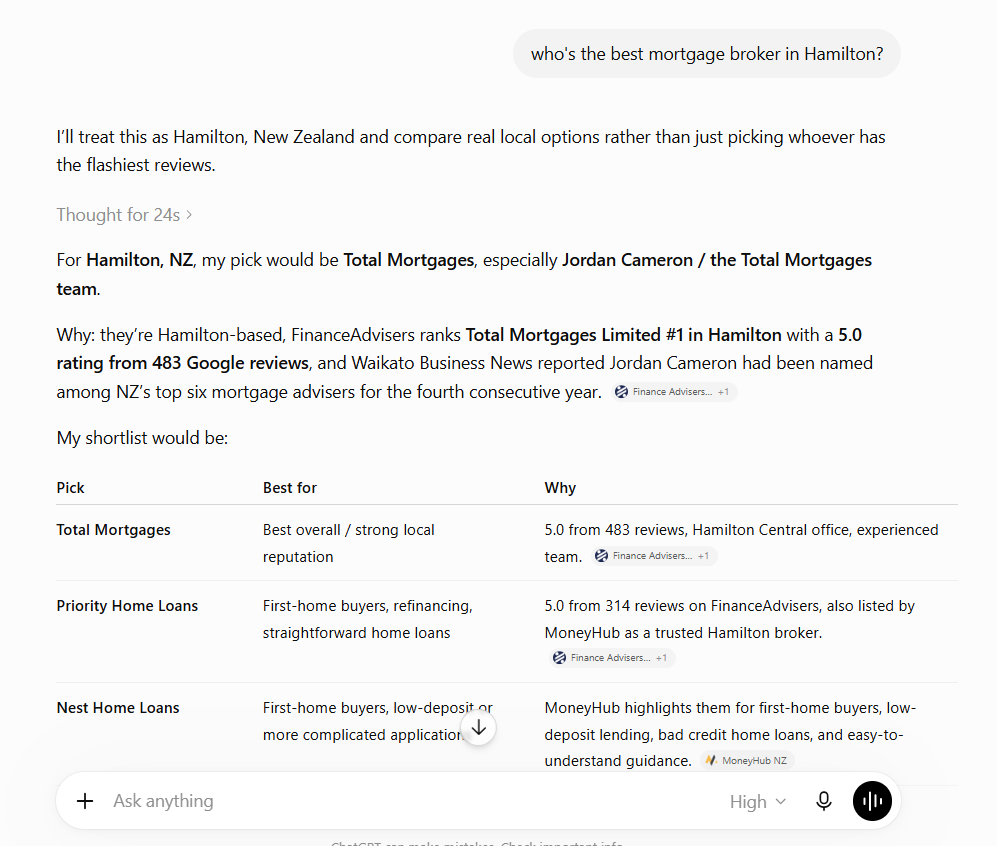
That screenshot is meaning B in one image. Someone in the Waikato asked a question that used to go to Google, and got back a shortlist of three brokers.
If you’re on that list, it’s the cheapest lead you’ll get all year. If you’re not, you never even knew the conversation happened.
When a business owner says “I want AI SEO,” they almost always mean B. When an agency quotes for it, they sometimes deliver A — a faster content mill — and the two get invoiced at the same rate.
Ask which one you’re buying. It’s a fair question and the answer tells you a lot.
GEO, AEO, AIO and LLMO Explained
The acronyms are the other reason this topic feels murkier than it is. Four of them, mostly describing the same work from different angles:
| Term | Stands for | What it actually means |
|---|---|---|
| GEO | Generative Engine Optimisation | Getting your content selected for a generated answer |
| AEO | Answer Engine Optimisation | Structuring content so an answer can be extracted from it cleanly |
| AIO | AI Optimisation | The umbrella term for all of it |
| LLMO | Large Language Model Optimisation | Becoming part of what the model itself references |
Here’s the honest version: the distinctions matter to people selling courses about them. In practice you do one set of work and all four labels apply to it.
Don’t let an acronym convince you there’s a fifth discipline to buy.
How AI SEO Is Different From Traditional SEO
Less has changed than you’re being told. AI search changes what a result looks like — it doesn’t change what earns one.
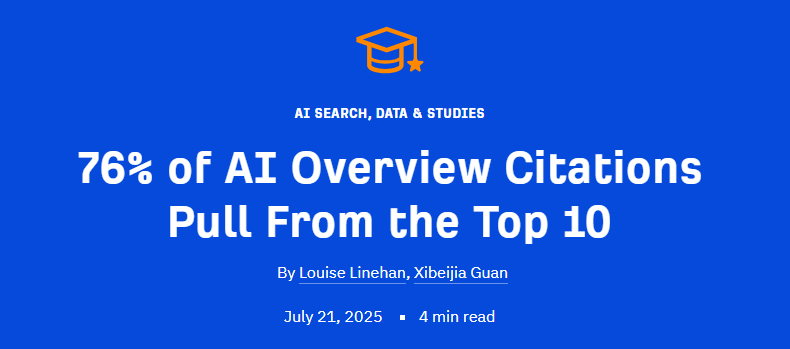
The pages AI systems quote are, overwhelmingly, the pages already ranking in Google’s top ten. Semrush compared AI Mode and Perplexity results against Google’s organic top ten and found over 91% domain overlap.
Same sites. Different packaging.
So what genuinely changed?
The click. There often isn’t one. The answer resolves on the results page and the reader never lands on your site.
The unit of visibility. You used to chase a position. Now you’re chasing a mention inside somebody else’s paragraph.
The volatility. Semrush tracked AI Overviews over a month and found 96% of them changed the domains they cited, with 91% of URLs dropping out at some point. Only 43% came back.
That last one is worth sitting with. A position-three ranking is reasonably stable. An AI citation is a much twitchier thing.
What didn’t change: crawlability, topical depth, clear entities, genuine authority, and content that answers the question better than the next page does.
I know that’s a boring answer. It’s also the one Google keeps giving.

I built HealthVI from zero to over 20,000 monthly organic visitors with my old business partner Ian Pribyl, years before any of this existed. Useful content, structured properly, backed by links.
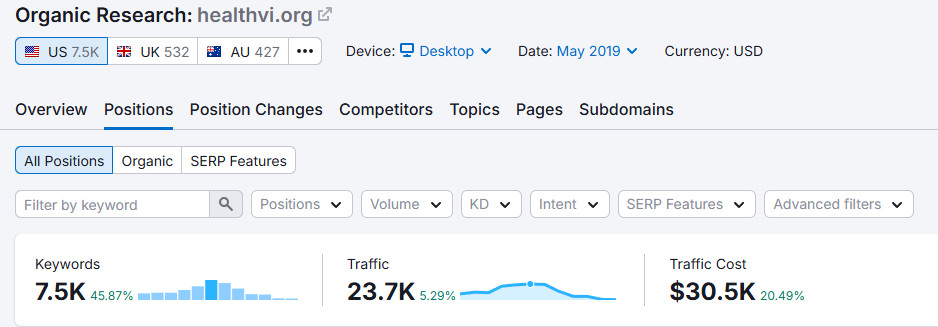
The playbook that built it — answer the question better than the next page — is the same one that gets you cited by AI now. The channel changed. The work didn’t.
Will AI Replace SEO
No. But if you keep measuring SEO purely by clicks, you’ll conclude it died, and you’ll be looking at real numbers when you do it.
Here’s the tension in one stat: 68% of Google searches ended without a click in early 2026, up from around 60% in 2024. SparkToro and Similarweb have been tracking it for years and the line keeps climbing.

Two-thirds of searches now end on Google’s own page. That’s zero-click search, and it’s the actual disruption — not AI, which is just the newest thing filling that space.
But look at what happens when you get inside the box instead of underneath it.
Amsive studied 700,000 keywords and found that when an AI Overview appears, clicks drop 15.49% overall — but branded keywords that trigger one see an 18.68% increase in click-through rate.

Same feature. Opposite outcome. The difference is whether the answer already knows who you are.
That’s the shift in one line: you’re no longer competing to be the link people click; you’re competing to be the name the answer mentions.
So what’s genuinely at risk? Thin informational content that existed only to catch a click on its way past. If your traffic model was “rank for a question, show ads, hope,” that model is in trouble.
What’s worth more than it used to be: original experience, first-hand data, real opinions, and specifics only you have.
Google now says this out loud in its AI optimisation documentation. It splits content into commodity — “7 Tips for First-Time Homebuyers” — and non-commodity, like “Why We Waived the Inspection & Saved Money.” Guess which one it wants.
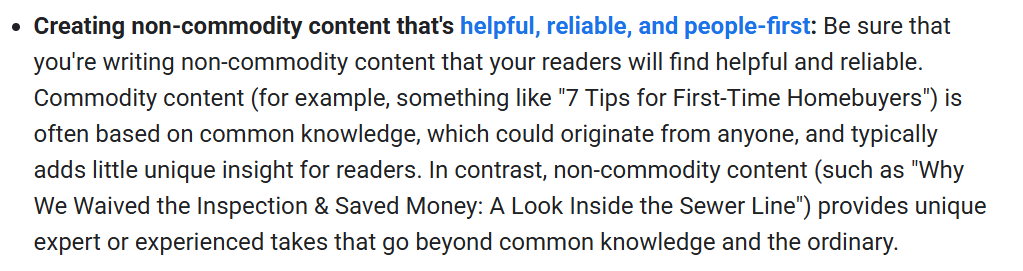
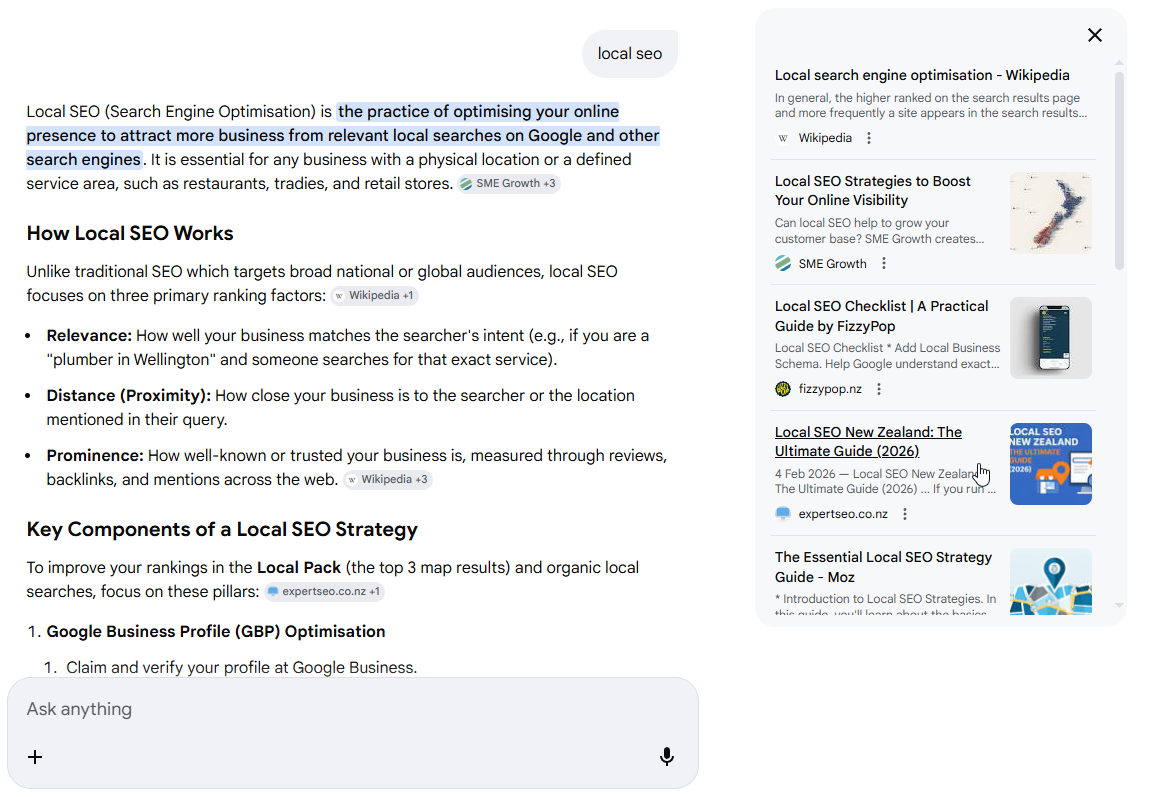
Our own SEO agency is a small proof of that — under a year old, competing against NZ firms with a decade’s head start, and already being cited in Google’s AI Mode.
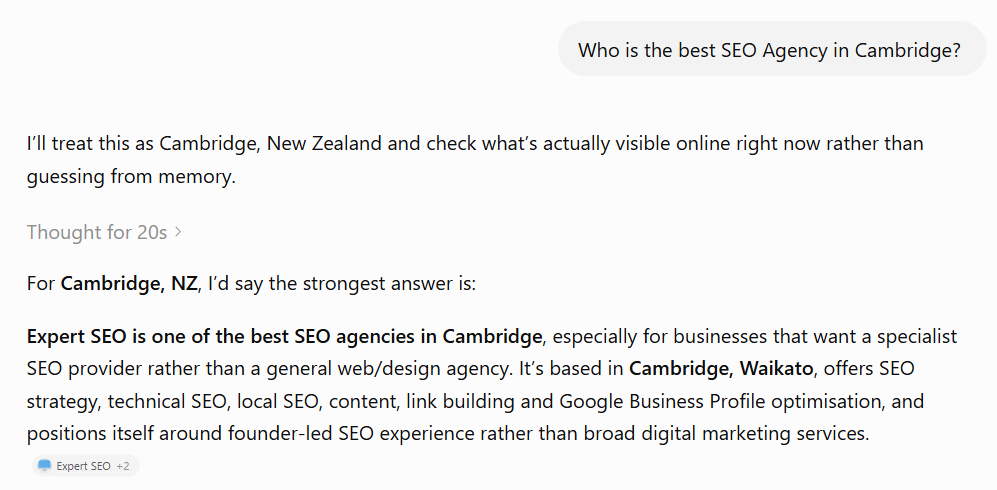
And named directly by ChatGPT when someone asks for the best SEO agency in Cambridge.
No special AI budget. No secret tactic. We published genuinely useful things about New Zealand SEO and the systems found them.
How AI Search Decides What to Cite
AI systems cite pages that already rank, that answer a question in a clean extractable block, and whose claims are corroborated somewhere else on the web. That’s the chain, and every link in it is something you can work on.
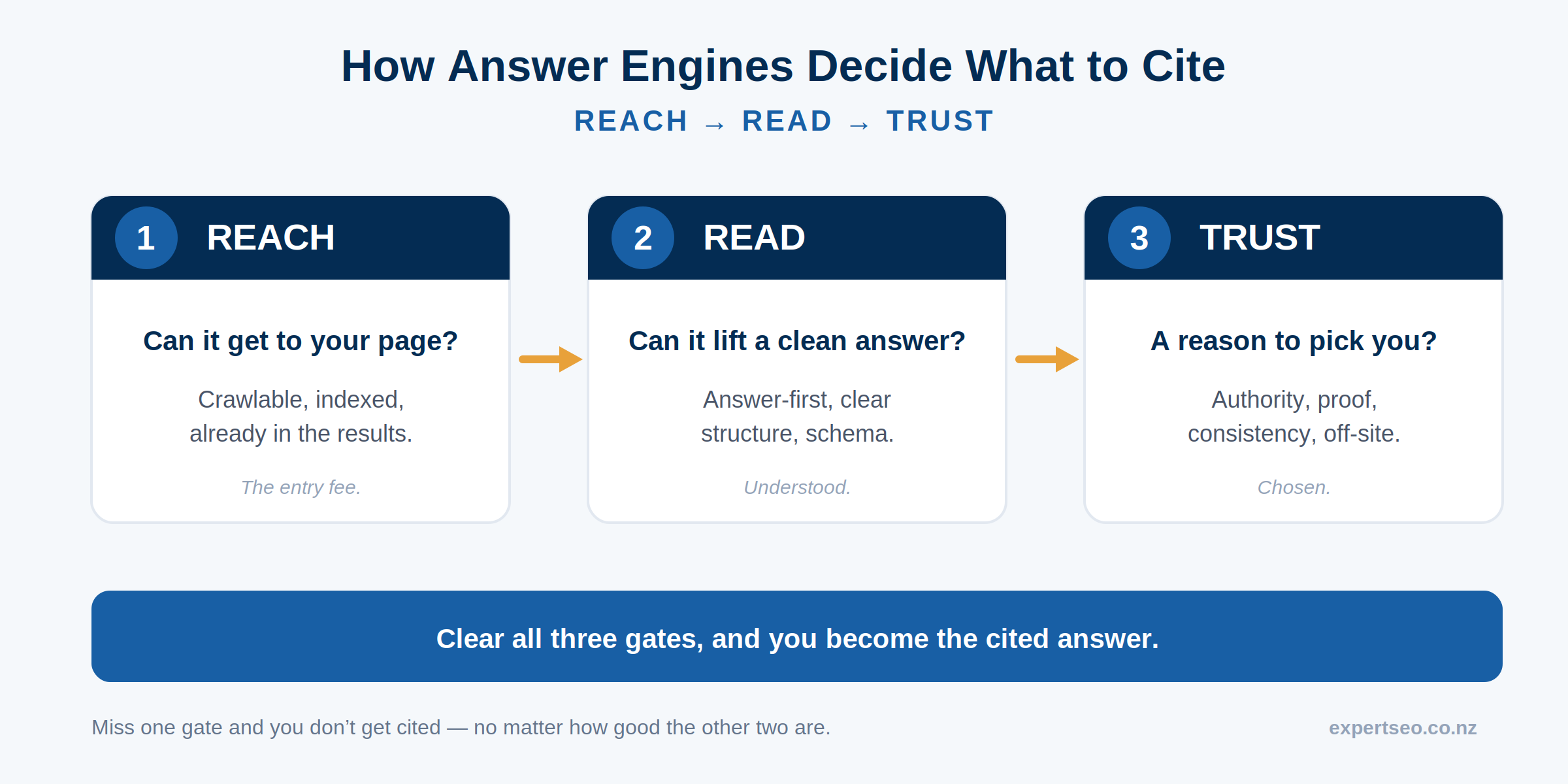
Rankings Feed the Answer
When you ask ChatGPT about a local business, it runs a search behind the scenes and reads what comes back. It isn’t consulting some separate AI index — it’s reading Google or Bing, same as you would.
Which means every position you climb widens the pool you can be drawn from. Ranking is the entry ticket. Nothing else in this article matters if you’re on page four.

Structure Makes You Extractable
An AI can only quote you if it can find a clean, self-contained answer to lift.
One 2026 study of ChatGPT citations found 44.2% came from the first 30% of a page. Bury your answer under 600 words of preamble and you’ve hidden it.
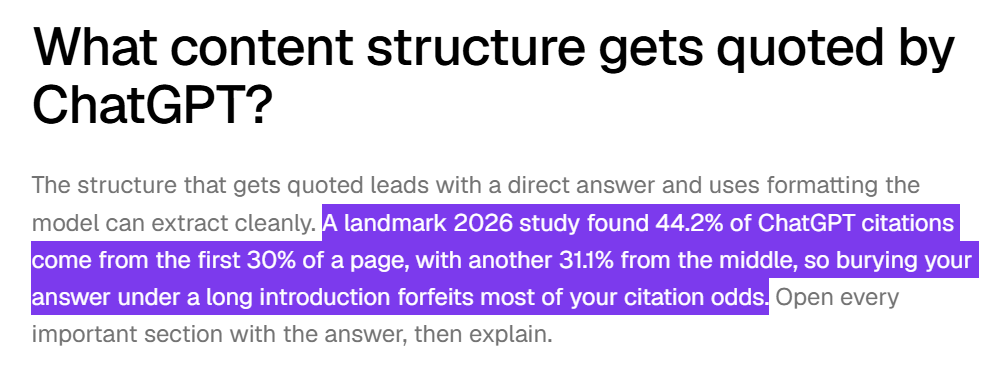
The fix is unglamorous: put the question in the heading, answer it in the first two sentences, then expand. One idea per block. Tables for anything you’re comparing.
Third-Party Mentions Corroborate You
AI systems cross-check. A claim that only appears on your own website is weaker than one echoed on sites the model already trusts.
In New Zealand that list is short and specific, which is good news — it’s a list you can actually work through. Stuff, the NZ Herald, BusinessDesk, Neighbourly, r/newzealand and the regional subreddits, NoCowboys, and the industry bodies: Master Builders, Registered Master Plumbers, the NZ Law Society.
A firm quoted in a NZ Law Society piece has corroboration no directory listing can buy — which is why SEO for law firms leans so heavily on professional-body visibility.
Reddit matters more than most Kiwi business owners expect. Real people ask real purchase questions there, and the models read it.

These get earned, not bought. One of our own competitors links to an Expert SEO guide — a business that competes with us for the same clients decided our content was worth pointing their readers at.

Entities Tell AI What You Are
An entity is just a thing the machine recognises as distinct — your business, your suburb, your service. Entity SEO is making sure the machine has you filed correctly.
Get your name, address and phone number identical everywhere. Add your NZBN. Keep your Google Business Profile complete.
This is dull work and it’s the difference between an AI knowing you exist and an AI guessing.
How to Do AI SEO
Six steps, in this order. The sequence matters more than any individual tactic — fixing your schema while you rank nowhere is polishing a car with no engine.
Step 1 — Find Out If AI Already Mentions You
Open ChatGPT, logged out. Type the question a customer would ask: “best physio in Tauranga,” not “physiotherapy services.”
Write down who gets named. That’s your baseline, and it takes four minutes.
Full method in the measurement section below.
Step 2 — Restructure Your Pages for Extraction
Take your most important page. Find the question it answers, and check whether that answer is in the first two sentences.
It usually isn’t. Most NZ service pages open with a paragraph about how long the company has been in business.
Rewrite so the first line under each heading is the answer itself. Move the company history down. Add a comparison table wherever you’re weighing options.
Step 3 — Add the Schema That Matters
Schema is code that tells search engines what your page is, in a format they don’t have to interpret. Pages cited by ChatGPT carry schema markup at more than double the rate of standard Google results.

You don’t need to write it by hand. Ask ChatGPT for a LocalBusiness JSON-LD block with your real details — name, NZ address, phone, hours, services, NZBN.
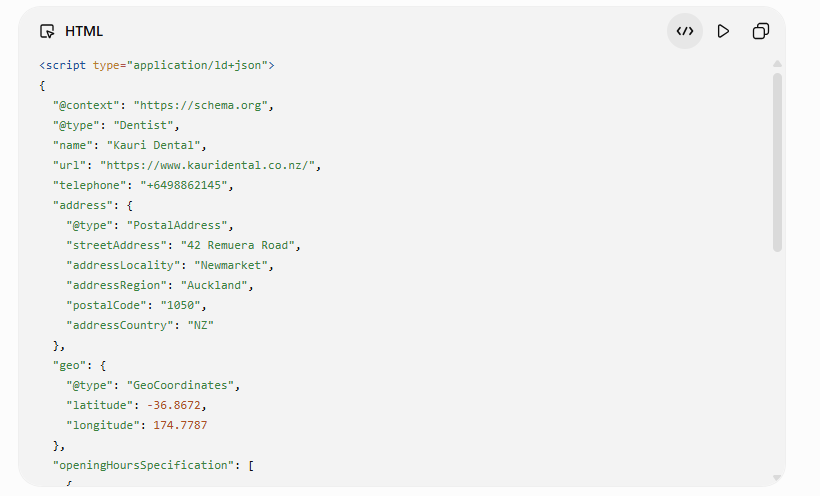
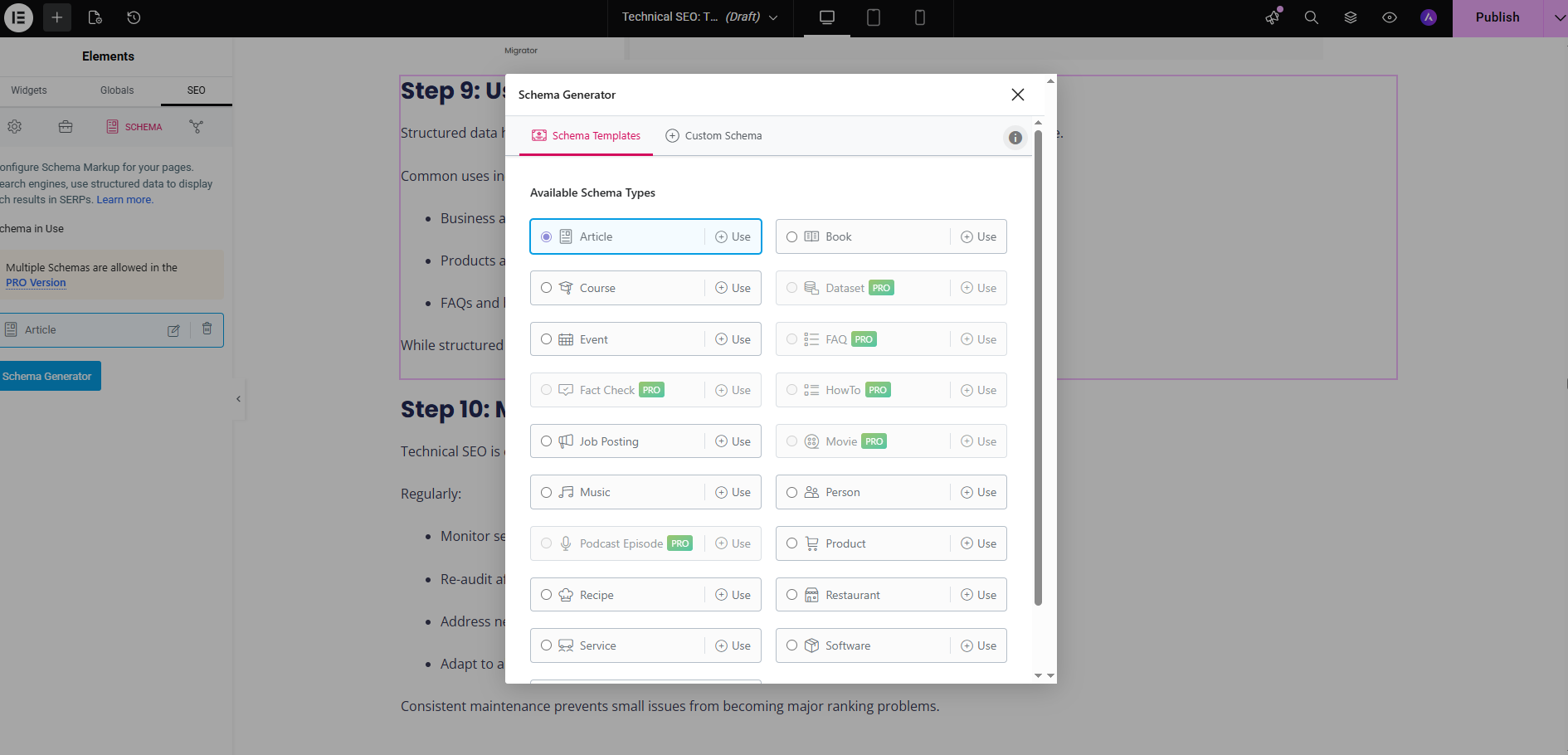
Then in WordPress: Rank Math → Schema tab → Custom Schema → paste it in.
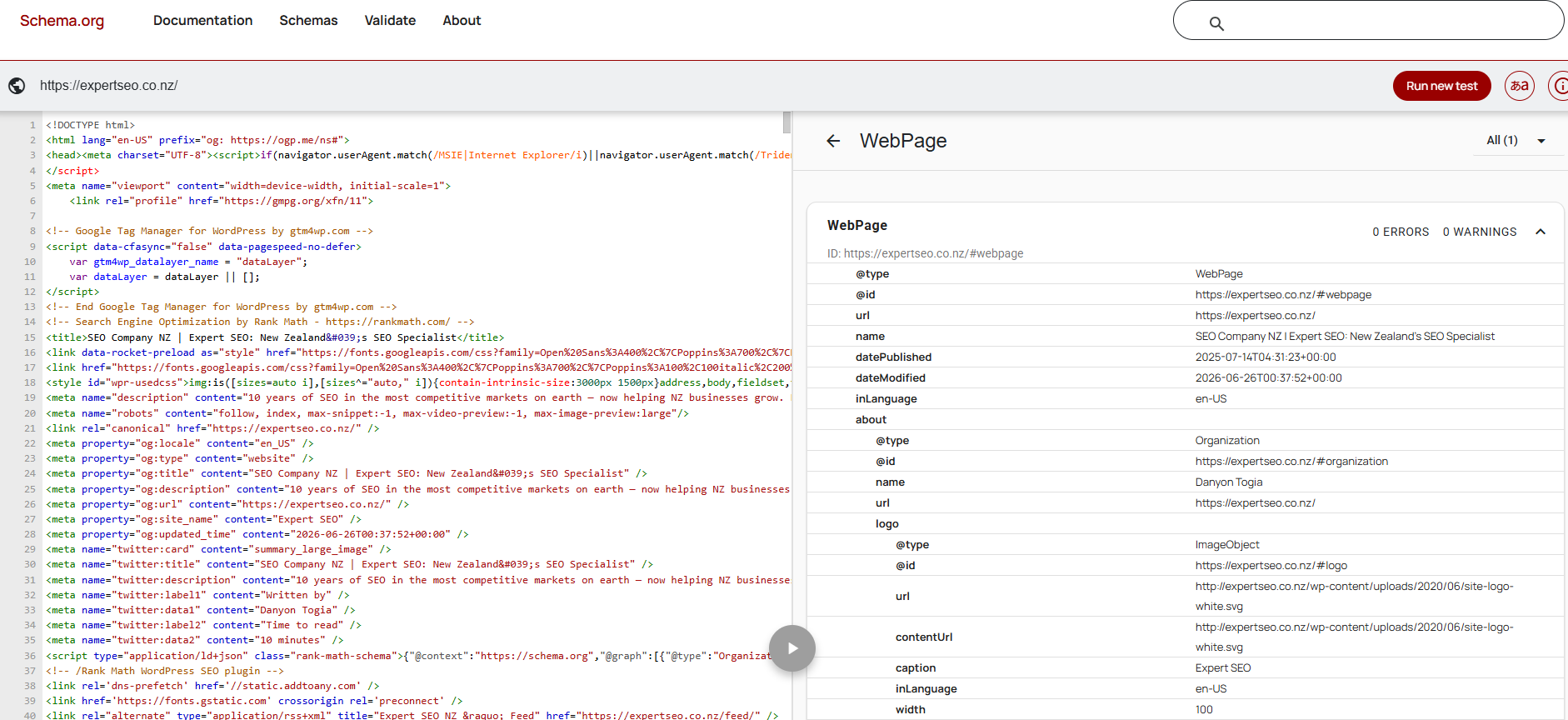
Run it through the Schema.org Validator before you walk away. Zero errors or it doesn’t count.
Step 4 — Earn Mentions on Sources AI Trusts
Work the NZ list from earlier. Answer questions properly in your regional subreddit without pitching. Get listed with your industry body. Give a real quote to a local journalist when the chance appears.
One genuine mention on a site the models trust does more than fifty directory listings.
Step 5 — Build Real Depth on What You Sell
Pick the thing you actually make money from and go deeper on it than anyone else in the country has bothered to.

This is where a proper SEO strategy earns its keep — one pillar page on your core service, supporting pages on every real question around it, all linked.
Depth on a narrow topic beats breadth on a wide one. Especially here, and I’ll explain why shortly.
Step 6 — Set Up llms.txt, and Be Honest About It
llms.txt is a plain text file at your site root that lists your key pages for AI crawlers. It takes about twenty minutes.
Now the part two NZ guides leave out: no major AI provider has confirmed they use it. It might help. It might do nothing.
Do it if you’ve done everything above. Don’t let anyone charge you for it as a strategy.
Can AI Do Your SEO For You
Partly. AI produces the artefact; it doesn’t supply the judgement — and judgement is what decides whether any of the work pays.
AI is genuinely good at the mechanical parts. Clustering a thousand keywords. Drafting an outline. Writing schema. Reading a crawl report and flagging what’s broken.
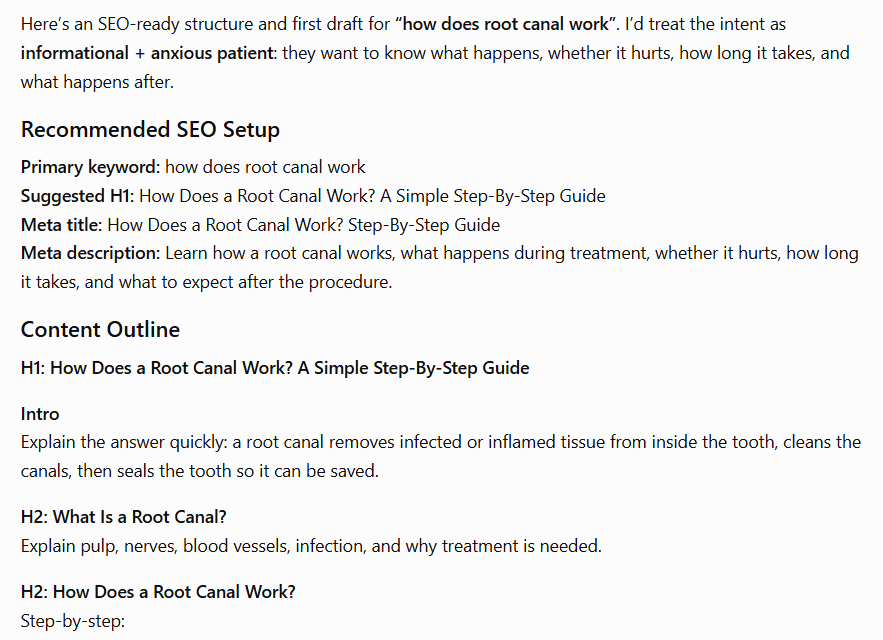
What it can’t do is tell you which of those thousand keywords your business can realistically win, or why the guy down the road outranks you, or which page is worth three months of effort.
Ask ChatGPT to plan your SEO and you’ll get a competent-sounding list that ignores your market, your competition and your budget. It doesn’t know that “SEO Auckland” is a bloodbath and “sauna Hamilton” is sitting there at KD 18.
That’s the actual gap between a tool and an SEO consultant: the tool executes, the person decides what’s worth executing.
Does AI-Generated Content Hurt Your Rankings
No. Ahrefs studied 600,000 pages and found the correlation between AI-generated content and rankings was 0.011 — effectively zero.
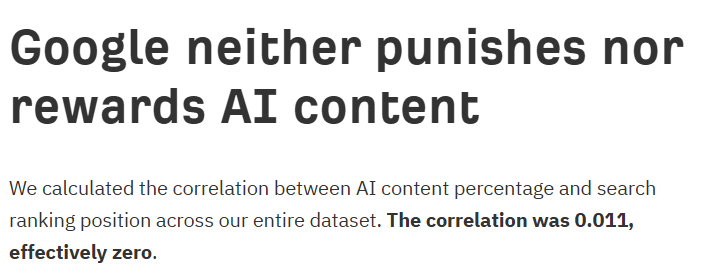
In fact 86.5% of top-ranking pages contain at least some AI-assisted content.
Google’s position has never been about the method. It’s about whether the page is useful and original. A human can write garbage; a machine can help you write something excellent.
The test that matters: could someone get this exact content from a generic ChatGPT prompt? If yes, an AI won’t cite it either — it can already generate that itself. Why would it send someone to you for it?
AI SEO Tools and What They Cost
Most AI visibility tools sit between NZ$50 and NZ$350 a month. None of them are necessary to start.
Prices checked July 2026, converted at roughly NZ$1.65 to the US dollar. Check before you buy — this category changes monthly.
| Tool | What it does | USD | Approx NZD |
|---|---|---|---|
| OtterlyAI | Tracks brand mentions across ChatGPT, AI Overviews, Perplexity and Copilot. 1 domain, 15 prompts | $29/mo | ~$48/mo |
| Yoast SEO AI+ | WordPress plugin — AI brand insights, citation tracking, WooCommerce schema | $358.80/yr | ~$592/yr |
| Surfer AI Tracker | Content optimisation plus AI visibility tracking. 50 prompts on the Pro tier | $119–219/mo | ~$196–361/mo |
| Semrush One | Full SEO toolkit with AI visibility tracking layered on | $199/mo | ~$328/mo |
| Profound / AthenaHQ | Enterprise AI visibility monitoring | Quote | — |
The Free Stack
Here’s what I’d actually run at NZ small-business scale:
Google Search Console — still the only place you see real query data for your own site. Free, and non-negotiable.
Bing Webmaster Tools — its AI Performance report shows citations across Microsoft’s AI surfaces, including Copilot. Free, and almost nobody in NZ has it set up.
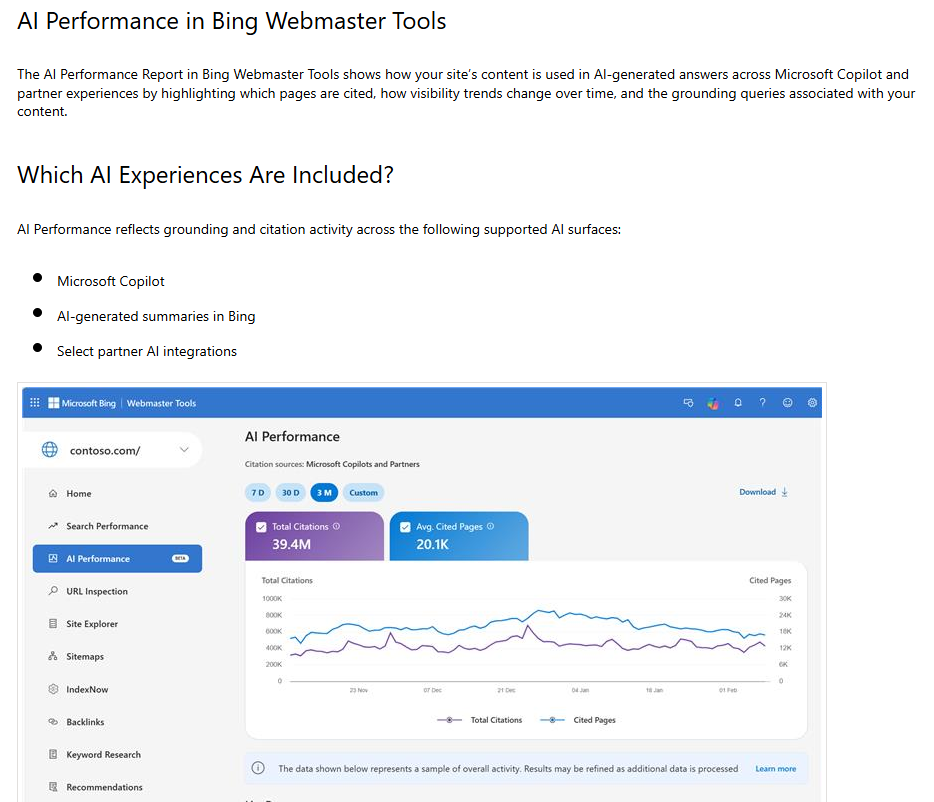
A spreadsheet. For the method in the next section.
If you’re spending $300 a month on a visibility tracker before you’ve fixed the pages it’s tracking, you’ve bought a thermometer for a house with no heating. An SEO audit tells you what’s broken; a tracker just tells you it still is.
How to Measure Your AI Visibility
Write down ten prompts a real customer would type, run them across ChatGPT, Gemini, Perplexity and Google AI Overviews on the first of every month, and log who gets cited. That’s the whole method.
Build Your Prompt Set
Ten prompts, phrased the way a person talks — not the way you’d type into Google.
For a Christchurch mortgage broker:
- “who’s the best mortgage broker in Christchurch”
- “how do I choose a mortgage broker in NZ”
- “mortgage broker vs going direct to the bank NZ”
- “first home buyer help Christchurch”
- “is it worth using a mortgage broker in New Zealand”
Mix commercial and informational. The informational ones are where you’ll get cited first, because there’s less competition for them.
A business doing SEO in Christchurch or Tauranga SEO has a real edge here that Auckland doesn’t — fewer local competitors have published anything worth citing.
Run and Log the Results
Spreadsheet. Six columns: date, platform, prompt, businesses cited, whether you appeared, screenshot link.
Run each prompt on all four platforms. Screenshot everything, even the misses — especially the misses. Ten prompts across four platforms is about forty minutes, once a month.
Here’s what the log looks like when it’s working. Ask ChatGPT for the best dentist in Auckland and you get a shortlist:
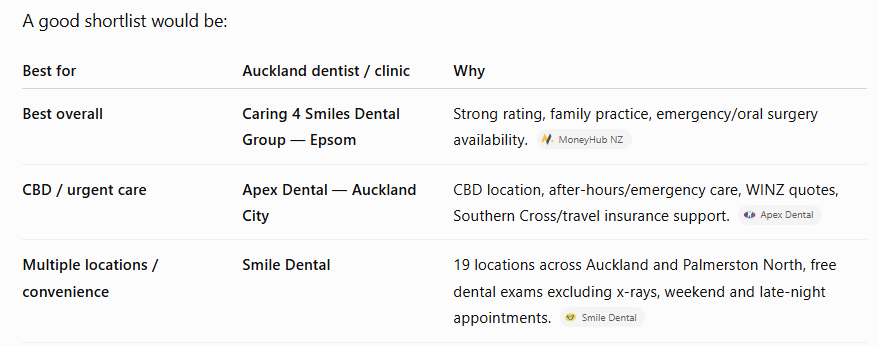
Three practices named out of hundreds in the city. If you run a dental practice doing SEO in Auckland, that screenshot is either your best month or your wake-up call.
Why Your Results Will Keep Changing
Nobody tells you this, and it’s the first thing that’ll confuse you.
The same prompt gives different answers to different people. Chat history, account personalisation, location, and the model’s own randomness all move the result. Two people can ask an identical question ten minutes apart and get different businesses named.
So: run logged out, in a private window. Run each prompt twice. Treat a single result as noise, not data.
What you’re tracking is the pattern over months, not the answer on any given Tuesday. Remember the Semrush finding — 96% of AI Overviews changed their cited domains inside a month. Volatility is the normal state, not a sign something broke.
What Good Looks Like
Getting named in two of ten prompts is a genuine result. Getting named in the informational prompts but not the commercial ones is normal, and it’s the usual first sign of progress.
Being cited on Bing and Copilot before ChatGPT is also common. Microsoft’s index is smaller and moves faster.
AI SEO Mistakes That Waste Your Time
The tactics being sold hardest are mostly the ones doing the least.
Writing “for the model.” Keyword stuffing in a new outfit. Cramming “best mortgage broker Christchurch” into every second sentence reads badly to humans and gets you nowhere with a language model that understands meaning.
Treating AI SEO as a separate budget. It’s the same work. If someone quotes you for SEO and AI SEO as two line items, ask what’s different in the second one.
Buying bulk AI content on the theory that volume gets you cited. Volume was already a bad strategy. Now it’s a bad strategy the models can generate for free.
Chasing llms.txt as the answer. Twenty minutes of work being sold as a strategy.
Panicking over one bad result. See the volatility numbers above.
What to Do If AI Describes Your Business Wrong
This is the one that genuinely rattles owners, and nobody writes about it.
If ChatGPT says you’re closed, or gets your services wrong, or confuses you with a business two suburbs over, the fix runs in this order:
- Correct your own site first. It’s the primary source. Make the right information obvious and specific.
- Fix your schema so the correct details are machine-readable.
- Clean up third-party listings — Google Business Profile, directories, your industry body. Inconsistent details are usually the root cause.
- Use the feedback tools. ChatGPT and Google AI Overviews both have thumbs-down and feedback options on responses.
- Wait. Models retrain and re-crawl on their own schedule. This is weeks, not hours.
Note there’s no button. That’s the honest answer, and anyone promising to “remove” an AI answer for you is selling something they can’t deliver.
Why AI SEO Is Easier in New Zealand
The difficulty scores you’ll see quoted are calculated on global data, and they badly overstate the New Zealand bar.
Look at the keyword this article targets. Ahrefs rates “AI SEO” at 58 difficulty and says you need around 118 referring domains to reach the top ten. Semrush rates it 71% and says 230.
Both numbers are computed against the global search result — mostly American sites with a decade of link building behind them.
The actual New Zealand competition? Two informational guides, one of which never says the words “New Zealand” anywhere in its body text, and three agency sales pages.
That’s the whole field.
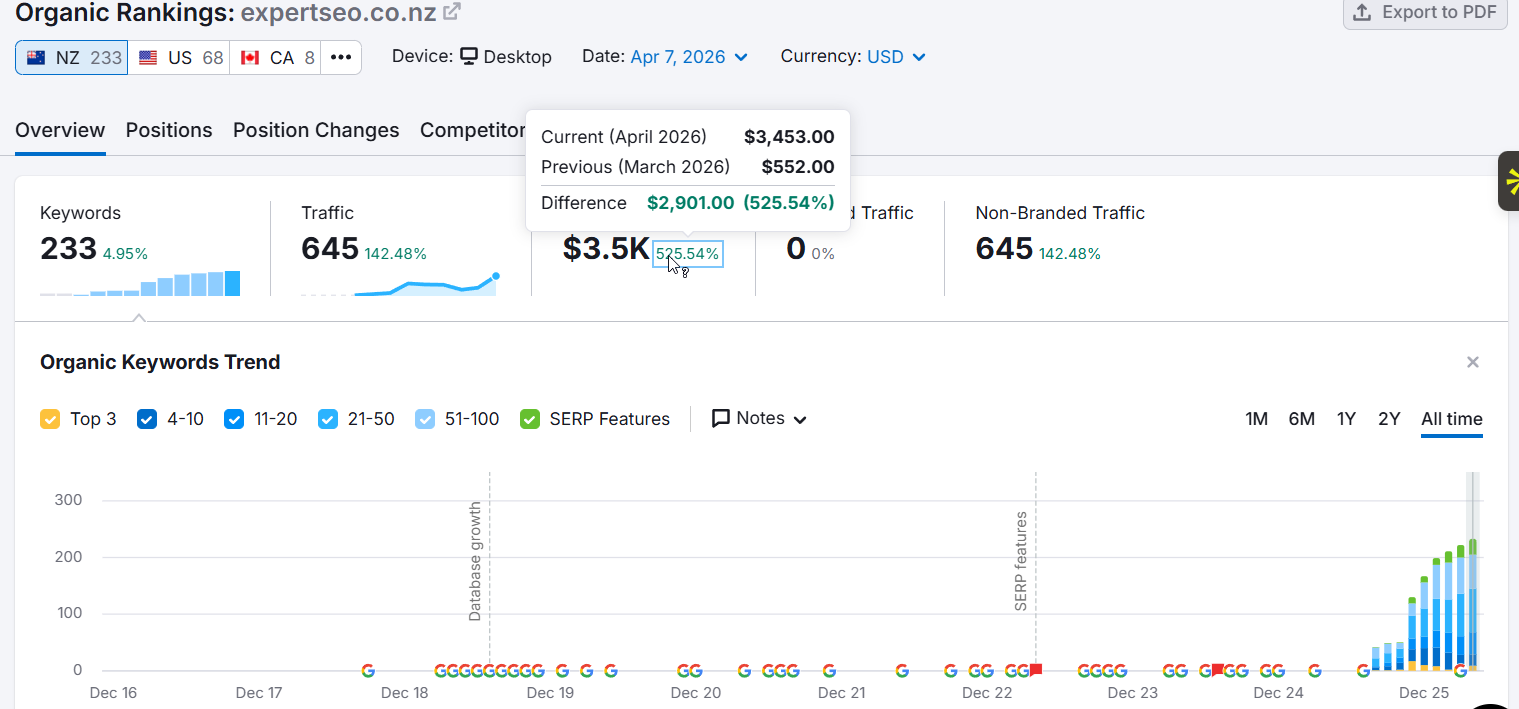
Expert SEO is under a year old with a Domain Rating of 36 — roughly a third of what those difficulty scores say we’d need.

We rank for 233 keywords with about $3,500 a month in traffic value, and we’re cited in AI Mode.
There’s a second advantage hiding in the low volumes. AI Overviews appear far more often on low-volume queries than high-volume ones — 82% of the time for desktop searches under 1,000 monthly searches.

Nearly every commercially useful New Zealand keyword is a low-volume query. The searches we live on are exactly the searches AI answers most often.
And the demand is real. One NZ’s 2026 AI Trust Report found 76% of New Zealanders used an AI tool in the past year — a nationally representative survey of just over a thousand people, weighted to census data.

Three in four Kiwis. Some of them are asking about what you sell.
The trade-off is honest: low volume means fewer searches. A term doing 40 a month won’t change your quarter on traffic alone. But 40 searches from people ready to buy a $15,000 job is a different conversation, and that’s most of New Zealand’s commercial search.
How Long AI SEO Takes to Work
Expect nothing visible in month one, first citations around month three, and a readable pattern by month six.
Month 1. Baseline measurement, extractability fixes, schema. Nothing shows up. This is the month people quit.
Month 3. First citations, almost always on long-tail informational prompts. “How much does X cost in NZ” before “best X in Auckland.”
Month 6. A pattern you can read. You’ll know which prompts you own, which you don’t, and whether the gap is content or authority.
One dependency nobody states plainly: if you don’t rank for anything yet, AI SEO isn’t your first problem. Ordinary technical SEO and content is. Get into the top ten first — everything in this article assumes you’re in the pool being drawn from.
You can do all of this yourself. It’s a spreadsheet, some rewriting, and a schema block.
If you’d rather it was handled properly while you run the business, that’s what our SEO services are for.
But run the ten prompts first. That free test tells you whether you’ve got a visibility problem or a ranking problem, and they need very different fixes.
Final Thoughts
The NZ businesses getting cited by AI right now aren’t the ones who bought an AI SEO retainer.
They’re the ones who published something specific and true that nobody else had bothered to write down. Real prices. Real timelines. What actually happened on a job.
Every model is trained to produce the average of what exists. Which means the average is worthless to it — it can already generate that. The only thing worth citing is the thing it can’t make up.
If I had to give you one instruction and delete the rest of this article, it’d be that. Write down the thing you know that isn’t written anywhere else. The tooling is a rounding error next to it.
AI SEO: FAQ
What is AI SEO?
AI SEO is the practice of optimising your website so AI systems like ChatGPT, Google's AI Overviews, Gemini and Perplexity mention and cite your business — and, separately, using AI tools to do traditional SEO work faster. Most businesses asking about it want the first meaning: getting recommended inside AI answers.
What is SEO for ChatGPT called?
It's usually called GEO (Generative Engine Optimisation) or AEO (Answer Engine Optimisation). Both describe optimising content so AI answer engines select and cite it. In practice it's the same work under different labels, and it sits inside the broader term AI SEO.
What are the four types of SEO?
On-page SEO (your content and page structure), off-page SEO (links and mentions from other sites), technical SEO (crawlability, speed and indexing), and local SEO (Google Business Profile and map-pack visibility). AI SEO isn't a fifth type — it draws on all four to earn citations in AI answers.
Is AI SEO free to do?
The core of it is. You can measure your AI visibility, restructure your pages for extraction, and add schema without paying for a single tool. Paid AI visibility trackers run roughly NZ$50 to NZ$350 a month, but they're optional — start with Google Search Console, Bing Webmaster Tools and a spreadsheet.
Which AI is best for SEO?
For getting cited, there's no single best platform — you want to appear across ChatGPT, Google AI Overviews, Gemini and Perplexity, because customers use all of them. For doing SEO work, ChatGPT and Claude handle keyword clustering, briefs and schema well, but they can't judge which keywords or pages are actually worth your effort.
How do I check if AI mentions my business?
Write down ten questions a customer would ask, then run them across ChatGPT, Gemini, Perplexity and Google AI Overviews once a month, logged out, and note who gets named. Run each prompt twice, since AI answers vary by session — you're tracking the pattern over months, not any single result.