Ask the internet how many backlinks you need to rank and you’ll get a number that makes you want to quit.
One popular 2026 study pins the median for a page-one website at 907 referring domains. Nine hundred and seven.
If you run a plumbing business in Tauranga, that number is not just wrong for you — it’s useless.
Here’s the truth after a decade of doing this: the number is almost always smaller than you think, and “how many backlinks” is the wrong question in the first place. For a lot of New Zealand keywords, you’re competing against pages with a handful of links, not hundreds.
So let me give you the real answer — how to find your number for your keyword — and then show you the metric that actually decides whether you rank, which isn’t the one everyone obsesses over.
What “How Many Backlinks Do I Need to Rank” Actually Means
First, a fix that changes everything: stop counting backlinks and start counting referring domains.
A backlink is any single link from another page to yours. A referring domain is a unique website linking to you. One blog that links to you from 50 of its posts is 50 backlinks — but one referring domain. One vote, not fifty.

Google works the same way. Fifty links from one site aren’t fifty votes — they’re one site vouching for you, over and over.
That’s why every SEO worth listening to measures referring domains, not raw backlink count. It’s the number that actually tracks with rankings.
So when you ask “how many backlinks do I need,” the real question is: how many quality websites need to link to my page for it to compete? And that has an answer — it’s just specific to your keyword, not a universal number.
The Honest Answer: It Depends on Who You’re Beating
You don’t need a magic number. You need slightly more (or better) referring domains than the pages currently ranking for your exact keyword. That’s the whole game. Google ranks you relative to your competition, so your competition sets the bar — not a blog post.
This is genuinely good news for New Zealand businesses, because our SERPs are often far less competitive than the US ones those scary numbers come from.
Take a real example. The keyword “how many backlinks do I need to rank” — the very thing you might be Googling.
Pull up the top-ranking pages in a tool like Ahrefs or Semrush and look at their referring domains: the results sit anywhere from 0 to about 28, and Ahrefs estimates you’d need roughly 4 referring domains to crack the top 10. Four. Not nine hundred.
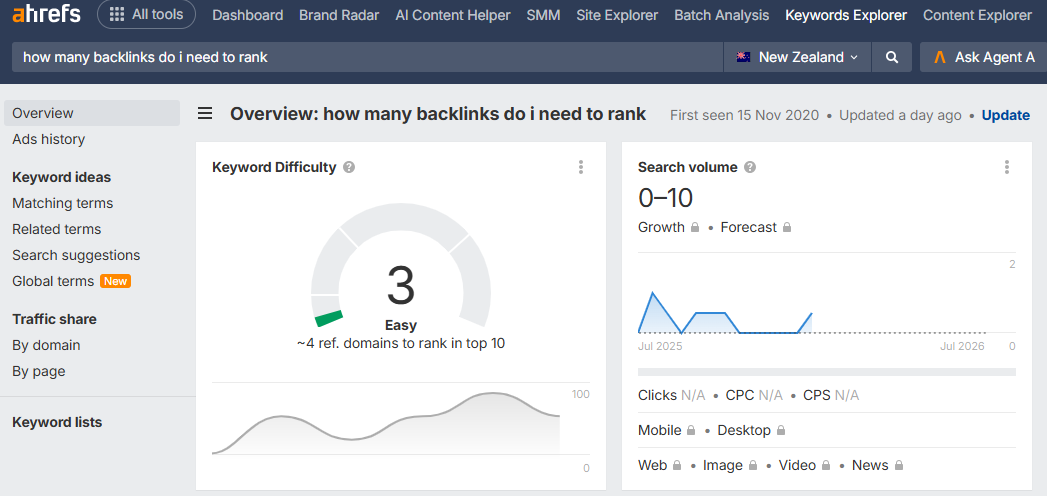
That gap — 4 versus 907 — is the whole point. The 907 figure is the median across competitive US industries, and it ranges from 76 in apparel to over 3,000 in finance and insurance. A local NZ keyword with informational intent is a completely different animal.

If you take an international benchmark and apply it to a Hamilton café or a Napier accountant, you’ll either give up early or waste months building links you never needed.
How to find your actual number
Here’s the process I’d run for any keyword, start to finish:
- Pick your exact target keyword. Not “plumbing” — the real thing people search, like “emergency plumber Tauranga.”
- Google it and open the top 5 results. Ignore the giant directories and Reddit threads; look at businesses like yours.
- Check their referring domains. Drop each URL into Ahrefs’ free Backlink Checker or Semrush and note the referring domain count for that specific page.
- Take the median of the top 3–5. That’s your rough target. Match it, then aim slightly higher in quality.
- Factor in link velocity. Your competitors keep earning links, so build steadily rather than in one spammy burst.
For a business chasing SEO in Tauranga, that five-minute check will usually show a target of single or low-double digits — a world away from the panic number.
Why Backlink Count Is the Wrong Thing to Obsess Over
Now the part that actually matters. Two pages can have the exact same number of links, and one will crush the other — because links are one ingredient, not the whole recipe.
Picture this. You’ve got a blog post with 10 solid backlinks. Semrush publishes a competing post targeting the same keyword with zero links to that page.
You’ll probably both make page one — but don’t be shocked when Semrush ranks above you anyway.
Why? Because Google isn’t just weighing the links to that one page. It’s weighing the authority of the whole domain behind it — and Semrush’s domain is a giant. It has thousands of high-quality pages, links pointing at the site as a whole, a mountain of brand mentions, reviews, and years of trust.
That authority flows through the site and lifts every page on it, including a brand-new one with no links of its own.
That’s the trap in “how many backlinks does my page need.” Ranking is decided by more than page-level links:
- Referring domains to your whole site, not just the target page — sitewide authority lifts individual pages.
- Link quality over quantity. Two links from trusted, relevant sites beat 100 from random junk. It’s not close — and editorial links inside real content make up 92% of page-one backlink profiles, while directory and resource-page links barely register.
- Internal linking, which passes authority from your strong pages to the one you’re trying to rank.
- Topical authority — how much genuinely useful content you’ve published around the subject, which tells Google you’re a real expert, not a one-page wonder.
- Domain age and trust, built up over time.
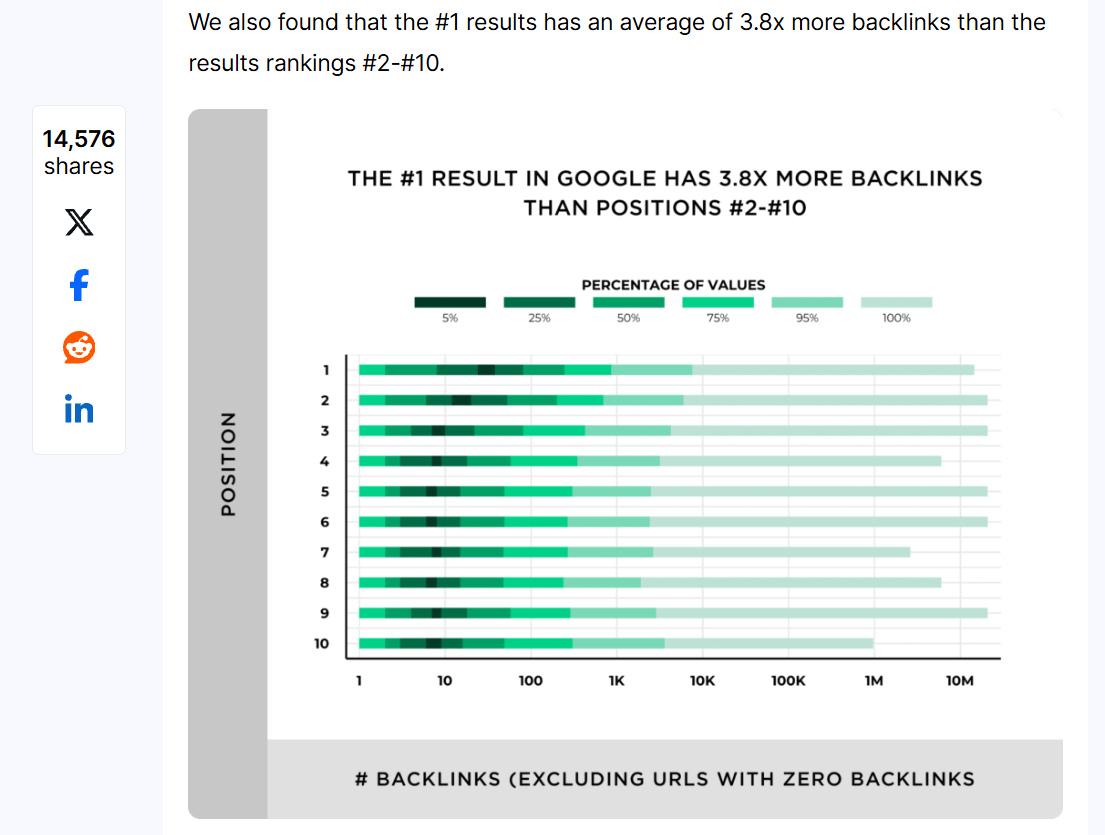
Backlinks are one of the biggest ranking factors — Google’s own systems lean on them heavily. An Ahrefs study of over a billion pages found 66.31% of them have zero backlinks. But links sit inside a bigger picture.
Chase the count alone and you’ll lose to sites that built the whole picture.
Proof This Works: Authority Beats Link Count
I’m not theorising here. My own SEO company is the case study.
Expert SEO is barely past its first year. It’s competing against New Zealand agencies that have been building their sites for ten years and sit on bigger domain ratings. On raw age and link count, we should lose.
We don’t. Expert SEO ranks for hundreds of keywords, gets cited in Google’s AI Overviews, and outranks decade-old agencies on plenty of terms — not because we out-linked them, but because we built topical authority fast: genuinely useful content across the whole pillars of SEO, tight internal linking, and real depth on the topics we care about.

And it’s not just ranking for a lot of keywords — it’s ranking #1 for the ones that count. We sit at the top for multiple searches pulling thousands of queries a month, one of them over 4,000.
I can promise you not a single one of those pages has 900 high-quality backlinks pointing at it.
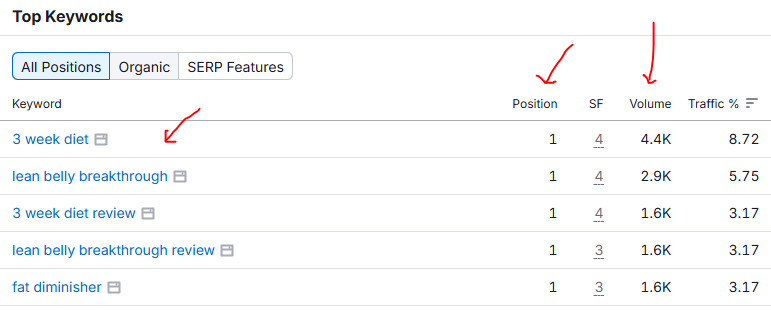
They rank because the domain is trusted — and domain authority makes it easy to rank for whatever you choose, with a big backlink profile or without one.
That authority doesn’t come from links alone. It’s built from the quality of the content you publish, how much of it you’ve got, the years you’ve put into doing that well, the age of your domain, and the total referring domains pointing at your site as a whole.
Every one of those predicts whether you’ll rank far better than the link count on a single page.
I’ve seen the same thing the other way in small business SEO across the country: businesses with more backlinks to a page still losing to a competitor whose whole site is simply more trusted and better organised. Links matter. But the site they point to matters more.
So What Should You Actually Do?
Stop counting links and start building authority. It’s slower, it’s harder, and it wins.
Here’s where I’d put the energy instead:
Publish high-quality content, consistently. Every strong, genuinely helpful page adds to your topical authority and gives Google another reason to trust your domain. This is the compounding engine — it’s exactly how we grew a health site (HealthVI) from zero to over 20,000 monthly visitors.
Earn links to your whole site, not just one page. A rising domain rating lifts everything. That’s off-page SEO working as a system, not a page-by-page grind.
Nail your internal linking. When you publish something new, link to it from your existing strong pages so their authority flows through. This is the most underrated, highest-leverage move most NZ businesses ignore completely.
Then, and only then, close the gap with targeted links. Once your foundation is solid, use the competitor referring-domain method above to top up the specific pages that need a nudge.
If you want to see where your site actually stands before you build a single link, that’s what an SEO audit is for — it shows your referring domains, your authority, and the gaps holding your pages back.
Final Thoughts
If you take one thing from this: “how many backlinks do I need to rank” is the beginner’s question, and chasing a number is how people waste money. The pros ask a better one — how do I make my whole domain more trustworthy than the sites I’m competing with?
For most New Zealand businesses, the honest answer to the original question is “fewer than the internet told you.”
Check your actual competitors, match their referring domains, and pour the rest of your effort into content and internal linking that builds authority across the board.
Do that, and you stop counting links — because you stop needing to.
If you’d rather have it built properly from the start, that’s what we do at Expert SEO. Whether you want it handled end to end with our SEO services or a straight answer on your specific site from an SEO consultant, we’re here.
How Many Backlinks Do You Need to Rank: FAQ
Do backlinks still matter in 2026?
Yes — they're still one of Google's strongest ranking signals. Around two-thirds of all pages have no backlinks at all. But quality and your whole domain's authority matter far more than raw count.
Can you rank without any backlinks?
Sometimes, yes — for low-competition or long-tail keywords, strong content on a trusted domain can rank with few or no links to that specific page. The more competitive the keyword, the more referring domains you'll need.
How many backlinks per month is safe to build?
There's no hard limit, but build at a natural pace — a handful of quality referring domains a month is fine. What looks spammy to Google is a sudden flood of low-quality links, not steady growth.
How long do backlinks take to affect rankings?
Usually weeks to a few months. Google has to crawl the linking page, then reassess your ranking. Treat link building as a slow, compounding investment, not an overnight switch.
Should links point to my homepage or my target page?
Both have a role. Links to your target page lift that page directly; links to your homepage and other pages raise sitewide authority that flows everywhere through good internal linking. A healthy profile has a mix.