

Let’s start with proof, because talk is cheap.
Our website is just over a year old. In its first months, it started getting cited by AI — pulled straight into Google’s AI answers and named by ChatGPT when people ask who’s best in our area.
It’s sitting beside Wikipedia and Moz in the results, sites with domains ten years older and a hundred times the backlinks.
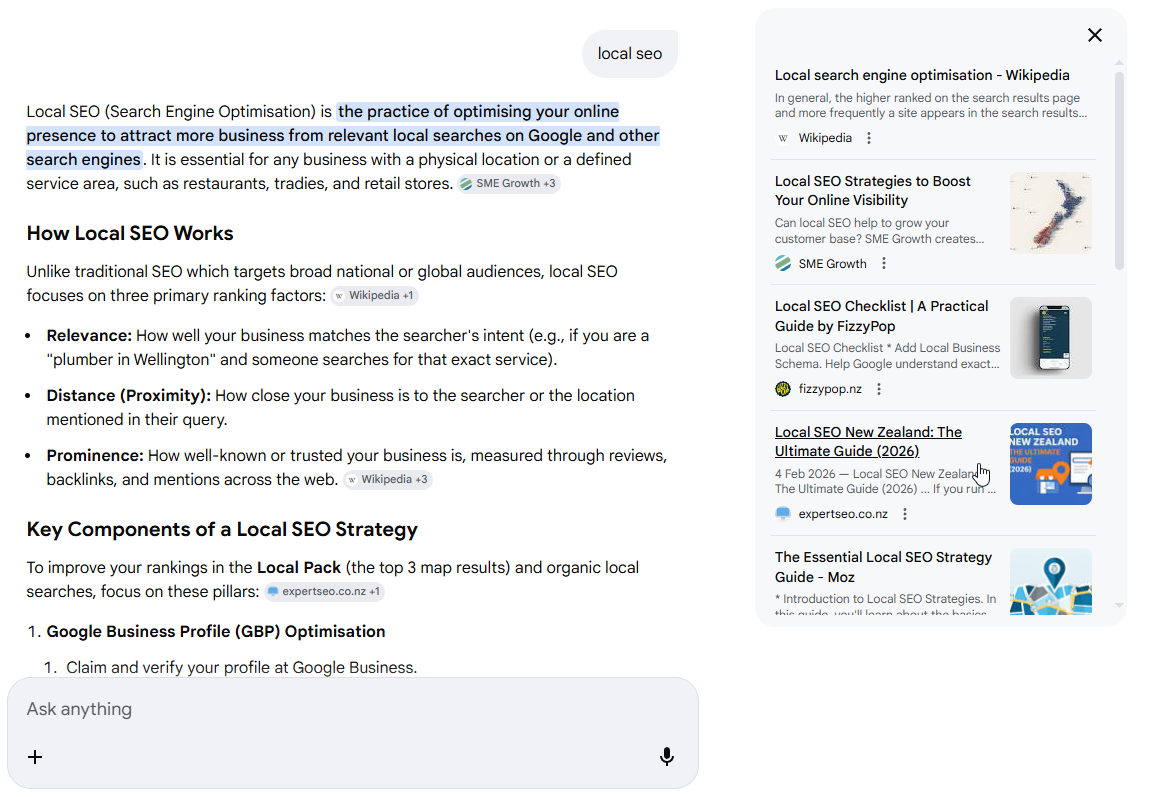
That didn’t happen by accident. It happened because the site is built the way answer engines want content built. That’s Answer Engine Optimisation — AEO — and this guide shows you how to do it.
Most AEO guides overcomplicate it, and none are written for Australian businesses.
This one won’t. We’ll show you what AEO is, why it matters here, and exactly how to do it — so your business gets cited by AI while your competitors are still working out what it means.
Key Takeaways
- Answer Engine Optimisation (AEO) is structuring your content so AI answer engines — Google AI Overviews, ChatGPT, Perplexity and Gemini — cite your business as the direct answer.
- AEO runs on top of SEO, it doesn’t replace it. The fundamentals — on-page SEO, the best content, and links — still do most of the work.
- The core moves: lead with a direct 40–60 word answer, write modular, scannable sections, and build brand mentions across the web.
- It matters now because AI answers are intercepting clicks. For Australian businesses, being the cited answer is the new number one — and almost nobody is doing it yet.
- Proof it works: our own year-old site is already cited by Google’s AI Overview and named by ChatGPT, up against ten-year-old competitors.
What Is Answer Engine Optimisation?
Answer Engine Optimisation (AEO) is the practice of structuring your content so AI-powered answer engines — Google’s AI Overviews, ChatGPT, Perplexity, Gemini and Copilot — can pull it, summarise it, and cite your business as the direct answer. Where traditional SEO aims to rank in a list of blue links, AEO aims to be the answer the AI gives.
An “answer engine” is anything that replies to a question with a synthesised answer instead of a page of links. Ask Google “best physio in Richmond” and you get an AI Overview at the top. Ask ChatGPT the same thing and it names a few clinics.
Neither shows you ten results to choose from. They give one answer. AEO is how you become part of that answer.
You’ll hear this called a few things — AEO, Generative Engine Optimisation (GEO), or “AI SEO.” Same core idea, slightly different labels: getting your content quoted by machines that answer questions. Don’t get hung up on the acronym.
Why Answer Engine Optimisation Matters In Australia
More searches now end without a click. Google answers in an AI Overview, ChatGPT answers in the chat, and the person never visits a website.
Ranking #1 the old way isn’t enough anymore — if the AI answer doesn’t mention you, you’ve lost the customer before they knew you existed.
The numbers back it up. Ahrefs found that keywords triggering an AI Overview see clicks drop by 34.5%. ChatGPT crossed 900 million weekly users in early 2026.
And the use of ChatGPT and AI tools for finding local businesses jumped from 6% to 45% in a single year — now the third most popular way people find a local service.
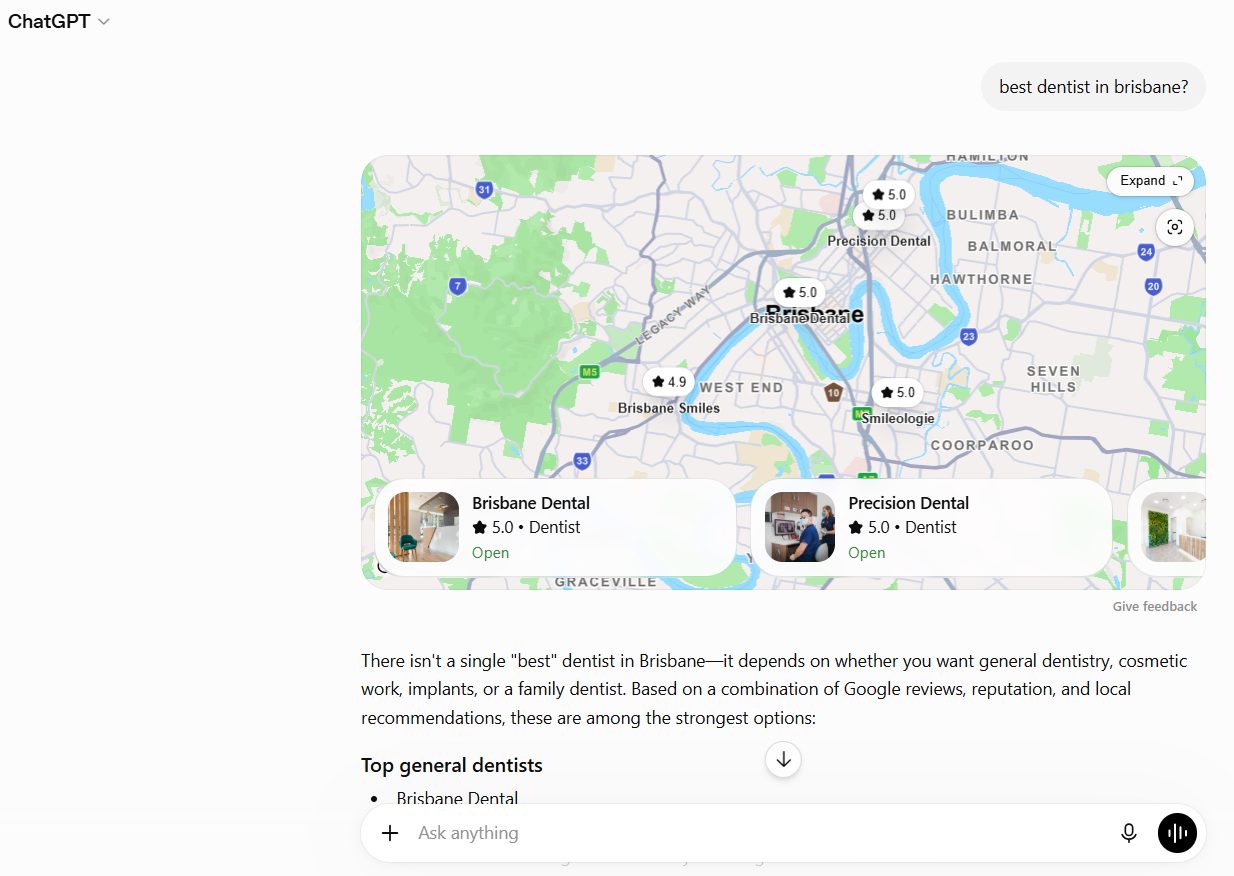
Look at what that means in practice. Someone in Brisbane types “best dentist near me” into ChatGPT. It hands them a shortlist of three clinics.
If you’re one of the three, you’re in the conversation. If you’re not, you don’t exist — it doesn’t matter how good your website is or how long you’ve ranked on Google.
It’s the same story whether you need SEO for a dental practice, SEO for a cosmetic clinic or SEO for a personal injury firm: this is bottom-of-funnel, ready-to-buy demand, decided by whether the AI knows and trusts you.
Here’s the opportunity for Australian businesses: almost nobody is doing this yet. The sources these engines cite for Australian queries are mostly overseas or generic.
The local businesses that structure their content properly now get to be the cited answer while their competitors are still arguing about whether AI search is a fad — and that’s as true for a practice investing in SEO in Brisbane as it is anywhere else in the country.
And no, this doesn’t mean SEO is dead. AI hasn’t killed search — Semrush found Google sessions went up after people started using ChatGPT. People search more, across more places. AEO runs on top of your SEO, it doesn’t replace it.
Answer Engine Optimisation vs Traditional SEO
The short answer to “is AEO better than SEO?” — it’s not a competition. SEO gets you ranked. AEO gets you cited. They share the same foundations — useful content, clean structure, trust — but they optimise for different finish lines.
| Traditional SEO | Answer Engine Optimisation | |
|---|---|---|
| Goal | Rank in the list of links | Be the cited answer |
| Win condition | Position #1 | Named in the AI response |
| Query style | Short keywords (“dentist Brisbane”) | Conversational questions (“who’s the best dentist in Brisbane for nervous patients?”) |
| Where it shows | Search results page | AI Overviews, ChatGPT, Perplexity, Gemini |
| The payoff | A click to your site | A recommendation, often before any click |
The nuance most guides get lazy about: AEO is not a replacement for SEO. It’s a layer on top. An AI engine can’t cite content it can’t find, can’t read, or doesn’t trust — and getting found and trusted is exactly what good SEO does.
If your SEO fundamentals are weak, no amount of AEO polish will save you. Get the foundations right, then optimise for the answer.
What carries over from SEO: quality, structure, E-E-A-T (experience, expertise, authoritativeness, trust). What’s new: writing for extraction — making it dead easy for a machine to lift a clean, correct answer out of your page.
How AI Answer Engines Decide What to Cite
AI engines aren’t magic. They favour content they can lift cleanly, from sources they can identify, that other places on the web back up. Get those three right and you become quotable.
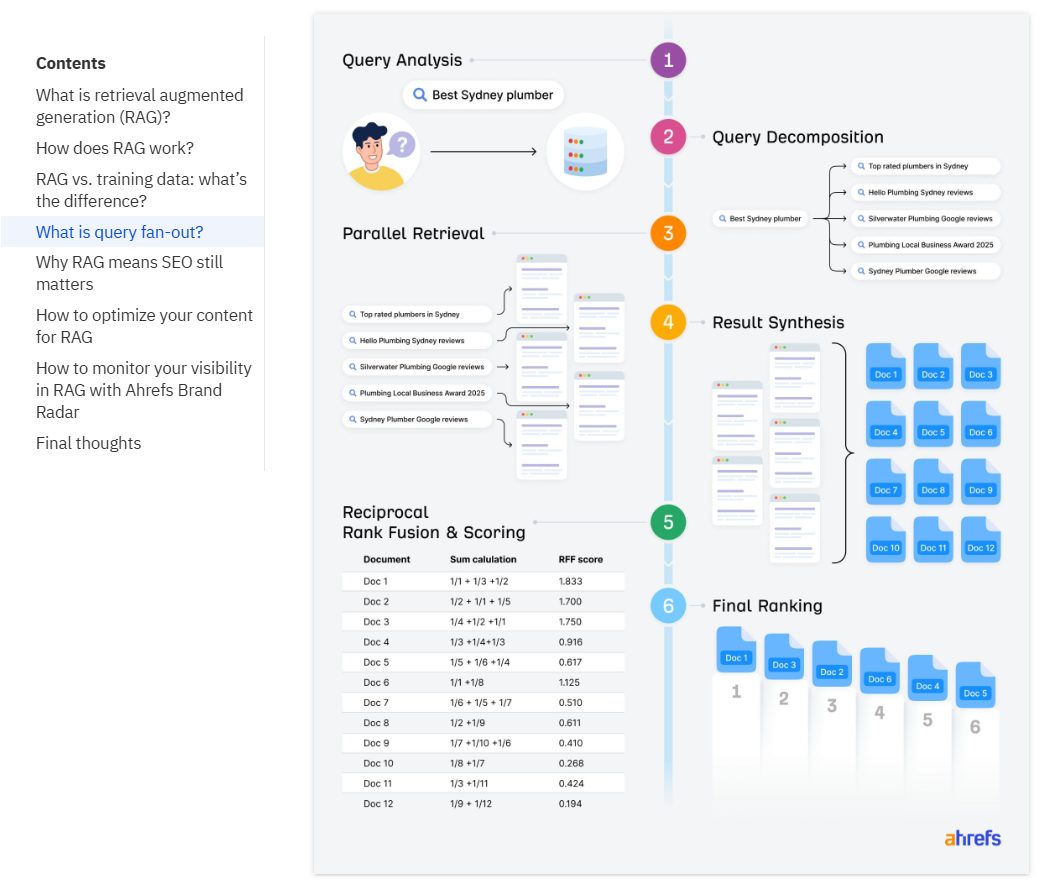
Here’s what’s happening under the hood. When someone asks “best Sydney plumber,” the engine breaks that into smaller questions, pulls in a set of documents that might answer them, and scores each one for how well it fits.
The pages that win aren’t always the highest-ranked — they’re the ones that answer the sub-question most clearly and cleanly. If you’re that plumber — or any business investing in SEO in Sydney — hoping to be the answer, three things decide whether it’s you:
Extractability. Can the model pull a clean, correct answer from one chunk of your page without needing the rest? If your answer is buried three paragraphs deep or tangled up with sales fluff, it’s hard to extract, so it gets skipped.
Structure. Clear headings, self-contained sections and schema markup tell the machine what each part of your page is. Structure is how a machine reads. A wall of text is a locked door.
Trust and corroboration. Who are you, and does the rest of the web agree? Consistent brand mentions, reviews, a real identifiable business, and being referenced on places like Reddit, LinkedIn and industry sites — AI cross-references all of it. If several independent sources say the same thing about you, you’re a safe citation.
Get those three right and your content keeps earning citations long after you publish.
One content site we built is still cited by ChatGPT and Google’s AI answers today — 26 AI mentions across 594 cited pages — years after the articles went up. Well-structured, useful content doesn’t age out of AI answers. It compounds.
How to Do Answer Engine Optimisation
This is the part every other guide skips. But before any AEO-specific move, a reality check: the fundamentals of SEO still do most of the heavy lifting.
Start with the SEO fundamentals
AEO isn’t a replacement for SEO — it runs on top of it. Three things still matter a ton, and no AEO trick works without them:
- On-page SEO — clean, well-optimised pages that target what people are searching for. (Our on-page SEO guide covers the lot.)
- The best content on the topic — more useful, more complete, and clearer than what’s ranking. AI cites the best answer, not the longest one.
- Link building — still one of the strongest trust signals there is. Pages the web links to are pages AI trusts.
AI engines pull their answers from content that already ranks and that the web already trusts. Skip the fundamentals and there’s nothing for them to find or cite. Nail them and you’re in the pool. Everything below is how you get picked out of that pool.
Lead with the answer
Put a direct, complete answer in the first paragraph under each heading — before the context, before the backstory. Aim for 40 to 60 words that stand on their own.
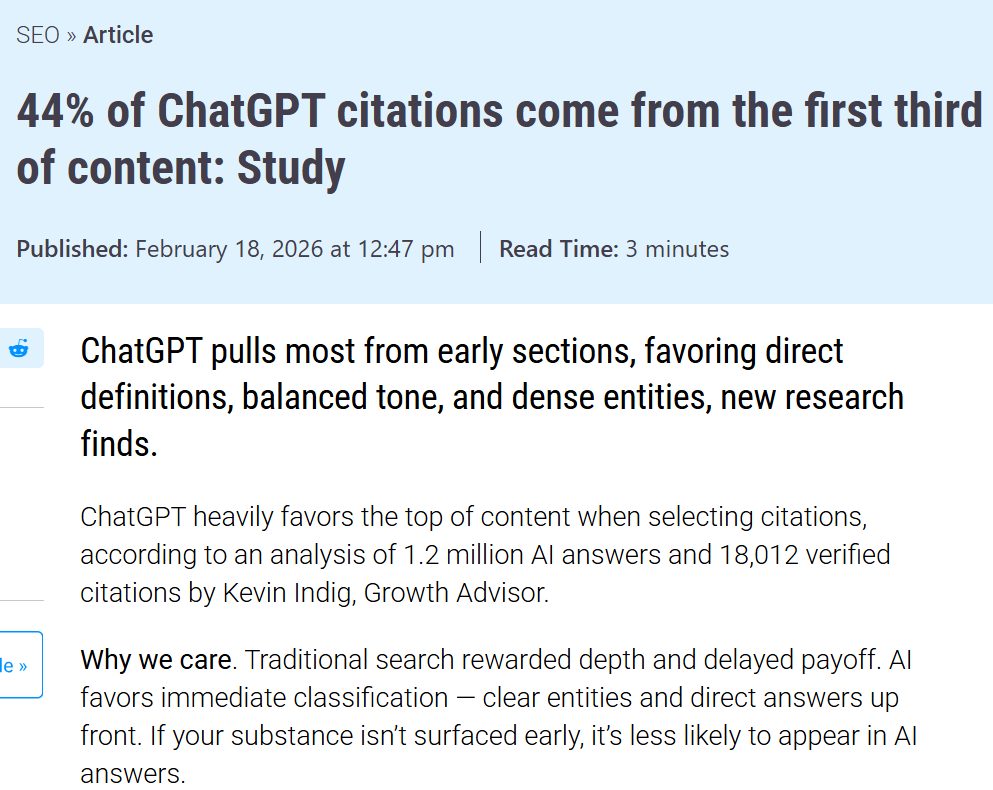
Why this matters more than anything else: a study covered by Search Engine Land found that 44% of ChatGPT citations come from the first third of a page, and another 31% from the middle. Bury your answer at the bottom and you’ve forfeited most of your citation odds.
Here’s the difference in practice.
Weak (buried): “There are a lot of factors that go into local SEO, and it’s something businesses often overlook. Over the years we’ve seen many approaches. Ultimately, at its core, local SEO is about…”
Strong (upfront): “Local SEO is the process of optimising your business to show up in location-based searches like ‘plumber Brisbane’ or ‘dentist near me.’ It focuses on Google’s map pack and local results, driven by your Google Business Profile, reviews and local relevance.”
The second one can be lifted straight into an AI answer. The first can’t. Write the second version under every heading.
Write in modular, self-contained sections
Structure your page so each section answers one question and makes sense on its own. One idea per H2. Clear H2s and H3s. Short paragraphs.
AI engines extract chunks, not whole pages. If a section only makes sense after reading the three above it, it can’t be lifted. Treat every section like it might be quoted in isolation — because it might be.
Format for scannability
Use bullet lists, numbered steps, and comparison tables instead of dense blocks of text. A table of “SEO vs AEO” or a numbered set of steps is far easier for a machine to parse and reuse than the same information written as a paragraph.
This isn’t dumbing down. It’s making your expertise machine-readable. The content still has depth — it’s just structured so both a busy human and an answer engine can grab what they need.
Build your brand mentions and entity signals
Get referenced where AI looks. That means a complete, consistent Google Business Profile, a steady stream of Google reviews, industry directories, and mentions on Reddit, LinkedIn and YouTube.
Keep your business name, address and phone number identical everywhere.
Why this matters: corroboration equals citation confidence. AI recommends businesses it sees mentioned consistently across trusted places. You can have perfect on-page AEO, but if the wider web has never heard of you, the engine has no reason to trust you as the answer.
Here’s a real example. We were featured on marketing.com.au — a recognised Australian marketing publication — with a link back to our site. That one placement pulls double duty. It’s a strong backlink, so it lifts our authority in Google’s eyes.
And that same authority makes AI engines more confident citing us, because we’re now referenced by a source they already trust. One good mention on a respected site improves your rankings and your odds of being the cited answer — the two goals feed each other.
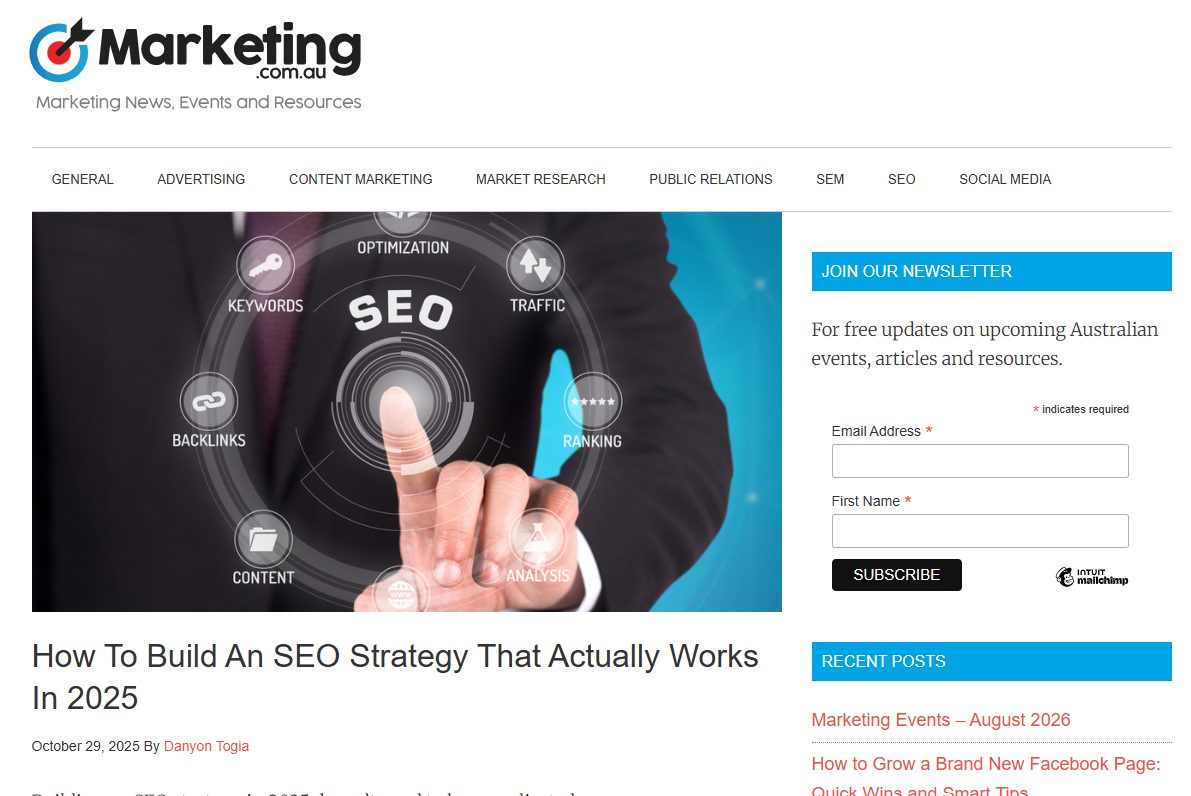
Get the fundamentals right, then answer upfront, write in clean modular sections, format for scannability, and build your mentions. That’s real AEO — and most of your competitors haven’t started.
The Tools Worth Using — and How to Check If It’s Working
There’s no magic AEO button, and anyone selling you one is overselling. What you need is a way to build clean, structured content and a way to check whether the engines are quoting you. Here’s the honest stack:
- Your SEO plugin — Rank Math or Yoast handle the on-page basics (and schema, if you want it) without touching code.
- Google Search Console — to watch your visibility and which queries you surface for.
- An AI-visibility tracker — optional, for teams with budget, to monitor mentions across ChatGPT, Perplexity and Gemini at scale.
But the most important test is free, and almost nobody runs it: ask the engines yourself. Open ChatGPT, Perplexity, Gemini and Google’s AI Mode.
Type the exact questions your customers ask — “best cosmetic clinic in Melbourne,” “best dentist near me” — and see who gets named. Do it once a month, track whether you appear, and note who’s being cited instead of you.
That’s your scoreboard. If you run a Melbourne clinic, this test tells you in thirty seconds whether AI is sending patients to you or a competitor — which is exactly why SEO in Melbourne now has to include AEO.
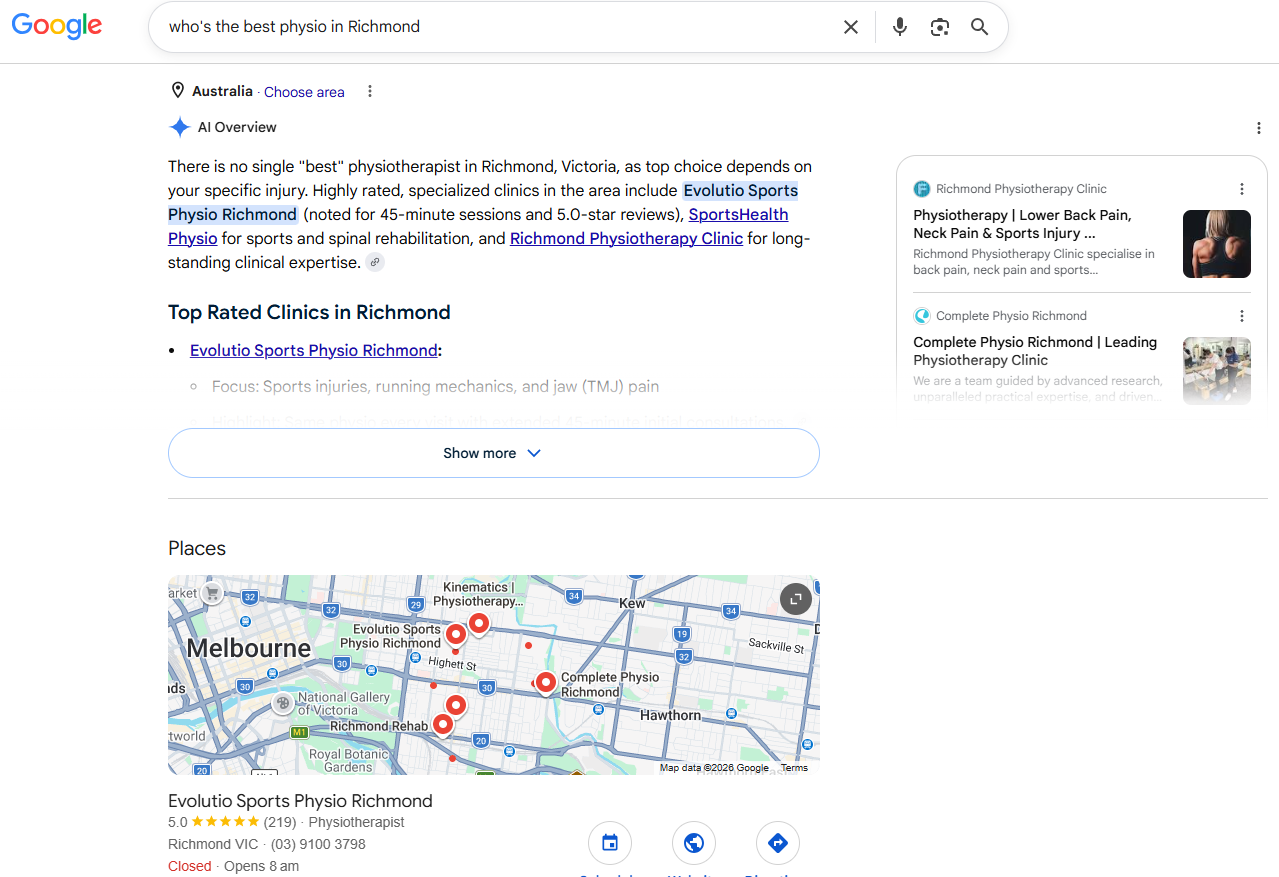
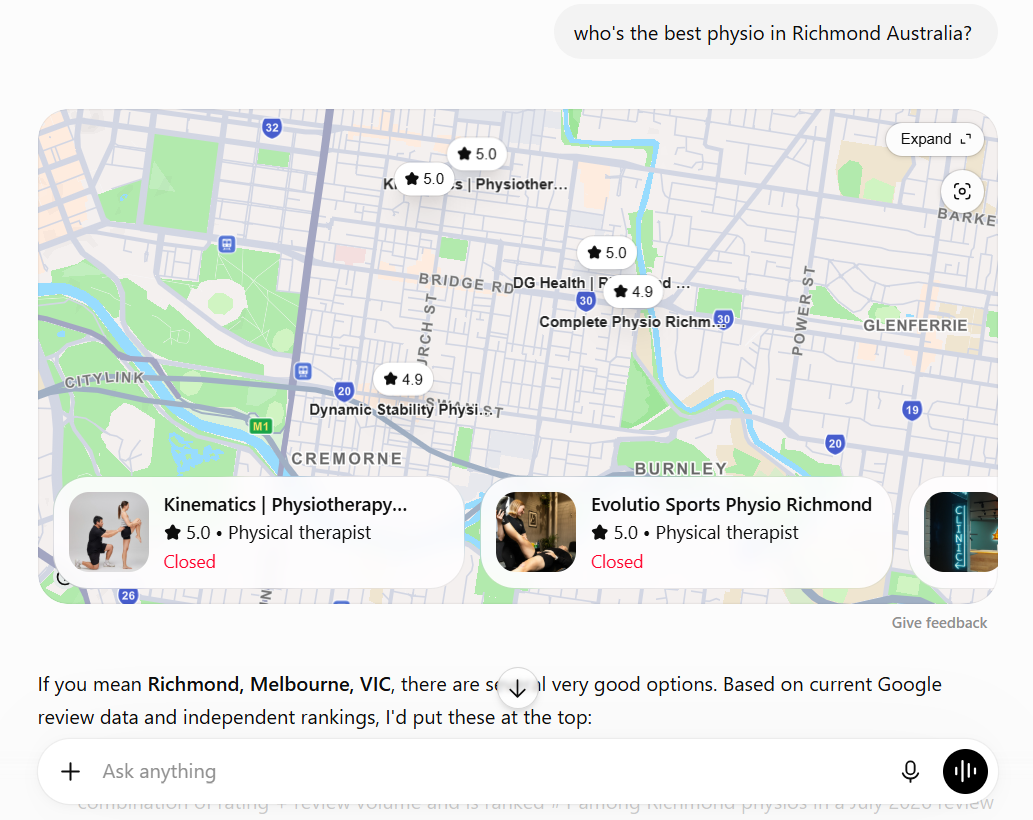
Run that exact test and you see the shift in one screen: ask Google and ChatGPT the same question, and both hand back a short, curated list of names. AEO is what decides whether you’re on it.
Proof It Works — Getting Cited by AI
Enough theory. Here’s what this looks like when it lands.
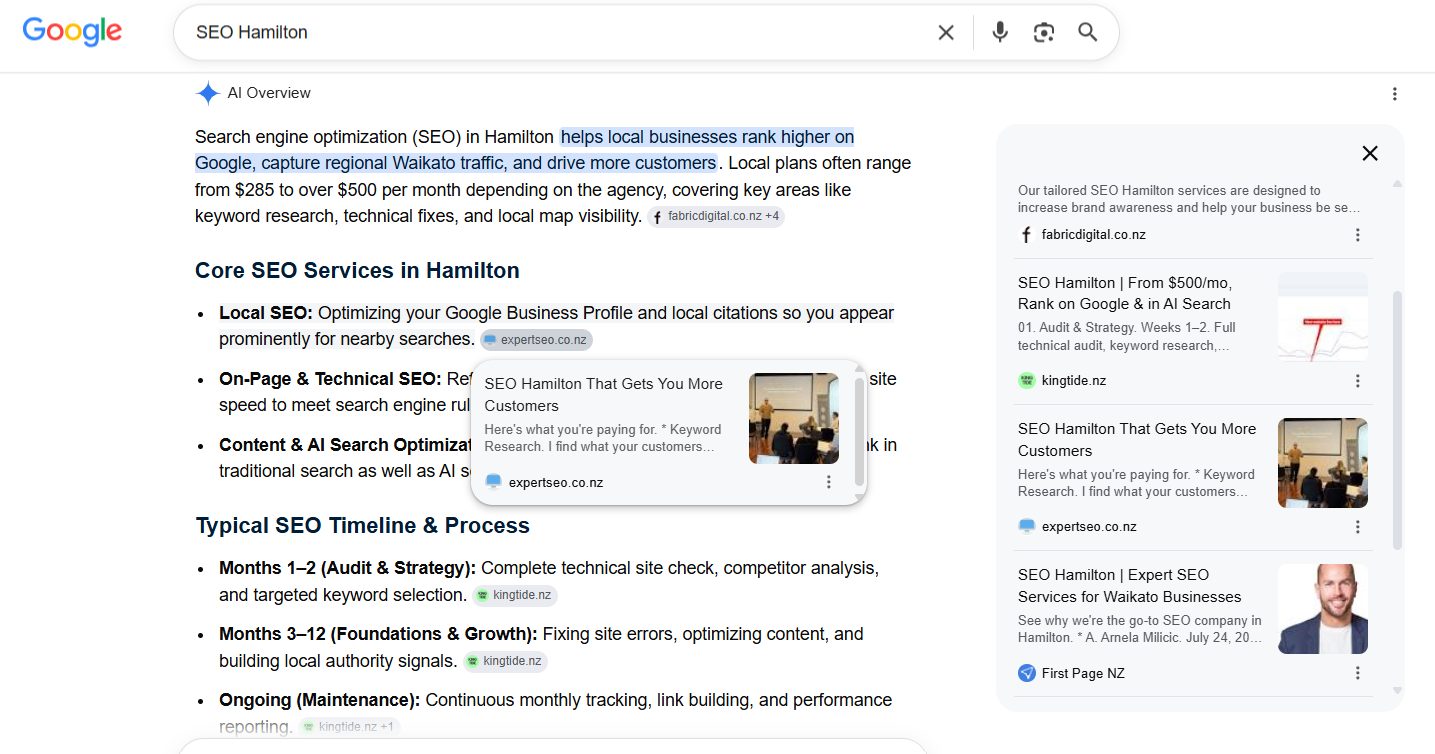
That’s Google’s AI Overview answering “SEO Hamilton” — and it cites our site directly, twice, listing our services inside the answer. Not ranked below the answer. Inside it.
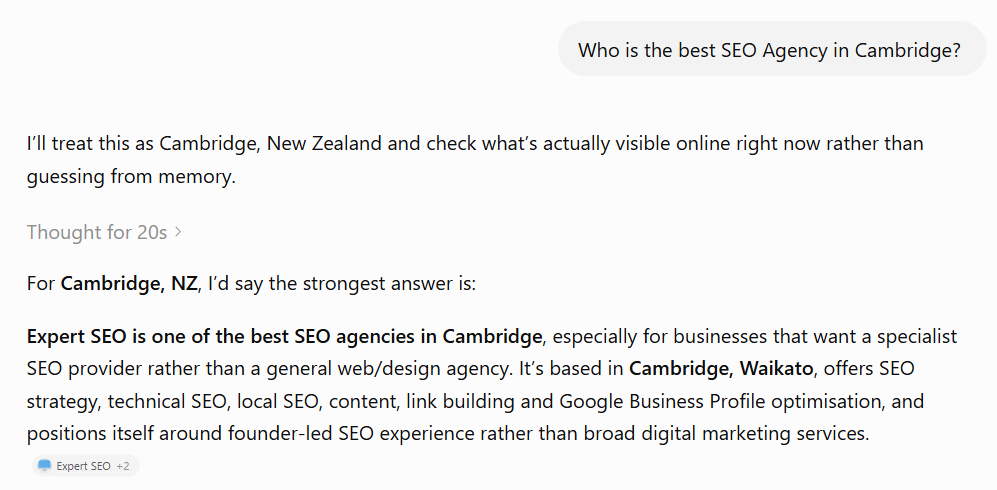
And that’s ChatGPT, asked point-blank who the best SEO agency in the area is. It names us. That’s the whole game — the model recommending you by name on a buying-intent question, before the person has clicked anything.
So why did it happen? The moves above, applied to our own site:
- We answer the exact questions people ask, upfront and cleanly.
- The site is structured in modular, scannable sections with clean, extractable formatting.
- Our business signals are consistent everywhere the engines look.
- The content is useful, so it earns mentions and trust.
The kicker is the timeline. Our domain is roughly a year old, with a Domain Rating of 36, going up against sites that have been around for a decade. It’s already ranking hundreds of keywords and getting cited by AI.
This isn’t a big-brand advantage. It’s a structure-and-usefulness advantage — the same one our Australian SEO agency builds for clients — and it’s available to any business willing to do the work.
Answer Engine Optimisation Mistakes to Avoid
Most businesses that aren’t getting cited are making the same few mistakes. Clear these and you clear the path:
- Burying the answer. Making the AI dig through 300 words of preamble to find the point. Lead with it.
- Walls of text. No headings, no structure, nothing clean to extract.
- Thin or duplicate content. Pages that add nothing a hundred others don’t. AI has no reason to pick you.
- No schema, or broken schema. Either you’ve skipped it, or it’s failing validation and doing nothing.
- Chasing every platform at once. Trying to game ChatGPT and Perplexity and Gemini before you’ve nailed the fundamentals on your own site.
- Faking authority. Inventing reviews or inconsistent business details. AI cross-checks — get caught and you’re dropped, not cited.
How Long Before You See Results
Some AEO wins land faster than traditional SEO, some slower. On-page moves — leading with the answer, cleaning up structure, adding schema — can get picked up within weeks as engines re-crawl your site. The trust signals — brand mentions, reviews, being referenced across the web — take months, the same way link building does.
It’s not set-and-forget. AI answers shift constantly; a query that named you last month might not this month.
Re-run your citation test, keep your content current, and treat it as ongoing. The businesses that stay cited are the ones that keep showing up.
Final Thoughts
AEO isn’t a new trick that replaces SEO. It’s the same discipline — be useful, be well-structured, be trusted — pointed at a new surface. The businesses winning AI citations aren’t doing anything clever. They’ve just made their content easy for a machine to lift and easy to trust.
The opportunity is that most of your competitors haven’t started. The engines are choosing their answers right now, and for a lot of Australian searches the sources they’re citing are generic or overseas.
Get in early and you become the default answer while everyone else is still catching up.
Do the work yourself — it works. Or, if you’d rather hand it to a team that already gets its own site cited by AI, take a look at our Australian SEO services.