

When an Australian picks a dentist, a lawyer, a plumber or a cosmetic surgeon, they don’t ask a mate anymore. They open Google, look at the map, and read the reviews.
The business with more genuine 5-star reviews wins the click before it’s said a word. The one with eleven reviews and no replies gets scrolled past.
Most owners know reviews matter.
What they don’t know is how to get a steady flow without feeling pushy, why the shop down the road with more reviews outranks them, what to do about a fake one-star, or whether it’s okay to just buy a few.
(It isn’t — and in Australia it’s illegal. More on that below.)
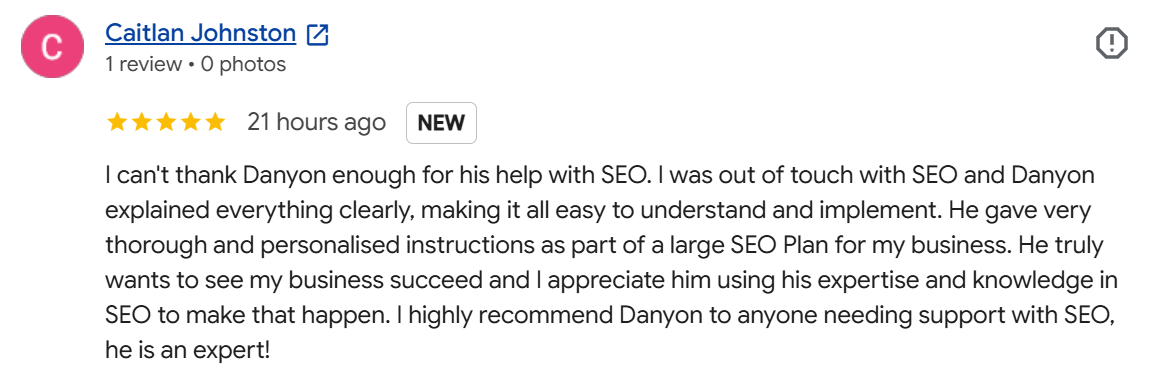
I don’t just teach this. Expert SEO holds a 5.0-star Google rating from real client reviews, built the exact way this guide will show you — by asking real customers, at the right moment, every time.

Reviews like this one are the whole point — specific, genuine, and worth more than any ad:
So here’s the complete, honest playbook: how to get more Google reviews, exactly how they lift your ranking, how to respond and deal with the bad ones, and the Australian rules you can’t afford to break.
Key takeaways
- What they are: Google reviews are the star ratings and written feedback customers leave on your Google Business Profile — the panel that shows in Google Maps and local search. They do two jobs: win trust with customers, and signal to Google that you deserve to rank.
- They’re a real ranking factor: It’s not just the star rating. Google reads your review count, how steadily new ones come in, the words customers use, whether you reply, and how recent they are.
- How to get more: Make it dead easy (a direct link and a QR code), ask at the moment the customer is happiest, follow up once, and get your whole team asking every time.
- Never buy them: Fake, paid, incentivised and “only ask the happy ones” reviews breach both Google’s policy and the Australian Consumer Law. The ACCC enforces it, and Google deletes fake reviews by the hundreds of millions — you pay to lose them.
- Reply to everything: A calm, personal reply to a bad review often wins more trust than the five-star ones. It also tells Google you’re an active, legitimate business.
- Measure what matters: Track the chain — reviews to visibility to calls and leads to revenue — not a vanity star count.
What Are Google Reviews?
Google reviews are the public star ratings and written feedback your customers leave on your Google Business Profile — the business listing that shows up in Google Maps and in the local results when someone searches for what you do.
Each one carries a 1-to-5 star rating, usually some text, and sometimes photos. Together they set your overall star rating and your total review count — the two numbers a potential customer sees first, right next to your name.
They do two jobs at once. For customers, they’re social proof — instant evidence you’re worth choosing.
For Google, they’re a trust signal that helps decide whether you show up in the map at all. That’s the whole reason they matter so much: one lever, pulling both the human decision and the ranking.
This guide is for business owners who want more and better reviews. If you’re trying to find or edit a review you left as a customer, that’s the consumer side of Google — this isn’t that.
Why Are Google Reviews Important for Australian Businesses?
For an Australian business, reviews often decide who gets chosen. Before someone calls your clinic or requests a quote, they’ve already read your reviews and compared them to the business up the road.
Around 97% of consumers read reviews online before choosing a business, and in 2026, 41% say they always read reviews when browsing — a big jump from 29% the year before. Reading reviews first is now the default, not the exception.
It’s one of the most consistent findings in every review study going, including BrightLocal’s Local Consumer Review Survey.

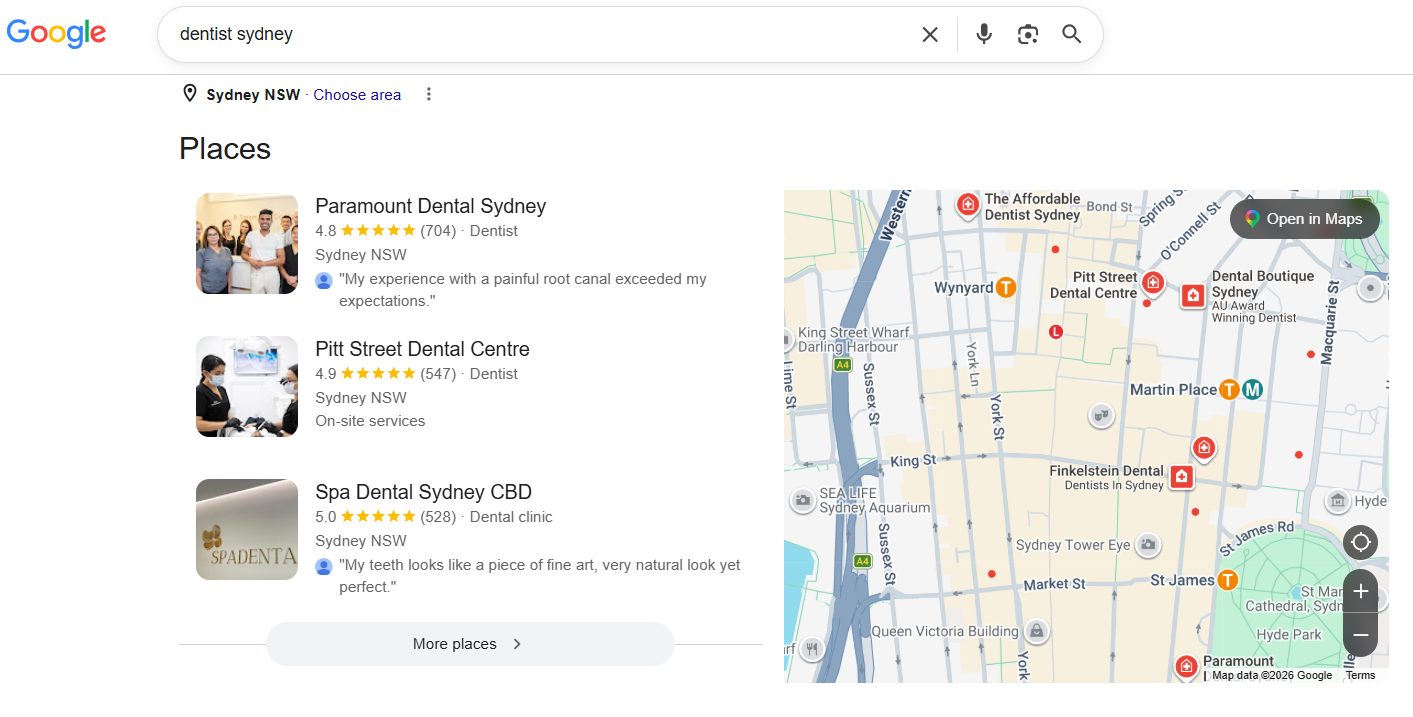
Think about how a customer really chooses. Search “dentist Sydney” and look at the top of the map: Paramount Dental sits at number one with 700+ reviews at 4.8 stars — above practices with a higher 4.9, and even one on a perfect 5.0, because they have far fewer reviews.
Volume and recency read as “lots of people chose this business, recently, and were happy.” That’s what wins the click, even when someone else’s star rating is technically higher.
Here’s the honest part most guides skip: a perfect 5.0 with six reviews converts worse than a 4.8 with two hundred.
Shoppers know real businesses have the odd off day. A flawless score with barely any reviews looks staged. Genuine and busy beats perfect and thin, every time.
And reviews don’t just win the click once someone sees you — they help decide whether you’re seen at all. That’s the next section.
How Google Reviews Affect Your Google Ranking
Everyone says “reviews help your SEO.” Almost nobody explains how. Here’s what Google is actually reading.
Google ranks local businesses on three things: relevance (do you match the search), distance (how close you are), and prominence (how well-known and trusted you are).
Reviews feed straight into prominence — and they’re one of the strongest levers you control. Here’s the review-specific part.
Review count. More genuine reviews signal a more established, trusted business. This is the “dentist Sydney” gap again — more reviews, stronger prominence, higher in the map, even past a rival with a higher star rating.
Velocity and recency. A steady trickle of new reviews beats fifty in one week and then nothing for a year. Bursts look manufactured (and often are). Recent reviews tell Google you’re active and still delivering — old reviews fade in weight over time.
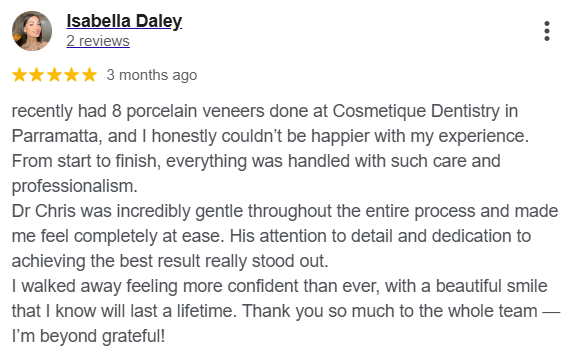
Keywords in the review text. When a patient writes “8 porcelain veneers at a Parramatta clinic,” those words are a relevance signal tied to your listing.
You can’t script this (that’s against the rules), but you can nudge it — a simple “if you mention what you came in for, it really helps others find us” is enough to gently steer real customers toward describing the service and the suburb, exactly like the review below.
Your replies. Responding to reviews signals an active, legitimate business, keeps the listing fresh, and is a light ranking positive on top of the trust it builds. We’ll cover how to reply below.
The rating itself. Your star rating matters more for whether people click and convert than as a raw ranking lever — but a rating that slides too low will eventually cost you both.
One honest caveat: reviews are one lever, not the whole machine. If you’re a long way from the searcher or your profile is thin, reviews alone won’t fix it.
But paired with a properly set-up profile, they’re often the difference between third in the map and buried on page two.
How to Get More Google Reviews
The businesses drowning in reviews aren’t lucky. They’ve made asking part of how they operate. You need four things working together: a dead-simple way to leave a review, the right moment to ask, a follow-up, and a team that asks every time.
Here’s the system.
1. Get your direct review link and turn it into a QR code. In your Google Business Profile, open “Get more reviews” and grab your review link — it takes the customer straight to the review box, already on your business.
Google gives you a ready-made QR code on the same screen. This kills the number-one reason people don’t leave reviews: friction. “Search for us on Google, scroll down, tap the stars…” loses people. One tap or one scan doesn’t.
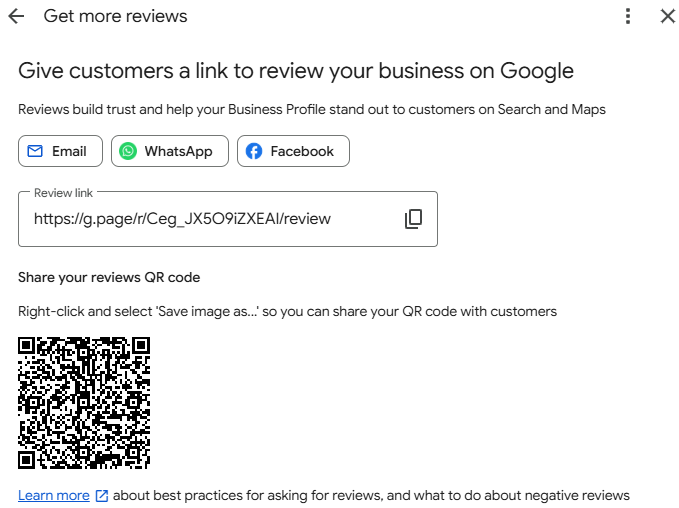
2. Put the link everywhere. The SMS you send after the job. Your email footer. The bottom of the invoice or receipt.
Your thank-you page. A QR code on the counter, the table, the back of the tradie’s ute, a “review us on Google” card handed over at the end. The more places it lives, the more reviews you get.
3. Ask at the peak-happiness moment. Timing beats everything. Ask when the customer is most delighted — not a random Tuesday three weeks later. It shifts by industry:
- Cosmetic surgeon or clinic — at the follow-up when they’re thrilled with the result, not the day of the procedure.
- Dentist — right after a smooth check-up or a great cosmetic result, at the front desk before they leave.
- Lawyer — the moment the matter’s won or settled, as a personal ask. Low volume, high value — a genuine one-to-one request lands far better than a mass send.
- Tradie (plumber, electrician, builder) — on-site, job done, customer visibly happy. Send the SMS before you’ve pulled out of the driveway. Tools like ServiceM8 and Tradify can fire it automatically the second you mark a job complete.
- Café, salon or retail — in the moment, at the counter or on the table, via a QR code while the good experience is fresh.
4. Make the ask human, not robotic. A real, short ask beats a corporate template. Something like:
“Really glad you’re happy with how it turned out. If you’ve got 30 seconds, a quick Google review would really help us — here’s the link. No worries if not.”
Adapt it to how you actually talk. The personal version outperforms the mass blast every time.
5. Follow up once. Most people mean to leave a review and forget. A single polite nudge a day or two later — “no pressure, just in case you didn’t get to it: [link]” — roughly doubles your response rate. Once. Don’t hound people.
6. Get your whole team asking. The owner can’t be the only one. Brief the front desk, the technicians, the account managers. Make it a habit, mention reviews in team meetings, celebrate good ones internally. A business where everyone asks collects reviews on autopilot.
7. Automate the sending, keep the ask personal. Your booking system or CRM can automate the send so nobody has to remember. Just don’t let automation strip the personal touch — and never use it to filter customers (that’s coming up in the rules).
Do these six or seven things consistently and the trickle becomes a stream. That’s all it takes.
Why You Should Never Buy or Fake Google Reviews
There’s a live market selling “5-star Google reviews for Australian businesses” — you’ll find it on Reddit, on Facebook groups, on Fiverr. It’s tempting when you’re starting from zero. Don’t touch it.
Buying reviews, posting fake ones, offering incentives for reviews, and “review-gating” all breach Google’s policy and the Australian Consumer Law. This isn’t a grey area.
Google’s rules, plainly. No paying for reviews. No offering discounts, prizes or freebies in exchange for a review. No fake reviews.
And no review-gating — funnelling only your happy customers to Google while diverting unhappy ones to a private feedback form. Google treats all of these as fake and misleading content.
The Australian Consumer Law layer. Fake and misleading reviews and testimonials are misleading or deceptive conduct under the ACL.
The ACCC treats them as a real enforcement priority, runs “internet sweeps” hunting for them, and has taken action against businesses over fake and manipulated reviews.
Their guidance for businesses on online reviews spells out what’s not allowed — including reviews written by family, staff or anyone paid to write them. Penalties for misleading conduct in Australia run into the millions.
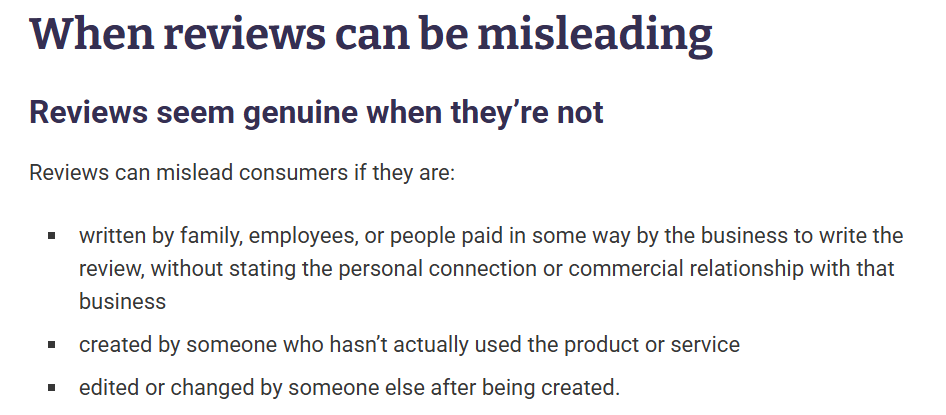
Google catches it anyway. Google’s spam systems remove policy-violating reviews at enormous scale — hundreds of millions of them a year.
Bought reviews come from flagged accounts, arrive in unnatural bursts, and often come from the wrong side of the world. They get stripped out — so you pay for reviews that vanish, and risk your profile on top of it.
The gating trap catches good people who don’t realise it’s a breach. Sending a text that asks “were you happy? yes/no,” then only showing the Google link to the “yes” crowd, feels like smart filtering. It’s specifically against Google’s policy. Ask everyone, the same way.
The takeaway is simple: the only review strategy that survives is genuine reviews, earned consistently. Everything in the section above is how you do that — legally, and in a way that sticks.
How to Respond to Google Reviews
Replying to reviews isn’t just manners. It signals to Google you’re an active, legitimate business, and it shows every future customer how you treat people — especially when something goes wrong. Reply to all of them.
Positive reviews. Keep it short, personal and specific. Name the thing they mentioned. Skip the copy-paste “Thanks for your feedback!” — it reads like a bot.
“Thanks Sarah — so glad the team sorted the leak fast for you. We’ll pass that on to Josh. Appreciate you taking the time.”
Negative reviews. This is the moment that matters, because future customers read your replies as closely as the reviews. Stay calm. Don’t get defensive. Don’t argue the facts in public. Acknowledge it, apologise where it’s warranted, and move it offline:
“Hi Mark, I’m sorry this didn’t meet the standard we aim for. That’s not the usual experience and I’d like to make it right — could you email me at [email] or call the office directly? — [name]”
A graceful reply to a harsh review can win more trust than a wall of five-stars, because it proves how you handle a problem. That’s what a nervous new customer is really trying to work out.
One Australian-specific caution for health, legal and financial businesses: never confirm someone was your patient, client or customer, or reveal any detail about their matter, in a public reply.
Confidentiality obligations still apply on Google. Keep the public reply generic and take the specifics private.
Reply promptly — a weekly check is the minimum. Speed signals you’re paying attention.
How to Deal With a Fake or Unfair Review
You can’t delete a review just because it stings — and you shouldn’t want to. But reviews that break Google’s rules can be flagged and removed. Knowing the difference saves a lot of stress.
What Google will remove: fake reviews, spam, off-topic rants, reviews from competitors or people who were never customers, conflicts of interest, and anything with profanity, hate or personal information.
What it won’t remove: a genuine customer who had a bad experience and said so. That one you handle with a good reply, not a takedown.
How to flag one. In your Google Business Profile, find the review, tap the three-dot menu and report it, choosing the policy it breaks. Then be patient — removal isn’t instant, and Google errs toward leaving reviews up. If it clearly violates policy and nothing happens, you can escalate through Google Business Profile support.
Why reviews sometimes disappear on their own. Google’s spam filter constantly removes reviews it judges fake or non-compliant — and it occasionally catches genuine ones in the net, which is why your count can drop for no obvious reason.
It’s frustrating, but it’s also why steady, genuine reviews from real local customers are the safest kind: they’re far less likely to be filtered than a sudden pile of them.
If a review is not just unfair but untrue and genuinely damaging, that can stray into defamation territory in Australia — but that’s a legal question, and I’m an SEO, not a lawyer. For most bad reviews, the right move is a calm public reply and a quiet effort to win the customer back.
How Many Google Reviews Do You Need?
There’s no magic number. But there is a real target: more than the businesses ranking above you, at a solid rating, with new ones always coming in.
Beat the businesses above you. Search your main term — “physio Bondi,” “family lawyer Perth” — and look at the three businesses in the map pack above you.
Note their review counts and ratings: search “physio Bondi” and the clinic on top has 213 reviews, while the one just below it has the same 5.0 rating but only 18. Same score, far fewer reviews, lower spot.
That’s your target to pass — you’re not competing with the whole internet, just the businesses taking the customers you want.

It’s a flow, not a finish line. Because recency matters and old reviews fade, a handful of new genuine reviews every month beats a one-off pile that then goes stale.
The businesses that win treat review-getting as a permanent habit, not a campaign.
Aim for 4.5 and up. Somewhere between 4.5 and 4.9 is the sweet spot — clearly excellent, but believable. As covered earlier, a suspiciously perfect 5.0 on thin numbers can hurt.
What “enough” looks like varies a lot by business. A suburban dentist competing with two others might dominate with 150 solid reviews.
A CBD law firm in a crowded market might need several hundred to stand out. Check your actual competitors — they set the bar, not a blog.
What Your Google Reviews Are Worth
Most owners track reviews like a scoreboard — “we’re on 87 now.” That misses the point. Reviews are worth something because of what they trigger.
Here’s the chain: more and better reviews lift your visibility in the map and your click-through rate. That means more calls, more direction requests, more website clicks. Those become leads. Leads become customers. The star count is just the first domino.
So track the chain, not the trophy. Your Google Business Profile insights show calls, direction requests and website clicks straight off your listing — watch those move as your reviews grow.
Add a simple “how did you hear about us?” on enquiries, and keep a basic record of leads to sales. That’s all you need to see what reviews are really doing.
And tie it back to money. For a cosmetic surgeon or a lawyer, a single extra client the reviews helped win can be worth thousands — sometimes more than a month of any other marketing.
That’s the real return on the fifteen minutes a week your team spends asking.
The honest bit: some of the impact never shows up cleanly in a dashboard. Someone reads your reviews, doesn’t call, then walks in a week later or Googles your name and converts.
That’s still your reviews working — which means the real value is usually higher than what you can measure, not lower.
Google Reviews by Industry
The system’s the same for everyone. What changes is the timing and the ask. Quick cuts for the industries where this matters most:
- Tradies (plumbers, electricians, builders) — ask on-site the second the job’s signed off and the customer’s happy. Automate the SMS through ServiceM8 or Tradify. QR code on the ute and the invoice.
- Dentists and medical — ask at the front desk after a good visit; recall reminders are a natural second touchpoint. Never confirm someone’s a patient in a public reply. More in our guide to SEO for dentists.
- Cosmetic and med-spa — ask at the “thrilled with the result” follow-up, not procedure day. High value per client means even a handful of reviews moves real revenue. See our guide to SEO for cosmetic surgeons.
- Lawyers and professional services — a personal ask at the win. Lower volume, higher stakes, and confidentiality applies to every reply. Our guide to SEO for personal injury lawyers covers the legal-specific side.
- Real estate agents — ask right after settlement or handover, when the emotion’s high. Collect reviews per agent, not just for the agency.
- Hospitality and retail — a volume game. QR on tables and receipts, in the moment, frictionless. A few seconds while the coffee’s good beats an email the next day.
Whatever you do, the fundamentals are the same wherever you compete. Whether you’re working on SEO in Melbourne, Sydney SEO, SEO in Brisbane or Perth SEO, reviews are one of the biggest local ranking levers you’ve got.
Final Thoughts
Reviews are the one local ranking factor your competitors can’t honestly shortcut.
Anyone can buy a slick website or switch on Google Ads. Nobody can fake genuine reviews for long — Google strips them, the ACCC pursues them, and customers can smell them. Which is exactly why real reviews, earned consistently, compound into trust and rankings that bought ones never will.
The businesses that win the map pack aren’t the ones with a clever hack. They’re the ones who made asking part of how they operate — every job, every visit, every happy customer, forever. It’s not complicated. It’s just consistent.
Get that habit right and reviews become one of the best returns in your marketing. If you’d rather hand your whole local presence — reviews, rankings and the profile behind them — to a team that does this for a living, take a look at our SEO services.