
Most New Zealand businesses pick their keywords by guessing.
They write a few blog posts, sprinkle in words they think people search, and wait. Six months later the traffic’s still flat and not a single customer has come from Google.
That’s not a content problem. It’s a keyword research problem.
Here’s the issue with almost every guide you’ll find on this: it’s American. It assumes 10,000 searches a month is a small keyword and tells you to buy a $150-a-month tool before you’ve found a single term. None of that fits a business selling to five million people.
So this guide does it differently. What keyword research actually is, why it matters, and exactly how to do it — with free tools, tuned for the NZ market. I’ve used this exact process to take my own brand-new Expert SEO domain to 233 ranked keywords in eight months, and on a content site I helped grow to over 433,000 ranked keywords. I’ll show you the receipts as we go.
Let’s get into it.
Key Takeaways
- What it is: Keyword research is finding the exact words people type into Google, then checking how many search them, how hard they are to rank for, and what those searchers actually want — so you build pages around real demand instead of guesses.
- You don’t need a paid tool. Google Keyword Planner, Google autocomplete, Search Console and AnswerThePublic will get a NZ business its first real keyword list for free.
- NZ changes the maths. A keyword doing 100–200 searches a month here can be your best source of customers. Ignore the US advice to skip anything under 1,000.
- Intent beats volume. A low-volume term where the searcher is ready to buy is worth more than a high-volume term where they’re just browsing.
- Don’t chase the biggest number. Score each keyword on three things — can I rank for it, does the searcher want to buy, can I serve them — and do the winners first.
- Google Keyword Planner overestimates volume 91% of the time, so treat every number as a rough guide, not gospel.
- It’s not dead in the AI era. You still research what people ask — the prize is now getting cited by AI, not just ranking blue links.
What Is Keyword Research?
Keyword research is the process of finding the exact words and phrases people type into Google, then checking how many people search them, how hard they’ll be to rank for, and what the searcher is actually after — so you can build content around real demand instead of guessing.
That’s it. No mystery.
Every keyword tells you three things: how many people want it (volume), how hard it’ll be to get (difficulty), and why they’re searching (intent). Master reading those three and you’ve mastered the core of it.
Here’s the mindset shift most people miss. A keyword isn’t a magic phrase you stuff into a page. It’s a topic. It’s a signal that a real person, somewhere in New Zealand, has a problem they’re trying to solve right now.
Your job is to find those signals and answer them better than anyone else.
Want proof this works at scale? I was part of a team of SEO professionals who worked on a sleep-niche website that ended up ranking for 433,559 keywords, with 14,421 of them sitting in the top three positions.

A sleep-niche site the team I worked on grew to 433,559 ranked keywords — every one started as a search someone typed into Google.
Every one of those started as a keyword someone typed into Google. We just found them, and answered them.
Why Is Keyword Research Important?
Keyword research is the difference between content people are actually searching for and content nobody ever finds. Get it right and every page you publish has a job to do. Skip it and you can pour six months into writing things zero people are looking for.
It’s the foundation of everything else in SEO. This is step one of the whole SEO process — before you write a word, before you touch on-page, before you build a single link. Pick the wrong target and every other bit of work you do is aimed at nothing.
Think about what’s at stake for a small business.
Your most expensive resource isn’t money. It’s time. Every hour you spend writing a page nobody searches for is an hour you’ll never get back. Keyword research is how you stop writing into the void.
It also shows you demand you’d never guess. The words you use for your product are often not the words customers use. A panel beater might not realise plenty of their customers search “car dent repair” instead. Research surfaces that gap.
And it’s how you find winnable ground. Instead of throwing yourself at terms owned by giants, you find the corners of the market where a small NZ business can actually rank.
Here’s my own proof. My SEO company is on a domain that’s under a year old, competing against agencies that have been building authority for a decade. On paper, no chance.
Yet it’s already ranking for 233 keywords, pulling around $3,500 a month in traffic value, in about eight months.
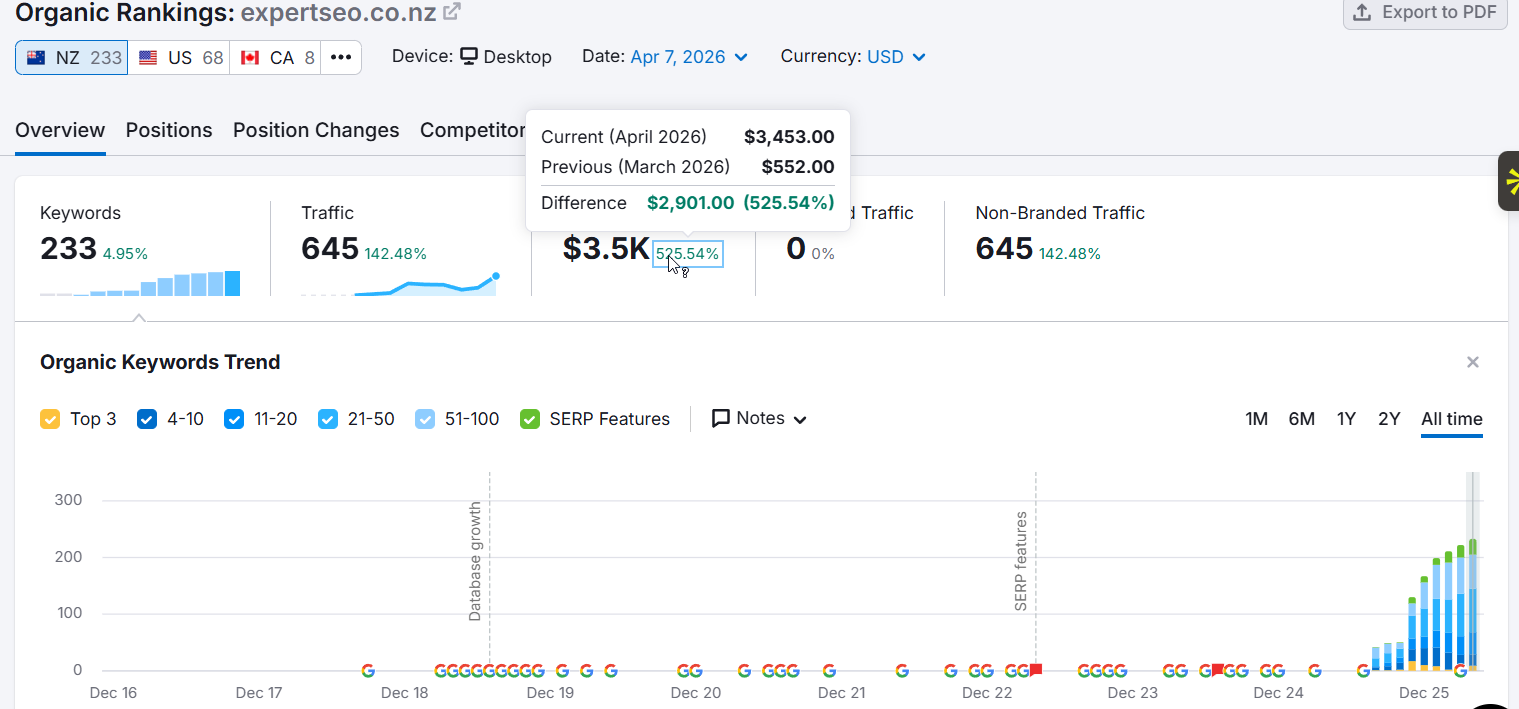
My own site, under a year old: 233 ranked keywords worth about $3,500 a month in traffic — because the targets were researched, not guessed.
That didn’t happen because I published more than everyone else. It happened because I researched the right targets, then answered them. Research first, write second — that’s the whole game.
How to Do Keyword Research (Step by Step)
Keyword research comes down to five steps: brainstorm your seed keywords, expand them with a free tool, dump them into a spreadsheet, group and map them to pages, then check the numbers and prioritise.
That’s the process at a glance. Now let me take you through it properly — click by click — so you can actually do it, not just nod along.
We’ll follow one real example the whole way: a plumber in Auckland.
Step 1 — Brainstorm your seed keywords
Seeds are your starting words — the broad terms your business is built on. You only need five to ten.
There are two ways to get them.
The obvious one: write down what you sell and where you sell it. For our Auckland plumber, that’s “plumber,” “blocked drain,” “hot water cylinder,” “gas fitting” and “emergency plumber,” each paired with “Auckland.”
The faster one: ask ChatGPT to do the first pass. Give it a prompt like this:
“You’re an SEO keyword research expert. I run a plumbing business in Auckland, New Zealand. List 20 seed keywords and topics my potential customers might type into Google when they need a plumber. Group them by service.”
Ten seconds later you’ve got a starter list — including angles you’d never have thought of yourself. Tidy it down to your best five to ten and move on.
Step 2 — Expand each seed in Google Keyword Planner
Now you turn five seeds into a couple of hundred real keywords. Here’s the exact path:
- Open Google Keyword Planner and click “Discover new keywords.”
- Type your first seed — “plumber Auckland” — and hit enter.
- Set the location to New Zealand and the language to English. This is the step everyone forgets, and it’s the one that matters most. Leave it on the default and you’re researching the wrong country.
- Click “Get results.”
You’ll get a table of related keywords with monthly search ranges — “emergency plumber,” “24 hour plumber Auckland,” “blocked drain repair,” and dozens more you didn’t think of.
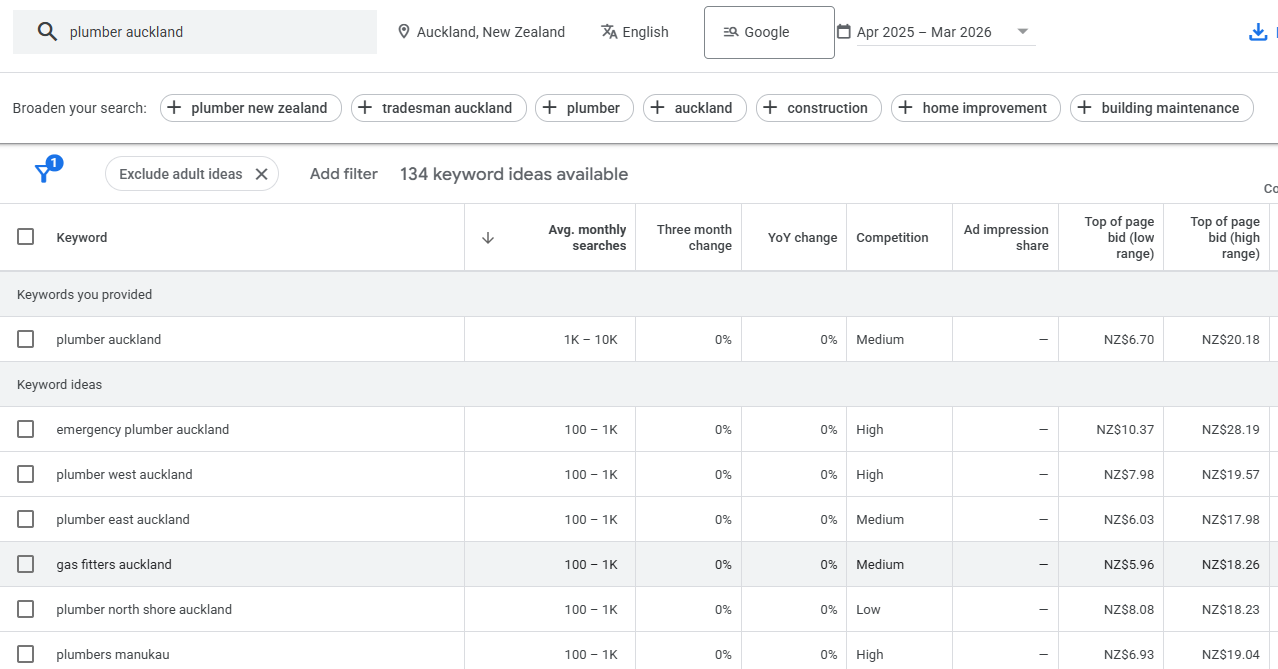
Google Keyword Planner turning one seed, “plumber Auckland,” into dozens of real keywords with NZ volume ranges.
Then click “Download keyword ideas” (top right) to export the whole list. Repeat for each seed. Ten minutes of clicking and you’ve got a few hundred real keywords, straight from Google.
Step 3 — Dump everything into a Google Sheet
Open a blank Google Sheet and paste every keyword in. Don’t filter or judge yet — just get them all in one place.
Then set up five columns across the top:
| Keyword | Monthly volume | Intent | Target page | Priority |
|---|---|---|---|---|
| blocked drain Auckland | 100–1K | Transactional | ||
| emergency plumber Auckland | 100–1K | Transactional | ||
| how to fix a dripping tap | 100–1K | Informational |
Paste your keywords into column one and their volumes into column two. Leave the rest blank — you’ll fill them in the next steps.
This sheet is your whole strategy in one place. It’s also the exact step most businesses skip, which is precisely why their content ends up random.
Step 4 — Group and map them to pages (keyword mapping)
This is the step that separates a real strategy from a pile of keywords.
First, group. Scan the list and cluster keywords that mean the same thing. “Blocked drain Auckland,” “drain unblocking Auckland” and “clear a blocked drain” are all one topic — so they’re all one page. Sort or colour-code the sheet so each cluster sits together.
Here’s what a finished cluster looks like — one core topic with all its related terms grouped around it, ready to become a single page:
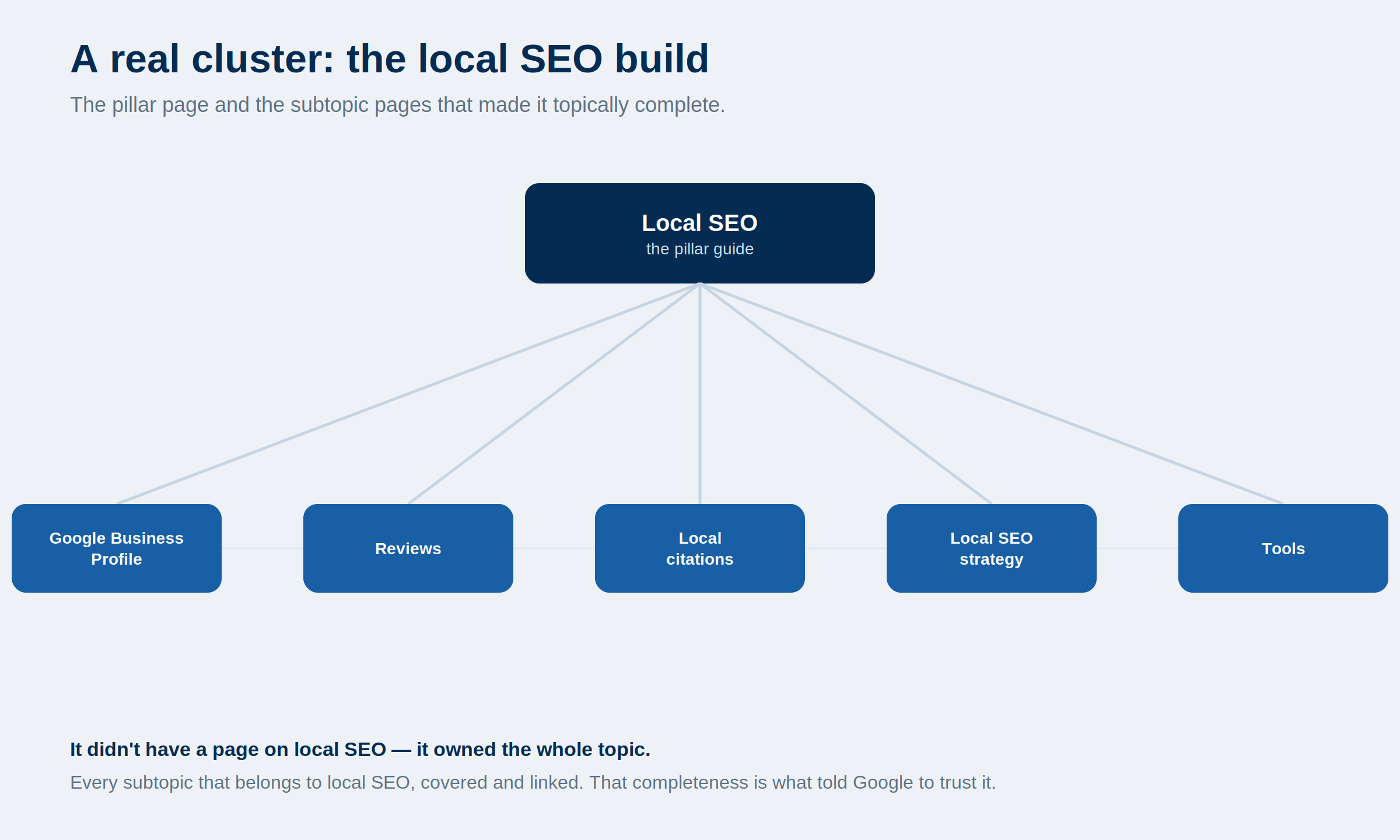
A finished cluster: one core topic with its related terms grouped around it, ready to become a single page.
Then, map. In the “Target page” column, assign each cluster to a single page you’re going to build:
- blocked-drain cluster → an “emergency blocked drains Auckland” page
- hot-water cluster → a “hot water cylinder repair Auckland” page
- how-to questions → individual blog posts
That’s keyword mapping: every keyword pointed at the exact page that’ll target it, decided before you write a single word. It stops you spinning up ten thin pages that fight each other, and it turns your sheet into a content plan you can just work through.
Here’s a real one from my own site — every keyword grouped and assigned to the page that targets it:
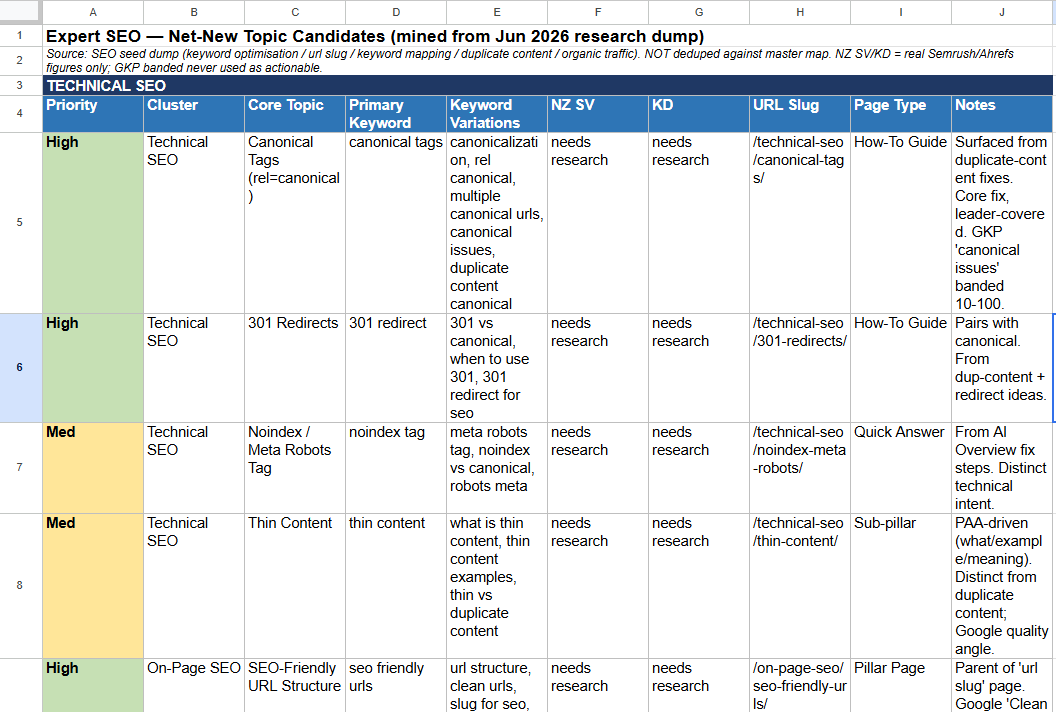
A real keyword map from my own site — every keyword grouped and assigned to the page that will target it, before any writing.
So — one page per keyword, or a cluster to a page? Always the cluster. Google happily ranks one strong page for hundreds of related terms, so give it one strong page. Each mapped cluster then becomes a piece of content that actually ranks.
Step 5 — Check the numbers, then prioritise
Last, you fill in the “Intent” and “Priority” columns by working through volume, difficulty and intent, then deciding what to build first. Both of those get their own section next, because that’s where most of the real thinking happens.
One honest note on time: your first full map is an afternoon’s work, not a week’s. Don’t let anyone make this sound harder than it is.
This whole process is the engine behind SEO in Auckland — real local demand, mapped to pages that convert.
The NZ Reality Nobody Tells You About
New Zealand has about five million people. So a keyword doing 100–200 searches a month here isn’t small — it can be your single best source of customers. The US guides that tell you to ignore anything under 1,000 searches will make you skip the exact terms that pay your bills.
This is the thing almost every keyword research guide gets wrong for a Kiwi audience.
Do the maths. The US has roughly 65 times our population. A keyword pulling 10,000 searches in the States might pull 150 here for the same thing. If your rule is “ignore anything under 1,000,” you’ve just deleted most of your market.
Look at the core term of this very article. “Keyword research” in New Zealand shows a Google range of just 100–1K searches a month. That’s normal for a NZ head term. Thin volumes are the environment you’re playing in — not a sign you’re doing it wrong.
Now here’s the part that matters more than volume: intent.
A search for “plumber Ponsonby” from someone with a burst pipe is worth more than 5,000 idle searches for “what does a plumber do.” One is a customer holding a credit card. The other is a student doing homework. Low volume plus high intent beats high volume plus low intent every single time.
That tie between a place, a ready buyer and a specific search term is exactly what local keyword research is built around — worth its own read if most of your customers come from your area.
So what does “good volume” look like in NZ? Loose rule: for a commercial, ready-to-buy term, even 50–200 searches a month is worth chasing. For informational blog content, you want a bit more to justify the effort. But the number is never the whole story — the intent behind it is.
Don’t just take my word on how thin the tail gets. Ahrefs studied a huge sample and found 94.74% of keywords get 10 or fewer searches a month.
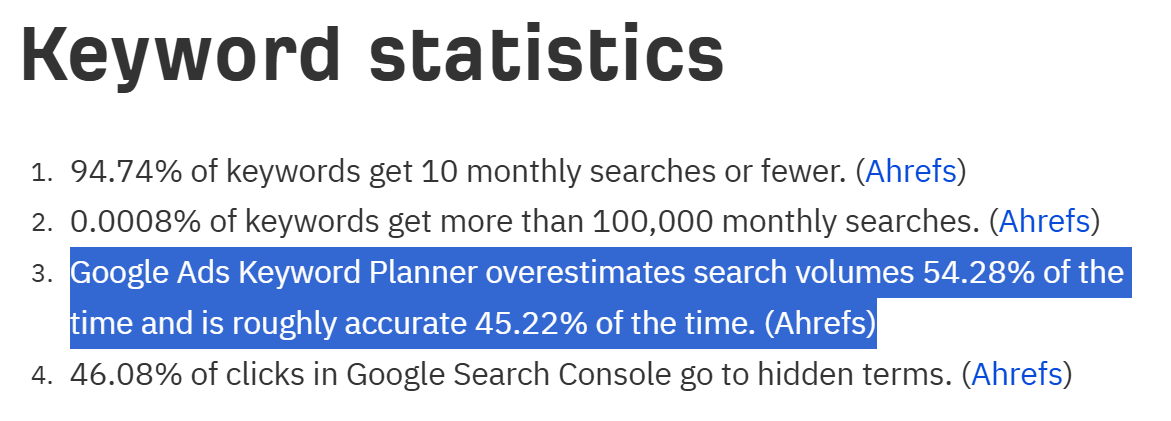
Ahrefs: 94.74% of keywords get 10 or fewer searches a month. The demand lives in the long tail — doubly so in a market our size.
The whole world’s search demand lives in the long tail. In a small market like ours, that’s doubly true. Chase the specific, ready-to-buy terms and let the giants fight over the vanity numbers.
The Free Keyword Research Toolkit
You do not need Ahrefs or Semrush to start. Four free tools — Google Keyword Planner, Google’s own autocomplete and related searches, Google Search Console, and AnswerThePublic — will get a NZ business everything it needs for its first real keyword list.
Let me show you what each one’s for.
Google Keyword Planner — your volume and ideas engine
Google Keyword Planner is free with any Google Ads account, and here’s the bit people miss: you don’t have to spend a cent on ads to use it. You’ll see an “account isn’t active” banner. Ignore it — the tool still works.

Keyword Planner works fully even with an “account isn’t active” banner — you don’t need to spend on ads to use it.
Open it via Tools → Planning → Keyword Planner, hit “Discover new keywords,” type your seed, and — this is critical — set the location to New Zealand. Leave it on the default and you’re researching the wrong country. It’ll hand you a list of related terms with volume ranges.
One catch: without ad spend, it shows ranges (like 100–1K) instead of exact numbers. That’s fine for our purposes — you’re comparing relative demand, not counting to the last search.
Here’s what a real search looks like — the seed “emergency plumber Hamilton” with its related keywords and NZ volumes:
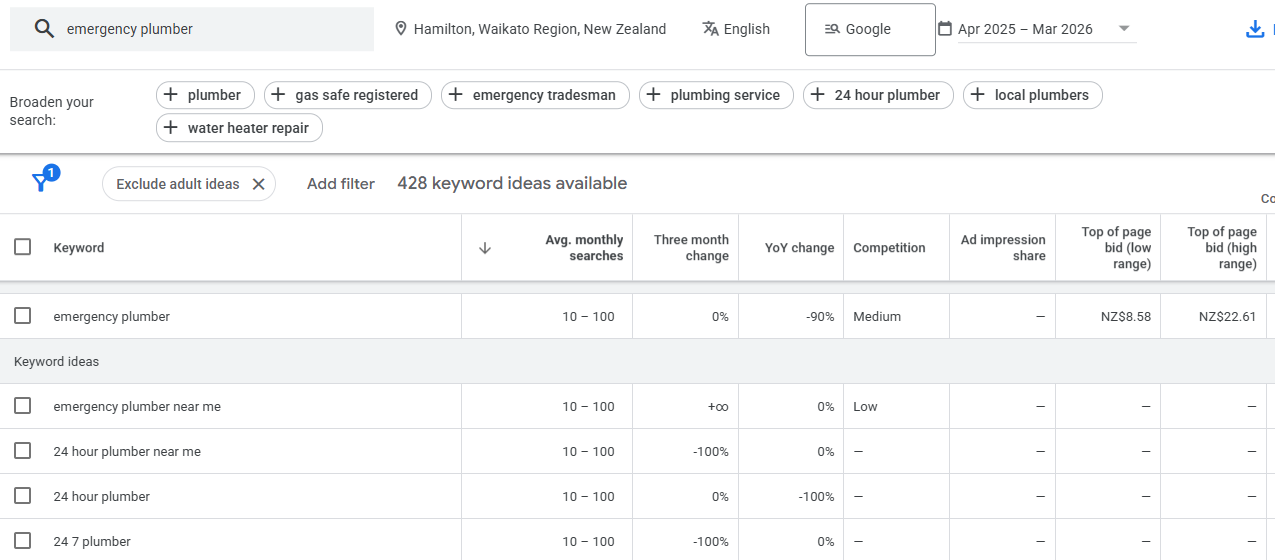
A real Keyword Planner search: the seed “emergency plumber Hamilton” and its related keywords with NZ volume ranges.
Google autocomplete + People Also Ask — free demand, straight from the source
Start typing your seed into Google and watch the suggestions drop down. Those are real searches, ranked by popularity, given to you for free. Scroll to “People also ask” and the “related searches” at the bottom of the page for a goldmine of the exact questions your customers are asking.
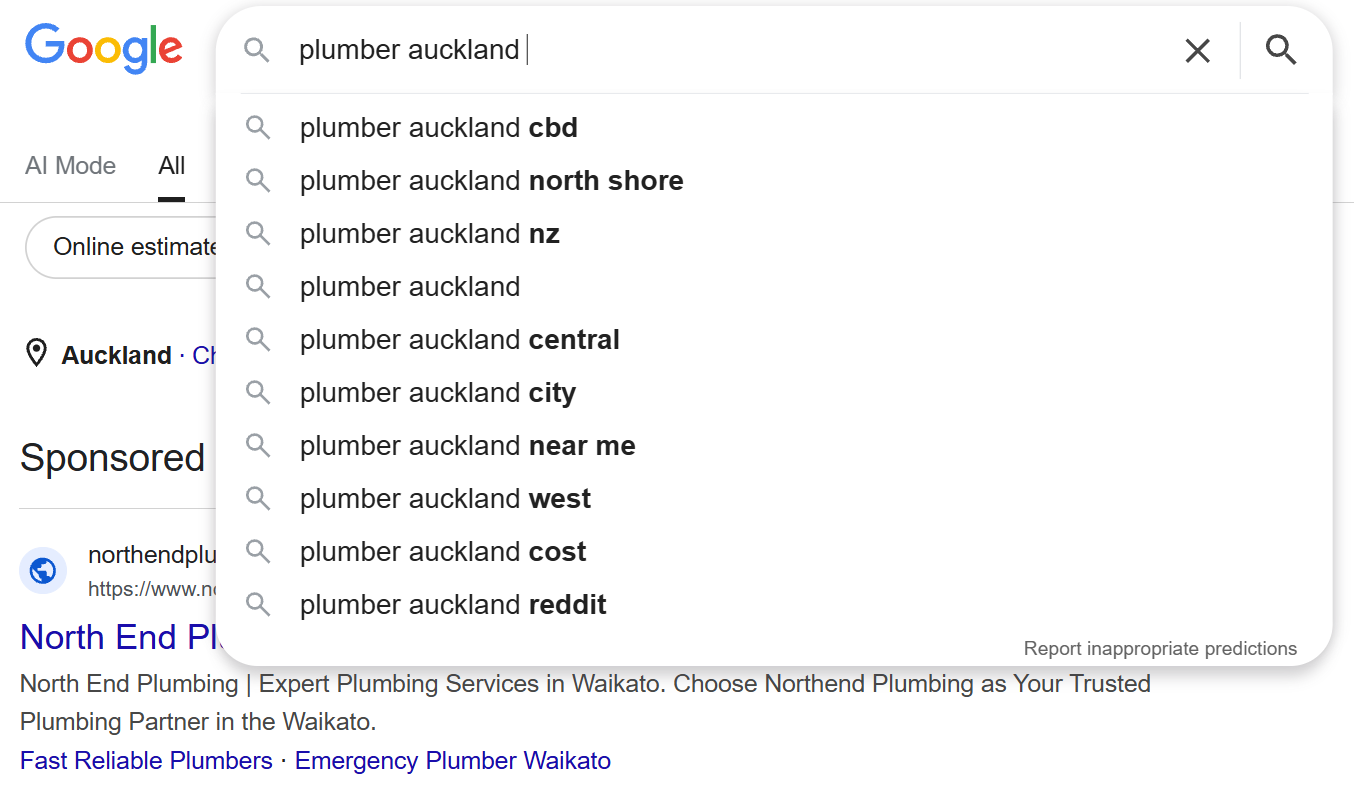
Google autocomplete for “plumber Auckland” — real searches, ranked by popularity, free.
Google Search Console — the one most people ignore
If your site’s been live a while, Google Search Console shows you the terms you already rank for — often on page two, where nobody sees you. These are the fastest wins you’ll ever find, because you’re already in the game. More on that in the prioritising section.
AnswerThePublic + Google Trends — questions and timing
AnswerThePublic takes a seed and spits out every “how,” “why,” “can” and “is” question around it. Brilliant for blog topics and FAQ sections. Pair it with Google Trends to check whether a term’s rising, dying, or seasonal (think “firewood” spiking every NZ winter).
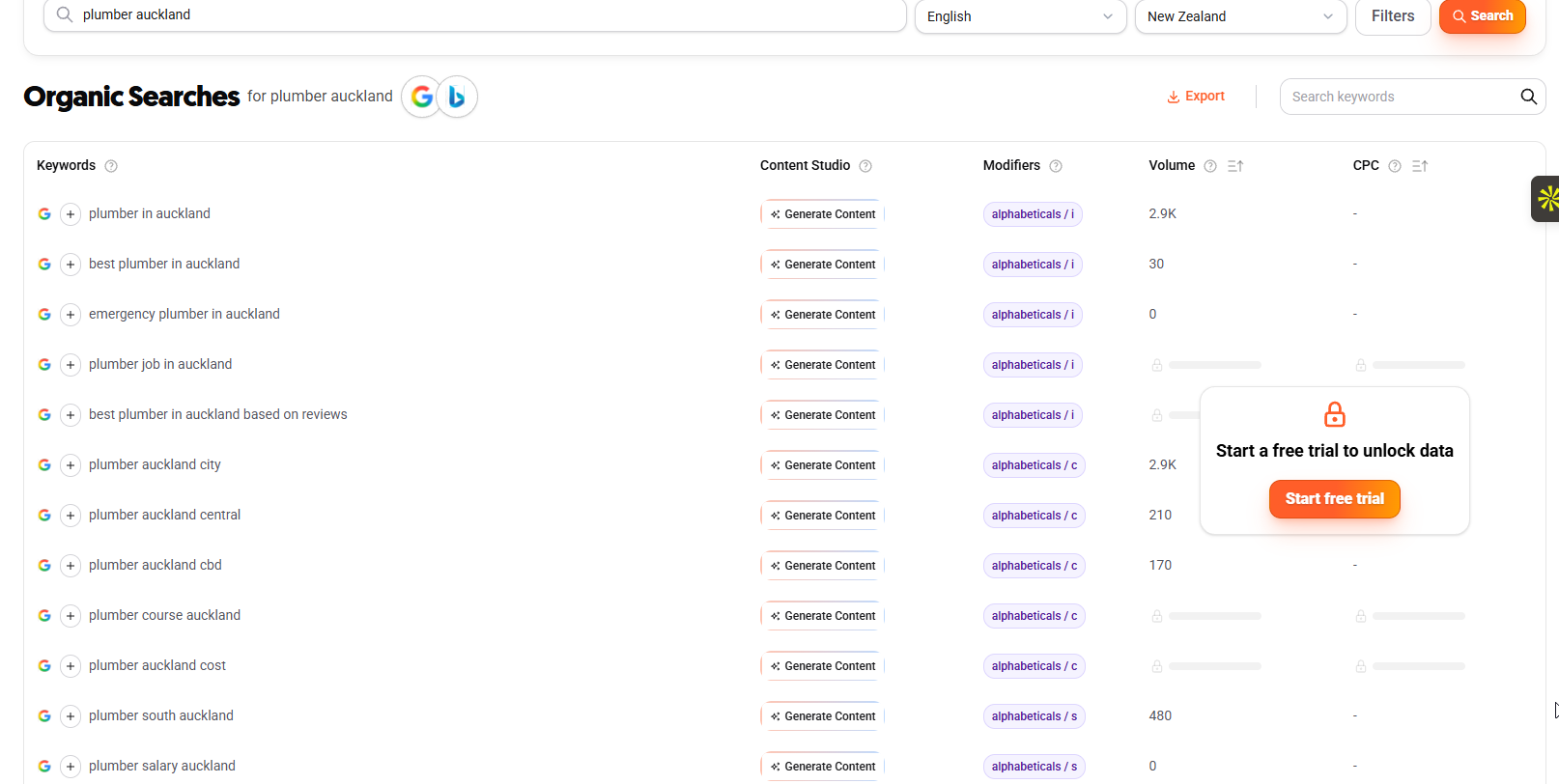
AnswerThePublic turns one seed into every question people ask around it — gold for blog topics and FAQs.
That’s a complete, professional workflow for zero dollars. So when do you pay? We’ll get to that honest answer near the end.
Reading the Numbers: Volume, Difficulty & Intent
Every keyword has three things worth checking: how many people search it (volume), how hard it’ll be to rank for (difficulty), and what the searcher actually wants (intent). Get intent wrong and the other two don’t matter.
Let’s break each one down properly.
Search volume — how many people want it
This is your demand gauge. But treat every number as an estimate, not a fact. Keyword Planner is especially loose — Ahrefs found it overestimates search volume 91.45% of the time across a study of 72,635 keywords.

Ahrefs studied 72,635 keywords: Keyword Planner overestimates volume 91.45% of the time. Use it to compare, not to predict.
So use volume to compare keywords against each other, not to predict exact traffic. A term showing 1K–10K is clearly bigger than one showing 10–100. That’s all you need it for.
Keyword difficulty — and why every tool lies about it
Difficulty scores tell you how hard it’ll be to rank on page one. Handy — but here’s what nobody tells you: every tool gives a different score for the same keyword. Ahrefs might call it 55 (Hard), Semrush 48% (Possible), Moz 60 (Hard).
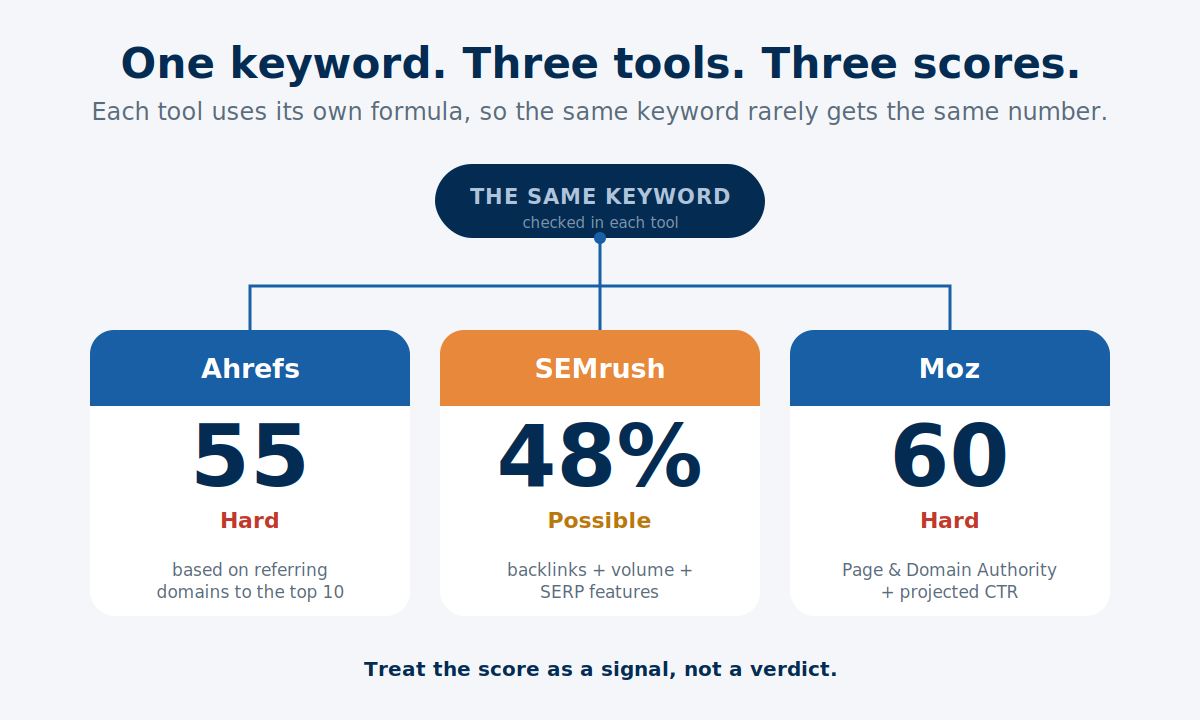
The same keyword, three different difficulty scores. Every tool guesses differently — so don’t trust any single number.
They’re all estimates built on different maths. Most of them lean heavily on how many backlinks the ranking pages have. So don’t treat any single score as truth.
The free way to judge difficulty is better anyway: just look at page one. Type your keyword into Google. Are the top results giant national brands and Wikipedia? Hard. Are they small local businesses with basic websites? Beatable. Your own eyes on the real SERP beat any difficulty score.
Search intent — the one that actually matters
Intent is why someone’s searching. It’s the whole ball game, because if your page doesn’t match it, you won’t rank no matter how good the content is.
There are four types, and reading them is simple — just look at what Google already ranks:
| Intent | What they want | Example (NZ) | What to build |
|---|---|---|---|
| Informational | To learn | “how does a heat pump work” | Blog post / guide |
| Commercial | To compare before buying | “best heat pump NZ” | Comparison / list page |
| Transactional | To buy / act now | “heat pump installer Auckland” | Service / landing page |
| Navigational | A specific site | “Mitsubishi heat pumps” | (Usually not yours to win) |
The trick: search your keyword and see what type of page ranks. Try “panel beater Hamilton” — the whole first page is local businesses and the map pack. That’s Google telling you the intent is transactional and local, the exact demand behind SEO in Hamilton. If instead the first page is buying guides, it’s commercial — and fighting that with a product page is a losing battle.
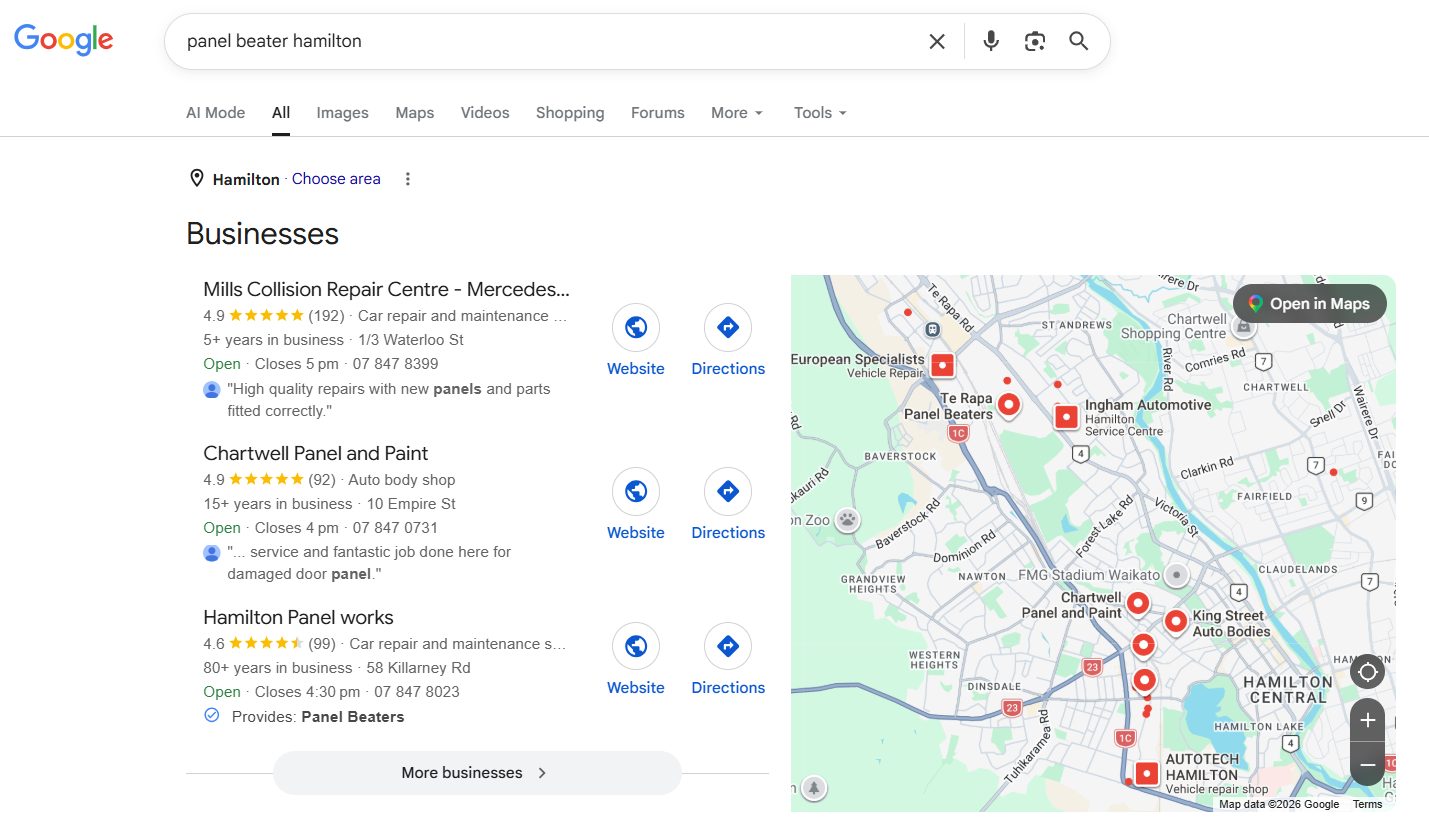
“Panel beater Hamilton” returns local businesses and a map pack — Google telling you the intent is transactional and local.
Match what’s there, then beat it — a big part of which is nailing your on-page SEO so the page clearly answers the query.
How to Prioritise: The Simple Rule
Don’t chase the biggest number. Score each keyword on three questions — can I realistically rank for it, does the searcher want to buy, and can I actually serve them — then do the winners first.
Most guides end on “well, it depends.” That’s useless. Here’s a rule you can actually apply.
For every keyword, ask three things and score each high, medium or low:
- Can I win it? Look at page one (from the section above). Beatable competitors = high. Giants everywhere = low.
- Will it make money? Commercial or transactional intent = high. Someone just learning = lower.
- Can I serve it? Does it match what you actually sell, to people you can actually help? A plumber in Hamilton ranking for “plumbing jobs Auckland” is worthless traffic.
The keywords that score high on all three are your first jobs. Do those before anything else.
Notice what this does: it kills the vanity trap. A term with 2,000 searches you can’t rank for and that doesn’t convert loses to a 90-search term you can win where the searcher’s ready to buy. Winnable, commercial and relevant beats big and useless — every time.
There’s also a shortcut if your site’s been live a while. In Search Console, filter for pages sitting in positions 5–20. These are “striking distance” keywords — you’re already on page two, so a little work often tips them onto page one fast.
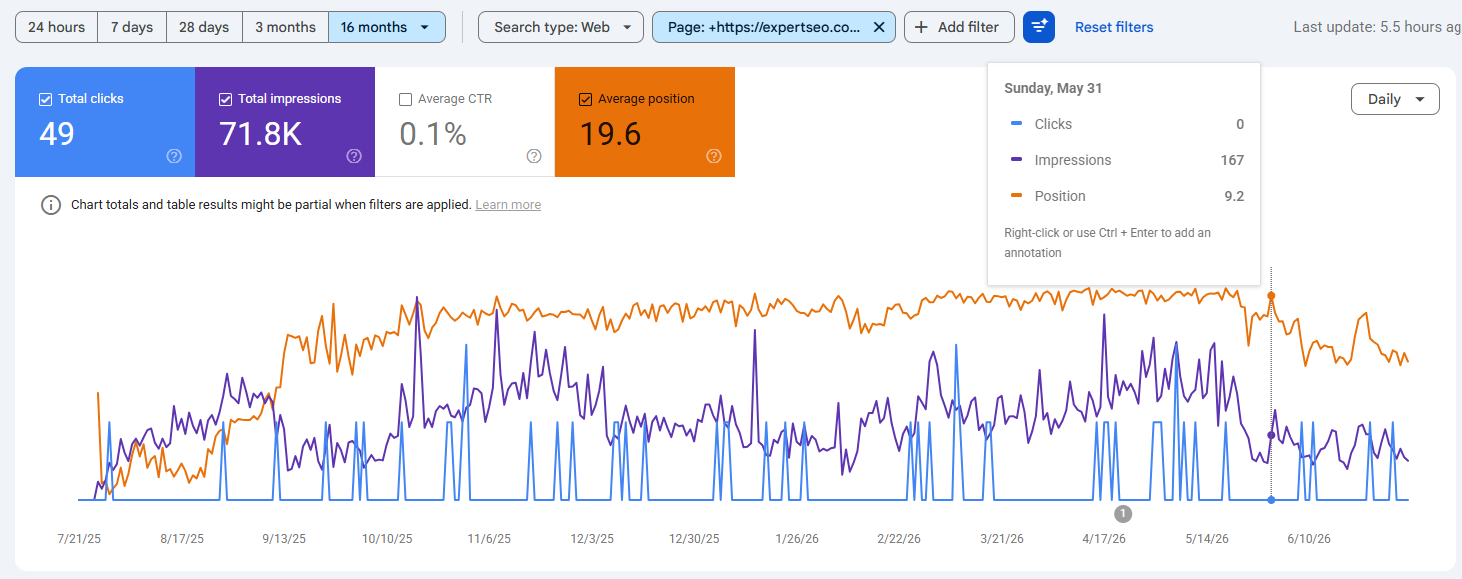
A striking-distance page: 71,800 impressions, 49 clicks, stuck at position 19.6. Already ranking — it just needs a nudge.
That page above is getting 71,800 impressions and only 49 clicks, stuck at position 19.6. It’s already ranking — it just needs a nudge. That’s the cheapest win in SEO, and most people walk straight past it.
A Real Worked Example (Seed → List → Ranked)
Enough theory. Let me run the whole thing on a different business — a café in Wellington — then show you the real results this process produces.
The seed is “brunch Wellington.” Drop it into a keyword tool and it fans out into clusters: best brunch spots, breakfast near me, good coffee, dog-friendly cafés — each with its own little pocket of demand.
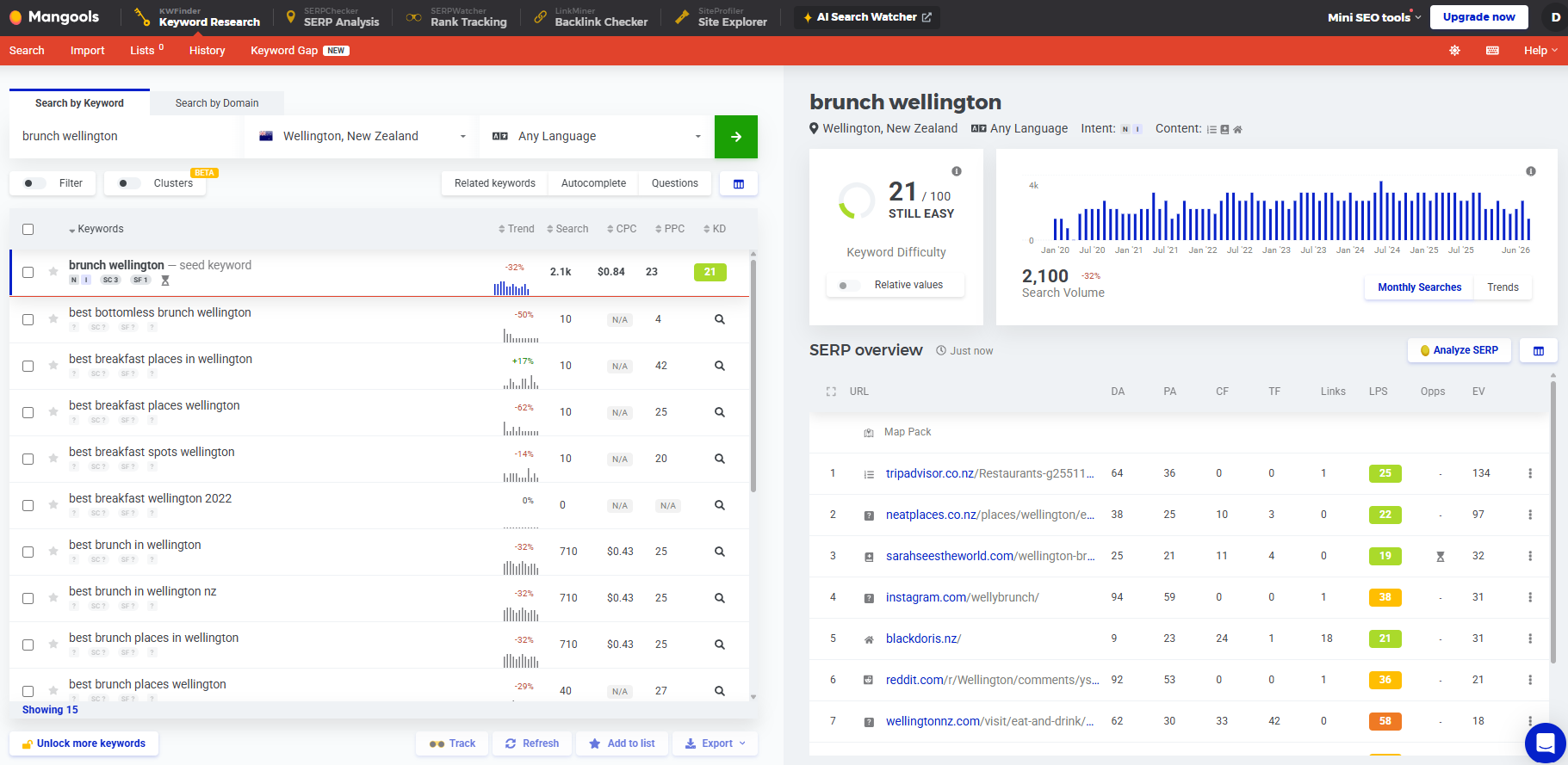
“Brunch Wellington” fanned out into clusters, with volume, difficulty and the live SERP alongside.
We group those into pages and check page one for each. “Best brunch Wellington” is all local list-style content and map results — commercial intent, beatable competitors. High-priority page. We build it. That’s the exact work behind SEO in Wellington: matching real local demand to pages that convert.
Now — does this actually produce results? Here’s the honest proof.
I grew a health site, HealthVI, from 0 to over 20,000 monthly organic visitors — every visit driven by content built around researched keywords.
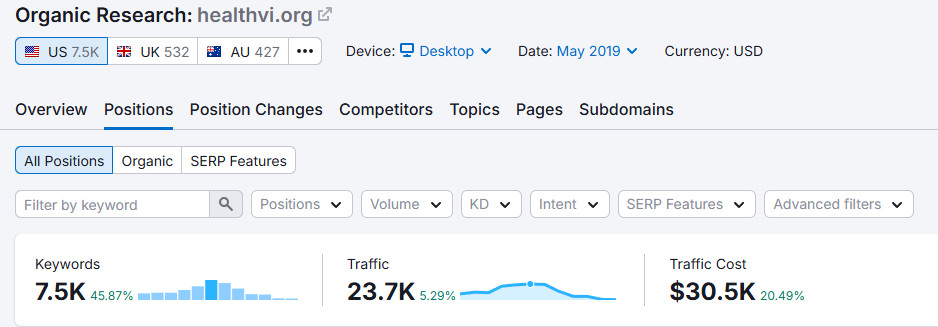
HealthVI: 0 to over 20,000 monthly organic visitors, built entirely on content aimed at researched keywords.
Another project, StoppingScams, regularly pulled over 5,000 visitors a day off the same approach.

StoppingScams: regularly over 5,000 visitors a day, off the same approach.
And that sleep-niche site the team I worked on built? It peaked at 911,624 visits a month. Same method every time: find what people search, answer it properly, be patient.
The honest bit? None of this was fast. The health site took the better part of a year. Keyword research doesn’t make SEO instant — it makes sure the slow work is pointed at something worth ranking for. It’s the exact process behind our SEO services, and even done full-time, it’s a long game.
Keyword Research for AI Search
AI Overviews and ChatGPT haven’t killed keyword research. They’ve changed the prize. You still research what people ask — the goal now is to structure your content so the AI quotes you as the answer.
“Isn’t SEO dead now that AI answers everything?” I hear this weekly. No. Someone still has to be the source the AI pulls from. Keyword research is how you find the questions worth being the answer to.
What changes is the format. AI engines love clean, direct answers. So research the questions people ask (AnswerThePublic and People Also Ask are perfect here), then answer each one in a crisp sentence or two right up top, before you expand. That’s the format that gets lifted into an AI Overview.
Here’s the NZ opening: AI engines have almost no New Zealand-specific source for most SEO and business topics. Everything they pull from is American. Write the genuinely local answer and you can become the cited source fast. This is the heart of ranking in AI search.
Proof it’s winnable quickly? My under-one-year-old domain is already being cited in Google’s AI Mode.
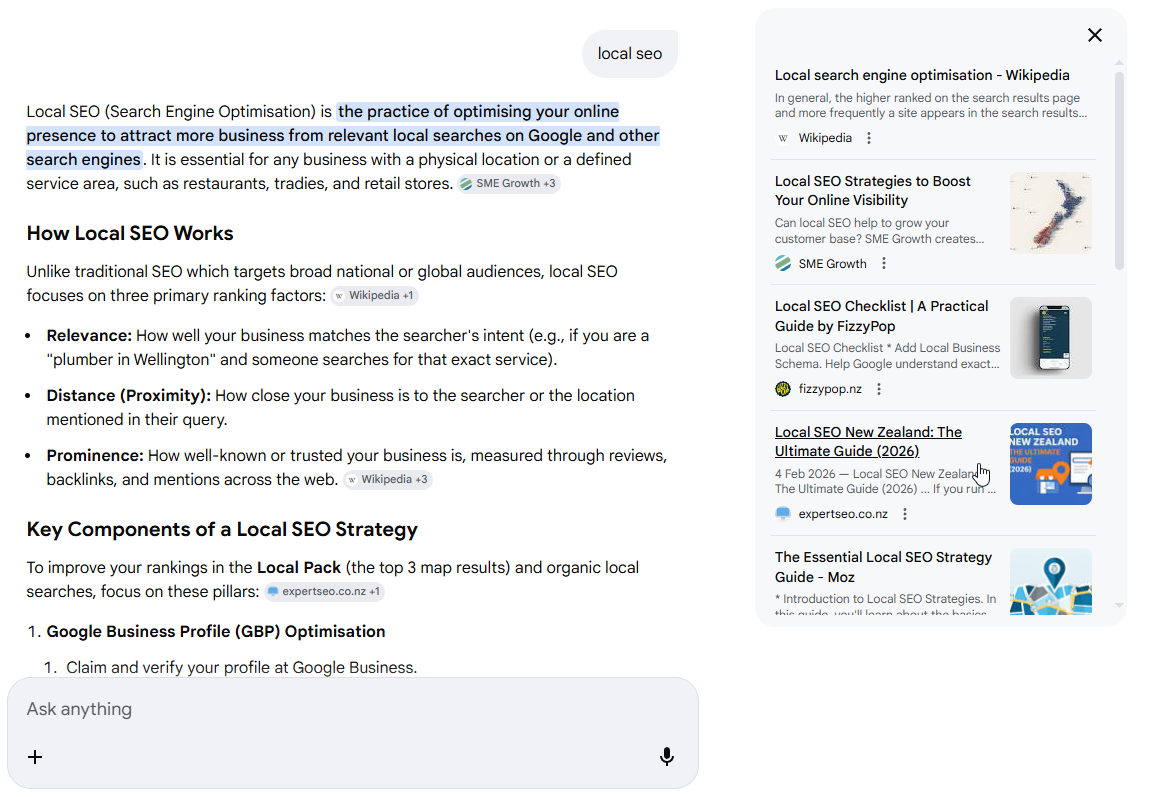
My under-one-year-old site, already cited as a source in Google’s AI Mode. The citation game is winnable fast.
The citation game is wide open here. Research the question, answer it cleanly, earn the mention.
Free vs Paid Tools
For your first keyword list, free tools are enough — full stop. Paid tools like Ahrefs and Semrush only start earning their keep once you’re publishing regularly and need competitor data and difficulty scores at scale.
Let me be straight with you, because most guides won’t be.
Every big US keyword research guide ends with “and here’s the paid tool you should buy.” Of course it does — they are the paid tool, or they earn a commission on it. I don’t sell one, so here’s the honest call.
What free gets you: everything in the toolkit section. For most NZ small businesses doing a handful of pages, that’s genuinely all you need. Don’t let anyone shame you into a subscription you won’t use.
What paying actually adds: the big one is competitor data — seeing every keyword a rival ranks for, in bulk. Plus faster difficulty scores, rank tracking, and content tools. Real value, but only if you’re using it weekly.
The honest threshold: if you’re publishing content regularly and SEO is a core channel, a paid tool pays for itself. If you’re doing a page a month, it won’t. Start free. Upgrade when the free tools start slowing you down, not before.
If you do want a rundown of what’s out there, I’ve compared the best keyword research tools I actually use, free and paid.
The Keyword Research Mistakes That Quietly Waste NZ Businesses’ Money
Most keyword research failures come down to five mistakes. Every one of them is avoidable, and every one quietly costs a business months of wasted effort.
1. Chasing volume over intent. The classic. You rank a big informational term, get traffic, and not one sale — because those searchers were never buying. Traffic isn’t the goal. The right traffic is.
2. Copying US volume rules. We covered this, but it’s the mistake I see most. “Ignore under 1,000 searches” is American advice that deletes your NZ market. Bin it.
3. One keyword per thin page. Spinning up a separate weak page for every close variation. Google would rather rank one strong page for the whole cluster. Splitting them just competes against yourself.
4. Fighting giants you can’t beat. Targeting terms where page one is all national brands and DR-90 monsters. You’ll never crack it. Find the local, specific corners where you can actually win.
5. Ignoring Search Console. Never checking the terms you already rank for. It’s free money sitting on page two, and most businesses never look.
Avoid these five and you’re already ahead of the vast majority of NZ businesses doing this.
How to Know Your Keyword Research Actually Worked
You’ll know it worked long before the sales land: rising impressions in Search Console, pages climbing into the top ten, and — the one that counts — the right people showing up.
Don’t wait for revenue to tell you if you’re on track. Watch these, in order.
First, impressions and position (the leading signals). In Search Console, a page you’ve targeted should start gathering impressions and creeping up the rankings within weeks. That’s Google saying “I see this, I’m testing it.” It comes well before clicks.
Then, qualified traffic. Not raw visits — the right visits. Ten people searching “emergency plumber Hamilton” are worth more than a thousand reading a random blog. If your enquiries are climbing, the research was aimed right.
A realistic NZ timeline: months one to three, you’ll see impressions and small ranking movements. Months three to six, real traffic and the first leads. Anyone promising page one in a fortnight is selling something.
That’s the shape of a working campaign — the HealthVI curve, from nothing to 20,000 a month, was just this playing out over time.
Final Thoughts
If you forget everything else in this guide, remember one thing: the number is never the point. The intent behind it is.
The mistake I watch NZ businesses make over and over is falling in love with a big search volume and building their whole strategy around a term that either can’t be won or doesn’t bring customers. Meanwhile the boring 90-searches-a-month keyword — the one where someone’s ready to pick up the phone — sits there ignored.
If it were my money, I’d rather own ten small, high-intent keywords that convert than one big vanity term that flatters my traffic graph and pays nothing.
Do the research. Point the slow work at the right targets. Then be patient enough to let it compound.
Keyword Research: FAQ
What is keyword research?
Keyword research is the process of finding the words people type into Google and checking their search volume, difficulty and intent, so you can build content around what people are actually searching for. It's the foundation of all SEO.
How do I do keyword research for free?
Use four free tools: Google Keyword Planner for volume and ideas, Google autocomplete and "People also ask" for real questions, Google Search Console for terms you already rank for, and AnswerThePublic for question-based keywords. That covers everything a small business needs to start.
Is Google Keyword Planner enough on its own?
For your first keyword list in NZ, yes. It gives you real volume ranges and keyword ideas straight from Google. You only need a paid tool once you're publishing regularly and want competitor data and difficulty scores at scale.
What's a good search volume for a keyword in New Zealand?
Lower than you think. Because NZ is a small market, a commercial keyword doing 50–200 searches a month can be well worth targeting. Intent matters more than volume — a ready-to-buy term with low volume beats a browsing term with high volume.
How do I find low-competition keywords?
Don't rely on a difficulty score — they disagree wildly between tools. Instead, search the keyword and look at page one. If the results are small local businesses with basic sites, it's beatable. If it's national brands and Wikipedia, move on.
Does keyword research still matter with AI and ChatGPT?
Yes. AI still pulls its answers from real content, so someone has to be the source. The prize has shifted from ranking blue links to being the page an AI Overview cites — and researching the exact questions people ask is how you get there.
How long does keyword research take?
Your first proper keyword list takes an afternoon. It's not the slow part of SEO — writing the content and earning rankings is. Research just makes sure that slow work is aimed at something worth ranking for.