
I’ve spent over a decade doing SEO — a good chunk of it competing in the United States, where the volumes are fat and the competition is a bloodbath.
I’ve also built and ranked stores here at home, where “high volume” often means a couple of hundred searches on a good day.
Here’s what bouncing between the two taught me: the process is identical, but the mindset for a small market is a different animal.
And almost every guide ranking for this keyword was written for someone in Ohio, not Onehunga.
So this is the New Zealand version.
What ecommerce keyword research actually is, why it matters more than any other SEO job you’ll do, and exactly how to run it for your own store — even when your numbers look tiny — right down to a strategy I built for a brand you’d genuinely recognise.
What Is Ecommerce Keyword Research?
Ecommerce keyword research is the process of finding the exact words people type when they’re ready to buy products like yours — then building your product pages, category pages, and content around those words so your store shows up at the moment someone’s reaching for their wallet.
Here’s how it’s different from normal keyword research, because it genuinely is.
Regular keyword research chases traffic. A blogger wants eyeballs on an article.
Ecommerce keyword research chases revenue. You don’t want browsers — you want buyers.
So the target changes. Instead of “how do I clean white sneakers” (a reader), you’re after “buy white leather sneakers size 10” (a customer with a card already out).
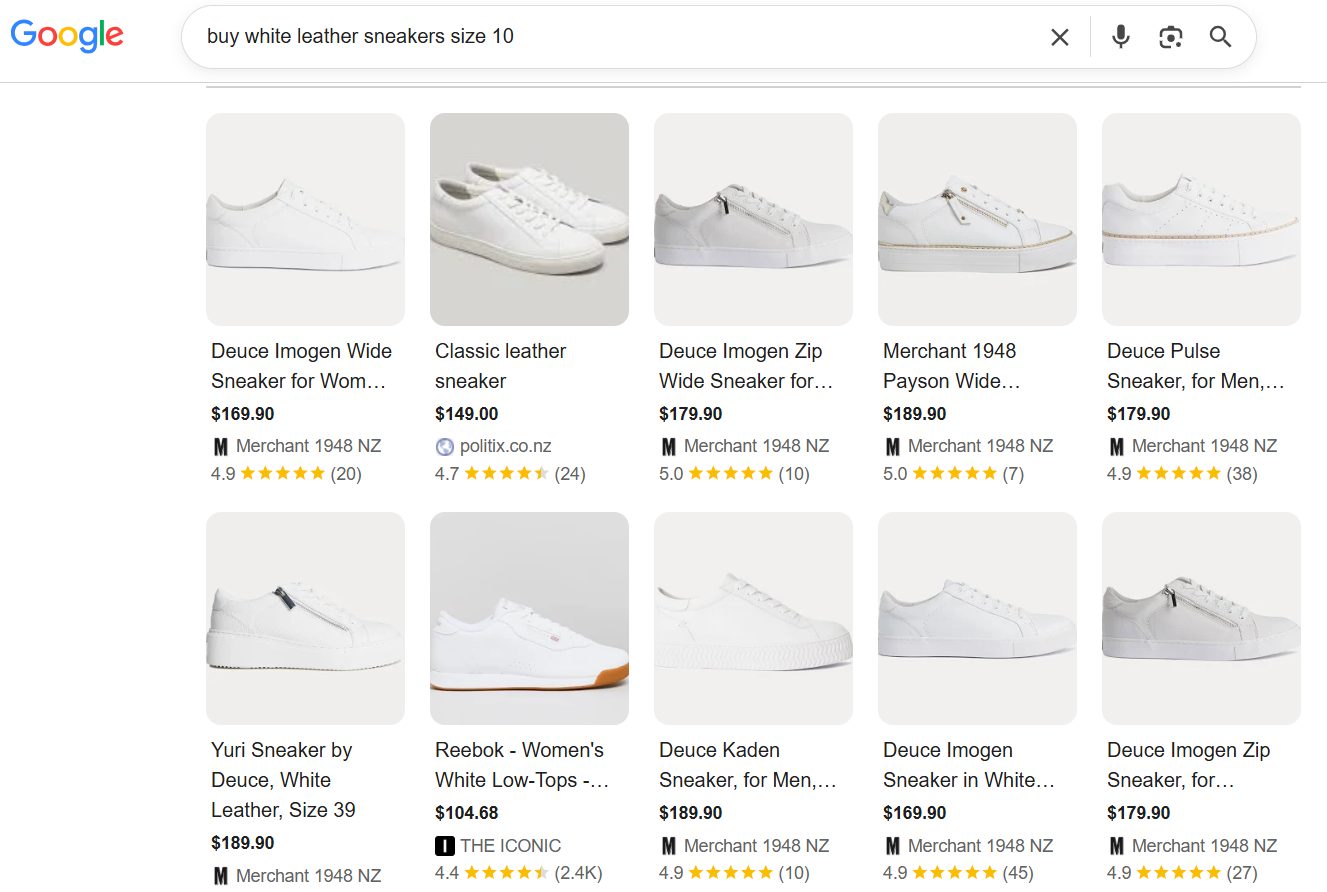
And the page changes too. That buyer keyword has no business on a blog post. It belongs on a product or category page — the page that actually sells the thing.
Quick contrast to lock it in:
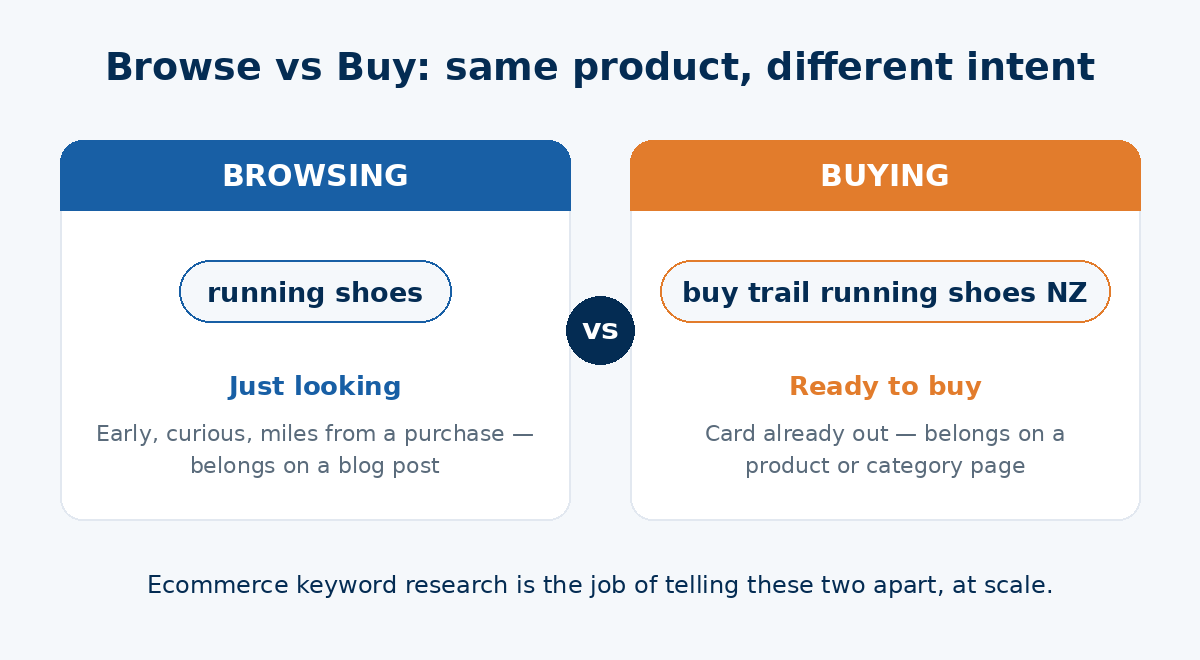
- “running shoes” — someone browsing, miles from a purchase
- “buy women’s trail running shoes size 8 NZ” — someone basically standing at the checkout
Same product. Completely different intent. Ecommerce keyword research is the job of telling those two apart, at scale, across your entire catalogue.
Why Is Ecommerce Keyword Research Important?
Get keyword research right and every page on your store has a job. Get it wrong and you’ve built a beautiful shop on a street nobody walks down.
Here’s why it sits at the very bottom of the whole thing:
Every other piece of ecommerce SEO — your product pages, your categories, your content, even your ads — gets built on top of the keywords you chose. Pick the wrong ones and you’re optimising, beautifully, for demand that isn’t there.
Three reasons it matters more than almost anything else you’ll do:
- It targets people ready to buy. You’re aiming at the exact search a customer makes with a card out — and once it ranks, that traffic keeps coming without you paying for every click, which ads never do.
- It shapes your whole store structure. Your categories, sub-categories and product pages should map to how people actually search. Keyword research is what tells you that map.
- It’s the difference between vanity traffic and revenue. A thousand visitors on a “how to lace shoes” post won’t pay your rent. Forty visitors on “buy trail running shoes NZ” might.
And this isn’t theory for me.
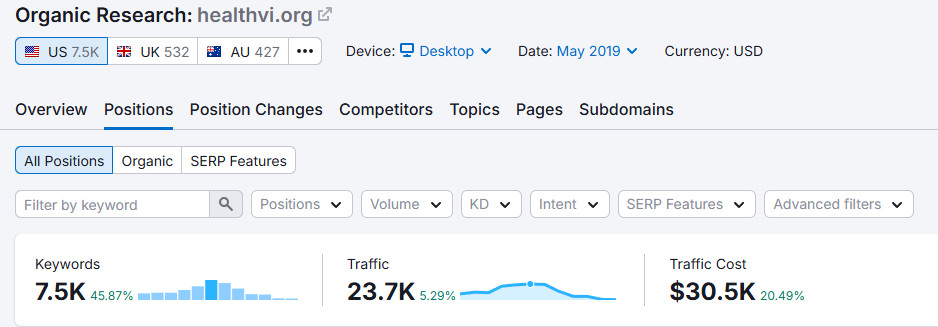
Back in 2017 I started a project with my former business partner and SEO mentor, Ian Pribyl — a health site called HealthVI. We built it on exactly these fundamentals: find what people actually search, build the right pages for it, link the whole thing together properly.
It went from zero to over 20,000 monthly organic visitors.
My own company, Expert SEO, is barely a year old — and it ranked #1 in New Zealand for “local SEO”, above Ahrefs and Semrush, two of the biggest names in the entire industry.
A site that didn’t exist eighteen months ago, sitting on top of both of them in the results.

None of that came from clever tricks. It came from getting the keyword foundations right first — the same foundations this article is about.
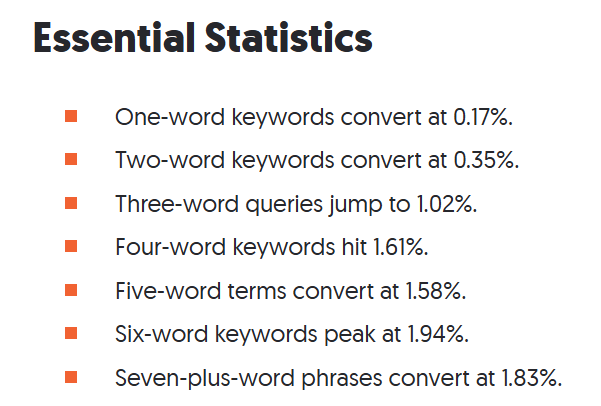
And the numbers back the approach: according to Neil Patel’s data, one-word searches convert at around 0.17%, while specific six-word phrases hit nearly 2% — more than ten times higher.
The person typing a long, specific search isn’t browsing. They’re buying.
Why Search Volume Works Differently for NZ Stores
A keyword with forty NZ searches a month can out-earn one with four thousand — because those forty are ready-to-buy Kiwis, not four thousand randoms scattered across the planet.
This is the bit no American guide will ever tell you, because they don’t have our problem.
In a market of five million people, your search volumes are always going to look broken next to US numbers. The mistake is reading that as “there’s no demand.” There’s plenty of demand — the tool just can’t see a market this small clearly.
So here’s the mindset shift: in a small market, you stop chasing volume and start chasing intent and coverage.
Two things quietly work in your favour here:
- Most keywords are tiny anyway. Research shows 92% of all keywords get fewer than ten searches a month. Volume was always a long tail — New Zealand just makes it impossible to ignore.
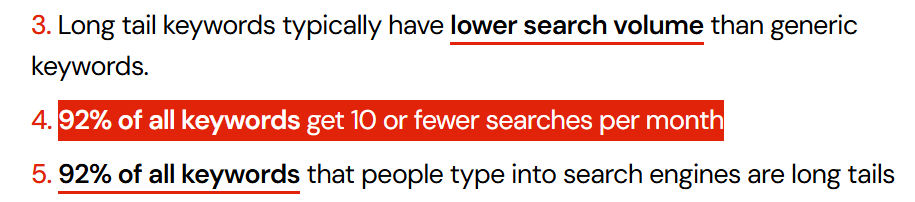
- The long tail is where the searching actually lives. Around 70% of all searches are long-tail. The specific, low-volume, high-intent stuff is where most buying happens — everywhere, not just here.

So how do you actually research in a market like ours? Three moves:
- Use Australian or global volume as a directional proxy. If “trail running shoes” pulls decent numbers across the Tasman, Kiwis are searching it too — your NZ tool just isn’t capturing the trickle.
- Trust intent over the number. “buy [product] NZ” at twenty searches a month is gold. Every one of those twenty wants to buy.
- Play the coverage game. You’re not trying to win one fat keyword. You’re quietly owning a cluster of small, specific ones that add up to real revenue.
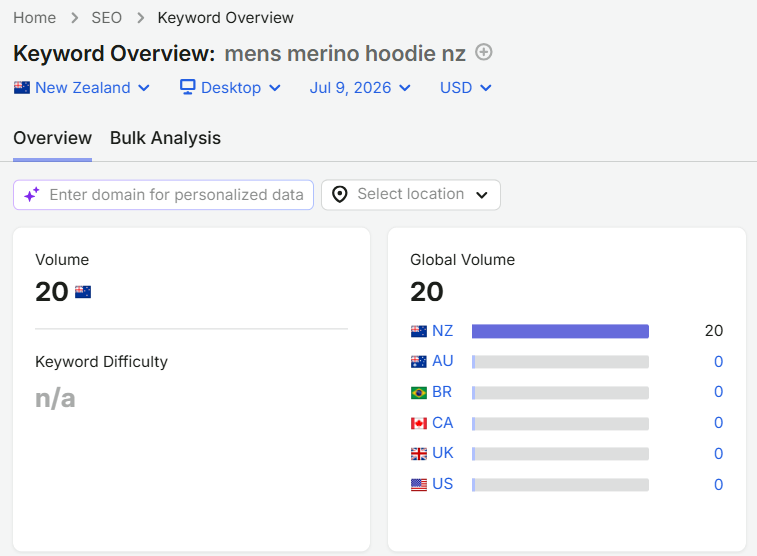
Picture a small NZ store selling merino gear. “Men’s merino hoodie NZ” shows just twenty searches a month in New Zealand — barely a blip.
But every one of those twenty is a cold Kiwi with their wallet out (which, if you sell merino, is exactly the customer you want). Rank for twenty of those tiny terms and you’ve got a business, not a blip.
How to Do Ecommerce Keyword Research
Here’s the exact process, start to finish — the same one I run on client stores. Seven steps. Follow them in order and you come out the other side with a keyword-to-page plan, not a pile of words.
1. Build your seed keyword list from your catalogue
Seeds are the roots everything else grows from — and the best place to find them is what you already sell.
Do this:
- Open a fresh Google Sheet.
- Down the first column, list your main product categories: those are your category seeds.
- Under each category, list the individual products: those are your product seeds.
- Add the obvious buyer variations you already know — buy, the brand names you stock, the materials, the use-cases.
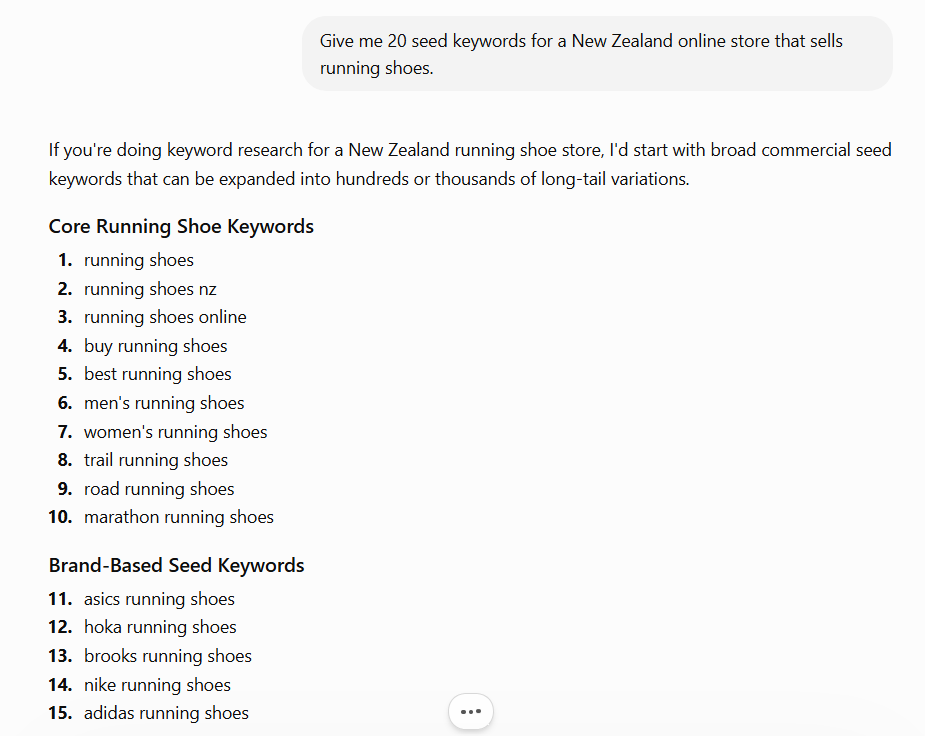
To speed up the first pass, ask ChatGPT: “Give me 20 seed keywords for a New Zealand online store that sells [your products].”
It’ll spit out a starting list in seconds — then you sanity-check it by hand, because it doesn’t know your catalogue like you do.
For a running shoes store, your category seeds might be running shoes, trail running shoes, road running shoes. Your product seeds drop a level: lightweight racing flats, cushioned marathon shoes, waterproof trail shoes.
2. Expand your list with keyword tools (free and paid)
Your brain knows your products. The tools know how people search for them. You need both.
The free path (this is the whole thing plenty of NZ stores need):
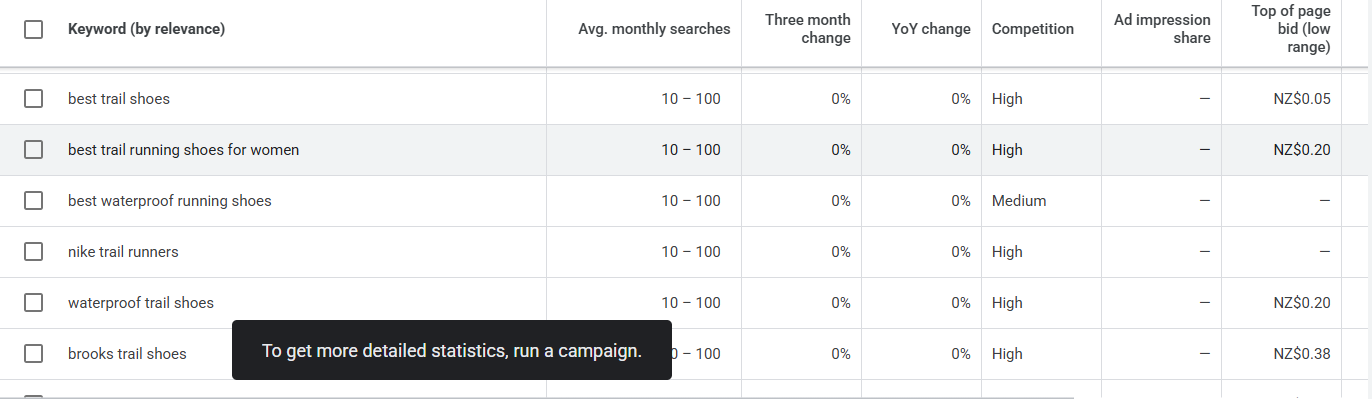
- Google Keyword Planner — go to Google Ads → Tools → Keyword Planner → “Discover new keywords” → type a seed → set the location to New Zealand → read the ideas and volumes it hands back.
- Keywords Everywhere — a browser extension that shows search volumes right inside the Google results as you browse.
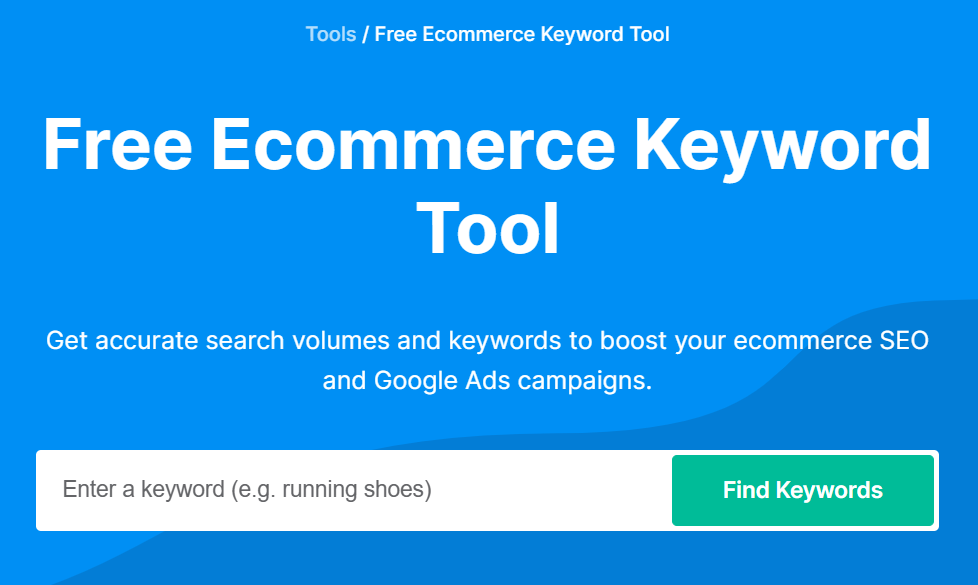
- Keyword Tool (keywordtool.io) or Backlinko’s free ecommerce keyword tool — both scrape Google’s autosuggest for long-tail variations the Planner buries.
The paid path (worth it once you’re serious):
- Semrush Keyword Magic Tool — type a seed, and it generates thousands of related keywords you can filter by intent and difficulty.
- Ahrefs Keywords Explorer — a strong second opinion on difficulty, plus the questions people ask around your product.
Run each seed through a couple of these and your list goes from a dozen keywords to a few hundred fast.
3. Mine where your buyers search
Tools miss the language real buyers use. To catch it, go where they actually are.
Work through these sources:
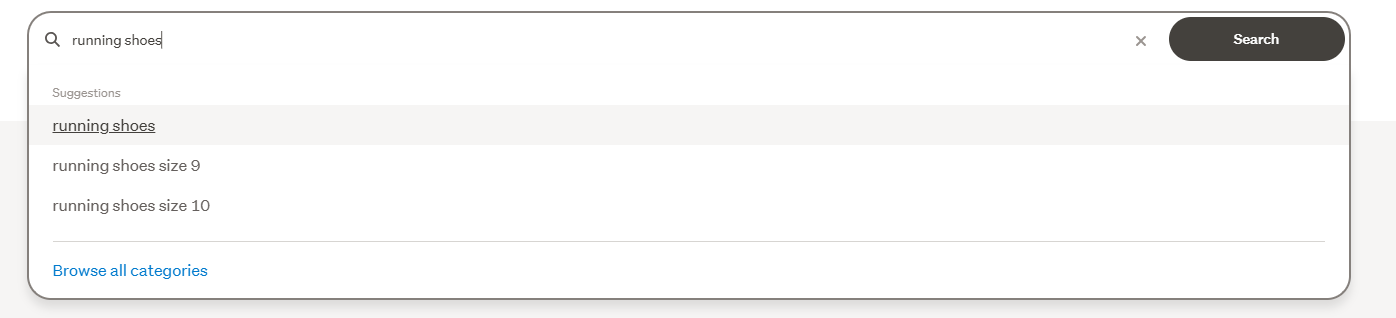
- Google autocomplete and related searches. Type your seed into Google, note every suggestion it tries to finish for you, then scroll to the “related searches” block at the bottom and grab those too.
- Marketplaces — and here’s the NZ twist. Forget Amazon. Your buyers are on Trade Me. Type your product into Trade Me’s search bar and note the auto-suggestions and the category names it offers — that’s real Kiwi buying language.
- Your own customers’ words. Reviews, support emails and live-chat logs are a goldmine — “fits wide feet,” “runs half a size small,” “good for flat feet.” People search in those exact phrases.
- Competitor keyword research. Drop a competitor’s domain into Semrush or Ahrefs, open their organic keywords, and find the terms they rank for that you don’t. That gap list is a ready-made to-do.
There’s real weight behind the marketplace move: in key markets, 63% of shoppers now start their product search on a marketplace like Amazon rather than a search engine.
In New Zealand, that same instinct points straight at Trade Me — so that’s where you mine.
4. Sort keywords by search intent
Search intent tells you what page a keyword belongs on. Miss it and you’ll stick a buying keyword on a blog post and spend months wondering why nothing sells.
Every keyword falls into one of three buckets:
- Transactional — ready to buy right now: “buy trail running shoes NZ” → product or category page.
- Commercial — comparing, nearly ready: “best trail running shoes” → category page or a comparison article.
- Informational — researching, early days: “how to choose trail running shoes” → blog post.
Go down your list and tag each keyword T, C or I. Semrush labels intent for you automatically, but back your own judgement on the close calls — it’s a tool, you’re the one who knows the buyer.
Then scale it with modifiers. Bolt these onto every product and you generate hundreds of keywords in minutes: buy, cheap, best, [size], [colour], [brand], near me, reviews, NZ.
| Keyword | Intent | Page it belongs on |
|---|---|---|
| buy trail running shoes nz | Transactional | Category page |
| asics trail running shoes | Transactional | Product page |
| best trail running shoes 2026 | Commercial | Comparison / category |
| trail vs road running shoes | Informational | Blog post |
| how to clean running shoes | Informational | Blog post |
5. Map every keyword to a page — and a revenue outcome
A keyword list is useless until every keyword has a home. This step — keyword mapping — is where research turns into an actual plan, and where most guides go quiet.
Do this:
- Group your keywords by the product or category they describe.
- Assign each group to a page. Broad category terms → category pages. Specific product terms → product pages. Questions and comparisons → blog posts.
- Where a group has no matching page, that’s your signal to build one. A keyword cluster with no home is a page waiting to be made.
- Note the revenue outcome beside each money page. Not “traffic” — revenue. Which product does this rank actually sell?
For the running shoes store, the map falls out like this:
| Keyword group | Maps to | Page type |
|---|---|---|
| running shoes | /running-shoes/ | Category — money page |
| trail running shoes | /running-shoes/trail/ | Sub-category — money page |
| Asics Gel-Trabuco | /running-shoes/asics-gel-trabuco/ | Product — money page |
| best trail running shoes for wide feet | a blog post | Informational — supporting |
| how to clean running shoes | a blog post | Informational — supporting |
Every keyword has a page, and every money page has a job.
6. Prioritise when you can only chase a handful
A small store has twenty pages and limited hours. You can’t chase everything, so chase the right things first.
Score each keyword group on three things:
- Intent — buyers beat browsers, every time.
- Winnability — a term you can realistically rank for, not a war with the giants.
- Revenue — does this product actually make you decent money?
Then work top-down. Rank “trail running shoes NZ” (buyers, winnable, sells well) long before you touch “running shoes” (a bloodbath you’ll lose to Rebel Sport and every global brand at once).
7. Put the keywords where they belong on-page
All that research is wasted if the keyword never makes it onto the page.
For each page, place the primary keyword in the page title, the H1, the URL, the first paragraph, and the image alt text. Then work your supporting keywords naturally into the descriptions and category copy.
The word “naturally” is doing real work there — you’re writing for the human first, the crawler second.
Stuffed copy reads like a ransom note and Google’s onto it anyway. The deeper mechanics of keyword optimisation are their own topic, but that’s the placement that matters most.
How AI Search Changes Ecommerce Keyword Research
People don’t just search “trail running shoes” anymore. They ask ChatGPT “what are the best trail running shoes for wide feet in NZ” — and your store either gets named in the answer or it may as well not exist.
That changes what you research for:
- Chase question-led and comparison keywords. The exact way people phrase things to an AI — full questions, specific constraints — is what you want on your list now.
- Treat your informational content as a citation play. That blog cluster isn’t just for humans anymore. It’s what the AI reads and pulls from when it decides who to name.
- Structure your answers for extraction. Lead every page and post with a direct, clean answer, then expand. That’s what gets lifted into an AI summary.
This matters because the click is disappearing.
According to Growth Navigate, an AI Overview can drop the click-through rate on a #1 result from around 40% to under 5%. If the AI answers the question and doesn’t name you, that visit never happens.
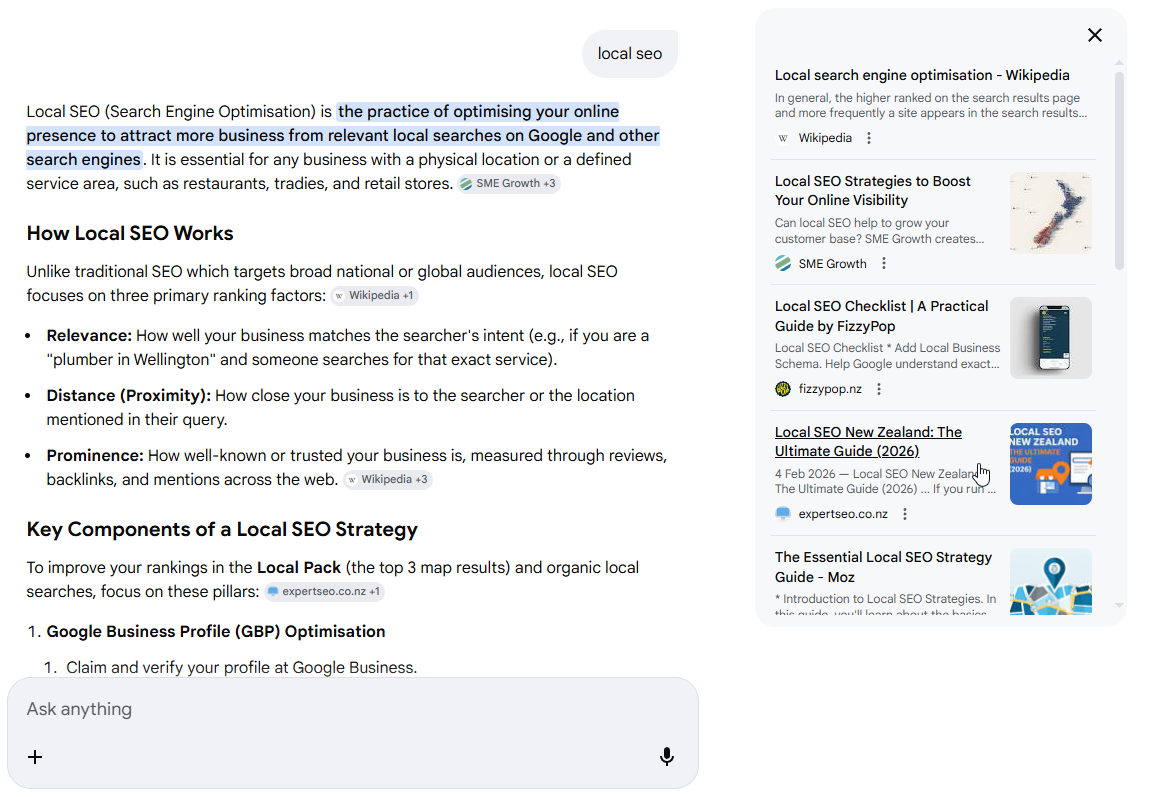
This isn’t a someday problem, either. Expert SEO is already being cited in Google’s AI Mode — a site barely a year old, getting named by the AI in its own answers.
Why You Also Need Informational Keywords
The keywords that don’t sell anything directly are the ones that make your selling keywords rank.
So far we’ve been chasing buyers. But if you only ever target buying keywords, you leave the single biggest lever in ecommerce SEO on the table: informational content.
Informational keywords are the searches people make when they’re nowhere near buying — “how to choose trail running shoes,” “how to break in new running shoes,” “what to look for in a running shoe.” No card out. Just researching.
You target them anyway, for two reasons:
- They build topical authority. Google trusts a store that covers the whole subject, not just the buy pages. Answer every question around your products and you become the authority Google wants to rank.
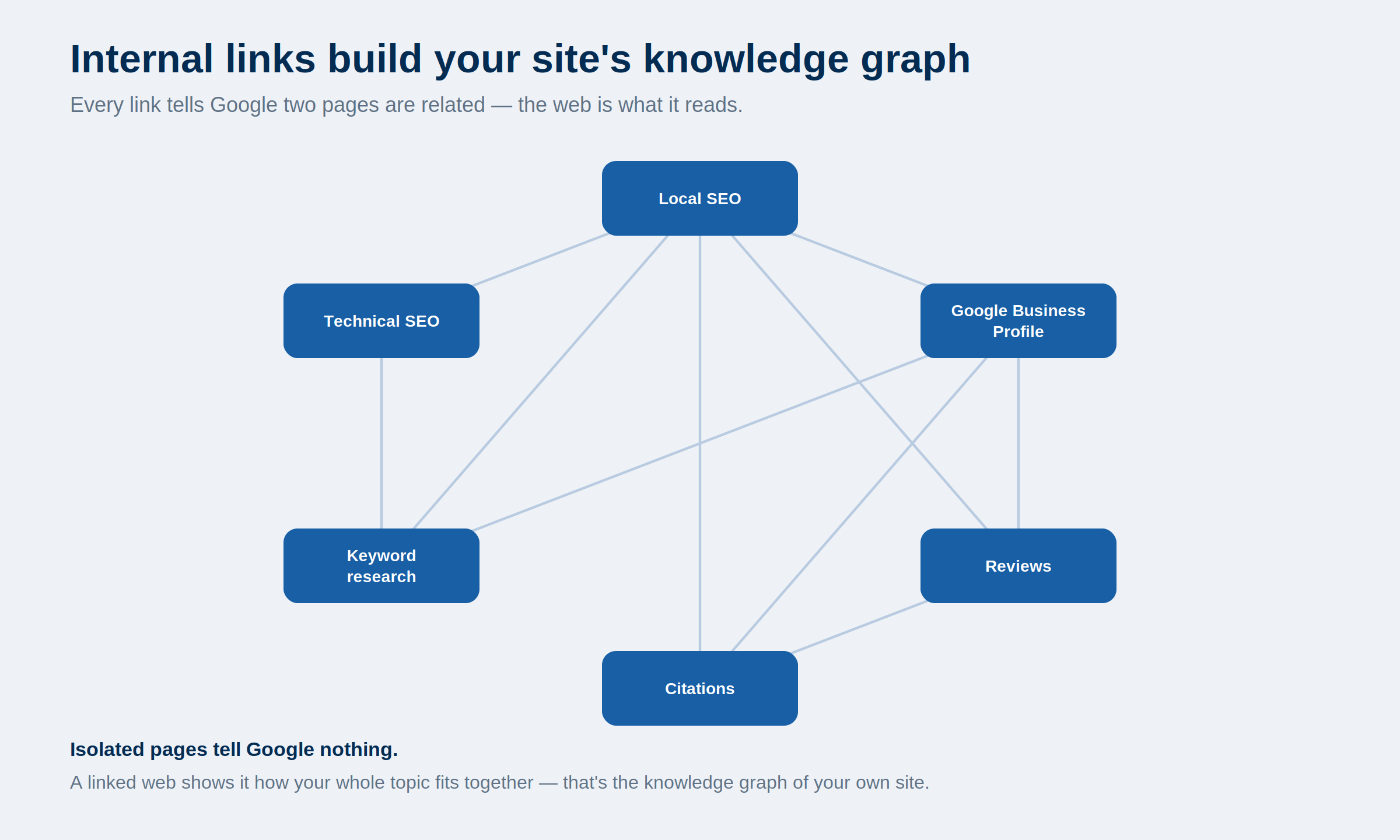
- They give you somewhere to link from. This is the big one. Every informational article is a place to link into your money pages — passing authority straight to the category and product pages you actually want ranking.
Here’s how it plays out for my own SEO agency.
My buying keywords are the money ones — SEO Auckland, SEO Christchurch and SEO Wellington — the searches a business makes when it’s ready to hire.
My informational keywords sit at the opposite end: how to do keyword research, what is SEO, how long SEO takes.
Nobody searching those is ready to buy. But they’re how I build the authority that makes the money pages rank — and every one of those informational posts links back to a money page.
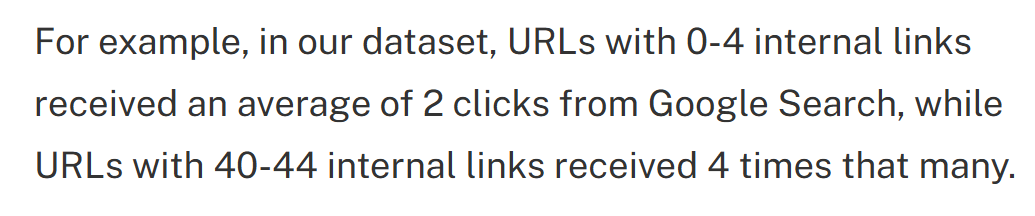
That second point isn’t a nice-to-have. Zyppy analysed 23 million internal links and found that pages with 40–44 internal links pointing at them earned 4x more search clicks than pages with barely any.
Those internal links are pure ranking horsepower, and informational content is how you build a fleet of them.
So for the running shoes store, a post like “how to choose trail running shoes” pulls in researchers, earns trust and links — then hands all of that authority to the trail running shoes category page it links to.
The blog post never sells a thing directly. It just makes the page that does sell rank higher.
That structure — buyer keywords for the money pages, informational keywords for the content that feeds them — is the exact play behind the strategy I’m about to show you.
A Real Ecommerce Keyword Strategy in Action
Let me show you the whole thing on a real brand — one you’d actually recognise.
I built a keyword strategy for a company that’s been featured on Shark Tank, written up in Oprah’s magazine, and had a mini-documentary made about them on the History Channel. Big brand. Real recognition.
I can’t name them, and I can’t tell you their actual product — so I’ve swapped it for running shoes.
The strategy I’m about to walk you through is identical; only the product’s changed to keep things confidential.
And here’s the beautiful part: it comes straight back to the fundamentals of SEO. Nothing clever, nothing new — just done properly, while everyone else stops halfway.
Here’s the play:
- Find every direct, commercial “buying” keyword. For running shoes, that’s the stuff people type with a card out: buy running shoes, running shoes NZ, trail running shoes, [brand] running shoes, women’s running shoes. These become your money pages — the category and product pages you actually want to rank.
- Then find the plethora of related informational topics. Around those money keywords sits a universe of questions and comparisons: best running shoes for a marathon, best trail running shoes, different types of running shoes, running shoes for wide feet, how to break in new running shoes. Dozens of them. Each one is a piece of content.
- Build content across both intents. The commercial keywords become sharp product and category pages. The informational keywords become a blog cluster — a genuine content campaign, not one lonely post published and forgotten.
- Internally link the cluster into the money pages. This is the move that makes the whole thing work. Every informational article links into its matching money page: the “best running shoes for a marathon” post links to the marathon-shoes category; “running shoes for wide feet” links to the wide-fit product page.
That last step is the quiet engine of the entire strategy. All the authority you build with the informational content — the trust, the links, the topical depth — you funnel straight into the commercial pages you actually want ranking and earning.
You build the authority with the informational content, and you spend it on the money pages: informational keywords earn the trust, commercial keywords cash it in.
When to Do Your Own Keyword Research vs Hire an Expert
Everything above is genuinely DIY-able — I’ve just handed you the entire process. The honest question isn’t whether you can. It’s whether you’ve got the time.
What’s fine to do yourself: building your seed list, mining Google and Trade Me autocomplete, and tagging a small catalogue by intent. If you sell twenty products, you can knock this out over a weekend and be better off for it.
Where it starts to bite: a few hundred products, a competitive niche, mapping every single keyword to the right page, and then building and interlinking a whole content campaign to feed your money pages.
The process stays simple — but the hours pile up fast, and the mapping and internal-linking work is where most store owners quietly run out of road.
That’s the point where an SEO expert earns their keep — someone doing this mapping and interlinking every day. If you’d rather hand the whole campaign off as done-for-you SEO services, that’s where we come in.
Ecommerce Keyword Research: FAQ
What is ecommerce keyword research?
Ecommerce keyword research is the process of finding the exact words people type when they're ready to buy products like yours, then building your product and category pages around those terms. Unlike regular keyword research, it targets buyers ready to purchase rather than readers looking for information.
How do I do keyword research for a small NZ store with low search volume?
Stop chasing volume and chase intent instead. Use Australian or global search volume as a directional proxy, trust buyer-intent keywords even at 20 searches a month, and cover a cluster of small, specific terms that add up — a handful of ready-to-buy Kiwis beats thousands of random browsers.
What's the difference between commercial and informational keywords?
Commercial (buying) keywords come from people ready to purchase, like "buy trail running shoes NZ", and belong on product or category pages. Informational keywords come from people still researching, like "how to choose running shoes", and belong on blog content that builds authority and links to your money pages.
What are the best free ecommerce keyword research tools?
Google Keyword Planner is the best free starting point — real data straight from Google. Pair it with the Keywords Everywhere browser extension and Backlinko's free ecommerce keyword tool to pull the long-tail variations from Google's autosuggest.
How many keywords should an ecommerce store target?
There's no fixed number — it depends on your catalogue. Map one primary keyword to every category and product page, then build informational content around the questions buyers ask. A small store might target a few dozen; a large catalogue, hundreds.
Does ecommerce keyword research still matter with AI search?
Yes, more than ever. AI search rewards question-led and comparison keywords and pulls answers from informational content, so lead every page with a direct answer — if the AI names your store in its response, you win a click a normal search might have lost.