

You’ve probably heard the line: Google uses more than 200 ranking factors.
It’s the kind of number that stops you before you start.
Two hundred things to get right, and you’re a tradie in Hamilton or a café owner in Tauranga trying to get found, not a full-time SEO. Where do you even begin?
Here’s what a decade of doing this has taught me. Most of those 200 barely move anything.
A handful do nearly all the work. And two of them matter so much more than the rest that if you only ever got those two right, you’d beat most of your competition.
This guide cuts the list down to what actually counts for a New Zealand business.
We’ll go through what the research has confirmed, what the big studies have measured, and what I’ve watched work first-hand on sites I’ve grown from nothing to thousands of visitors a day.
What Are Google Ranking Factors?
Google ranking factors are the signals Google’s algorithms use to decide which pages to show for a search, and in what order.
That’s it. Every time someone searches “panel beater Hamilton” or “family lawyer Auckland,” Google sifts through everything it has indexed and ranks it using these signals. The pages that send the strongest signals end up at the top.
But there’s a wrinkle that trips a lot of people up, and it explains why the number-one result for this exact search is so unhelpful.
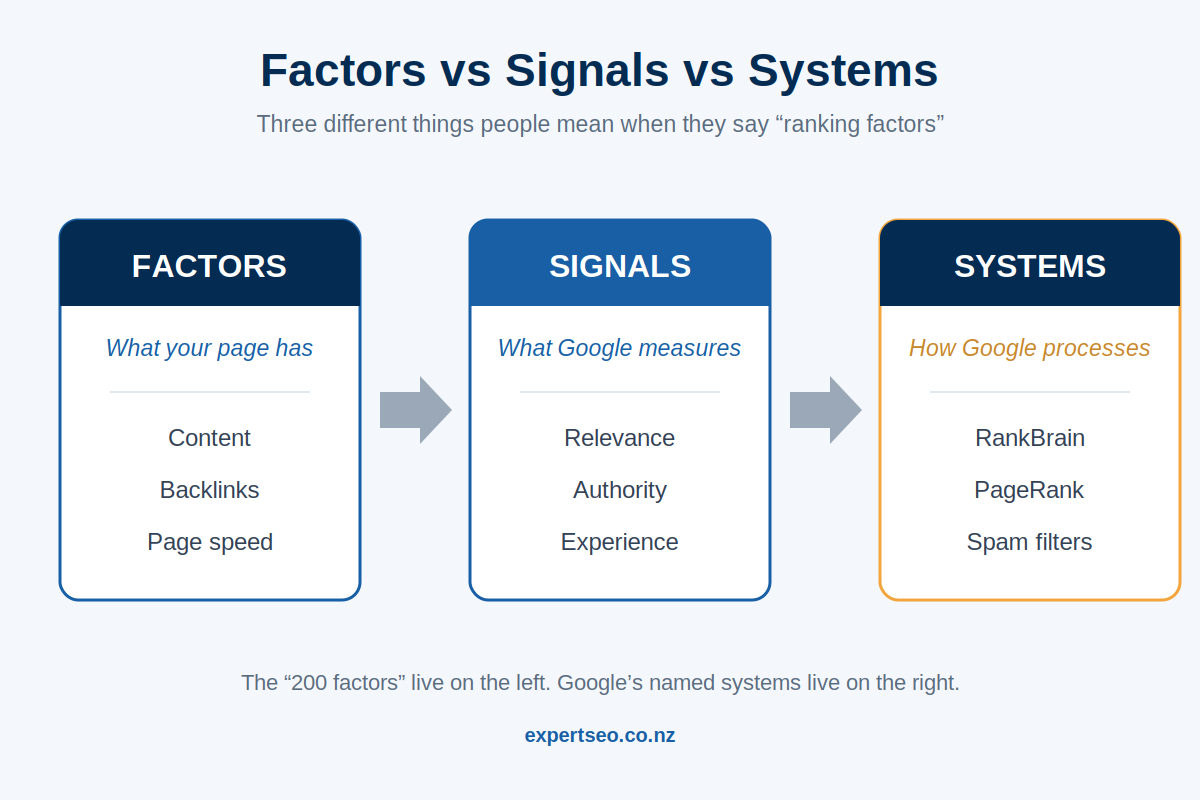
There are three different things people mean when they say “ranking factors”:
- Factors are what your page actually has — the content on it, the links pointing to it, how fast it loads.
- Signals are what Google measures from those factors.
- Systems are how Google processes them — named systems like RankBrain, PageRank, and the various spam filters.
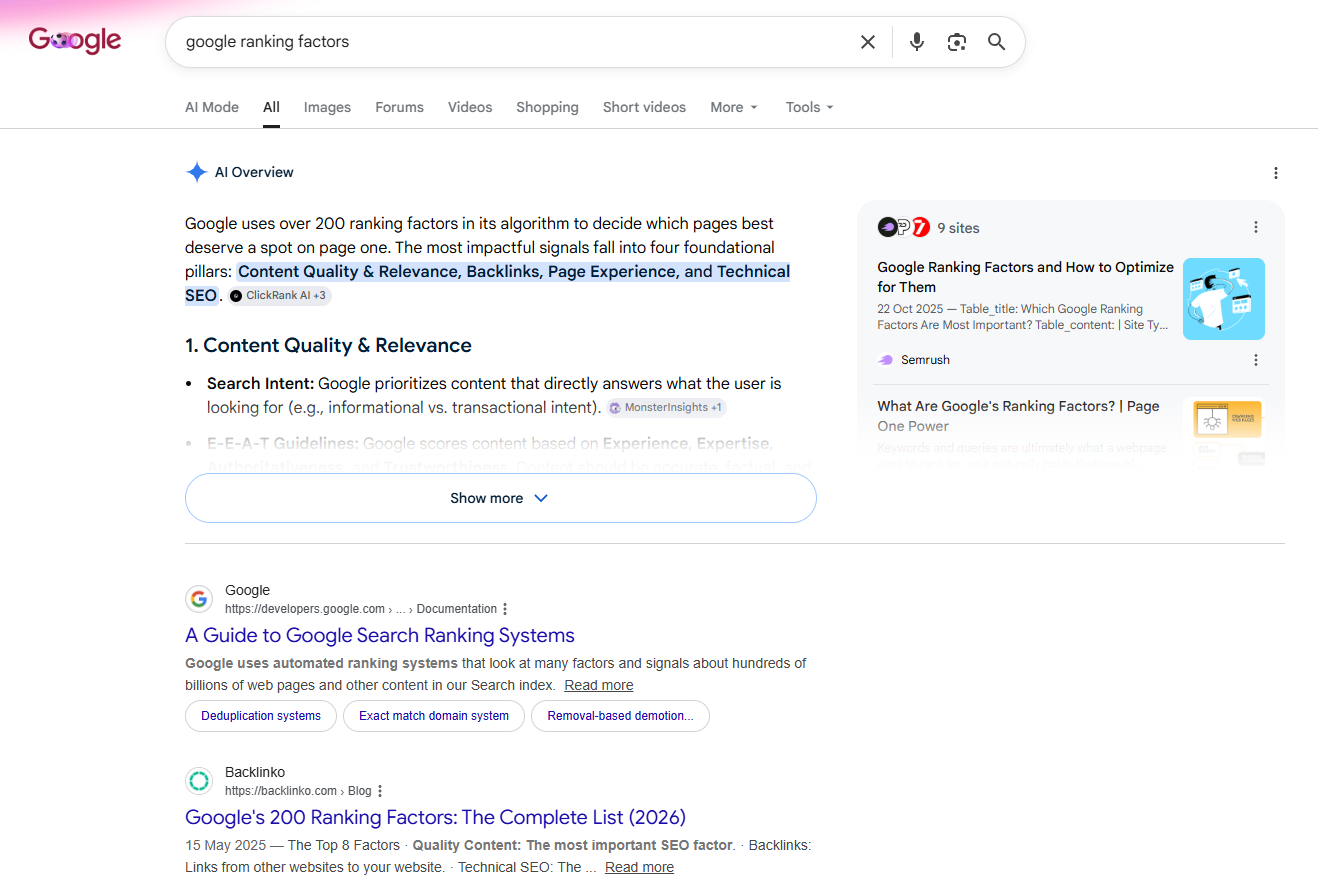
The top-ranking page for “google ranking factors” is Google’s own documentation, and it’s a guide to ranking systems — a glossary of RankBrain and PageRank and Panda.
It ranks on raw authority, but it never tells a business owner what to actually do. That gap is exactly what this guide is for.
How Many Ranking Factors Are There, Really?
Nobody outside Google knows the exact number, and the famous “200” figure has never been confirmed by Google itself.
It’s worth being fair about where that number came from, though, because it wasn’t made up. SEO researchers have spent years working Google out through patents, leaks, controlled experiments, and large-scale studies.
Backlinko’s list of 200 factors is sourced from Google patents and SEO testing.
Semrush has run ranking studies across millions of search results. Ahrefs takes the opposite, stricter line and only counts what Google has flat-out confirmed. None of that is lazy. It’s genuine work.
So the right way to think about ranking factors is as a spectrum of confidence, not a flat list of 200 true-or-false claims:
- Confirmed by Google — a short list Google has stated outright: backlinks, relevance, freshness for time-sensitive queries, HTTPS, mobile-friendliness, and page experience.
- Backed by studies — factors the big tools have measured a correlation for, like referring-domain diversity and content depth. Strong evidence, even if Google stays quiet on them.
- Speculative — patent-derived or tested ideas Google has never acknowledged, which may carry little or no weight.
The lesson for a small NZ business is simple. You weight your effort by how confident the evidence is, and you ignore the rest. Most of the 200 sit in that third bucket, and chasing them is how people burn months going nowhere.
The Five Pillars Google Actually Ranks On
Strip all the factors back and they roll up into five questions Google is really asking about every page.
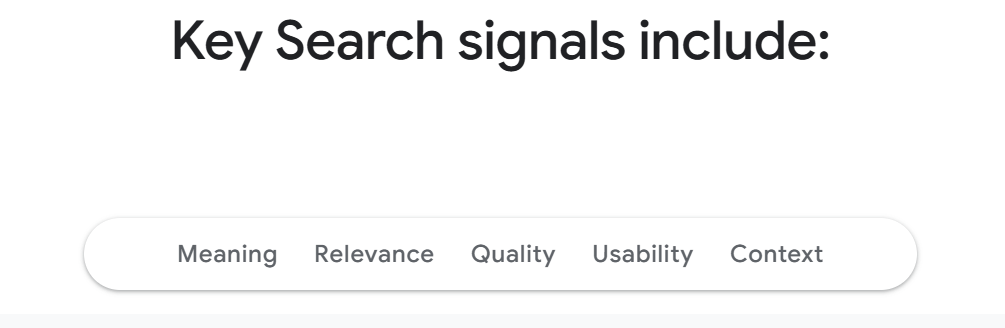
This is Google’s own framework, lifted straight from how it describes search. Every individual factor is just a more detailed version of one of these:
- Meaning — does the page understand what the searcher actually wants?
- Relevance — does it genuinely match that intent?
- Quality — is it trustworthy, accurate, and written by someone who knows the topic? (This is where E-E-A-T lives.)
- Usability — is it fast, mobile-friendly, and easy to use?
- Context — does it fit the searcher’s location, history, and settings? (This is where being a New Zealand business matters — Google knows when someone wants a local result.)
Keep these five in your head and the 200-factor noise gets a lot quieter. Everything that follows is just these pillars, made practical and put in order of what matters most.
The Ranking Factors That Actually Matter, in Order
A handful of factors do nearly all the work. Here they are in the order that actually matters for a small New Zealand business — not listed flat like every other guide does it.
1. Content quality and E-E-A-T
This is the foundation. Before a link or a clever bit of technical work can do anything, the page has to genuinely answer what the person searched.
Google’s whole job is matching searchers to the most helpful result, so helpful content is the price of entry.
The big studies back this hard.
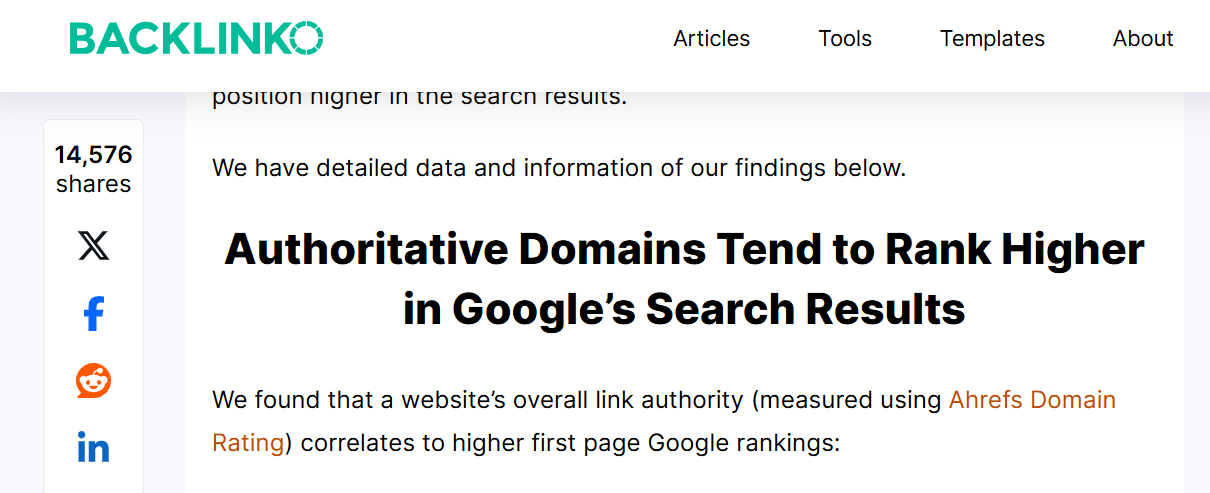
When Backlinko and Ahrefs analysed 11.8 million search results, they found that authoritative domains publishing thorough content tend to rank higher.
E-E-A-T — experience, expertise, authoritativeness, trustworthiness — is Google’s way of measuring whether the person behind the content actually knows their stuff.
For a dentist writing about implants, that means real detail a patient can use, not 300 words of fluff that could’ve been written by anyone.
Good SEO for dentists almost always comes down to content that proves genuine expertise, because Google leans hard on trust signals for anything health-related.
2. Backlinks and authority
Backlinks are the trust vote. When another website links to yours, it’s telling Google that someone else found your content worth pointing to.
They’re the original foundation of Google’s algorithm, and they’re still one of the heaviest signals going.
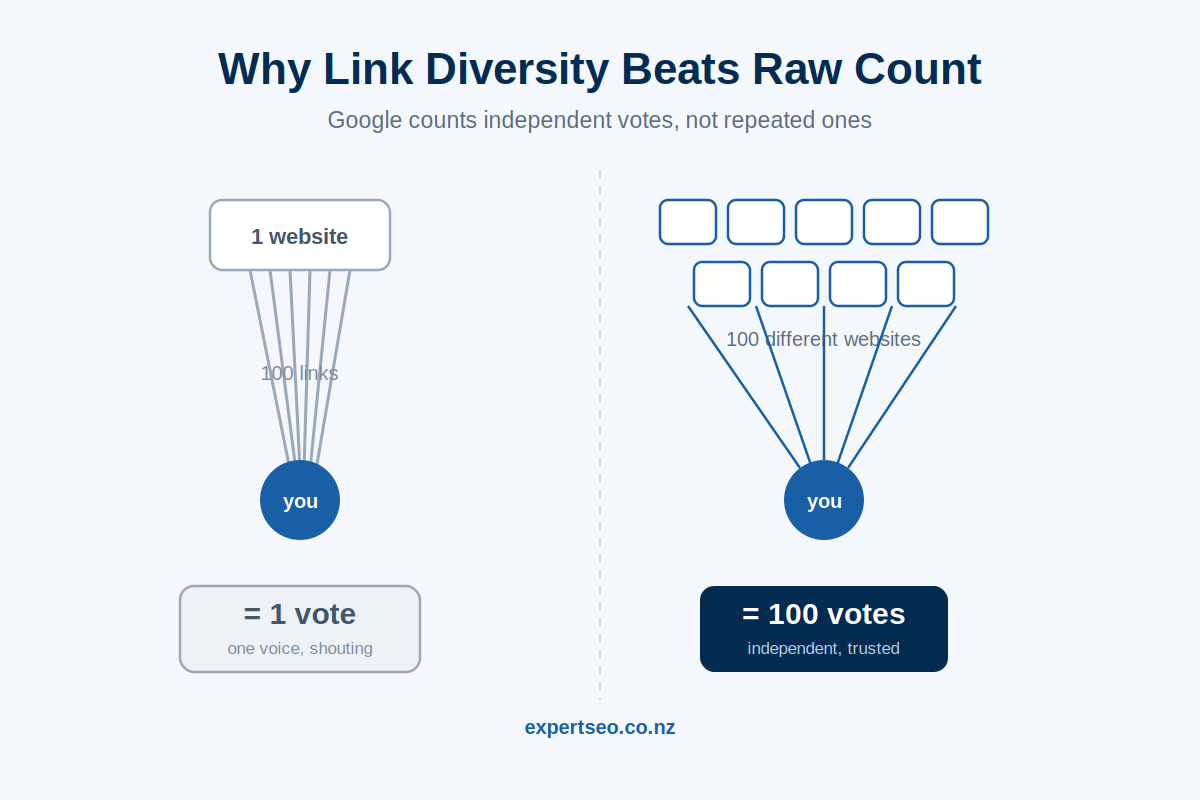
Backlinks are links from other websites pointing to yours, and the key insight most people miss is that diversity beats raw count.
One hundred links from one website is one vote, shouted a hundred times. One hundred links from a hundred different websites is a hundred independent votes — and Google treats that far more seriously.
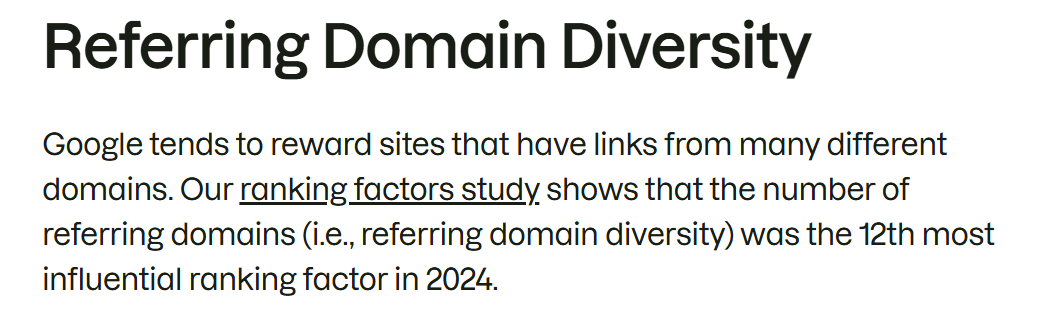
Semrush’s 2024 study ranked referring-domain diversity as the 12th most influential factor of everything it measured.
This is also where most NZ businesses fall down, and where earning links properly separates the sites that rank from the ones that don’t.
3. Search intent and relevance
This is the cheapest win on the list, and the one most NZ sites get wrong.
Relevance goes beyond having the keyword on the page. What really counts is matching the format Google is rewarding for that search.
Look at what’s already ranking — if the top results for a term are all guides, Google wants a guide; if they’re all service pages, it wants a service page. Fighting that is how good content ends up on page three.
Say a mortgage broker writes a brilliant 2,000-word explainer targeting “mortgage broker Auckland.” That keyword has buying intent — the searcher wants someone to call, not an essay to read.
The explainer won’t rank, because it’s answering a question nobody asked. This is why SEO for mortgage brokers, and every other competitive service niche, lives or dies on matching intent before you write a word.
Getting your keyword targeting right first saves you from writing the wrong thing beautifully.
4. Technical SEO and crawlability
Technical SEO is the floor, not the ceiling. Google can’t rank a page it can’t crawl or index — so if there are technical problems blocking the way, none of the above matters.
Think of it like the wiring and plumbing in a house. Nobody compliments you on it, but if it’s broken, nothing else works.
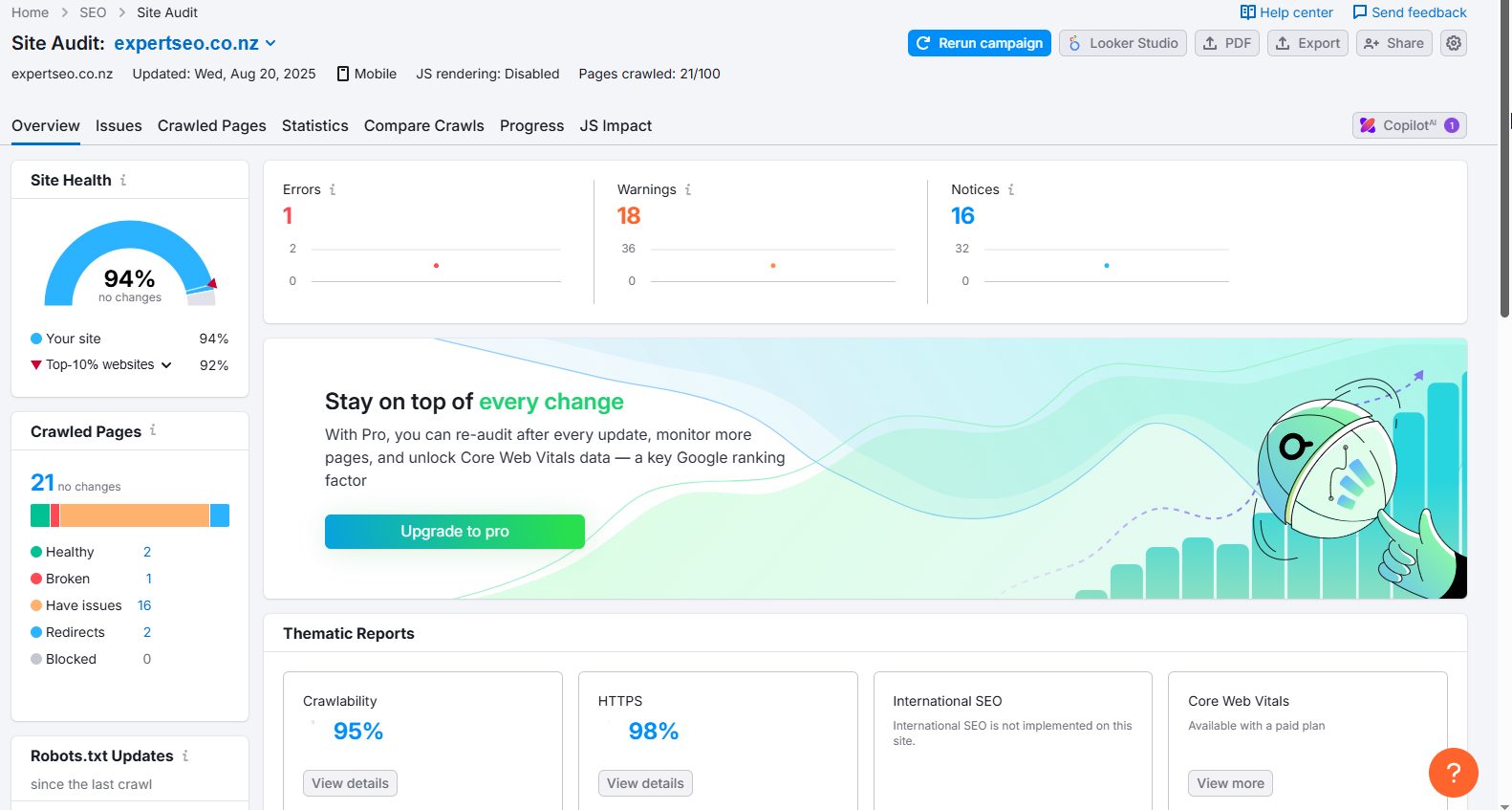
The technical side of SEO covers crawlability, indexing, site structure, and making sure Google can actually reach and understand your pages.
For most NZ small business sites it’s not glamorous, but it’s quick to sort and it removes the handbrake.
If you’re not sure whether something technical is holding you back, an SEO audit is the fastest way to find out before you waste effort elsewhere.
5. Page experience and Core Web Vitals
This one is real but badly overweighted. Core Web Vitals measure loading speed, interactivity, and visual stability — and yes, Google uses them.
But you’re not chasing a lightning-fast site — just one that’s fast enough. Google only demotes the genuinely slow experiences.
Worth knowing: that same 11.8-million-page study found no clear correlation between raw page speed and rankings.
Speed matters for your visitors and for not getting demoted, but it won’t lift you up the rankings on its own. Don’t spend a fortnight shaving milliseconds when your content and links are where the real gains sit.

(One correction worth flagging, since a lot of older guides still get this wrong: the metric for interactivity is now INP, Interaction to Next Paint. The old First Input Delay was retired. If a guide still lists FID, it’s out of date.)
6. The minor leagues
These are confirmed factors that carry small weight: HTTPS, mobile-friendliness, freshness for time-sensitive topics, and on-page tags like titles and headings. Get them right — they’re easy — but don’t mistake them for the main game.
Keyword-optimised title tags help Google understand your page, but they won’t push you up the rankings on their own. On-page housekeeping is worth doing, but it’s housekeeping, not strategy.
The Two Factors That Move the Needle Most
If you only get two things right, make them content and links. Everything else is support.
For more than a decade I’ve done SEO in some of the most competitive markets going — including years competing in the United States, where the level is brutal and most NZ agencies have never had to play.
Across all of it, two factors have done more for rankings, traffic, and revenue than everything else combined: high-quality content and high-quality links. Maximise those two and you genuinely can’t go far wrong.
Here’s why it’s those two specifically. Content earns you the relevance — the right to rank for a search at all.
Links earn you the authority — the weight to outrank everyone else who’s also relevant. One gets you into the race; the other helps you win it.
Nearly every one of those 200 factors is really just a smaller deposit into one of those two accounts.
I’ll give you the proof, because I’d rather show than tell.
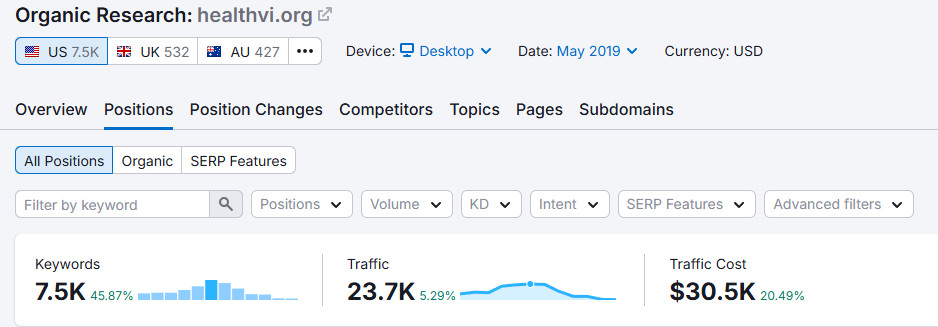
HealthVI went from zero to over 20,000 monthly visitors in under a year. That wasn’t clever technical tricks.
It was relentless, genuinely helpful content, backed by links — a project I built with my mentor and former business partner Ian Pribyl (which even got us into a bit of legal trouble at times, but that’s a story for another day).
Then there’s our SEO company itself. The domain is under a year old. It’s competing against New Zealand agencies that have been building their sites for a decade.
And it’s already outranking a fair few of them — not on domain power, because we don’t have it yet, but on content and relevance.
That’s the whole game in miniature, and it’s why SEO in Auckland, the most competitive market in the country, still comes down to depth and relevance more than raw size.

And you don’t have to take my word for it; the data for this very keyword proves the point.
When I pulled the pages ranking for “google ranking factors,” a site with a domain rating of 65 was sitting on page one — against Google’s own documentation at a domain rating of 99.
The little guy was beating a near-perfect-authority page because it had a sharper, better-structured take. That’s content and relevance outpunching raw domain power, in black and white.
Now, the studies agree with the order.
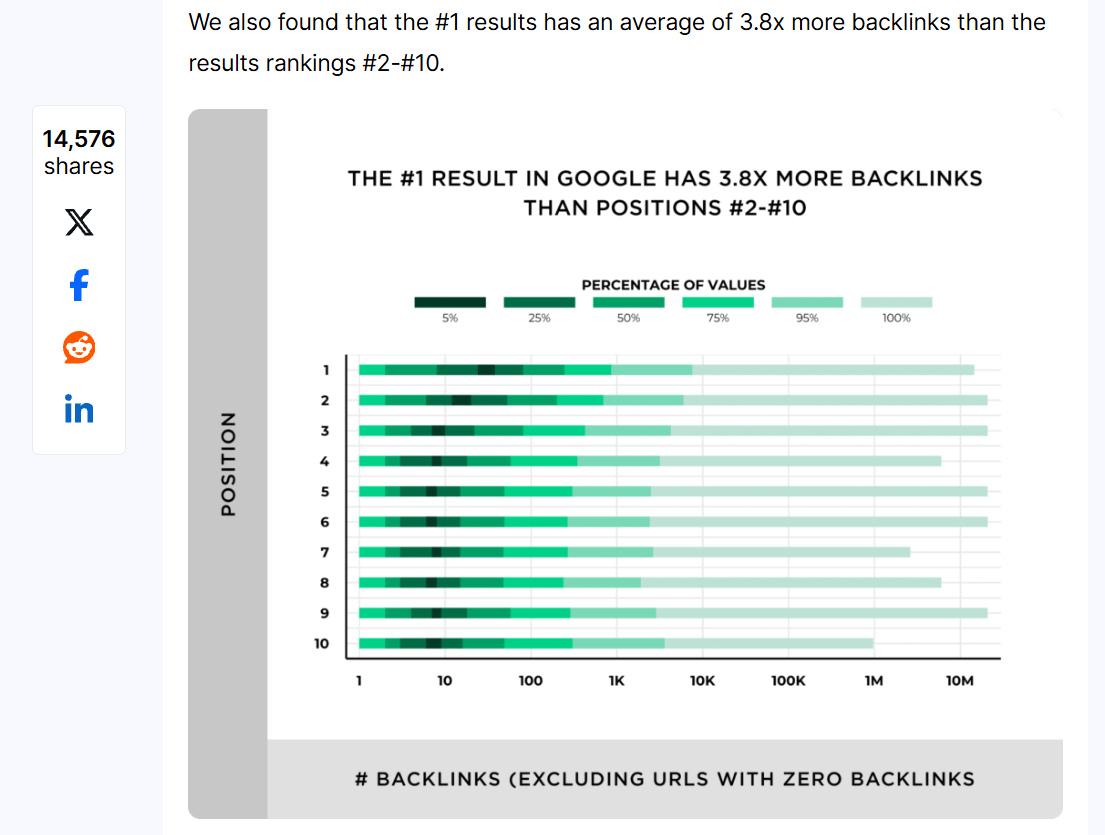
The number-one result in Google has, on average, 3.8 times more backlinks than positions two to ten.
And here’s the stat that should give every small business hope: around 95% of all pages on the web have zero backlinks. Most of your competitors aren’t doing the link side at all. Do it even moderately well and you’re ahead.
Here’s the way I think about it: content and links are two accounts, and every bit of work is a deposit. Like any account, they compound — the page you write and the link you earn this month keep paying interest for years.
That’s why SEO crawls at first and then suddenly takes off. You’re not building traffic so much as building trust, and trust accrues.
The Factors That Matter Less Than You’d Think
A few well-known factors are real and confirmed but carry so little weight that pouring time into them is how small businesses stall.
Exact-match domains, keyword density, meta keywords (Google stopped using these as a ranking signal years ago), hitting some magic word count — these get a lot of airtime because they’re easy to measure and easy to tick off, which is exactly why people fixate on them.
Content and links are hard work; fiddling with keyword density feels like progress without being progress.
Google has openly contradicted several of them. Its own John Mueller has said domain age does nothing. The reframe is the whole point of this guide: put your effort where the impact is, not where the busywork is comfortable.
Is SEO Dead in 2026?
No — SEO is very much alive in 2026. What’s changed is where it shows up: the same two factors that win blue-link rankings now also decide whether AI surfaces cite you.
This is the question I get most, so let’s deal with it head-on. Yes, AI Overviews have changed the search results. They now reach around 2 billion people a month, and for informational searches like this one they show up a lot. On some queries, fewer people click through to websites than they used to.
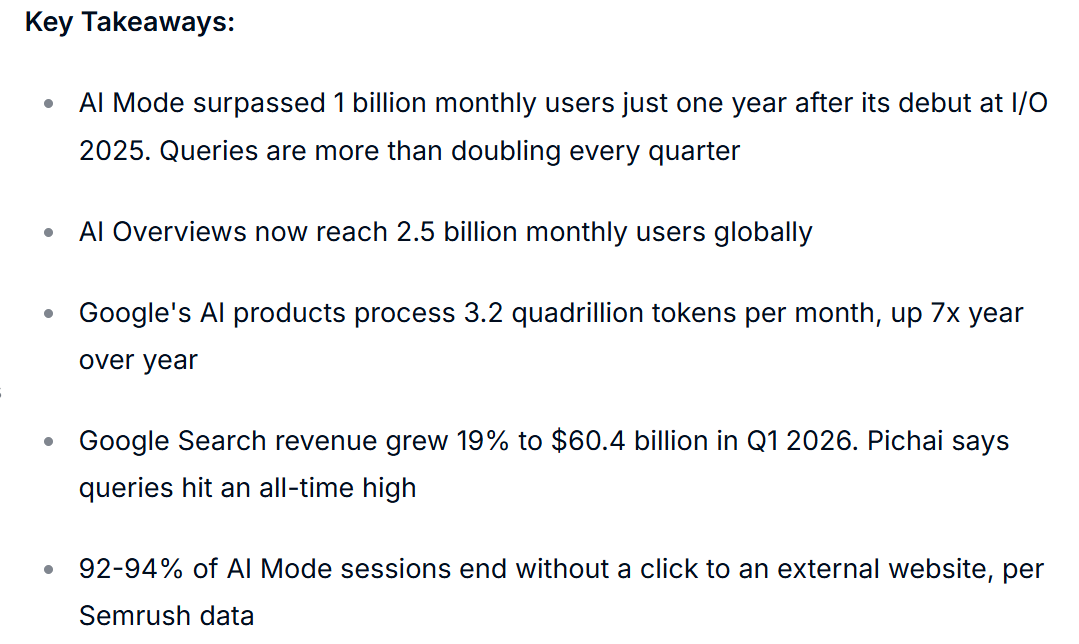
But changed isn’t dead. Google’s search ad revenue still grew 17% year-on-year into late 2025 — search is bigger business than ever, not a dying one. And 65% of businesses report better results from combining SEO with AI, not worse.
Here’s the part that matters for you. AI Overviews and tools like ChatGPT decide what to cite using the exact same signals: authoritative, trustworthy content (that’s your content) and the trust signals that say a source is credible (that’s your links).
Ranking in AI search runs on the same engine as ranking in regular search. Our own under-one-year-old domain is already getting pulled into AI Overviews — because the content-and-links formula feeds both. SEO didn’t die.
It got a second front, and the same two factors win it.
Organic vs Google Business Profile Ranking Factors
Everything above is for organic — the standard blue-link results. If you’re chasing the local map pack, a different set of factors takes over.
This trips people up because most guides blend the two together. They’re not the same.
When someone searches “café near me” or “electrician Christchurch,” Google often shows a map with three local businesses above the normal results, and that map pack runs on its own signals:
- Relevance — how well your Google Business Profile matches the search.
- Distance — how close you are to the searcher (largely out of your hands).
- Prominence — how well-known you are, driven heavily by reviews and citations.
So an electrician doing SEO in Christchurch who’s chasing the map pack is playing a different game to one chasing organic blue-link results — and if the map is where your customers find you, that’s a local SEO job with its own playbook.
Worth knowing which game you’re actually playing before you start optimising for the wrong one.
What Should You Prioritise First?
Which factors to chase first depends entirely on where your site is starting from — and the answer flips depending on your situation.
If you’ve got a brand-new site: content and technical basics first. Links can’t save a site with thin or missing content — you’ll just be pointing authority at pages that don’t deserve to rank.
Say you’re a builder who’s just launched a new site; the smart first move is genuinely useful pages and clean crawlability, not a rush of links. (Good SEO for builders almost always starts there, because trades sites are usually thin on content and quick to improve.)
If you’ve got an established site: links and freshness. Your content foundation is already there, so the lever is authority — earning links to push your existing pages further, and keeping the important ones updated.
This is also the honest moment to ask whether you do this yourself or hand it off. SEO is learnable, and plenty of business owners do it well. But it’s a real time investment, and the content-and-links work that matters most is also the work that takes the most hours.
If you’d rather put those hours into running your business, that’s where professional SEO services earns its keep — or you can bring in SEO consulting to point you in the right direction and check you’re spending effort where it counts.
Either way, the businesses that pull ahead aren’t the ones chasing all 200 factors — they’re the ones who nail the two that matter and keep showing up while their competitors don’t. That’s where we come in.
Google Ranking Factors: FAQ
What are the top 3 Google ranking factors?
The three that matter most for the average business are high-quality content, backlinks from other websites, and search-intent relevance (matching what the searcher actually wants). Content and links do most of the heavy lifting; relevance makes sure you're answering the right question in the first place.
How many ranking factors does Google use?
Nobody outside Google knows the exact number. The well-known "200 factors" figure has never been confirmed by Google — it's an industry estimate built from patents, studies, and testing. What matters more than the count is that a small handful of factors do nearly all the work.
What is the single most important ranking factor?
If forced to pick one, high-quality content — because nothing else can rank a page that doesn't genuinely answer the search. Backlinks are a very close second, since they provide the authority to outrank other relevant pages. In practice the two work together.
Are backlinks still a ranking factor in 2026?
Yes. Backlinks remain one of Google's strongest signals, and they now also influence whether AI Overviews and tools like ChatGPT cite your site. The number-one result in Google has, on average, 3.8 times more backlinks than positions two to ten.
How long before these factors affect my rankings?
SEO compounds, so it's slow then fast — usually a few months for early traction and longer for competitive terms. The content and links you build keep paying off over time, which is why the businesses that start early and stay consistent pull away from the ones that don't.
Recommended Reading
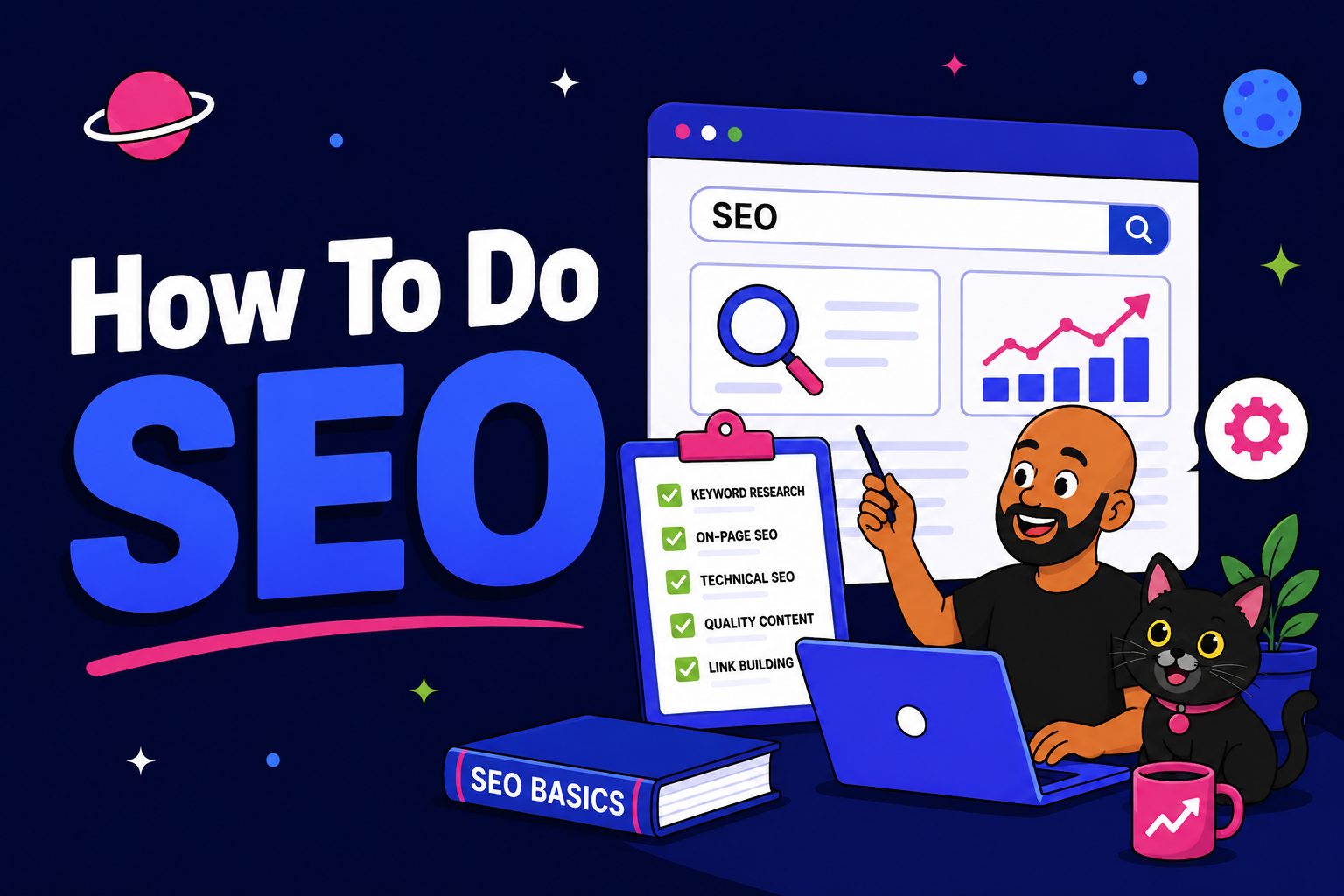
The full step-by-step process from keyword to ranking.
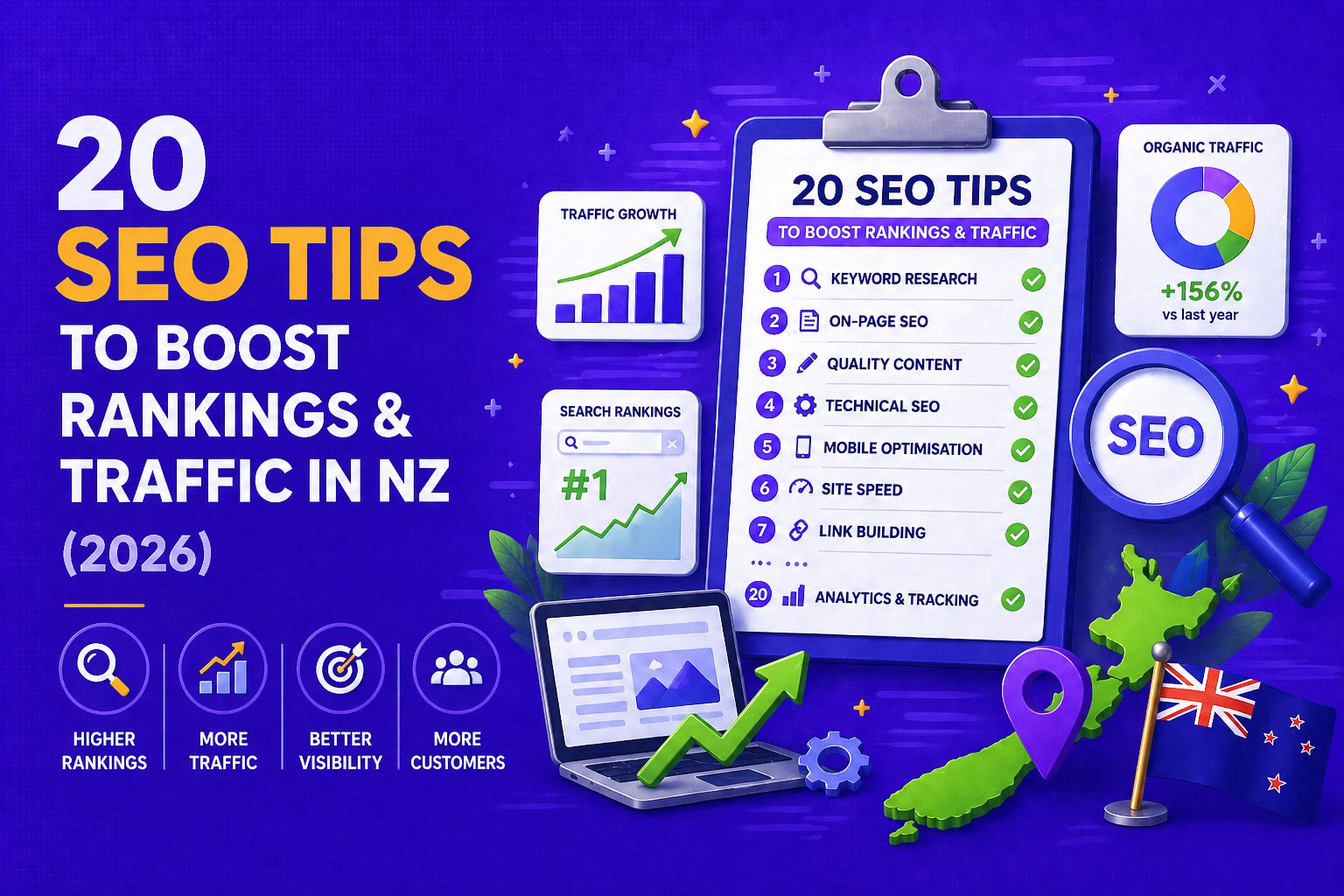
Realistic timeframes for an NZ business, and why it compounds.
An honest look at the return, with real numbers.