
This is the most complete digital marketing guide written specifically for New Zealand businesses.
In this guide, you’ll learn:
- What every digital marketing channel actually is, in plain English
- Which one to start with, based on what you sell and who buys it
- What digital marketing costs in New Zealand — real numbers, not ranges pulled from an American blog
- How long each channel takes before it works
- What the results actually look like when it does
And you’re about to learn it from someone who’s actually done it.
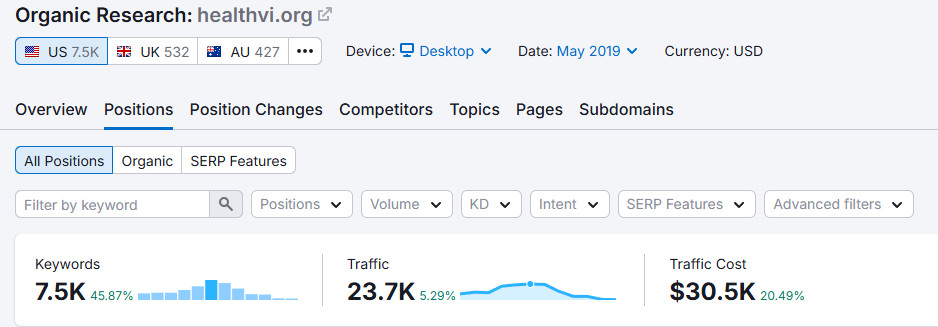
I built HealthVI from nothing to over 20,000 organic visitors a month, using the same approach I now run at Expert SEO.
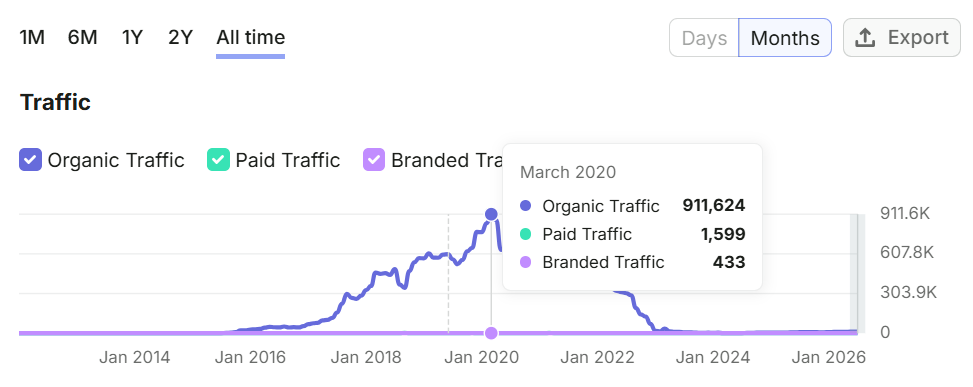
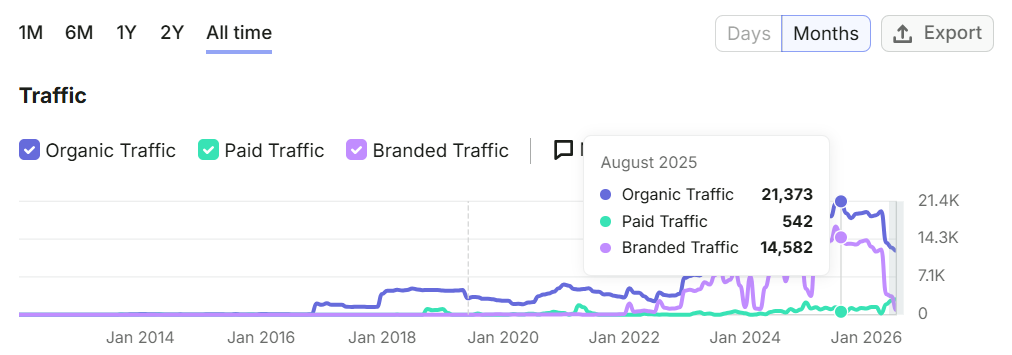
I did the content and SEO for one of the most popular sleep sites on the internet. At its peak it was pulling 911,624 organic visits a month, ranking for 433,000+ keywords, with over 14,000 of them sitting in the top three.
That put it in the top 0.01% of websites on the planet — about one in every ten thousand.
I ran StoppingScams to over 5,000 visitors a day.

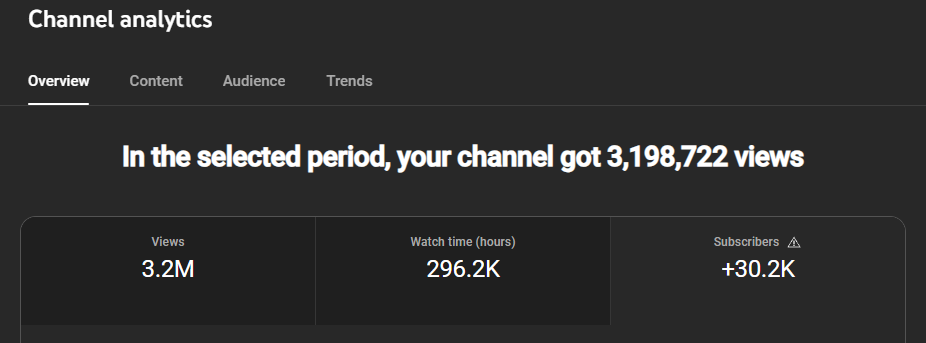
I’ve built a YouTube channel to 3.2 million views, 30,000+ subscribers and 296,000 watch hours — which is its own lesson in how search works on a platform that isn’t Google.
And a researcher from Harvard reached out to interview me about AI and search — which was a strange morning, but a fair sign the work travels.

None of that came from tricks. It came from doing a small number of boring things properly, for longer than most people are willing to.
Let’s get into it.
Key Takeaways
- What it is: Digital marketing is any marketing you do through an online channel — search engines, your website, social media, email and paid ads — to get people to find and buy from your business.
- There are six channels worth your attention: SEO, paid search, content, social media, email, and AI search. You don’t need all six.
- New Zealand’s search market is roughly one-seven-hundredth the size of the global one, which makes ranking nationally realistic here in a way it never is overseas.
- Expect to spend $500–$1,500 a month doing it yourself, $1,500–$4,000 with a freelancer or small agency, and $4,000+ with a full-service agency — plus ad spend on top.
- Paid ads work in days. SEO and content take three to six months to move and twelve to compound. Anyone promising faster is selling you something.
- 96.2% of New Zealanders are online and Google handles 87.52% of our searches, so search is where most buying decisions here start.
- The businesses that win in a market this small aren’t the ones spending the most. They’re the ones who picked one channel and stayed on it.
What is digital marketing?
Digital marketing is any marketing you do through an online channel — search engines, your website, social media, email and paid ads — to get people to find and buy from your business.

That’s it. The term covers a lot of ground, which is exactly why it feels slippery.
Traditional marketing puts your message somewhere and hopes the right person walks past it — a billboard on the Southern Motorway, a spot on ZM, a flyer in a letterbox in Papamoa.
Digital marketing puts your message where someone is already looking for what you sell, and lets you count what happened next.
You’ll see three names for the same thing: digital marketing, online marketing, internet marketing. There’s a technical distinction — digital includes things like SMS and digital billboards that aren’t strictly on the internet — but in practice, nobody in New Zealand uses the terms differently. Treat them as interchangeable.
So what does a digital marketer actually do all day? Three things, in a loop: figure out where the demand is, put something in front of it, then measure whether it worked and adjust. Everything else is detail.
Why is digital marketing important?
It matters because search is where buying decisions start — and in a market this small, one well-ranked page can put you in front of a serious chunk of your addressable customers.
New Zealand is close to fully online. DataReportal counted 5.06 million internet users here, 96.2% of the population at the end of 2025. There’s no meaningful offline audience left to reach.

And when we look for something, we overwhelmingly use one search engine. Google handles 87.52% of New Zealand searches across all devices. Bing is a distant 8.85%.

We’re also spending real money online. New Zealanders spent over NZ$12.7 billion online in 2025, an increase of nearly $1.1 billion on 2024, driven by both more transactions (+6%) and bigger baskets (+4%). Instore spending grew just 2% over the same period.

Here’s the part that matters more than any of those numbers, though. Digital marketing is the only kind you can actually audit. You can see which search term brought someone in, which page they landed on, and whether they called. Try getting that from a radio ad.
Now the honest counterweight, because you’ll hear the upside from every agency that calls you: most of it is slower than it’s sold as. Organic channels take months. Paid channels stop the moment you stop paying. Anyone telling you otherwise is describing a product that doesn’t exist.
What are the types of digital marketing?
There are six types of digital marketing worth knowing: SEO, paid search, content marketing, social media marketing, email marketing, and AI search optimisation.
You’ll see other counts. Some articles say four types, some say five strategies, some talk about four pillars or four C’s. Those are frameworks people invented to sell courses — there’s no official list. These six cover everything you’d actually spend money on.
Search engine optimisation (SEO)
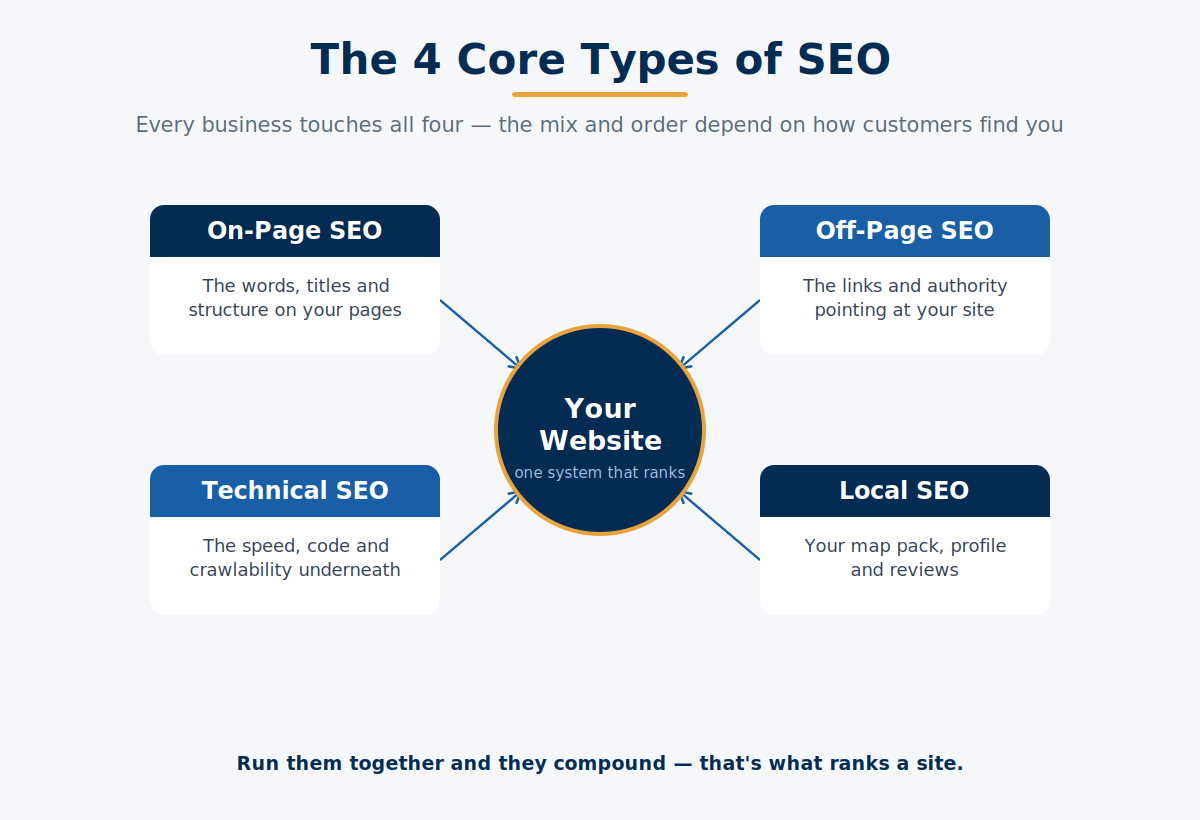
SEO is the work of getting your website to show up in Google’s unpaid results when someone searches for what you sell.
You do it by picking the search terms your customers actually type, building pages that answer them properly, making the site technically sound so Google can read it, and earning links from other websites so Google trusts you.
The appeal is simple: you’re not renting the traffic. A page that ranks keeps working while you’re asleep, on holiday, or flat out with jobs.
Paid search (PPC / SEM)
Paid search is buying an ad slot at the top of Google’s results for a specific search term, and paying only when someone clicks it.
Pay-per-click, PPC, SEM, Google Ads, search engine marketing — all the same thing, wearing different hats.
The trade-off against SEO is speed versus permanence. Paid search works this afternoon. It also stops this afternoon, the moment your card declines.
Content marketing
Content marketing is publishing genuinely useful material — articles, videos, guides — that attracts the people who’d eventually buy from you.
It’s the fuel for SEO rather than a separate thing sitting beside it. A panel beater in Hamilton writing an honest piece on what a repair actually costs is doing content marketing and SEO in the same act.
Social media marketing
Social media marketing is using platforms like Facebook, Instagram, LinkedIn and TikTok to build an audience and sell to it, either through posts you don’t pay for or ads you do.
The important distinction: organic social is a relationship channel, paid social is an interruption channel. Organic keeps people who already know you warm. Paid puts you in front of people who’ve never heard of you and weren’t looking. Both work. They work at different jobs.
Email marketing
Email marketing is sending offers, updates and useful content to a list of people who’ve given you their address.
It’s the least glamorous channel and reliably one of the best performing, because you own the list. Google can change its algorithm and Meta can change its ad rules, but nobody can take your email list off you.
Litmus’s survey work puts email ROI between 10:1 and 36:1 for most companies, and between 36:1 and 50:1 for the next tier up. Read it as a range rather than the flat “$36 for every $1” figure that gets quoted everywhere — but even the bottom of that range beats most channels.

AI search optimisation
AI search optimisation is the work of getting your business named inside AI answers — Google’s AI Overviews, ChatGPT, Gemini — rather than just inside the blue links underneath.
This is the newest of the six and the one no other guide on the first page of Google covers. There’s a full section on it below.
How does digital marketing work in New Zealand?
New Zealand’s search market is roughly one-seven-hundredth the size of the global one, and that single fact changes almost every recommendation you’ll read in an overseas guide.
Here’s the number that made me want to write this section. “Digital marketing” gets about 2,300 searches a month in New Zealand. Globally, the same term gets around 1.5 million.
That’s not a rounding difference. That’s a different sport.
And it cuts in your favour far more often than it cuts against you.
Ranking nationally is realistic here. In the United States, “plumber” is a war. Here, a genuinely good plumbing website with a bit of patience can own its city and then most of the country. Ahrefs reckons this exact keyword needs around 99 referring domains to crack the top ten in New Zealand. In the US market you’d multiply that many times over.
Content punches above its weight. Because so few New Zealand businesses publish anything useful, the bar to become the best resource on a topic here is embarrassingly low. That’s the whole reason a site like ours could rank against agencies with a decade’s head start.
Paid gets expensive fast. Small market, thin inventory, and a handful of agencies bidding each other up. “Marketing agency near me” is running a top-of-page bid around NZ$59.52. In a market this size, that’s brutal maths for a small business.
And copying American advice will burn your budget. Every US guide tells you to chase volume. Here, volume barely exists — you chase search intent instead. Two hundred searches a month for “emergency plumber Hamilton” is worth vastly more than twenty thousand for “plumbing tips,” because one of those people has water coming through the ceiling right now.
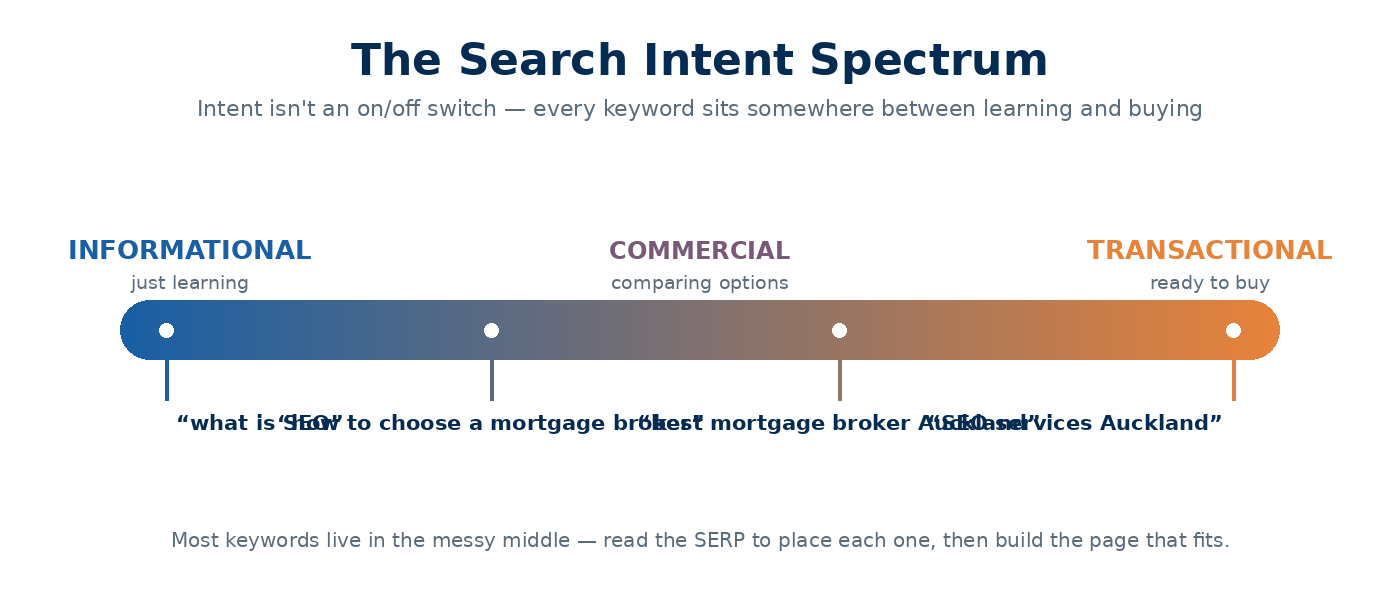
Low volume doesn’t mean low value. It means the person searching is closer to their wallet.
Which type of digital marketing should you start with?
Start with one channel, not five. Which one comes down to a single question: are people already searching for what you sell, or do you have to create the demand?
If they’re searching, you go to search — SEO first, paid search if you need cashflow this month. If they’re not, you go to social and content, and accept it’ll take longer.
Almost every New Zealand small business falls into one of four buckets:
| Your business | Start with | Why |
|---|---|---|
| Local service business (dentist, physio, lawyer) | Local SEO + Google Business Profile | People search “dentist near me” with intent to book. The map pack is free and most competitors half-fill their profile. |
| Trade (plumber, sparky, builder) | Local SEO, then paid search for emergencies | Emergency searches convert immediately. Being in the map pack at 9pm on a Sunday is worth more than any social following. |
| Ecommerce | Paid social + product SEO | Demand often has to be created, and you can test what sells with $20 before committing. |
| B2B / professional services | Content + LinkedIn | Long sales cycles. Nobody buys $30,000 of consulting off an Instagram ad. |
Take a dentist in Auckland. People search “dentist Auckland” and “emergency dentist Auckland” every day with a clear intention to book. The demand already exists, so the job is showing up for it — claim and fully complete the Google Business Profile, get a review system running, build one strong page per service. Paid ads are a supplement, not the strategy.
Now take a Christchurch business selling a product nobody’s looking for yet. No search demand to capture, so you have to interrupt someone’s scroll instead. Paid social first, test five creatives at $20 a day, and put the winners on repeat.
Same country, same budget, completely different first move.
For the first six months, ignore everything else. You’ll be told you need TikTok, a podcast, a newsletter and a rebrand. You need one channel producing enquiries.
How much does digital marketing cost in New Zealand?
Expect $500–$1,500 a month doing it yourself with tools, $1,500–$4,000 with a freelancer or small agency, and $4,000+ with a full-service agency — plus ad spend on top of any of those.
Almost nobody publishes these numbers, so let’s put them somewhere public.
Doing it yourself: $0–$500 a month. Google Business Profile is free, Google Search Console is free, Google Analytics is free. A keyword tool runs $150–$250 a month if you want one. The real cost is your time, and it’s usually five to ten hours a week to do it properly.
Freelancer: $1,000–$3,000 a month, or $80–$150 an hour in New Zealand. Good for one channel done well. Less good when you need strategy across several.
Small agency or consultant: $1,500–$4,000 a month. This is where most New Zealand SMEs land, and it’s the bracket our own SEO and web design services sit in.
Full-service agency: $4,000–$10,000+ a month, usually with a minimum term.
Ad spend sits on top of all of it. And New Zealand ad prices are worth seeing before you budget, because they’re higher than people expect for a market this small. These are pulled straight out of Google’s own Keyword Planner, set to New Zealand, seeded with “digital marketing agency”:
| Search term | Top-of-page bid, low | Top-of-page bid, high |
|---|---|---|
| advertising and digital marketing | NZ$20.72 | NZ$73.05 |
| search engine optimisation companies | NZ$13.16 | NZ$70.73 |
| marketing agency near me | NZ$6.21 | NZ$59.52 |
| digital marketing in social media | NZ$10.05 | NZ$45.78 |
| web digital agency | NZ$5.86 | NZ$43.30 |

Sit with that top column for a second. At the high end, one click on “advertising and digital marketing” costs NZ$73.05. Ten clicks is $730. If one in ten of those becomes a customer, that customer cost you $730 before you’d done a minute of actual work for them.
For plenty of New Zealand businesses that maths simply doesn’t clear. Which is exactly why organic matters more here than the ad platforms would like you to believe.
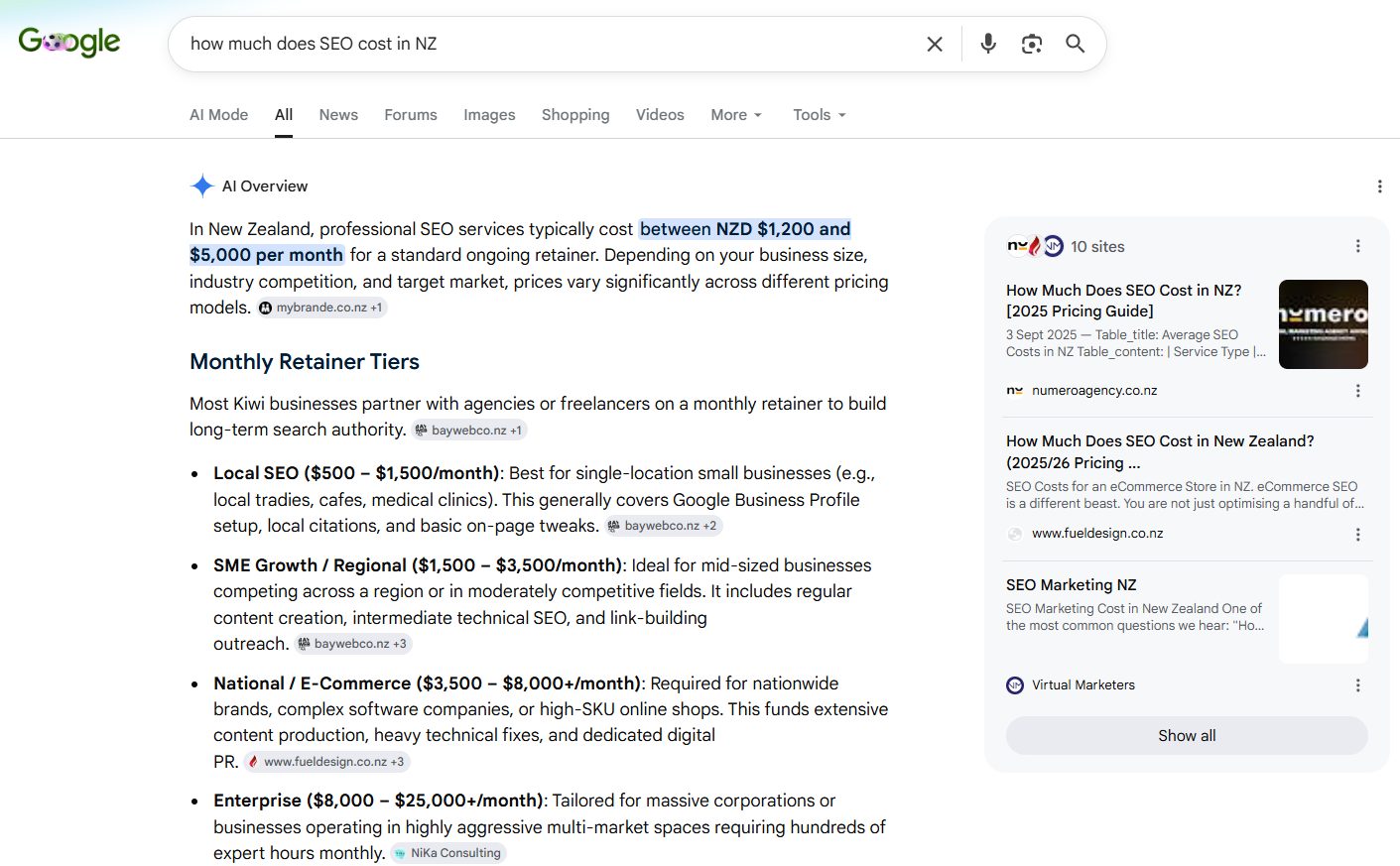
Google’s own AI Overview now quotes NZ$1,200–$5,000 a month as the going rate for SEO here, which lines up with what I see.
One warning on the bottom end. A $299-a-month SEO retainer buys you roughly two hours of someone’s attention. Two hours a month cannot move a website. What it usually buys instead is an automated report, a handful of directory submissions, and a link package from a site nobody reads. You’re better off spending nothing and doing your Google Business Profile properly.
How long does digital marketing take to work?
Paid ads work within days. SEO and content take three to six months to show movement and around twelve to compound. Anyone promising faster is selling you something.
Here’s the realistic timeline by channel:
| Channel | First signs | Meaningful results |
|---|---|---|
| Paid search | 1–7 days | 4–6 weeks once you’ve cut the losing keywords |
| Paid social | 3–14 days | 4–8 weeks after creative testing |
| Local SEO | 4–8 weeks | 3–6 months |
| SEO and content | 8–12 weeks | 6–12 months, then it compounds |
| Immediate on send | 3–6 months to build a list worth sending to | |
| AI search | 2–6 months | Follows your organic visibility |
The hardest part is months one to three of anything organic, because it genuinely looks like nothing is happening. Impressions climb, positions crawl from 60 to 40 to 25, and not one of those movements sends you a single visitor. People quit right there, one month before the curve turns.
What happens next is why it’s worth sitting through. HealthVI went from zero to over 20,000 organic visitors a month — but almost none of that arrived in the first quarter. It arrived because the pages published in months one to three were still working in month eighteen, alongside everything published since.
That’s the actual argument for organic in a market this small: it accumulates. Paid search resets to zero the day you stop paying. Content doesn’t.
The ceiling is higher than most New Zealand business owners think, too. The sleep site I worked on ended up ranking for 433,559 keywords, with 14,421 of them in the top three.

Nobody gets there in a quarter. Everybody who gets there started with one page.
How is AI changing digital marketing?
AI isn’t replacing digital marketing. It’s changing where the answer gets served — which means there’s now a sixth channel: getting your business named inside AI answers.
This is the question I get asked most, usually in a slightly worried tone, so let’s deal with it directly.
Google’s AI Overviews now appear on a meaningful share of searches. Semrush’s study of over 10 million keywords tracked them going from 6.49% of queries in January 2025 to a peak of 24.61% in July, settling around 15.69% by November.

At the same time, people have started asking AI tools the questions they used to type into Google. Ask ChatGPT for a builder in your suburb and it’ll give you names, not ten blue links. BrightLocal’s 2026 research put the use of AI tools for local business recommendations at 45%, up from 6% the year before — now the third most popular way people find a local business.

So the fear — that AI eats your traffic — is half right. Some clicks do disappear, and zero-click searches are now a normal part of how Google works. But something more useful is happening underneath: getting cited is the new ranking.
When someone asks ChatGPT for the best dentist in Auckland, it names three or four. Being one of them is now a marketing outcome, and almost nobody in New Zealand is deliberately working towards it.
Three things make a page citable. Answer the question directly in the first sentence or two, rather than warming up for four paragraphs. Structure it cleanly with real headings, so a machine can find the answer without guessing. And demonstrate genuine first-hand expertise, because both Google and the AI tools are increasingly good at spotting content assembled from other content.
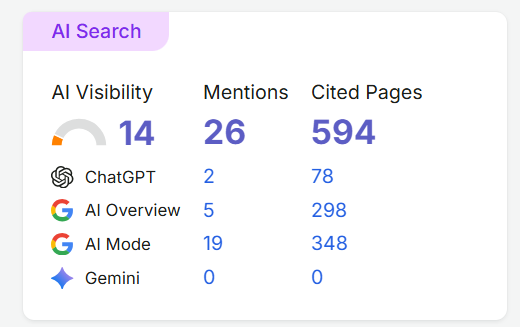
Here’s the proof it lasts: that sleep site is still being cited across AI search today — 26 mentions across 594 cited pages — years after most of the content was written.
The traffic that does come through converts unusually well, too. Microsoft’s Clarity team analysed 1,277 domains and found visitors arriving from AI tools signed up at 1.66% versus 0.15% from search — though that study looked at publisher sites, so read it as directional rather than a promise for your plumbing business.
So, will AI replace digital marketers? It’ll replace the ones whose entire job was rewriting other people’s articles. It won’t replace the work of understanding a market, making a decision and running an experiment — which was always the job.
Where NZ businesses waste money on digital marketing
Most wasted digital marketing spend in New Zealand goes to the same four places, and all four are avoidable.
1. Running every channel at once on a budget that can’t fund any of them. $1,000 a month split across Google Ads, Facebook Ads, SEO and a social media manager buys you four things done badly. The same $1,000 on one channel buys you one thing done properly. In a small market, depth beats spread every time.
2. Paying for traffic to a website that can’t convert it. This is the most expensive mistake on the list. If your site takes six seconds to load, hides your phone number, and has no reason to trust you on it, more visitors just means more people leaving. Fix the destination before you pay for the journey.
3. Cheap link packages. You’ve had the email — 500 backlinks for $99. At what real links actually cost, that price is impossible. Those links come from sites that exist only to sell links, and Google has been identifying them for well over a decade. At best you’ve wasted $99. At worst you’ve bought yourself a problem that takes months to undo.
4. Buying tactics before anyone’s diagnosed the problem. This is the big one, and it’s the most common.
I once did the SEO strategy for an ecommerce brand that had been featured on Shark Tank, in O Magazine, and had a mini documentary made about them on the History Channel. A running shoe brand — serious profile, real revenue.
They didn’t need more tactics. They needed someone to tell them which tactics.
That job was pure consulting: audit what they were already doing, find what was actually broken, map the strategy, and forecast the impact before they spent a cent implementing it.
An SEO audit costs a fraction of a month’s retainer and routinely saves you the next six. If a supplier wants to sell you a package before they’ve looked at your site, that’s your answer.
How do you know if digital marketing is working?
Four numbers tell you almost everything: where your traffic comes from, what percentage of it converts, what each customer costs you to acquire, and what you earn back per dollar of ad spend.
Here’s what each one does and where to find it.
Traffic by source. Not “how many visitors” — where they came from. Google Analytics splits organic, paid, social, email and direct for free. This is the number that tells you which channel is actually pulling.
Conversion rate. The percentage of visitors who do the thing you want: call, book, buy, submit the form. If 500 people visit and 10 enquire, that’s 2%. Most New Zealand service websites sit between 1% and 3%.
Cost per acquisition. Total spend divided by customers gained. If you spent $2,000 and got 8 customers, each cost $250. Whether that’s good depends entirely on what a customer is worth to you over their lifetime — which is a number you should know and most people don’t.
Return on ad spend. Revenue divided by ad spend. Only relevant if you’re running ads.
Check them weekly when you start, monthly once things settle. Look for the trend over four to six weeks, not day-to-day wobbles — daily numbers in a market this small are mostly noise.
Now the bit nobody in this industry likes to say out loud: attribution is broken at small scale, and it’s especially broken here.
Someone finds you on Google, doesn’t call. Sees your van in Riccarton a week later. Checks your Instagram. Asks a mate. Then rings you from a bookmark. Your dashboard credits exactly one of those touchpoints, usually the last, and quietly writes off the rest.
The practical workaround costs nothing and beats any dashboard: ask. Put “how did you hear about us?” on your enquiry form and actually ask it on the phone. In a country this size, the messy human answer is usually more accurate than the analytics.
Should you do digital marketing yourself or hire someone?
Do it yourself while you have more time than money and the work is repetitive. Hire when the bottleneck is expertise rather than hours.
Some of this genuinely doesn’t need a professional.
Do it yourself: claiming and completing your Google Business Profile, asking customers for reviews and replying to every one, posting to social consistently, and writing about the questions your customers ask you every week.
The fundamentals of SEO for a small business are genuinely DIY-able. That last one is the most undervalued task in New Zealand small business — you already know the answers, you just haven’t written them down.
Get help with: technical SEO, competitive paid search, earning links, and strategy when you’ve got several channels running and no idea which is carrying the weight. That last one is what an SEO consultant is actually for.
The pattern I’d back for a New Zealand business your size: do the free fundamentals yourself for three to six months, see what moves, then pay someone to accelerate the channel that’s already showing signs of life.
That’s a far better use of $2,000 a month than handing it over on day one and hoping.
If you do hire, four questions sort the good from the rest quickly. What exactly will you do in month one? What am I paying for versus what’s ad spend? How will we know it worked? And can I see a result you got for a business roughly my size?
A straight answer to all four is a good sign. Vagueness on the last one is the tell.
Final Thoughts
If you remember one thing, make it this.
The businesses that win at digital marketing in New Zealand are almost never the ones spending the most. They’re the ones who picked one channel and stayed on it for twelve months while their competitors changed tactics every quarter.
I’ve watched it happen for a decade now, on both sides of the Pacific.
The plumber who wrote one honest article a month for a year beats the one who spent $3,000 on a rebrand. The dentist who asked every single patient for a review beats the one running Facebook ads to a website that doesn’t load.
Consistency isn’t the exciting answer. It’s just the one that keeps working.
Digital Marketing: FAQ
What exactly does a digital marketer do?
A digital marketer finds where demand for your product exists online, puts your business in front of that demand, then measures what happened and adjusts. In practice that means keyword research, running ads, writing content, sending emails and reading the numbers.
What are the 4 types of digital marketing?
Most lists say SEO, paid search, social media and email. That's a useful starting four, but it leaves out content marketing and AI search optimisation. You'll also see "4 pillars", "5 strategies" and "4 C's" — these are marketing frameworks people invented, not an official standard.
How do I start digital marketing with no experience or budget?
Claim your Google Business Profile, fill it out completely, and start collecting reviews. Then write one page answering the question customers ask you most. That's free, takes a weekend, and outperforms most paid campaigns run by beginners.
Can I self-learn digital marketing?
Yes. Google's own free certifications cover the fundamentals, and running a real website teaches you more than any course. The catch is that it takes months of doing it badly before you're doing it well.
Will AI replace digital marketers?
It will replace people whose job was rewriting other people's content. It won't replace understanding a market, choosing a strategy and running experiments. AI has also created a new job: getting your business named inside AI answers.
How much does digital marketing cost for a small NZ business?
Between $500 and $1,500 a month doing it yourself with tools, $1,500 to $4,000 with a freelancer or small agency, and $4,000+ with a full-service agency. Ad spend sits on top of all of those.
How long before digital marketing pays for itself?
Paid search can pay for itself in the first month if your margins allow it. SEO and content typically take six to twelve months to cover their cost, then keep returning long after you stop paying for them.
What skills does a digital marketer need?
Keyword research, writing, basic analytics, and enough curiosity to keep testing. The technical skills are learnable in weeks. The judgment about where to spend takes years.