

A few months ago, my SEO company was a brand-new domain with barely any backlinks.
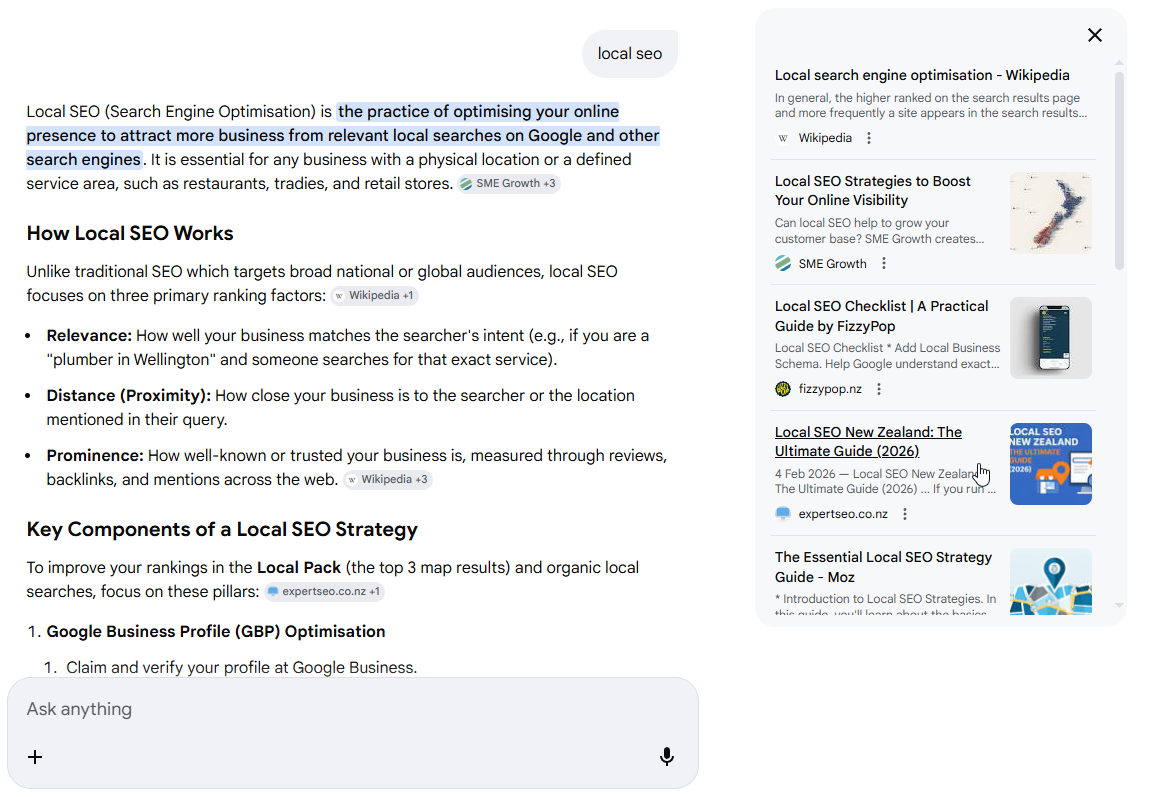
A few weeks ago, it got quoted in Google’s AI Overviews, cited by ChatGPT, and ranked above New Zealand agencies that have been building their sites for a decade.
It didn’t take a huge link budget or any clever tricks.
What got us there was topical authority — and it’s the single most useful thing a small NZ business can understand about modern SEO.
Most guides on this topic are written for the US market by sites you’ll never out-rank, and the one NZ explanation I could find gets the definition flat wrong.
So here’s the proper version: what topical authority actually is, why it matters more in 2026 than it ever has, and the exact process to build it — with a real NZ example you can copy.
What Topical Authority Actually Is
Topical authority is how completely and credibly your website covers a subject. The more thoroughly you answer everything a person could ask about a topic, the more search engines — and AI — treat you as the expert source on it.

That’s the whole idea. Depth and trust on one subject, not a scattering of pages across ten.
Here’s the shift that makes it click.
Most people do SEO keyword by keyword: they find a search term, write a page for it, move on, find another, write another.
Topical authority flips that. Instead of chasing single keywords, you set out to own an entire topic — every question, every angle, every sub-problem a reader could have.
Let’s say I run a website about home espresso.
The keyword-by-keyword approach writes one post on “best espresso machine NZ” and calls it a day.
The topical-authority approach covers the whole world of home espresso: how to dial in a grinder, why your shots taste sour, milk-frothing technique, water hardness, machine maintenance, bean storage.
Forty questions answered properly, all linked together.
Google looks at the second site and sees something the first can’t fake: a place that genuinely knows this subject inside out.
That’s the part worth banking: topical authority is earned by covering a subject completely, not by being the most popular site.
Topical Authority vs Domain Authority (They’re Not the Same)
Topical authority and domain authority are different things, and confusing them is the most common mistake people make with this topic.
The one NZ guide I could find on it even defines topical authority as “also known as domain authority.”

I read that twice to make sure I wasn’t the one losing it.
They’re not the same, and treating them as one is how businesses end up throwing money at links when the real problem is shallow content.
For the decade I’ve been doing this, that single mix-up has cost more NZ sites more time than almost anything else.
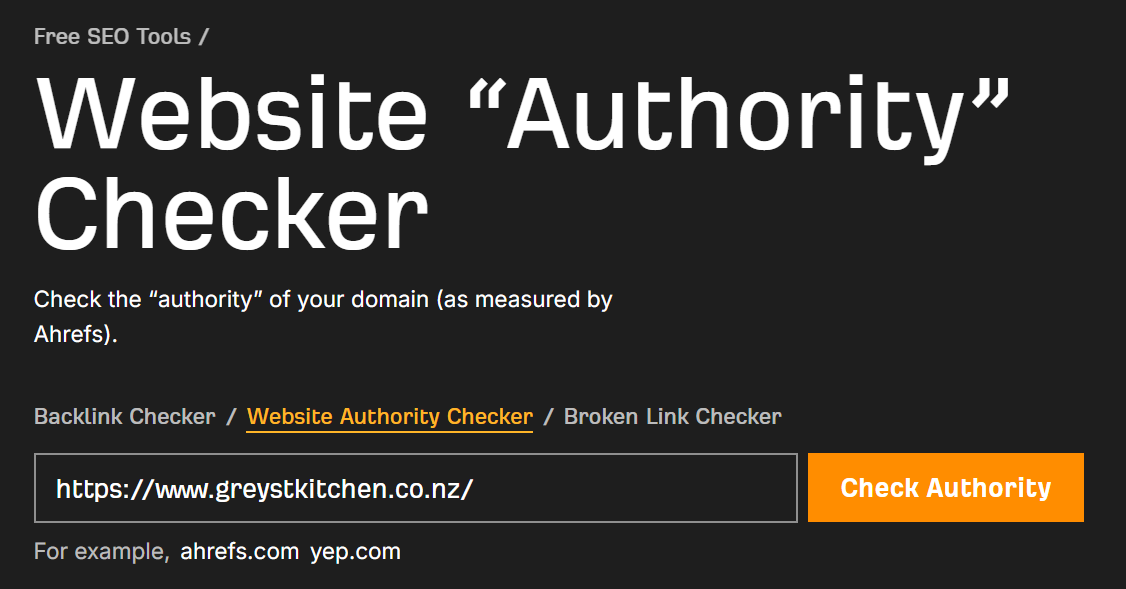
Domain authority is a score — usually from a third-party tool like Moz or Ahrefs — that estimates how strong your whole site is, mostly based on backlinks. It’s not a Google metric — just an outside guess at your site’s overall link power.
Topical authority is about how deeply and credibly you cover one subject. It’s earned through content, structure, and real expertise — not link count.
Here’s the difference in a table:
| Domain Authority | Topical Authority | |
|---|---|---|
| What it measures | Overall site strength | Depth of expertise on one topic |
| Mostly built from | Backlinks | Comprehensive, interlinked content |
| Who scores it | Third-party tools (Moz, Ahrefs) | Inferred by Google and AI |
| How you grow it | Earning links | Covering a topic completely |
The reason this distinction matters so much: you can have a low domain authority and still beat a high-authority site on a specific topic. A small NZ site that covers one subject properly can out-rank a giant that mentions it once.
That’s not theory. That’s the entire escape route for small businesses in this country — and it’s where this gets interesting.
Why Topical Authority Matters More Than Ever in 2026
Topical authority is no longer a nice-to-have. It’s the thing that decides whether AI search quotes you or your competitor.
Here’s why it works differently now:
Search isn’t just ten blue links anymore. Google’s AI Overviews — those AI summaries sitting at the top of the results — now reach over 2.5 billion monthly users.
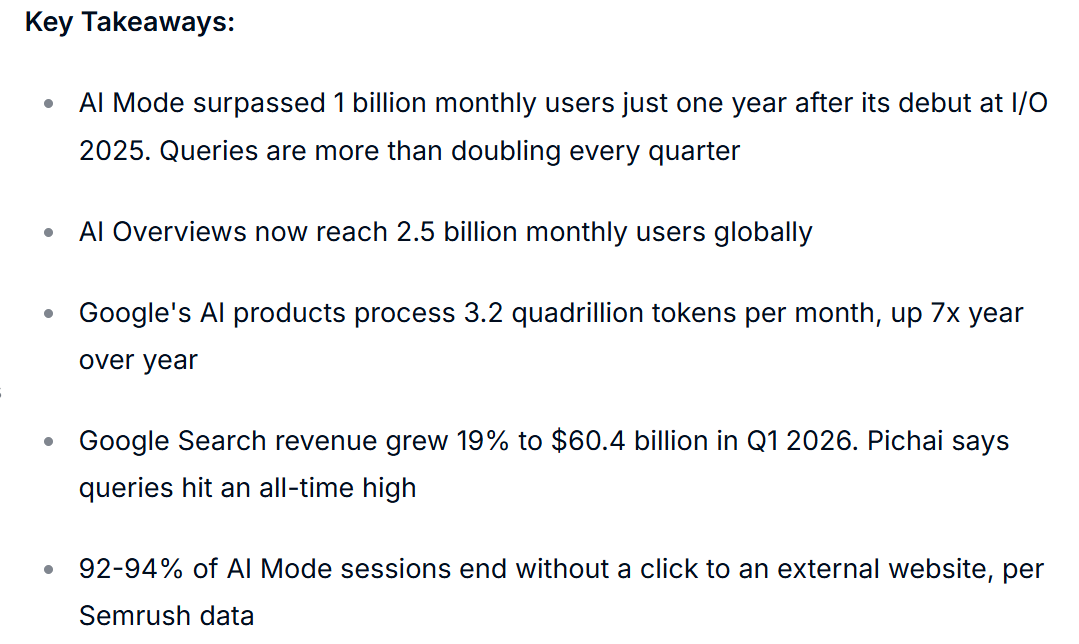
ChatGPT, Gemini and Perplexity answer questions before anyone scrolls. And all of them pull their answers from sites they consider authoritative on the subject.
The catch is that being in the AI answer is now the whole game.
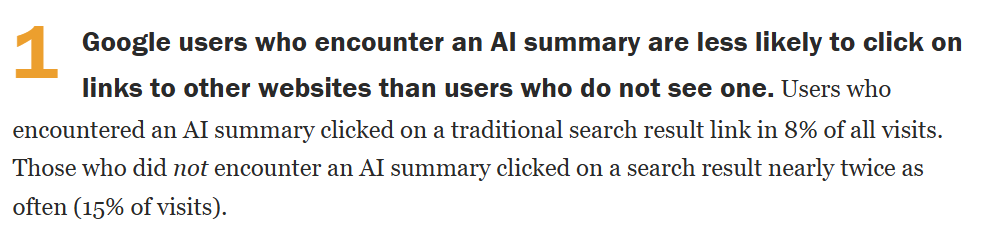
Pew Research Center found that when an AI summary appears, people click a normal search result in just 8% of visits, versus 15% when there’s no summary — and barely 1% click a source inside the overview itself.
So the question stops being “how do I rank tenth” and becomes “how do I get cited in the answer.”
Topical authority is how. AI systems lean on sources that cover a topic comprehensively and credibly, because those are the safest sources to summarise from.
This is also the honest answer to the “is SEO dead now that AI’s here” panic.
SEO didn’t die; it consolidated. The reward just moved harder toward depth and trust — which is exactly what topical authority builds.
It’s the foundation of ranking in AI search: cover a subject comprehensively and credibly, and you become a source AI is comfortable quoting.
And there’s a compounding bonus: once Google trusts your site on a topic, new articles in that topic rank faster. You stop starting from zero with every post.
Why It’s How Small NZ Sites Beat the Giants
You’ll never beat a DR 90 site like Ahrefs on backlinks. You can absolutely beat them by covering a specific topic more completely than they bother to.
In a small market like New Zealand, that’s not just an option; it’s the only sensible plan.
Think about what the average NZ business is up against. Search “topical authority” and the results are wall-to-wall international heavyweights with thousands of links each.
Backlinko’s analysis of millions of search results found the number one result has, on average, 3.8 times more backlinks than positions two through ten.

You are not winning that arms race. Trying to out-link Ahrefs from a Cambridge-based site is like turning up to a downpour with a garden hose: admirable effort, wrong tool.
But here’s the thing about those giants: they cover a topic once, broadly, then move on to the next. They have ten thousand topics to feed. You have one.
So you go narrow and deep where they go broad and shallow. You out-cover them on the one subject that actually matters to your business.
This is exactly how our SEO company got off the ground — and it’s not the first time. Most agencies here have nowhere near the reps that, humbly,
I’ve put in competing in the United States, where the SERPs are brutal and shallow content gets eaten alive.
Back in 2017 I started a project called HealthVI with my mentor and former business partner Ian Pribyl.
We took it from zero to over 1,000 visitors a day in just over a year, almost entirely on content depth (it even landed us in a bit of legal trouble along the way, but that’s a story for another day).
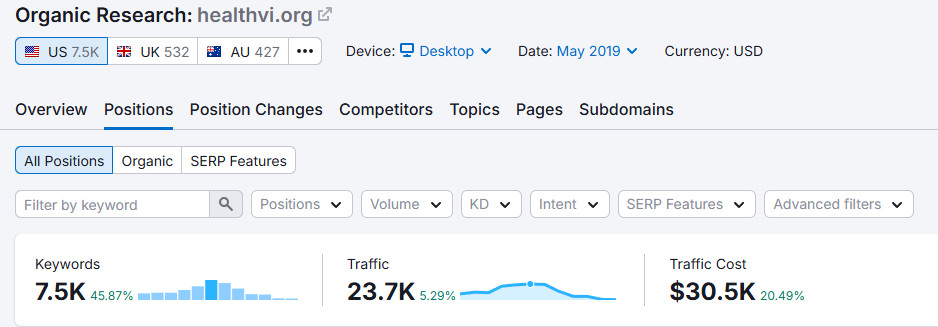
We did the same thing with Stopping Scams, which pulled over 5,000 visitors daily.

None of those sites won on raw authority early on. They won by becoming the most complete resource in their corner of the internet.
That’s also why a market like SEO in Auckland — the most contested in the country — still has room for a focused newcomer, and why professional services fighting it out in SEO in Wellington can climb on depth rather than spend.
You don’t need to be the biggest site. You need to be the most thorough one on your topic. This is the core of building an SEO strategy that actually works for a smaller business.
How Google Actually Measures Topical Authority
There’s no “topical authority score” hiding in Google. It doesn’t have a dial labelled topical authority. Instead, it infers your expertise from a handful of signals working together.
Those signals are:
Coverage. How completely your site addresses the topic. One thin page on “small business SEO” says little.
Fifteen pages covering every sub-question says you’re a serious source. Backlinko’s analysis of millions of search results found comprehensive, in-depth content consistently out-performs shallow pages — coverage is the signal doing the heavy lifting.

Structure. How your content connects. A tight internal link structure between a main page and its supporting articles shows Google the shape of your expertise — which pages are the pillars and which are the detail.
On-page signals. Whether each page is clearly about what it claims to be about. This is plain optimising your pages — clear titles, headings, and content that matches intent.
E-E-A-T. Experience, Expertise, Authoritativeness, Trust. Real authorship, first-hand experience, and citing solid sources all feed this. It’s why a page written by someone who’s actually done the thing beats a page assembled from other blogs.
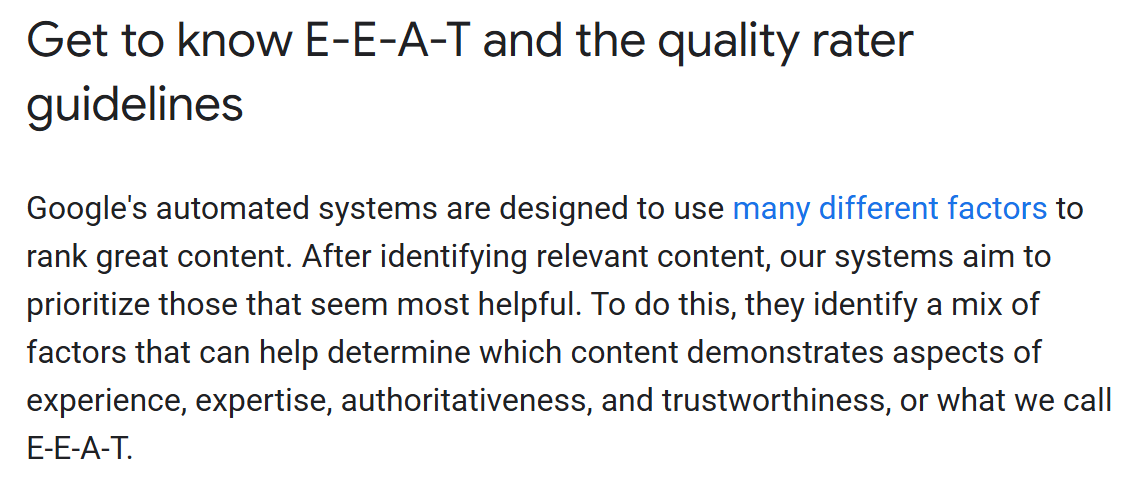
None of these is a single switch. Topical authority is the picture they paint together: a site that covers a subject thoroughly, links it sensibly, and clearly knows what it’s talking about.
How to Build Topical Authority, Step by Step
Building topical authority comes down to five moves: choose a focused topic, map every question around it, build a pillar page plus supporting articles, link them tightly, and cover real intent better than anyone else.
Let me walk through each one.
First, choose a focused topic. Pick something narrow enough that you can realistically own it. “Marketing” is too broad for anyone. “SEO for NZ mortgage brokers” is a topic a focused site can actually dominate.
The narrower your starting scope, the faster you build authority — you can always expand outward once you own the core.
Next, build a topic map. This is the part most people skip, and it’s where the work really lives. A topic map is simply every question and subtopic a reader could have about your topic, organised so you can see what to write.
These days I’ll run the first pass through ChatGPT to widen the net fast. It’s good at surfacing subtopics you’d never have thought of, which you then sanity-check against real search data and what you actually hear from customers. Let it build the map; don’t let it write the articles.
Here’s a prompt that does the job:
You’re an SEO strategist helping a [type of business] in [city, NZ] build topical authority around [core topic].
List every subtopic, question and angle a reader could have about it. Organise them into one pillar page plus supporting cluster articles, and label each as informational or commercial intent.

You can also build it from People Also Ask boxes, Google autocomplete, the gaps in competitor articles, and — most valuable of all — your own experience of what customers actually ask.
Good keyword research feeds this, but your head feeds it more.
Then create your pillar and clusters. The pillar page covers the broad topic and links out to everything.
The cluster articles each go deep on one sub-question. Pillar = the overview. Clusters = the detail. Together they tell Google you’ve covered the whole subject, not just the headline.
Interlink the cluster. Every cluster article links up to the pillar and across to its siblings where it’s genuinely relevant.
This is the structure that signals expertise — and it’s the step people most often half-do. Loose pages floating around with no links between them read as a pile of articles, not a body of expertise.
Cover intent, not just keywords. Some questions are informational (“what is a mortgage pre-approval”), some are commercial (“best mortgage broker Hamilton”).
A topic you’ve truly covered answers both — the research questions that build trust and the buying questions that bring revenue.
A financial adviser who only writes sales pages and never answers the early questions has covered half a topic, and Google can tell.
Then you keep filling gaps over time. Topical authority is a build, not a launch. Every question you answer that competitors haven’t makes the picture more complete.
Content over 3,000 words — which usually means content that actually covers a subject properly — earns 77% more referring domains than short content, so depth pays off twice: it builds authority directly and pulls in the links that help everything else.
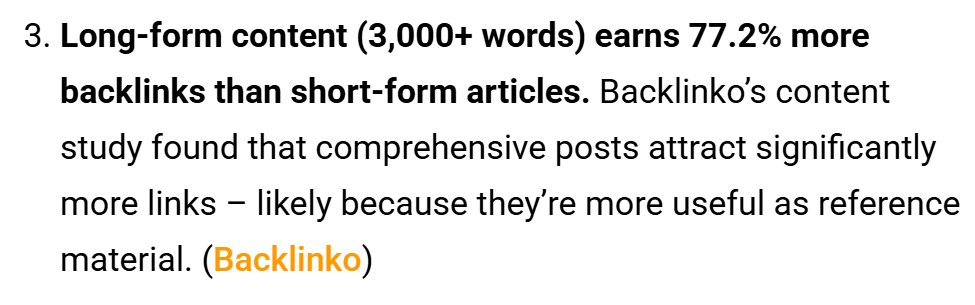
This is the heart of publishing content that ranks.
Do this consistently and, nine times out of ten, you’ll out-rank the bigger sites that never bothered to go this deep.
A Real NZ Topic Map Example
Here’s what a real topic map looks like for a mortgage broker in Tauranga trying to own their patch.
The pillar page is the broad one: something like “Mortgage Broker Tauranga” — the page that introduces the business, the service, and links out to everything else.
Then the clusters go deep on every question a borrower actually has:
- First-home buyer guides (KiwiSaver withdrawal, the First Home Grant, low-deposit lending)
- Refinancing and breaking a fixed term
- Self-employed and contractor mortgages
- How pre-approval actually works
- What to do when the bank says no
- Construction and turn-key lending
Each of those is a separate article. Each links back up to the pillar and across to the relevant siblings.
The informational ones (KiwiSaver rules, how pre-approval works) build trust and pull in early-stage searchers. The commercial ones (the service pages) catch people ready to act.
Cover that list properly and you’ve built something a generic national comparison site simply hasn’t: the complete, local, genuinely expert resource on mortgages in that region.
That’s how mortgage broker SEO wins — not on domain power, but on owning the topic in a way the big players never will for one NZ town. The same map works for any service business; just swap the topic and the questions.
How to Measure Topical Authority
There’s no official topical authority score, so ignore any tool that claims to give you one. You measure it through proxies — signals that tell you whether your authority on a topic is growing.
The ones worth watching:
Rankings across the whole topic, not one keyword. Are you climbing for the cluster as a group, not just the pillar? That’s authority spreading.
How fast new pages rank. When a fresh article in your topic ranks within days instead of months, Google trusts your site on that subject. That speed is the clearest sign topical authority is working.
Impressions in Search Console. Watch the topic’s impressions trend up over time. It’s the earliest signal, well before clicks move.
AI citations. Are you turning up in AI Overviews and ChatGPT answers for your topic? That’s the modern authority signal, and it’s free to check — just ask the questions and see who gets quoted.
Be wary of “topical authority checkers.” Most slap a number on your site that doesn’t map to anything Google actually does. The real measure is whether you’re ranking and getting cited across a topic.
If you want a clear read on what’s helping or hurting your coverage, a proper SEO audit will tell you far more than any authority-score widget.
The Mistakes That Waste Months
Most failed attempts at topical authority die from the same handful of mistakes. Here’s where the time gets burned:
Publishing volume without covering intent. Twenty thin posts that all rephrase the same question aren’t coverage — they’re noise. One properly answered question beats five shallow ones.
Diluting the site across unrelated topics. This is the big one. A site about plumbing that suddenly starts blogging about recipes and travel tells Google it isn’t sure what it’s about.
I’ve seen a law firm’s site lose ground because someone decided to blog about general “business tips” instead of going deeper on legal questions. Stay in your lane and dig.
Thin pages padding the cluster. A cluster of weak 300-word articles doesn’t build authority; it drags the whole topic down. Every page has to earn its place.
Ignoring the internal links. Pages with no links between them don’t read as a body of expertise. The structure is half the signal.
Quitting before it compounds. Which brings us to the part nobody warns you about.
What the First Few Months Actually Look Like
For the first couple of months, building topical authority looks like nothing’s working. That’s normal, and it’s exactly when most people quit.
Here’s the honest timeline.
You publish your pillar and your first few clusters, and… not much. A trickle of impressions.
The odd ranking on page four. It feels like watering a paddock in the dark — no sign anything’s taking, and you start wondering if you’ve been sold dud seed.
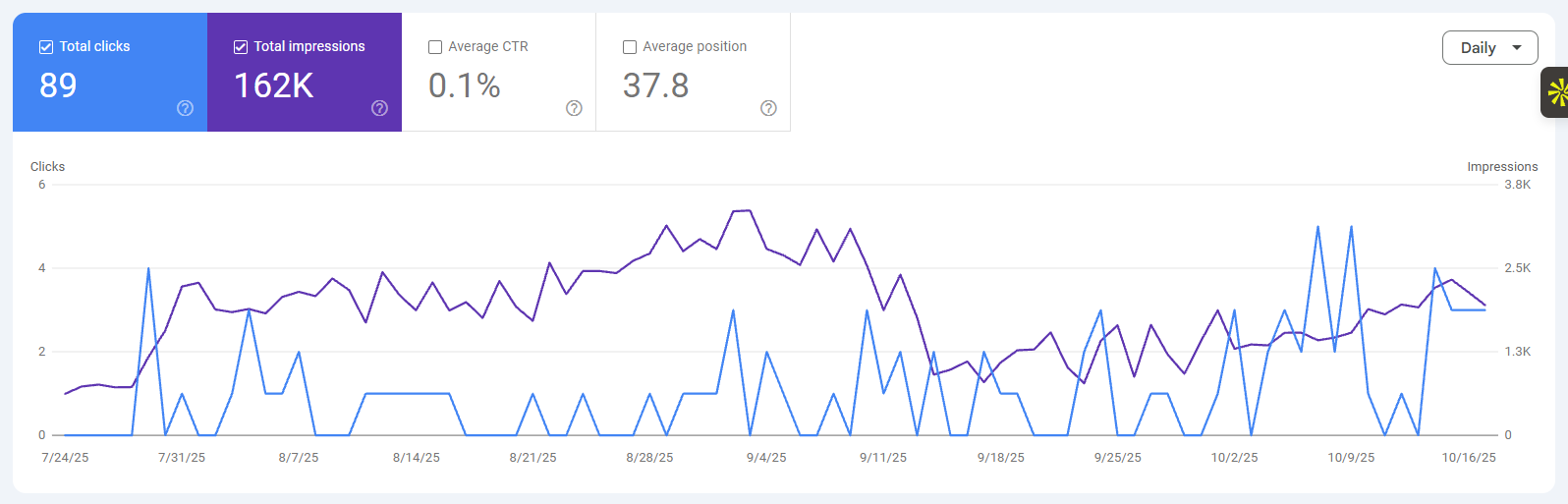
Then somewhere around month three or four, if you’ve kept going, it starts. Pages that sat at position 40 jump to page two.
New articles rank within a week instead of vanishing. The whole topic lifts together, because Google has finally seen enough to trust you on it.
That’s the compounding curve, and it’s a big part of why how long SEO takes catches so many businesses off guard.
Our own site went from a brand-new domain to AI citations and out-ranking decade-old agencies — but not in week one. The early months looked like the early months always look: quiet.
The businesses that win at this aren’t the ones with the best first month. They’re the ones still publishing in month four.
When to Build It Yourself vs Hire an Expert
You can build topical authority yourself. There’s no secret to it: a focused topic, a thorough map, a pillar and clusters, tight internal links, and the patience to keep going. The real question is whether you’ve got the hours.
For a lot of NZ business owners, the honest answer is no.
Mapping a topic properly, writing twenty in-depth articles, and interlinking them takes serious time, and that time competes with running the actual business.
If you’ve got the appetite and the hours, do it yourself — this guide is the whole playbook.
If you’d rather hand it off, that’s where we come in. You can get professional SEO help to build the whole topic cluster for you, or SEO consulting if you want the strategy and a map to run yourself.
Either way, the goal is the same: become the most complete source on your topic, and let that do the ranking.