

Somewhere along the way, someone told you to “sprinkle in LSI keywords.”
Maybe a blog post. Maybe a plugin. Maybe an SEO tool waving a list of related words at you, promising better rankings if you just stuff enough of them in.
Here’s the straight answer before we go any further: LSI keywords don’t exist. Google has said so out loud, more than once.
The idea has floated around SEO for over a decade. Half the advice written about it is wrong, and chasing it is a great way to burn hours on a tactic that was never real in the first place.
So let’s clear it up properly — what people actually mean by “LSI keywords,” why they’re a myth, and what really moves rankings instead.
What Are LSI Keywords?
LSI keywords are words and phrases supposedly related to your main keyword — terms a search engine reads to work out what your page is actually about. LSI stands for Latent Semantic Indexing.
Say your main keyword is “flat white.” The “LSI keywords” would be the related terms that naturally cluster around it: espresso, steamed milk, barista, café, single origin.
The theory goes like this: scatter those related words through your content, and Google reads them as proof your page covers the topic — so it ranks you higher.
That’s the pitch you’ll find on a thousand blog posts and behind every “LSI keyword generator” on the internet.
It sounds reasonable. It’s also wrong.
Are LSI Keywords a Real Ranking Factor?
No. Google does not use latent semantic indexing to rank pages, and it never has on the open web.
This isn’t a grey area. Google’s own John Mueller put it about as plainly as anyone could: “There’s no such thing as LSI keywords — anyone who’s telling you otherwise is mistaken.”
He said that in 2019. Then, because the myth refused to die, he said it again in 2023 — same answer, a few years more tired.

So where did “LSI” even come from?
It’s a real technology — just an ancient one. Latent semantic indexing comes from a 1988 research paper, built to make sense of small, fixed sets of documents. Think a single library’s catalogue, not the entire internet.
That’s the problem. LSI was designed for a closed room of a few thousand documents.
Google indexes hundreds of billions of constantly-changing pages. The maths that worked for the library was never going to scale to the web — and Google’s engineers knew it from the start.
SEO researcher Bill Slawski, who spent years buried in Google’s patents, summed the whole thing up: “LSI keywords do not use LSI, and are not keywords.”
Why People Still Talk About LSI Keywords
If Google doesn’t use them, the obvious question is why the term is still everywhere. It survives for two reasons, and neither one is Google.
First, money. There’s a whole industry of “LSI keyword generator” tools — apps named after a technology Google doesn’t use, selling you lists of words you don’t need. The name sells. So the name sticks.
There’s a bit of a game in this industry, too.
Throw enough technical-sounding jargon at a business owner — “latent semantic indexing,” “co-occurrence vectors,” “semantic density” — and their eyes glaze over.
It sounds so complicated they decide not to think about it, hand the whole thing over, and pay someone to make the scary words go away.
Half the time, that jargon does nothing but make simple work look complicated — so you stop asking questions and open your wallet.
Second, copying. SEO advice gets repeated far more than it gets checked. One blog said “use LSI keywords” back in 2015, a hundred others copied it, and the claim hardened into fake gospel.
I’ll be straight about why I can call it bullcrap with a clear conscience.
I came up competing in the United States, where the market is savage — you keep your finger on the pulse or you get buried. Staying current isn’t optional over there.
New Zealand is a gentler game. Far fewer players, far less pressure. Which means plenty of agencies here are still running tactics that quietly stopped working years ago — and “add your LSI keywords” is one of them.
Most haven’t had to keep their edge sharp the way you do competing overseas (humbly).
You’ll even see invented stats propping it up — “LSI keywords boost traffic by 30%,” that kind of thing. Follow the link back to the source and there isn’t one. Someone made the number up, and everyone else borrowed it.
What Google Uses Instead of LSI Keywords
Here’s the part that matters: Google doesn’t use LSI, but it absolutely understands meaning. So related words do help your SEO — just not for the reason the myth claims.
Modern Google runs on semantic analysis, entities, and natural language processing.
Updates like Hummingbird, RankBrain and BERT taught it to read a page the way a person does — for meaning and context, not just matching strings of letters.
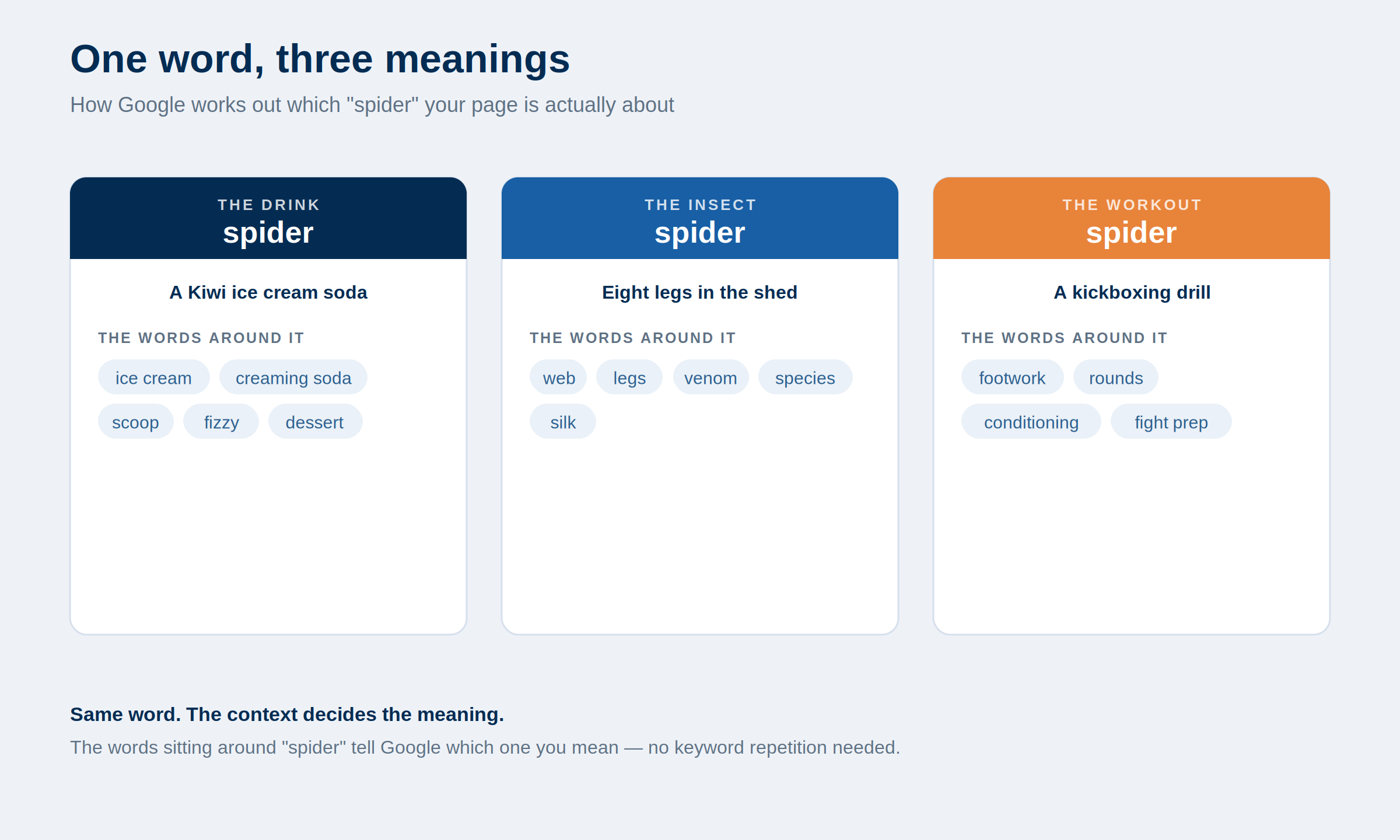
Take the word “spider.” On its own, Google has no clue which one you mean.
Talk about webs, eight legs and huntsmans, and it knows you mean the creature.
Mention ice cream, fizzy and a tall glass, and it knows you mean the Kiwi dessert — a scoop of ice cream drowned in soft drink.
Bring up City Kickboxing, footwork and fight prep, and it knows you mean the conditioning drill the fighters run.
Same word, three completely different meanings. The surrounding words are what tell Google which one you’re on about. That’s entities and context at work — not LSI.
Back when Google graded a page on keyword density — how many times a term appeared — stuffing in related words might have nudged things. Those days are long gone.
Now think about our law firm. Write a genuinely good page on SEO for law firms, and you’ll mention litigation, conveyancing, family law and court without even trying.
Not because you hunted down a keyword list — because you actually know the subject. The related terms show up on their own, the way they always do when an expert writes about their field.
That’s the bit the “LSI” crowd has backwards. Related words don’t cause good rankings. They’re a by-product of content that genuinely covers its topic.
Before we move on, let’s kill the vocabulary confusion, because three terms get mixed up constantly:
| Term | What it actually means | Does Google use it? |
|---|---|---|
| LSI keywords | A 1980s indexing method misapplied to SEO | No — Google has confirmed it doesn’t |
| Semantic keywords | Words and concepts related in meaning to your topic | Yes — this is how modern search understands content |
| Secondary keywords | Other real search terms you also want a page to rank for | Yes — these are deliberate ranking targets |
When someone says “LSI keywords,” they almost always mean semantic keywords. The difference matters, because only one of them is real — and the real one, semantic SEO, is genuinely worth understanding.
Why Semantic Keywords Aren’t What Get You Ranked
So related terms help a little, and they turn up on their own. Good. Now here’s the opinion I’ll back with ten years of doing this: they’re nowhere near important enough to spend a single minute chasing.
I’ve been doing SEO for over a decade — competing in brutally expensive US markets, not just New Zealand — and I’ve helped build and grow sites past 100,000 visitors a month.
In all that time, “did I use enough related keywords” has never once been the thing that moved the needle.

The reason is simple. Search engines got smart. Really smart.
We’re well past the days when you could nudge a ranking by feeding Google the right vocabulary.
Now you’ve got AI Overviews and large language models reading your content for genuine expertise and completeness — can this page actually answer the question, written by someone who clearly knows their stuff?
You don’t fake that with a word list.
Take Expert SEO — my own agency. It’s under a year old, sitting in a market full of NZ agencies with ten-year head starts. It ranks #1 for competitive terms, above the Ahrefs and Semrush pages, on a fraction of their authority.

It also gets pulled straight into Google’s AI answers and cited in ChatGPT responses.
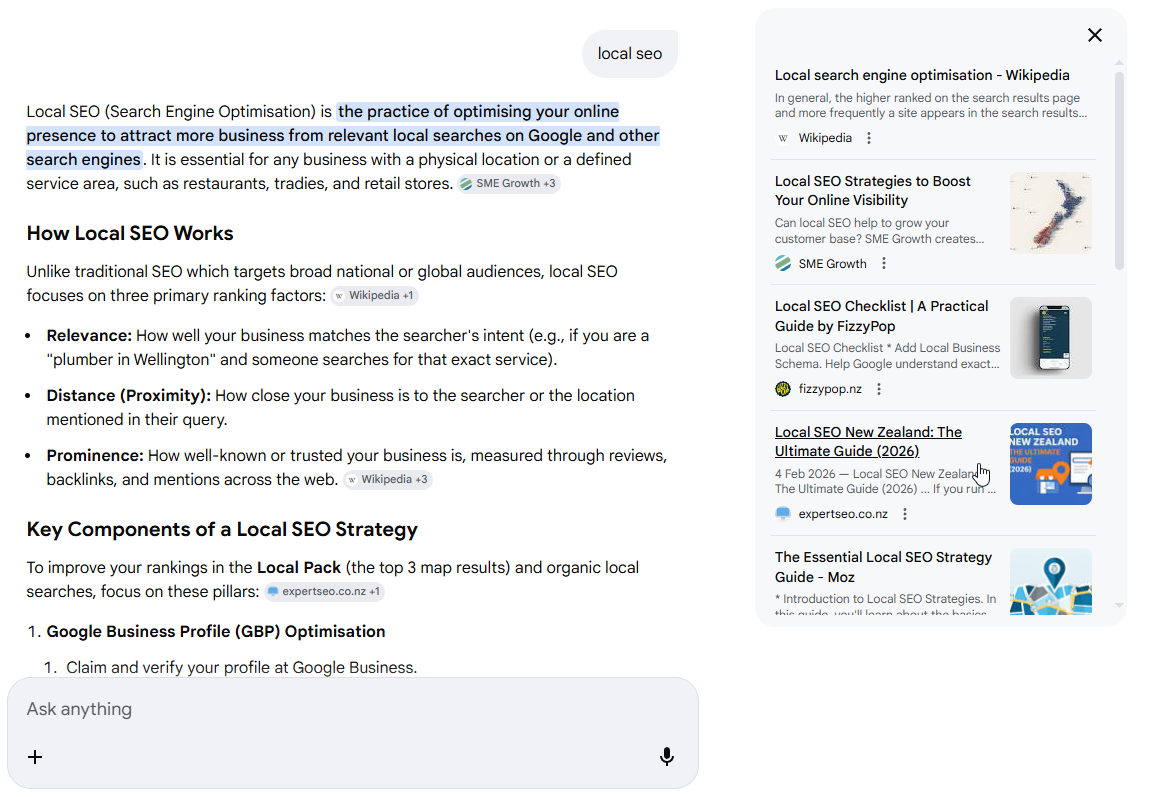
I didn’t get there by counting semantic keywords. I got there by covering topics properly and building authority.
And that’s where your time should actually go. If you want to move rankings, the levers that matter are topical authority — becoming the site Google trusts on your subject — and link building, earning other credible sites to vouch for you.
Put the energy where the leverage is. The related words come free; authority is what you have to earn.
What to Do Instead of Chasing LSI Keywords
Forget hunting for LSI keywords. The job is simpler and far more effective: cover your topic completely, answer the real questions people have, then put your effort into authority.
Here’s the process I actually use:
- Start with search intent. Before anything else, work out what the person actually wants when they search your keyword — an answer, a comparison, a service. Get this wrong and nothing else matters. This is where real keyword research starts: with intent, not volume.
- Map the subtopics and questions to cover. Pull the real things people ask using Google autocomplete, the “People also ask” box, the related searches at the bottom of the results, and Ahrefs’ “also rank for” report. You’re not collecting magic words — you’re finding the questions your page has to answer to be complete.
- Write it like an expert would. Now just explain the topic properly. Say you run an SEO agency in Auckland: write the page a business owner actually wants to read, and the related terms — pricing, rankings, case studies, differentiators — land on their own. No checklist required.
- Then build authority. Once the content genuinely covers the topic, the real ranking work begins — earning links and building depth across your site. This is the part that’s hard, slow, and worth it.
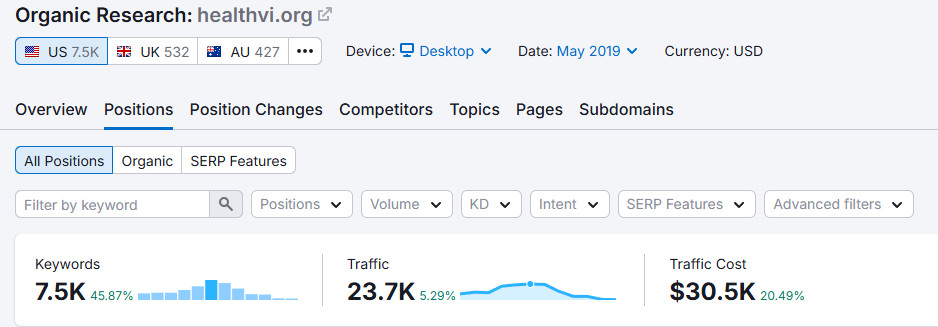
This is exactly how I grew HealthVI from zero to over 20,000 monthly visitors — a health site I built with my former business partner and SEO mentor, Ian Pribyl (a project that even landed us in a bit of legal trouble at times).
We never once sat around brainstorming “LSI keywords.” We covered topics better than anyone else, then built the authority to back it up.
ChatGPT and Claude are fine for speeding up step two. They’ll spit out subtopics and angles you might have missed — just treat them as an idea generator, not the final word.
The judgement about what actually belongs on the page is still yours.
Don’t Over-Optimise Your Content
There’s an opposite mistake here, and it’s just as damaging: cramming related words into your content to hit some tool’s score.
Plenty of content optimisation tools will scan your draft and tell you to use the word “cheese” 47 more times to “match top-ranking pages.”
Ignore that. Writing for a score instead of a reader is how you end up with stiff, keyword-stuffed content that Google’s helpful-content systems are built to demote.
Write for the person reading. Cover the topic because it deserves covering. The score takes care of itself — and so does your ranking.
When to Do SEO Yourself vs Hire an Expert
Whether you tackle this yourself comes down to one thing: time.
The approach in this guide isn’t secret or complicated. Pick topics that match real intent, cover them better than anyone else, and build authority steadily over months.
If you’ve got the hours to learn it and do it consistently, you can absolutely run your own SEO.
If you’d rather have it handled properly — by someone who’s done it for a decade — that’s where done-for-you SEO comes in.
We cover the topics, build the authority, and skip the myths entirely.
Either way, stop worrying about LSI keywords. They were never the thing.
LSI Keywords: FAQ
What does LSI stand for?
LSI stands for Latent Semantic Indexing — an information-retrieval method from the 1980s. Despite the name being everywhere in SEO, Google doesn't use it to rank web pages.
What's an example of an LSI keyword?
For the topic "flat white," so-called LSI keywords would be related terms like espresso, barista, steamed milk and café. They're just words semantically related to the topic — not a special keyword type Google tracks.
Are LSI keywords a ranking factor?
No. Google has confirmed it doesn't use latent semantic indexing, so LSI keywords are not a ranking factor. Covering your topic thoroughly is what helps — not a list of related words bolted on afterwards.
What's the difference between LSI keywords and semantic keywords?
"LSI keywords" refers to an outdated 1980s method Google never used on the open web. "Semantic keywords" are simply words related in meaning to your topic — and those genuinely help search engines understand your content. When people say LSI, they almost always mean semantic.
How do I find LSI keywords?
You don't need to. Instead of hunting for magic words, find the real subtopics and questions to cover using Google autocomplete, the "People also ask" box, related searches, and tools like Ahrefs. Cover those properly and the related terms appear on their own.
Can I use ChatGPT to find related keywords?
Yes. ChatGPT or Claude are useful for brainstorming subtopics and angles you might have missed. Treat them as an idea generator, then use your own judgement about what actually belongs on the page.
Recommended Reading

Topic Clusters
How to group your content so Google sees you as the authority on a whole topic, not just one page.
SEO Content
How to plan and write content that actually ranks in New Zealand — from brief to published.

Content Optimisation
The real way to optimise a page for search — covering a topic fully, no keyword-stuffing required.