

You’re halfway through writing a page. The Rank Math light next to “keyword density” just flicked orange. It reckons you haven’t used your keyword enough, and now you’re tempted to scroll back up and wedge it in a few more times.
Don’t.
I’ve got a page that ranks #2 in New Zealand for “SEO Hamilton.” Its keyword density is 0.23%. Rank Math absolutely hates it — red cross, the lot.

It ranks anyway.
This guide breaks down what keyword density actually is, whether it matters (short version: barely), and the exact on-page checklist to nail instead — so you can hit publish and stop counting words.
What Is Keyword Density?
Keyword density is the percentage of times your target keyword appears on a page compared to the total word count.
Use your keyword 10 times in a 1,000-word article, and that’s a density of 1%.
The formula is dead simple:
(number of times the keyword appears ÷ total words) × 100
So a page for an Auckland café that mentions “best brunch Auckland” 8 times across 800 words sits at 1%.
Every keyword density checker you’ll find — and there are dozens — just runs that one sum for you. Paste your text in, it counts, it spits out a percentage.
Handy to know. Not handy to chase. Here’s why.
Does Keyword Density Actually Matter for SEO?
No. Keyword density isn’t a Google ranking factor, and it hasn’t been one for well over a decade.
That’s not my hot take. It’s Google’s own position.
Matt Cutts, who used to run Google’s webspam team, told people to stop obsessing over keyword density years ago. His point was blunt: there’s no magic ratio, and anyone selling you one is probably selling keyword density software too.
Google’s John Mueller has said much the same since — keyword density is something he wouldn’t focus on. Just write naturally.

And you can watch it play out on my own pages. I run an SEO company called Expert SEO.
One of our pages ranks #2 in Google for “SEO Hamilton.” Rank Math flags its density at 0.23% — the keyword shows up a grand total of 12 times — and throws a red cross next to it.
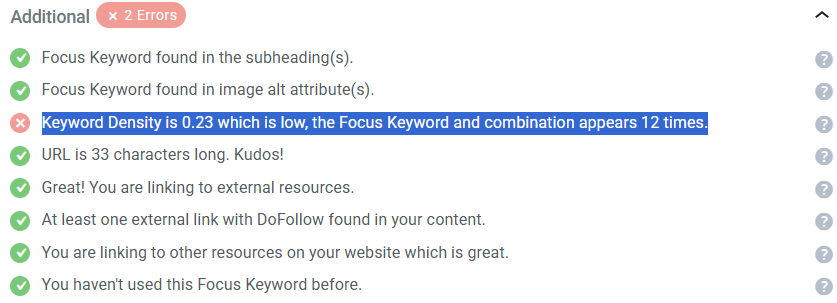
The SEO Hamilton page sits at #2 for the exact term anyway.

If density were a real ranking factor, that page would be buried. It isn’t. Modern search engines don’t count repetitions to figure out what a page is about — they read topics, synonyms and context.
Density is a symptom of writing naturally about your subject. It was never the cause of the ranking.
Is There an Ideal Keyword Density?
There’s no ideal keyword density. No target percentage Google wants, and any specific number you’ve been handed was invented by someone — not enforced by Google.
You’ve probably seen “1–2%” thrown around. Or “0.5% to 3%.”
That second range comes straight from Yoast — its plugin hands you a green light when your keyphrase density lands between 0.5% and 3%.
Here’s the part worth noticing: Yoast itself now says using your exact keyphrase a set number of times has become less important. They still check it, but they’ll tell you straight that Google has moved on.
So chasing a number is the actual mistake. My Hamilton page sits at 0.23% — miles under Yoast’s “minimum” — and ranks #2.
Write the page naturally, cover the topic properly, and the density sorts itself out. Run a checker afterwards if you’re curious. Just don’t write to hit a target.
Keyword Density vs Keyword Stuffing
The only “density” that gets you in trouble is the kind that reads as stuffing — and that’s a spam penalty, not a density rule.
Keyword stuffing is when you cram a keyword in so many times the writing stops sounding human.
Google’s spam policies call it out directly: filling a page with keywords to manipulate rankings can get your site demoted.
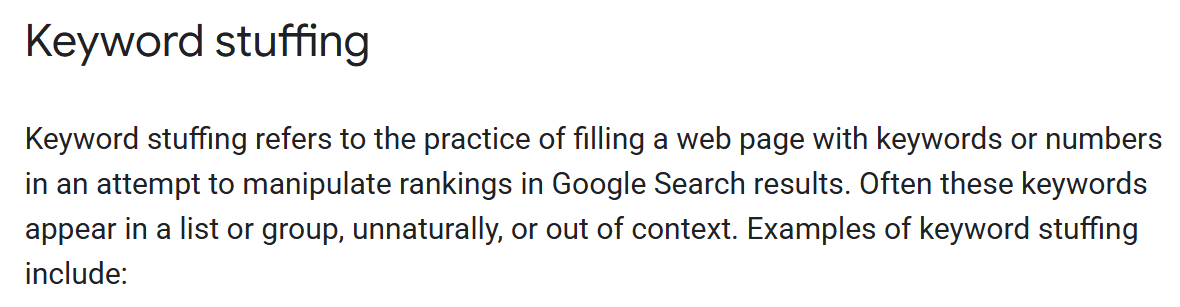
The line between natural use and stuffing isn’t a percentage. It’s a readability test.
Read the page out loud. If it sounds forced — the same phrase shoved in again and again — you’ve overdone it. If it sounds like a person explaining something, you’re fine.
That’s the real risk with density targets. Chase a high number and you drift toward stuffing. Chase nothing and write for the reader, and you’ll never get close.
Why People Still Obsess Over Keyword Density
People fixate on keyword density because a plugin trained them to.
Yoast and Rank Math both stick a little traffic light next to it. Green is good, orange means “fix me,” red means panic. And a dot turning green feels like progress.
So people chase the green — even when the plugin is flagging the one thing that doesn’t matter.
That red cross on my Hamilton page? That’s the trigger. It’s the plugin telling me to “fix” a page that’s already sitting at #2.
Plugins check density because it’s easy to measure, not because it’s important. A percentage is simple to calculate. “Did this page genuinely answer the question better than everyone else’s?” isn’t — so the plugin doesn’t even try.
Once you’ve sorted the on-page basics below, you have my full permission to ignore that orange light forever.
Get Your On-Page SEO Right, Then Forget the Number
Get your keyword into six places, write naturally, and you’ve done everything keyword density was ever a clumsy stand-in for.
This is the only “density” rule worth following. Nail your on-page SEO placement and you never need to think about percentages again.
Put your main keyword in these six spots:
- The URL
- The H1 — your main page title
- At least one H2 — a subheading
- The meta title
- The meta description
- The first 100 words of your content
That’s it. Do that, then write the rest for a human.
One catch: you can only do this if your site actually lets you edit those fields. Plenty of cheap template builds lock down your URLs, headings and meta tags — which is exactly why our website design is built to rank, not just to look good.
Say you’re a builder targeting “new home builder Tauranga.” Your URL is /new-home-builder-tauranga/. It’s in your H1. One of your H2s is “What a new home builder in Tauranga actually does.” It’s in your meta title and description. And it lands in your opening paragraph.
Six placements, sorted. From there you just explain what you do, answer what people ask, and never count a single keyword.
Whether you’re doing SEO in Auckland or anywhere else in the country, those six spots don’t change.
And look back at my Hamilton page for a second. Every other check is green — subheadings, alt text, links, URL length. The single red cross is density. That’s the one I ignored, and it’s ranking #2.
What Matters Far More Than Keyword Density
Once your placement’s right, the things that actually move rankings are quality content, strong backlinks, and matching search intent — every one of them infinitely more important than how many times you used a word.
Here’s where your time should actually go.
High-quality content. The page that fully answers the question wins. Depth, clarity, real help — that’s what Google and AI both reward. It starts with targeting the right keywords and then answering them better than anyone else.
Strong backlinks. Backlinks are still one of the biggest ranking factors going. They’re votes of trust from other websites, and they’ll do more for your rankings than any amount of keyword nudging.
Search intent. Rank the right type of page for the query. “How does a root canal work” wants a guide; “emergency dentist Hamilton” wants a service page. Match what the searcher actually came for.
Think about where an hour of your time goes furthest. An hour spent earning a good link, or writing a genuinely better page, beats an hour spent fiddling with your keyword count every single time.
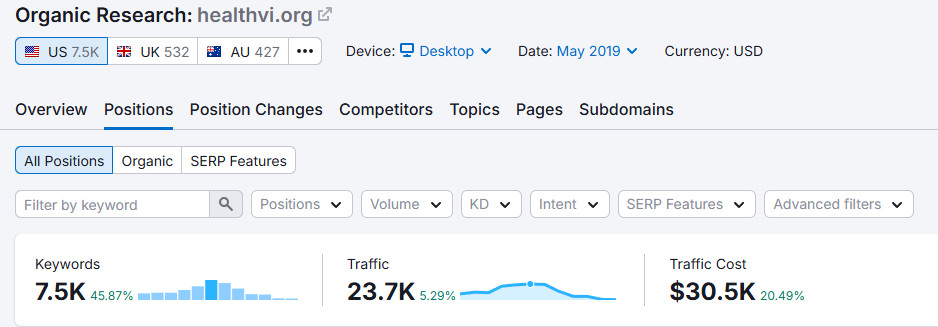
I grew a health site, HealthVI, from zero to over 20,000 monthly visitors doing exactly that — covering the topic properly and building authority. Not once did I check its keyword density.
Keyword Density in the Age of AI Search
AI search rewards keyword density even less than Google does.
ChatGPT and Google AI Overviews cite the source that answers the question best — not the one that repeats a phrase the most.
If anything, large language models are harder to fool with repetition. They work on meaning, not word counts. Stuffing a keyword won’t get you quoted. A clear, genuinely useful answer will.
The one time it’s still worth a quick look
There’s exactly one scenario where a density check earns its keep: when content’s been written by a cheap freelancer or churned out by AI, and you want to make sure it hasn’t accidentally stuffed your keyword over and over.
That’s a sanity check for stuffing — not a target to hit. You’re scanning for “did this go unnaturally high,” not “did this reach 2%.”
That’s the exception. Everywhere else, the number’s a distraction.
DIY vs Hiring an SEO Expert
Getting your on-page basics right is genuinely something you can do yourself.
The six-spot checklist above is most of the on-page game, and any business owner can apply it in an afternoon.
The harder, slower work is where it gets tricky — producing quality content consistently, building links, fixing technical issues, and keeping the whole thing moving month after month. That’s the stuff that eats time and takes experience.
If you’d rather hand that over and get back to running your business, done-for-you SEO is exactly where we come in.
Keyword Density: FAQ
What is keyword density in 1,000 words?
In a 1,000-word article, keyword density is how many times your keyword appears out of those 1,000 words, shown as a percentage. Use it 10 times and that's 1%.
There's no figure you need to hit — write naturally and it sorts itself out.
What is keyphrase density?
It's the same thing as keyword density. Yoast calls it "keyphrase density" because most search terms are more than one word.
The calculation is identical: keyword count ÷ total words × 100.
What is a keyword density of 2%?
A 2% density means your keyword makes up 2 of every 100 words — so 20 times in a 1,000-word page.
It's not a goal to aim for; it's just a number a checker gives you after the fact.
Is keyword density still important in 2026?
No. It isn't a Google ranking factor, and AI search cares about it even less.
Get your keyword into your URL, title, headings, meta and opening lines, then put your energy into quality content and links.
How do I check my keyword density?
Paste your content into any free keyword density checker and it'll work out the percentage for you.
Treat it as a sanity check for accidental stuffing, not a target to chase.
Recommended Reading

On-Page SEO Checklist: 25 Steps for NZ Websites
The full placement checklist, step by step.

Keyword Optimisation: How To Do It For NZ SEO
How to actually use your keywords once you've found them.

On-Page SEO vs Off-Page SEO
Where on-page fits in the bigger ranking picture.