

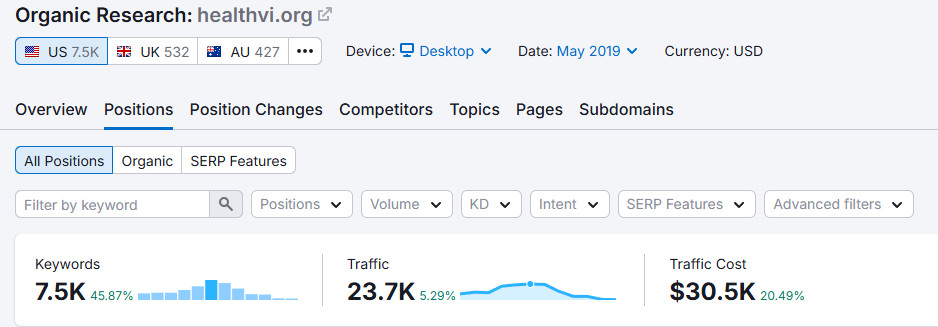
A sub-one-year-old New Zealand website, sitting in Google’s AI Overview and getting quoted by ChatGPT, ahead of agencies that have been building their sites for ten years.

That’s not a flex (well, maybe a little).
It’s the thing this whole guide is about.
Because the reason a near-new site can punch that far above its weight has a name, and the name is semantic SEO.
You’ve probably heard the term thrown around. And if you’ve read the big guides on it — Backlinko, Ahrefs, Semrush — you’ve seen it explained with running shoes and Paleo diets and a travel guide to Cinque Terre.
Good explanations. But none of them show you a real build. None of them is a New Zealand site you can go and check for yourself.
This one is.
I’m going to walk you through what semantic SEO actually is, why it now decides whether AI mentions you at all, and exactly how to do it — using a page I built that ranked number one in New Zealand, past the Ahrefs and Semrush guides, as the worked example.
Let’s get into it.
What Is Semantic SEO?
Semantic SEO is the practice of building content around a whole topic — its related concepts, entities and questions — so search engines and AI understand what your page means, instead of just matching the exact keyword.
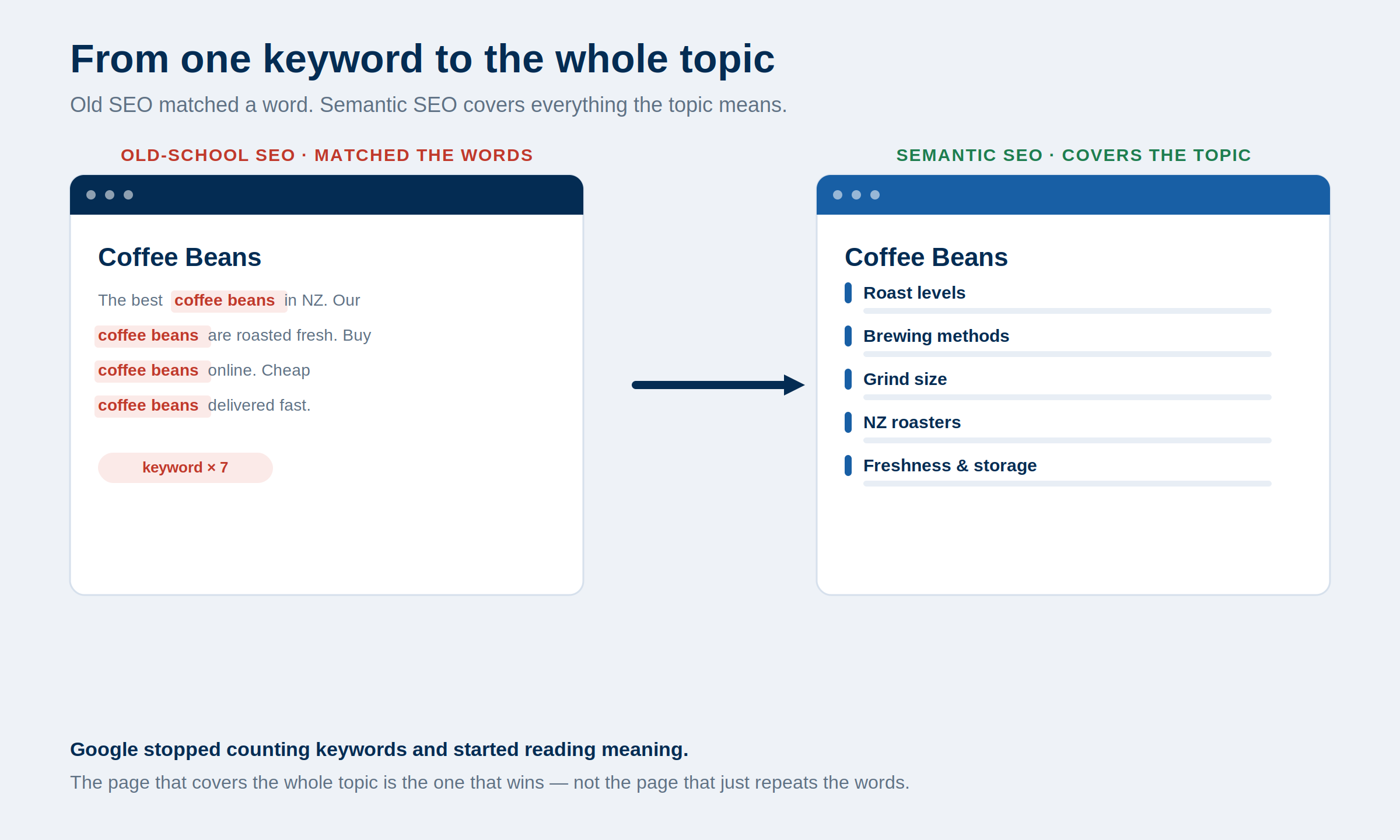
Here’s what it actually looks like:
Old-school SEO was about the keyword.
If you wanted to rank for “coffee beans,” you made sure the phrase showed up in your title, your headings, your text — enough times that Google went “ah, this page is about coffee beans.”
Match the words, win the ranking.
Semantic SEO is about meaning.
Google doesn’t need you to repeat the keyword anymore.
It reads the whole page and works out what you’re really talking about from the context — the related words and ideas sitting around it.
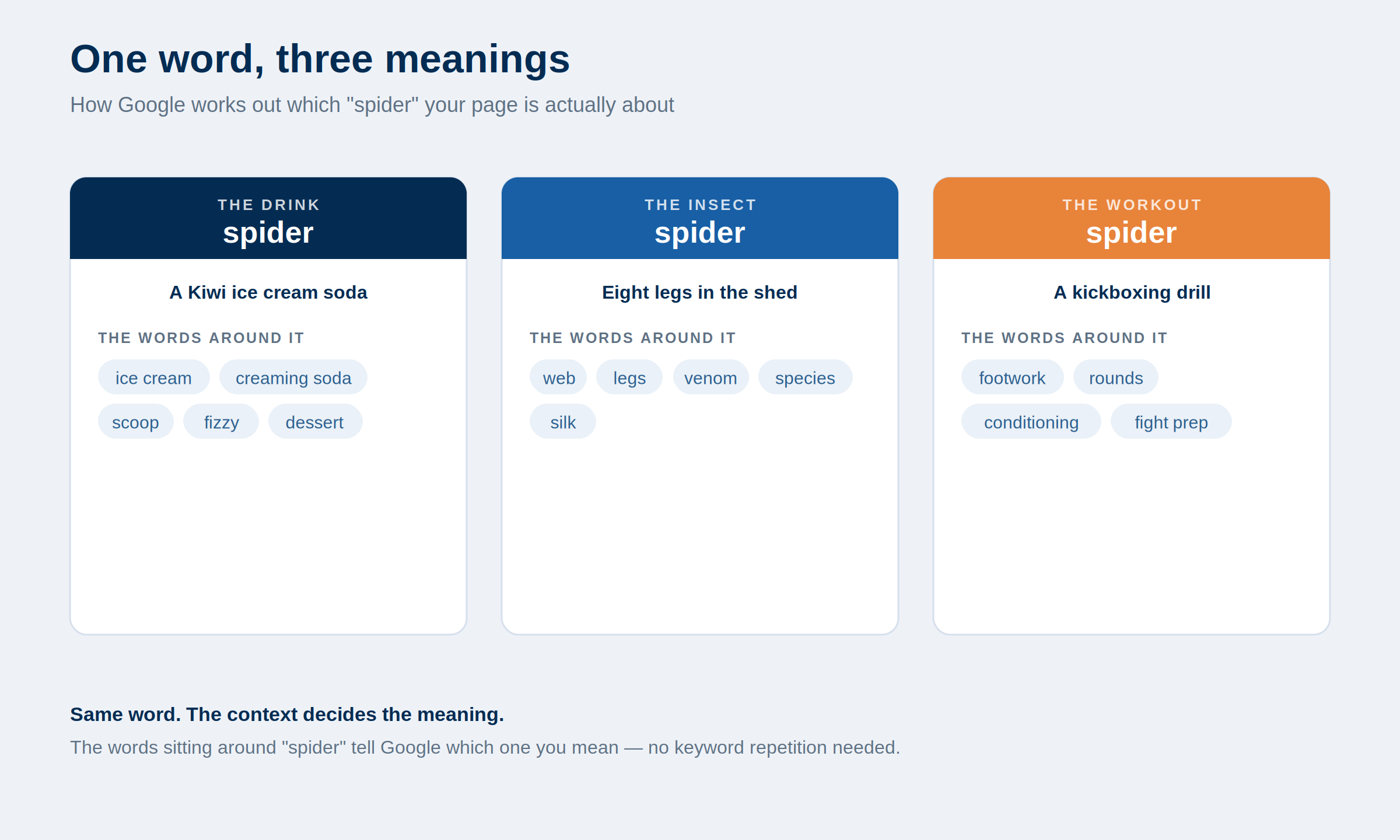
Take the word “spider.”
In New Zealand, a spider is a drink — a scoop of ice cream dropped into fizzy, usually creaming soda or lemonade.
It’s also the eight-legged thing in the corner of your shed.
And down at City Kickboxing, a “spider” is a conditioning drill the fighters do to prep for a fight.
Same word. Three completely different meanings.
So how does Google know which one your page is about? The words around it.
A page about the drink talks about ice cream, fizzy, scoops, dessert.
A page about the bug talks about webs, legs, species, venom.
A page about the drill talks about footwork, rounds, conditioning, fight prep.
The surrounding context tells the search engine which “spider” you mean — without you having to spell it out.
That’s semantic SEO working. Meaning from context, not keyword repetition.
Now here’s the trap, because it’s the exact mistake this spider example makes it easy to fall into.
You do not want all three spiders on one page to show range. That’s the opposite of what you want.
A page covering the drink, the bug and the workout has no clear meaning — Google can’t tell what it’s about, so it ranks for none of them.
You pick one meaning, then you cover everything inside that one topic as completely as possible.
The drink page covers ice cream flavours, which fizzy works best, how to make one, the Kiwi history of it, the variations.
Every concept that belongs to that topic — and nothing from the other two.
One topic per page.
Then you connect related pages to each other with internal links across your site.
That web of connected pages is where the bigger magic happens, but it starts here: one page, one meaning, covered to the bone.
Semantic SEO vs Traditional SEO
Traditional SEO matched words. Semantic SEO matches meaning.
You still do keyword research — you just stop stopping there.
In the early days, SEO was mostly about placement: keyword in the title, the H1, the URL, the first hundred words, sprinkled through the body.
Do that, and Google had enough to rank you.
On-page placement was the game.
That still matters — it’s the baseline.
But it’s no longer the whole story, because Google got smarter about meaning.
There are actually three ways a search engine can match a query to a page:
- Lexical — straight word-matching. You search “red leather shoes,” it finds pages with those exact words. Old Google worked like this.
- Semantic — matching by meaning. You search “comfortable red shoes for dancing,” and it understands the intent and surfaces the right products even if those exact words aren’t on the page. This is how LLMs work, almost entirely.
- Hybrid — a bit of both. A lexical base with semantic understanding layered on top. This is what Google actually uses today.
So keywords didn’t die; they just stopped being enough.
And here’s where I’ll say the quiet part out loud: semantic SEO is one of the ways search engines filter out the crap.
Think about it:
Dropping a keyword in the right spot is easy — anyone can do it.
I’ve had clients come to me after working with other SEO agencies — agencies charging real money — whose entire strategy was apparently “put the keyword in the title and hope.”
Their results showed it.
But properly covering a topic? Genuinely answering what the searcher came for, every angle of it? That’s hard.
It takes knowledge, effort, and actually caring about the reader.
You can’t fake it with a plugin.
So when Google has to decide who to trust — who to rank, who to feed into an AI answer — semantic depth is a brilliant filter.
The person who’s covered the topic completely is almost always more useful than the person who just placed the keyword well. Semantic SEO is how Google tells those two apart.
Here’s the difference at a glance:
| Traditional SEO | Semantic SEO | |
|---|---|---|
| Optimises for | A single keyword | A whole topic and its meaning |
| How Google reads it | Word matching | Meaning and context |
| Content shape | One keyword, repeated | Full topic coverage, related concepts |
| What wins | Right keyword placement | Most complete, useful answer |
| AI search | Largely invisible | How you get cited |
Why Semantic SEO Decides Whether AI Cites You
AI doesn’t match keywords — it takes your question, breaks it into a bunch of related sub-questions, and pulls answers from sources it understands and trusts.
Semantic SEO is how you become one of those trusted sources.
This is the part that changes everything, so stick with me.
AI search is enormous now.
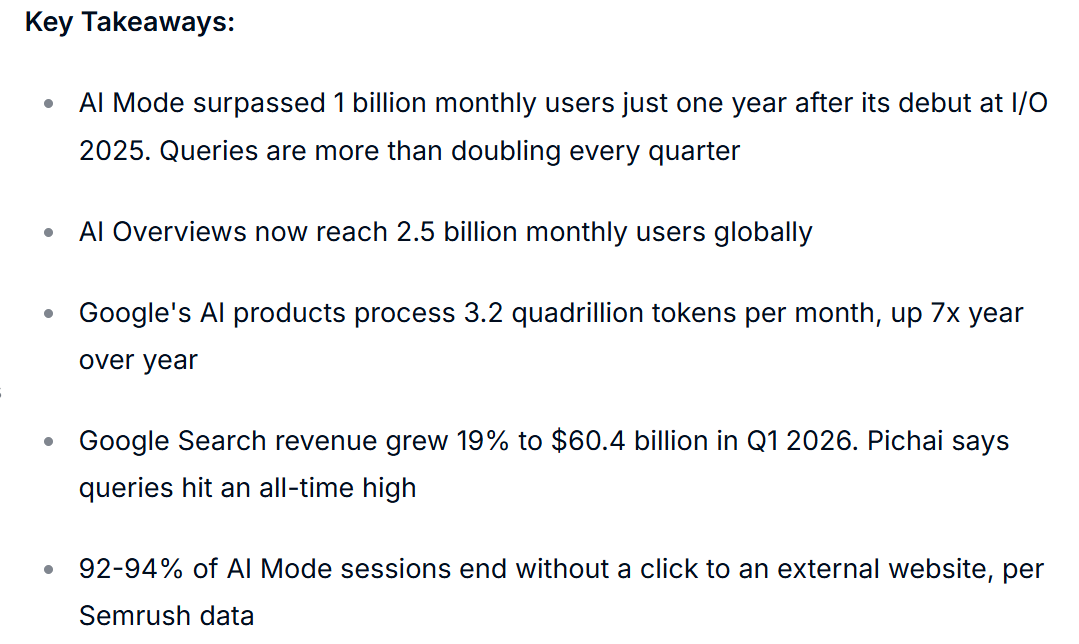
Google’s AI Overviews — the AI summaries sitting above the normal results — reach over 2.5 billion monthly users as of 2026.
Google’s AI Mode passed a billion monthly users in its first year, with query volume doubling every quarter.
This isn’t a side feature anymore — it’s how a huge chunk of people search.
And it works differently from blue-link search in a way that matters for you.
When you ask an AI a question, it doesn’t just look for a page with your keyword.
It does something called query fan-out — it expands your one question into a fan of related questions, searches all of them, then synthesises an answer from multiple sources.
The average AI Mode query is already three times the length of a traditional search, because people ask AI full, messy, conversational questions.

So a single keyword-optimised page can’t win this game.
If your page only answers one narrow slice of the topic, it only matches one branch of the fan-out.
The page that gets pulled into the answer is the one that covers the whole topic — every branch the AI fanned out into.
That’s semantic SEO: cover the topic completely, and you match more of the fan-out, which means you get cited more.
And getting cited is the new ranking.
When an AI Overview appears, only about 8% of searches end in a click, down from 15% when there’s no Overview.
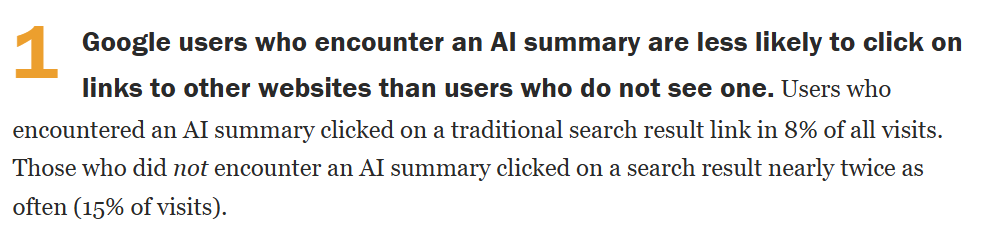
The traffic is shrinking.
But the brand named inside the answer still wins — it’s seen, it’s trusted, it gets the business even without the click.
Winning the AI citation is now tied directly to revenue, not just visibility.
Old goal: rank on the page.
New goal: be the source the answer is built from.
Semantic SEO is how you get there.
The Four Building Blocks of Semantic SEO
Four things do the heavy lifting in semantic SEO: entities, topical authority, search intent, and schema.
Get these right and you’re most of the way there.
Entities
An entity is a thing search engines recognise as a distinct, real concept — a person, a place, a company, an idea.
“Auckland” is an entity. “Google Business Profile” is an entity. So is “semantic SEO.”
Entities are how Google tells your spiders apart.
It knows “Apple” the company from “apple” the fruit because each connects to a different web of related entities — one sits near “iPhone” and “Tim Cook,” the other near “orchard” and “fruit.”
When your content clearly references the right entities, you’re handing Google the context it needs to understand exactly what you mean.
For an NZ business, that’s as simple as being specific and real: name the suburbs, the regions, the actual things in your world.
“A panel beater in Penrose, Auckland” carries far more entity signal than “a car repair business.”
Topical Authority
Topical authority is what you build when you cover a topic so completely that Google starts treating you as a go-to source on it.
You don’t earn it with one page.
You earn it with a pillar-and-cluster structure: one main “pillar” page on the broad topic, surrounded by a cluster of deeper pages on every subtopic, all linked together.

Cover every angle of a subject and Google starts to see your site as an authority on that whole subject — not just the single page.
This is the engine room of semantic SEO, and we’ll go deep on how to build it in a minute.
Search Intent
Search intent is the reason behind the search — what the person actually wants, not just the words they typed.
“How does panel beating work” and “panel beater Auckland quote” contain similar words but completely different intent.
The first wants information — it’s someone curious, perfect for a blog post.
The second wants to hire someone now — it’s commercial, and it needs a service page.
Same topic, totally different page.

Matching intent is non-negotiable in semantic SEO, because Google ranks the page that matches what the searcher meant, not the page that merely contains the words.
(I’ll show you exactly how to read intent in the how-to section below.)
Schema Markup
Schema markup is code you add to a page that spells out your facts in a language machines read cleanly — “this is a recipe,” “this is a local business,” “these are the reviews.”
It’s worth doing.
But I want to be straight with you, because the industry oversells it.
For years the pitch was “add schema, win AI search.”
Then in May 2026 Ahrefs ran the numbers — they tracked 1,885 pages that added schema markup and measured what happened to their AI citations.
The result? Basically nothing.
A slight drop on AI Overviews, no meaningful lift on ChatGPT or AI Mode.
They even found that the major AI systems read only the visible content on your page when they fetch it — your schema is invisible to them at the moment they’re deciding whether to cite you.

So schema is technical hygiene, not a magic lever.
Keep it — Google says there’s no penalty, it still powers some rich results, and Bing uses it.
But don’t believe anyone who tells you schema is how you win AI search.
The actual answer is everything else in this guide.
How to Do Semantic SEO
Semantic SEO done right is a repeatable process: read the intent, map every subtopic, build the cluster, cover each piece completely, then connect it all into a web of links.
Here’s the exact process, step by step.
Step 1: Read the Search Intent First
Before you write a word, work out what the searcher actually wants.
And the best place to figure that out is the search engine itself — it’ll tell you, if you look.
Type your core keyword into Google and read the page like a detective:
- What’s ranking? If the top results are all long guides, Google wants a guide. If they’re product pages, it wants a product page. Match what’s already winning — don’t fight it.
- What’s in the AI Overview? It shows you the exact angles Google thinks matter for this query.
- What’s in People Also Ask? Real questions real people are asking around this topic — each one is a section you might need.
- What do the autocomplete suggestions show? Start typing your keyword and watch what Google fills in. That’s real search demand.
Add it all up and the search engine has basically handed you a blueprint of what the searcher wants.
You can also lean on tools — Keywords Everywhere, for instance, spits out an intent label for a keyword so you’re not guessing.

Read the intent right and everything downstream gets easier; read it wrong and you can write a brilliant page that ranks for nothing, because it answered a question nobody asked.
Step 2: Map Every Subtopic
Now find every subtopic that lives inside your core topic.
This is where completeness is won or lost.
Start with the core topic, then dig out everything connected to it.
The PAA questions and autocomplete from Step 1 give you a head start.
But the fastest way to surface the subtopics you’d never think of yourself is ChatGPT.
Give it a prompt like: “I’m writing the most complete guide on [topic] for a New Zealand audience. List every subtopic, question, and related concept I’d need to cover to make it genuinely exhaustive.”
It’ll hand you a map — and there’ll be branches on it you’d have missed.
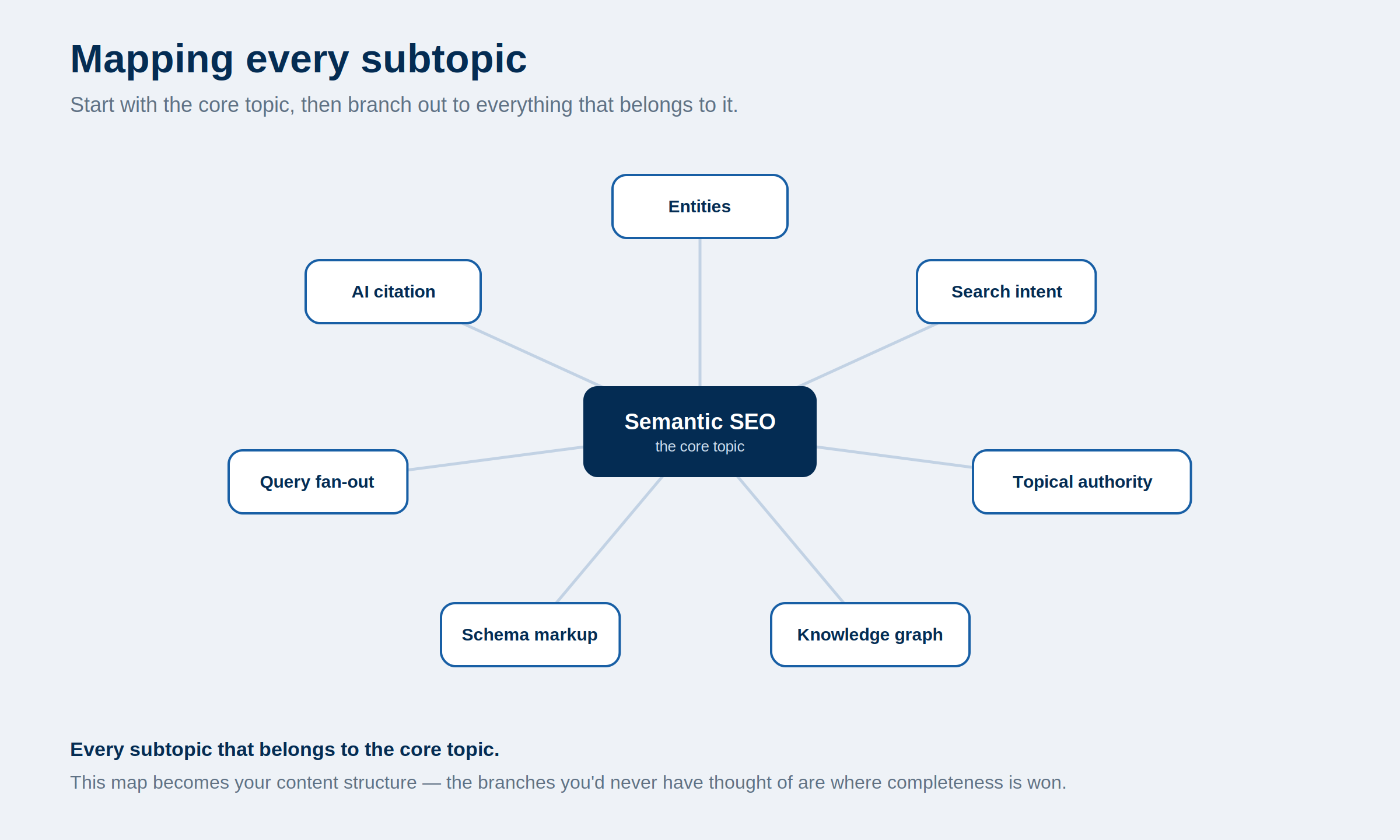
The goal is a full list of every concept that belongs to your topic.
That list becomes your structure.
Step 3: Build the Pillar-and-Cluster Architecture
Take your map and shape it.
One pillar page covers the broad topic.
Cluster pages go deep on each subtopic.
They all link to each other.
A pillar page on “local SEO” links out to cluster pages on Google Business Profile, reviews, local citations, and so on — and each of those links back.
Together they tell Google: this site doesn’t have a page on local SEO, it owns the whole topic.
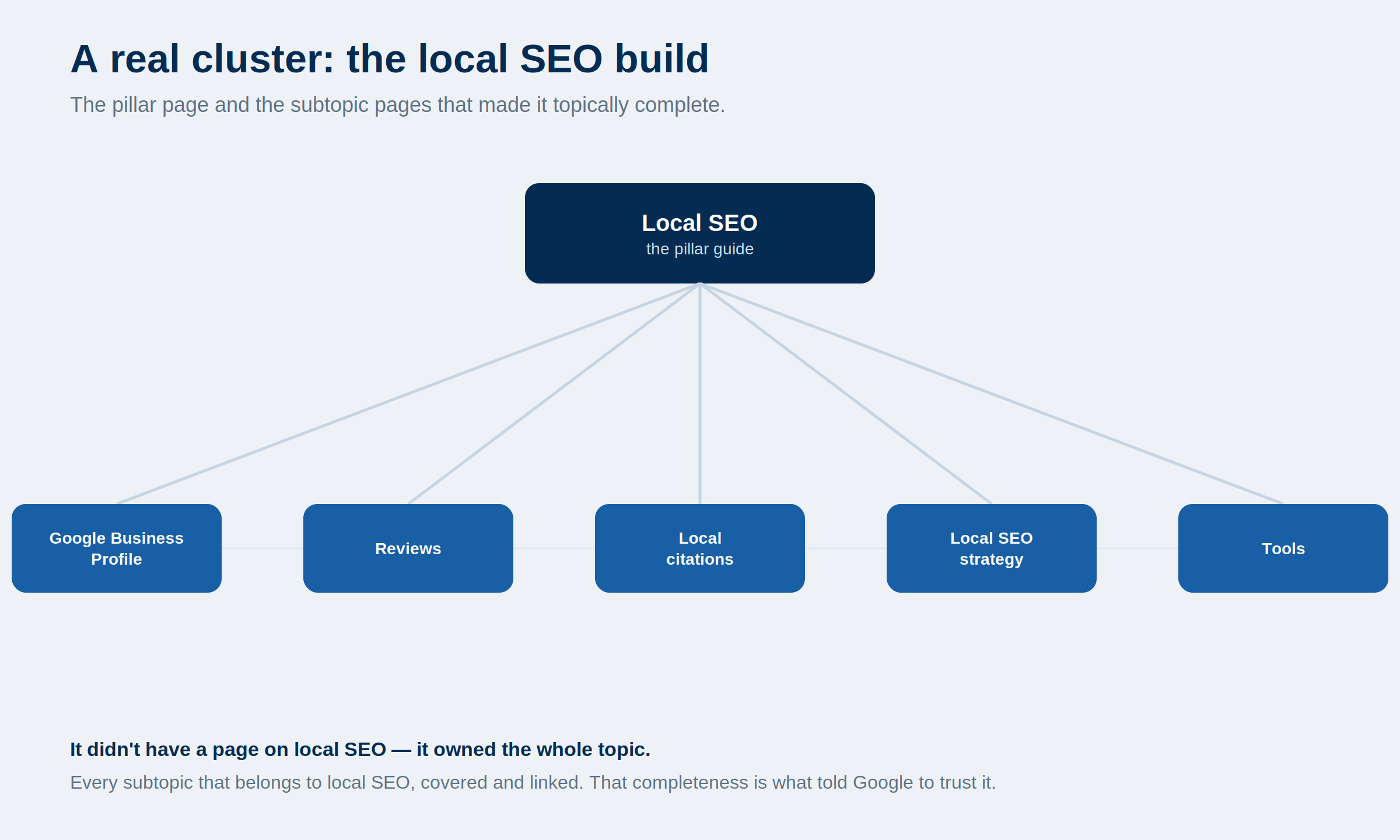
That structure is what builds topical authority.
One page is an opinion. A connected cluster is an authority.
Step 4: Cover Each Piece as Completely as Possible
For every topic and subtopic, go all the way.
Answer the main question, then the related ones, then the ones the reader hasn’t thought of yet.
This is the bit there’s no shortcut for.
Semantic SEO isn’t a trick you apply to thin content — it is the depth.
A page that genuinely answers everything a searcher could want is the page Google trusts and AI cites.
Half-cover it and you’ve built a cluster of weak pages, which is worse than one strong one.
Write like the reader should never need another tab open.
That’s the standard.
Step 5: Connect It Into a Knowledge Graph
Link your related pages together with internal links — this is what turns a pile of pages into a web Google can read.
Every internal link is you telling Google “these two things are related.”
Link your local SEO pillar to your Google Business Profile page, your reviews page, your citations page, and you’ve drawn the relationships out explicitly.
Google reads that web — the “knowledge graph” of your own site — and understands your topical structure far better than it could from isolated pages.
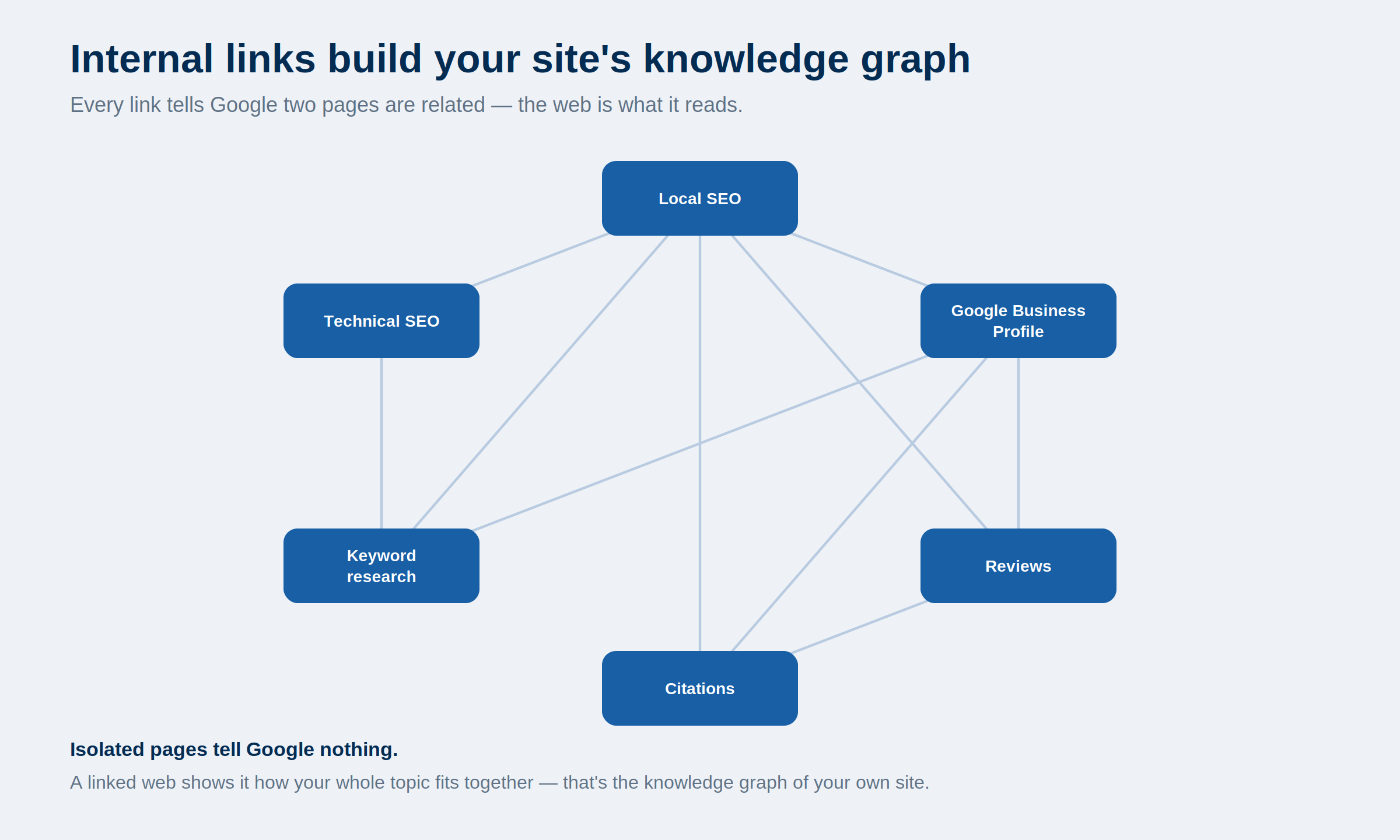
This article is doing it right now.
Every link in this piece points to a genuinely related concept on this site, building the same web I’m describing.
Internal linking done well isn’t decoration — it’s how the whole structure holds together.
A Real NZ Semantic SEO Example: How I Outranked the Ahrefs and Semrush Guides
My local SEO guide ranked number one in New Zealand (past the Ahrefs and Semrush guides, past agencies that had been at it for a decade) on a domain less than a year old.
Not because of authority, but because it covered the topic more completely than any of them.
Here’s the full story, because it’s the clearest proof I can give you that this works.
I was targeting “local SEO” in New Zealand.
On paper, no chance.
I was up against Semrush and Ahrefs — two of the biggest SEO platforms on earth, with domains carrying enormous authority — and a handful of NZ agencies who’d been building their sites for ten-plus years.
My site was months old.
So I didn’t try to beat them on authority. I couldn’t.
I beat them on completeness.
Instead of chasing the keyword, I covered the entire topic of local SEO, with a New Zealand spin the international guides didn’t have. I covered:
- What local SEO actually is
- Why it matters for a Kiwi business
- How to set up and optimise a Google Business Profile
- How reviews work and how to get them
- How local citations build trust
- A full local SEO strategy
- The tools worth using
Every one of those is a related concept that belongs to the topic of local SEO.
Covering all of them is what made the page topically complete — and that completeness is what told Google the page was the authority, ahead of sites with far more raw power behind them.
It worked.
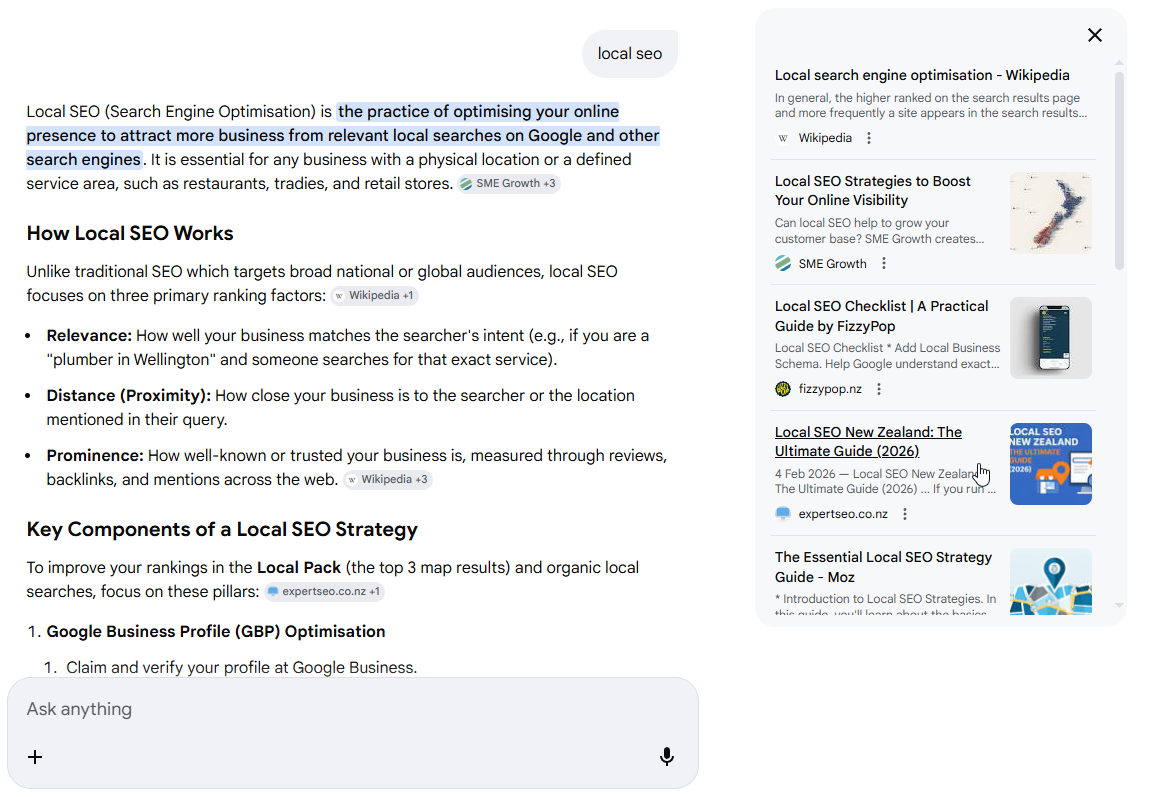
The guide ranked number one in New Zealand, above the Semrush and Ahrefs guides.
And it got pulled into Google’s AI mode as a cited source — the exact outcome this whole guide is about.
Now, the honest part, because I’m not going to pretend it’s a fairy tale.
After Google’s May core update, that page slipped in the rankings.
That doesn’t undo the lesson — a near-new domain genuinely climbed past the giants on completeness alone, and that’s the thing worth taking away.
It’s also a reminder that semantic depth gets you in the room, but authority and freshness keep mattering too.
Semantic SEO is the lever that lets a small site compete. It’s not a force field.
I didn’t beat the big guides on authority. I beat them on completeness.
That’s semantic SEO in one line.
The Mistakes That Quietly Kill Semantic SEO
Most semantic SEO mistakes come from treating it as a keyword trick instead of a topic strategy.
Here are the ones that do the most damage.
Chasing “LSI keywords.” You’ll still see advice telling you to stuff your page with “LSI keywords” — supposedly related terms Google rewards.
I laughed the first time I read a self-proclaimed NZ expert pushing this.
LSI (latent semantic indexing) is a decades-old document-retrieval technique that Google has flat-out said it doesn’t use.
Optimising for “LSI keywords” is optimising for something that isn’t there.
Cover the topic properly and you’ll naturally use the related terms — because they belong to the topic, not because you’re gaming a list.

Stuffing synonyms. Related to the above.
Cramming in every synonym for your keyword isn’t semantic SEO — it’s keyword stuffing wearing a clever hat.
Semantic SEO is about covering related concepts, not related words.
Mixing unrelated meanings on one page. Remember the spider trap.
Trying to cover the drink, the bug and the workout on one page to look comprehensive does the opposite — it blurs your meaning and you rank for nothing.
One topic per page.
Building clusters with no depth. A pillar page pointing to ten thin, half-written cluster pages isn’t topical authority — it’s the skeleton of it.
The links don’t help if the pages they point to don’t actually deliver.
Depth first, structure second.
Topical Authority vs Brand Authority
Topical authority is covering a topic so completely that search engines trust you on it.
Brand authority is being known and trusted as a name.
AI search increasingly weighs both — and the good news is they feed each other.
Here’s why these two became such a big deal:
As search shifts to AI, the engines have a hard job: out of millions of pages, who do they cite?
They need signals for trust.
And two of the cleanest signals available are topical authority and brand authority.
Think about it from Google’s side:
If one SEO agency has a hundred-plus pieces of genuinely useful content covering every corner of SEO, and another has a single thin article, which one is easier to trust and recommend?
The one that’s clearly gone deep.
Comprehensive coverage is a trust signal that’s hard to fake — which makes it exactly the kind of thing an AI leans on when deciding who to cite.
That’s topical authority.
And here’s the part most people miss: brand authority grows out of it.
When you build topical authority — when you genuinely dominate a niche, plant your feet, and become the site that actually helps people — your brand starts to build too.
More people find you, mention you, trust you.
That brand recognition feeds back into how AI sees you, which gets you cited more, which builds the brand further.
It snowballs.
The two work hand in hand: topical authority earns the trust, brand authority compounds it.
For a small NZ business, this is genuinely good news.
You don’t need a massive brand to start.
You start with topical depth — something you can control — and the brand builds on the back of it.
That’s the exact play behind our SEO company.
How Long Semantic SEO Takes in New Zealand
The minimum I aim for is a year.
But here’s the reframe that matters: if you’re going to be in business longer than a year anyway — and you are — then the timeline isn’t really a problem.
You’re building an asset that compounds.
That said, New Zealand has an advantage the international guides never mention.
Our market is small.
Search volumes are lower, sure — but so is the competition.
There are far fewer sites genuinely fighting for topical authority on any given NZ topic than there are in the US or UK.
Which means you can out-depth the competition faster here than the big international guides assume, because there’s simply less to out-depth.
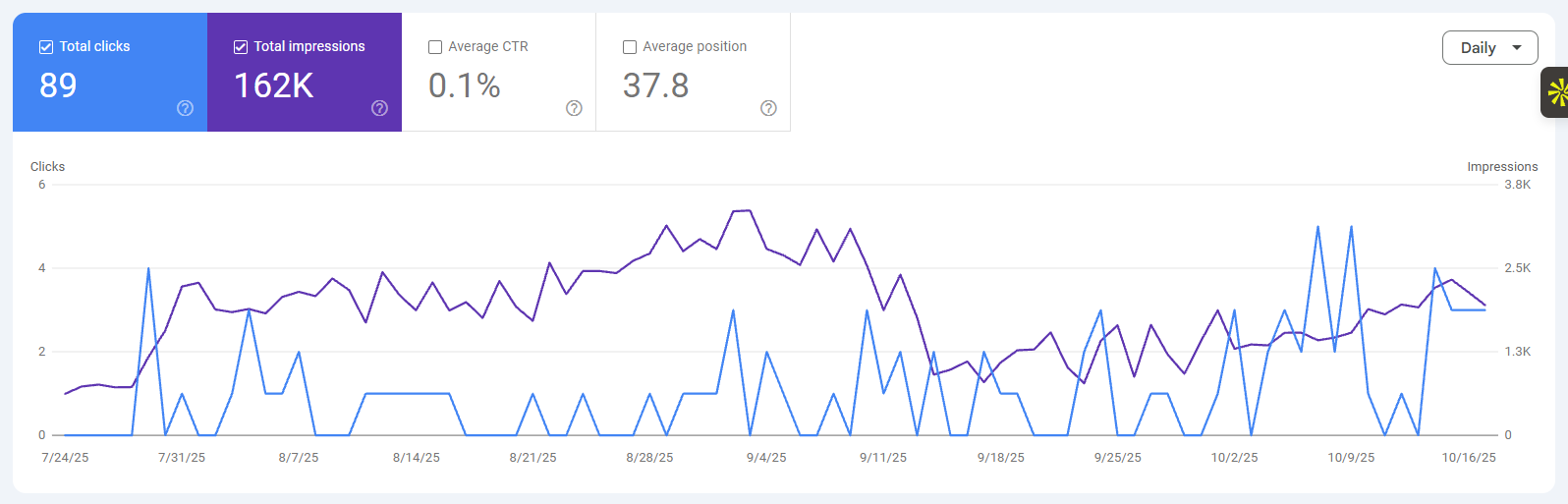
In practice, for a lot of NZ topics, a well-built cluster can start showing real traction in three to six months — not the years the American guides quote.
The local SEO build I walked you through earlier hit number one well inside its first year, against the biggest names in the industry.
Competition still sets the pace, though.
If you’re chasing a busy main centre — SEO in Auckland, say, where far more businesses are fighting for the same terms — sit at the longer end and expect closer to a year.
In a smaller regional market with fewer players, three to six months is realistic.
So if you’re a small NZ business wondering whether semantic SEO is worth it given your modest search volumes — yes.
The low volume is the opportunity.
It’s how you punch above your domain weight and own your niche before anyone else bothers to.
Doing It Yourself vs Hiring an Expert
Everything in this guide is learnable.
You can map your topic, build your cluster, write deep, link it together, and start earning topical authority yourself.
Plenty of businesses do.
The honest catch is two-fold.
It’s slow — it’s a lot of content, written properly, over months.
And the architecture is easy to get wrong.
A cluster built on the wrong intent, or thin pages, or a messy link structure, can have you doing all the work and getting little back.
The mistakes earlier in this guide aren’t hypothetical — they’re the ones I see constantly.
So the call comes down to time and certainty.
If you’ve got the hours and you want to learn the craft, build it yourself — this guide is the map.
If you’d rather it was built right the first time, by someone who’s done it before and competed at a high level, that’s where our SEO services come in.
Either way, the method is the method.
Cover the topic, build the structure, connect it, and become the source.
That’s how a small NZ site ends up sitting in the AI answer, ahead of the giants. That’s where we come in.
Semantic SEO: FAQ
What is semantic SEO?
Semantic SEO is the practice of building content around a whole topic — its related concepts, entities and questions — so Google and AI understand what your page means, not just which keyword it contains.
Instead of repeating one phrase, you cover the entire subject as completely as possible.
What's the difference between semantic SEO and traditional SEO?
Traditional SEO matched keywords; semantic SEO matches meaning.
Old-school SEO rewarded putting the exact phrase in your title, headings and body. Semantic SEO rewards covering the topic so thoroughly that Google can tell what the page is genuinely about from the context around the words.
Does semantic SEO help you get cited by AI search?
Yes. AI tools like Google's AI Mode break a question into many related sub-questions — a process called query fan-out — and pull answers from sources that cover the whole topic.
The more completely your page covers the subject, the more of those sub-questions it can answer, and the more likely it is to be cited.
How long does semantic SEO take to work in New Zealand?
Plan for a year as a baseline, though many NZ topics show real traction in three to six months because the local market is far less competitive than the US or UK.
Competitive main-centre terms sit at the longer end; smaller regional niches move faster.
Do I need schema markup for semantic SEO?
Schema is useful technical hygiene, but it isn't how you win AI search.
A May 2026 Ahrefs study of 1,885 pages found schema gave no meaningful lift to AI citations, because AI systems read your visible content, not your markup. Keep schema — but put your real effort into covering the topic.
Are LSI keywords part of semantic SEO?
No. LSI keywords are a myth — Google's John Mueller has said outright they don't exist.
Cover a topic properly and you'll use the related terms naturally, because they belong to the subject, not because you stuffed them in from a list.
Recommended Reading
How to Do SEO: Step by Step for NZ Websites
The full process from keyword to ranking — the practical companion to this guide.
SEO Content
How to write content that actually ranks — covering a topic in the depth Google rewards.
Link Building
How to earn the backlinks that turn topical depth into ranking authority.