
A while back, I ranked a book in the top 10 of a few Amazon category lists.
The cover was rough. I’ll be honest with you — it was genuinely bad.
And it still climbed. Because getting ranked on Amazon comes down to a handful of levers, and none of them are “have a pretty listing.”
There’s a common belief that Amazon SEO is just stuffing keywords into a title and hoping. Pop into any Amazon seller forum and you’ll find someone insisting there’s “nothing really to it.”
There’s a lot to it.
I know, because I’ve done it — ranked a real product, watched the algorithm respond, and worked out which moves actually mattered. I’ll walk through that exact book later in this guide.
Here’s the other problem: nearly every Amazon SEO guide online is written for a seller in Ohio.
None of them tell a Kiwi what selling on Amazon from New Zealand actually involves — which is a real gap, because we don’t even have our own Amazon store.
So this guide covers the lot: what Amazon SEO is, why it matters, how Amazon’s search algorithm decides what to rank, the exact steps to optimise a listing, the New Zealand reality nobody else mentions, and whether it’s even worth your time.
What Is Amazon SEO?
Amazon SEO is the process of optimising your product listing so it ranks higher when someone searches on Amazon. Title, keywords, images, reviews, price, sales — you shape all of it so Amazon’s search engine puts your product in front of buyers.
That’s the whole game: get seen by people who are already reaching for their wallet.
It helps to picture what Amazon’s search bar actually is. It’s a shopping engine, not an information engine.
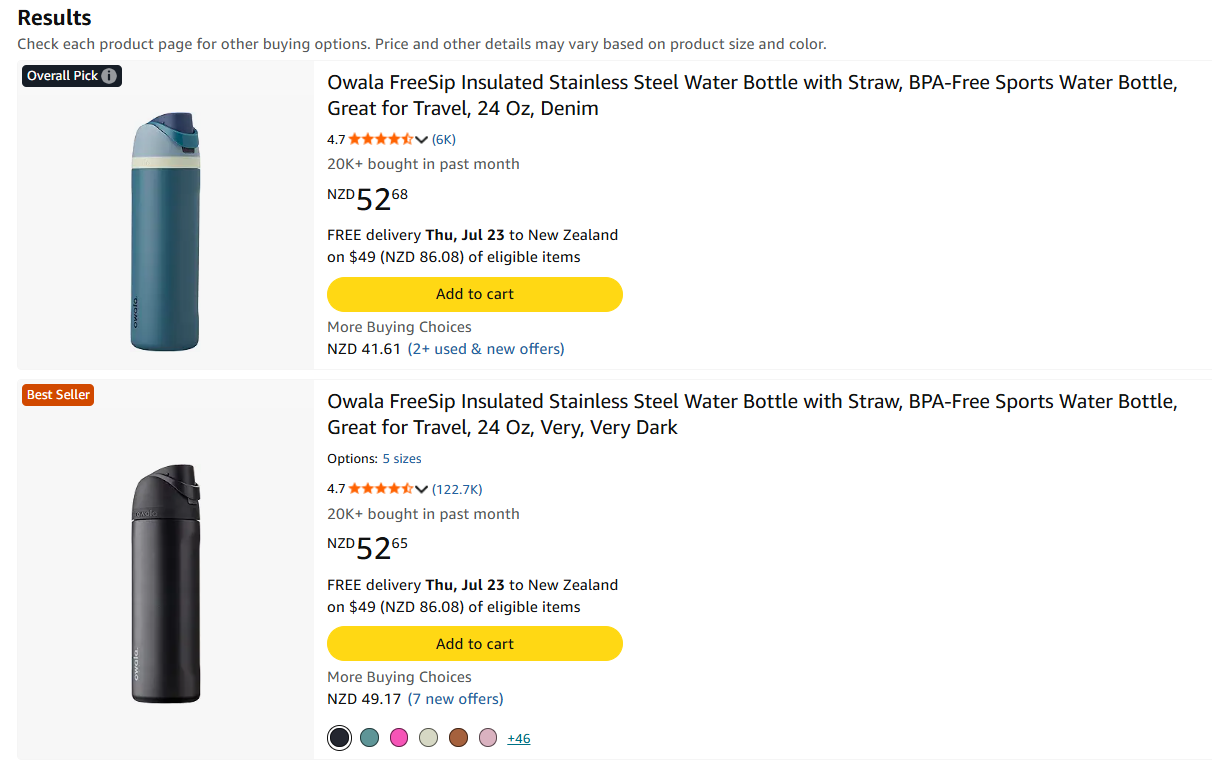
When someone types “protein shaker bottle” into Amazon, they’re not researching — they’re buying. Amazon’s only job is to show them the product most likely to earn the sale.
Your listing is your pitch to that engine. Amazon SEO is how you make the pitch land.
Why Is Amazon SEO Important?
If your product isn’t near the top of Amazon’s results, it may as well not exist. Shoppers don’t dig. They click something on page one and get on with their day.
Here’s why that matters more than most people realise: Amazon is where the buying starts.
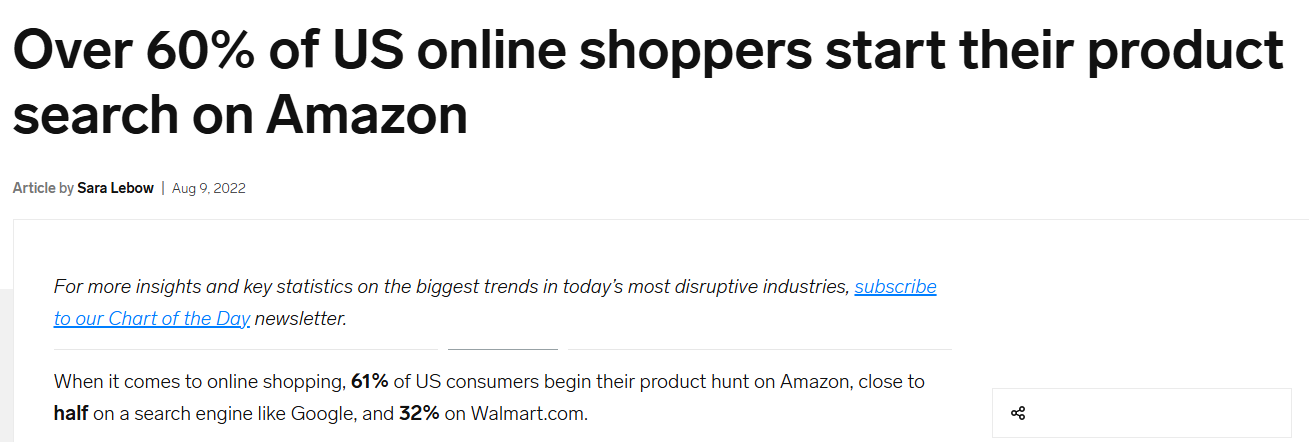
Around 6 in 10 US shoppers now begin their product search on Amazon rather than Google, according to eMarketer. That’s a huge slice of buying intent skipping the search engine entirely.
And those shoppers barely scroll. Roughly 30% of US consumers look through two pages of Amazon results at most before deciding.
Page one is the whole battlefield.

Now stack the intent on top. Half of all Amazon purchases are wrapped up in under 15 minutes, per North One. People land, compare, and buy — fast.
So the maths is simple. High intent plus shallow scrolling means the products up top take the sales, and everyone below fights over scraps.
There’s a trap in this too. A great product with a poorly optimised listing gets stuck: low visibility means low sales, low sales tell the algorithm nobody wants it, and it sinks further. Sellers call it the death spiral. Amazon SEO is how you climb out of it — or never fall in.
How Does the Amazon Algorithm Rank Products?
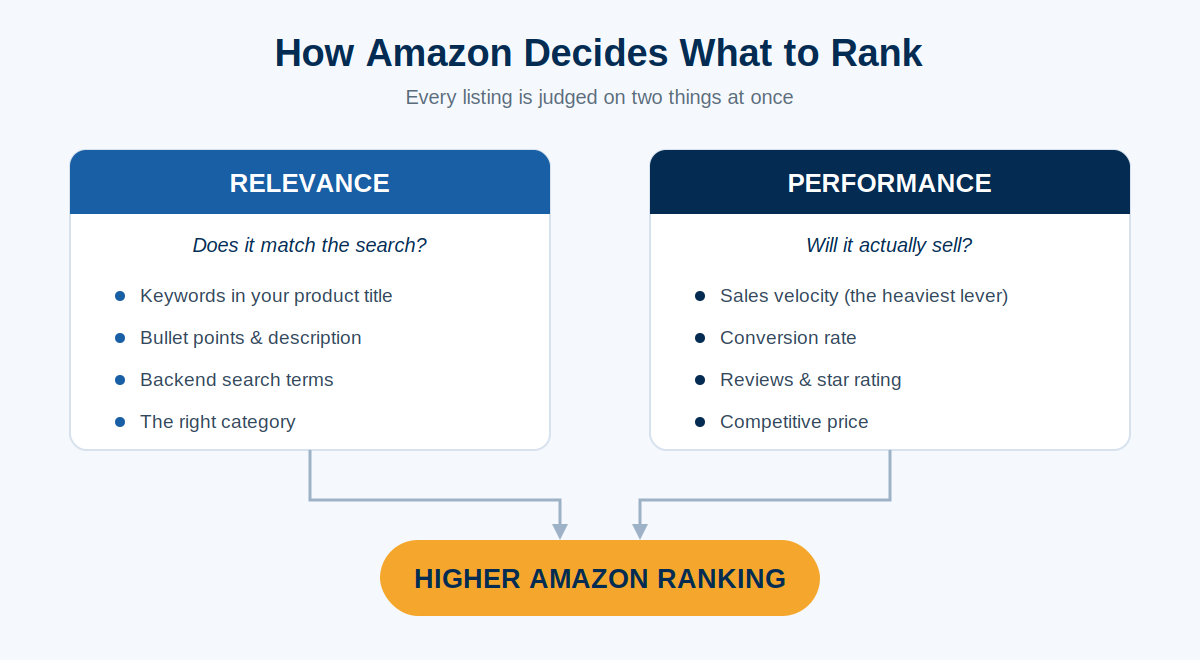
Amazon’s algorithm asks two questions about every listing: is this what the shopper searched for, and if I show it, will they buy? The first is relevance. The second is performance. Get both right and you rank.
Relevance is the keyword side.
If someone searches “stainless steel water bottle” and those words aren’t in your listing, you don’t show up — simple as that. Amazon has to be able to match your product to the search.
Performance is where Amazon differs from Google. Google ranks on authority and links. Amazon ranks on sales.
The single heaviest lever is sales velocity — how consistently your product sells. A listing that converts clicks into purchases tells Amazon “shoppers want this,” and Amazon rewards it with more visibility. More visibility drives more sales. The flywheel spins.
That’s the core loop. Everything else — reviews, price, images — feeds one of those two questions.
One thing worth clearing up, because it confuses people.
You’ll see “A9” and “A10” thrown around like they’re two different engines Amazon shipped. Amazon never officially released an “A10.”
It’s seller shorthand for the way the ranking factors have shifted over the years — more weight on conversions, external traffic, and seller history, less on raw keyword matching. Useful shorthand; not an official product.
The real shift in 2026 is Rufus — Amazon’s AI shopping assistant.
Shoppers now ask it full questions like “what’s the best water bottle for tramping?” and it answers by reading listings. That means writing in plain, natural language matters more than ever, because your listing has to be legible to an AI, not just a keyword-matcher.
It’s the same move we teach for ranking in AI search on Google — clarity wins.
This is also why I don’t buy the “is SEO dead in 2026” hand-wringing. Search isn’t dying; it’s changing shape.
The businesses that write clearly and answer the question keep showing up. On my own SEO company’s site — Expert SEO — a domain under a year old is already getting cited in Google’s AI Mode and ranking above tools like Ahrefs and Semrush for competitive terms.
That’s not luck; it’s understanding how modern search decides what to surface. The same instinct transfers straight to Amazon.
Amazon SEO vs Google SEO: What’s the Difference?
Google ranks information and authority. Amazon ranks whatever is most likely to sell right now. Same word, “SEO,” two very different engines.
On Google, nearly every search is a question, and you win with content and backlinks built over months.
On Amazon, nearly every search is a purchase, and you win with a tight listing and a steady stream of sales. There are no backlinks pushing an Amazon listing up the rankings — the sales do that job.
Speed is different too. Google SEO is a long game; you’re building trust with an algorithm over months. Amazon can move a listing in days, because the algorithm only cares about one thing: which product sells.
But here’s where the two worlds meet — and it’s the part most guides skip. Traffic you send to an Amazon listing from outside Amazon boosts its rank.
Amazon notices when buyers arrive from Google, YouTube, or social, convert, and prove demand. That external push spikes your sales velocity, and velocity is king.
It’s the same muscle behind off-page SEO: building demand and signals from beyond the platform itself. I used exactly this crossover to rank my own Kindle book — I’ll walk through how a little further down.
Which Amazon Marketplace Should NZ Sellers Use?
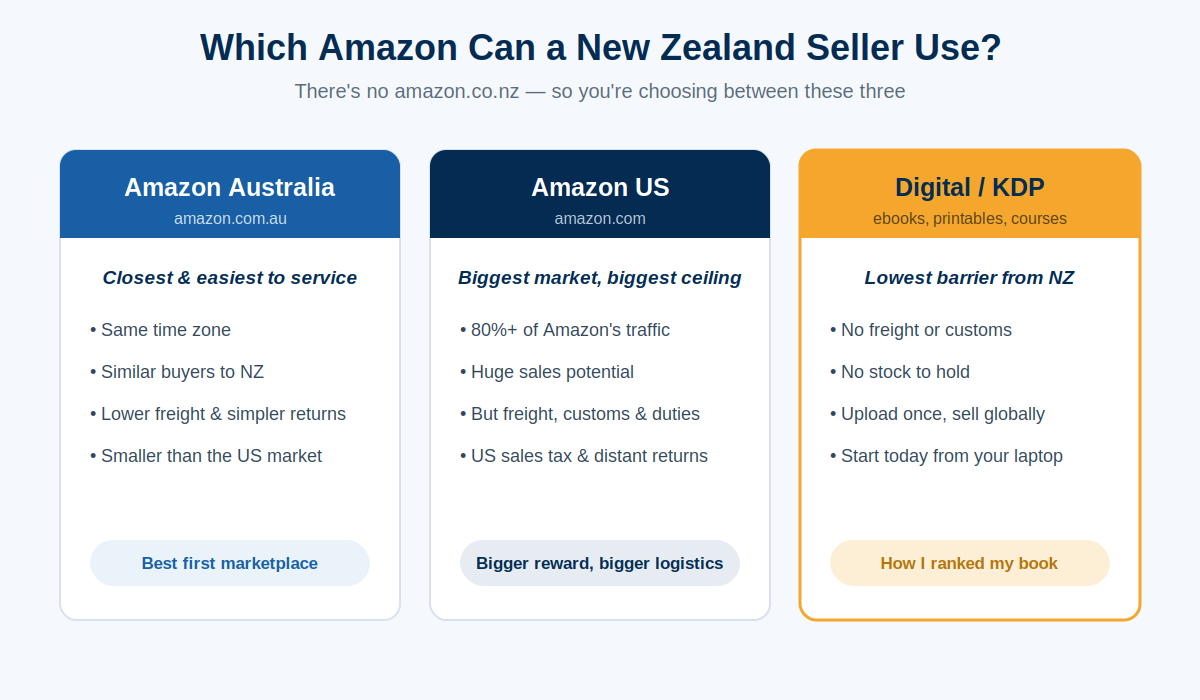
There is no amazon.co.nz. If you’re selling from New Zealand, you’re listing on Amazon Australia or Amazon US — and that decision comes before you touch a single keyword. The SEO principles are identical across marketplaces. The logistics are not.
This is the single biggest thing every other Amazon guide misses. They assume you’re already a US seller shipping from a warehouse in Kentucky. You’re not. You’re in Tauranga, and the first real question is which Amazon are you even on?
Here’s the lay of the land:
- Amazon Australia (amazon.com.au) — closest market, same time zone, similar buyers. Smaller and less mature than the US, but far easier to service from NZ. A sensible first marketplace for most Kiwi sellers.
- Amazon US (amazon.com) — the giant. Over 80% of Amazon’s traffic sits there, so the ceiling is huge. But servicing it from NZ means freight, customs, US sales tax, and returns from the other side of the planet.
- Fulfilment reality (FBA from NZ) — if you’re shipping physical stock, you’re sending it into Amazon’s warehouses (FBA), which means international freight, import duties, and GST to think through before you sell a single unit.
And this is where my ebook example quietly becomes the useful one. It was a digital product — a Kindle book through KDP. No freight. No customs. No pallets to the States. I uploaded a file and it was on sale globally.
So if you’re a New Zealander wondering whether you can even do this without a shipping container, the answer is yes — digital products (ebooks, printables, courses) are the lowest-barrier way onto Amazon from here.
Physical FBA is very doable too; it just carries the logistics tail.
If you’d rather keep the sale on your own turf, that’s a different play entirely — building your own store with ecommerce SEO, or heading into the Aussie and US markets through your own site with international SEO. Amazon is one channel, not the only one.
How to Do Amazon SEO
Ranking on Amazon comes down to two jobs: build a listing the algorithm understands, and generate enough early sales to prove people want it. Everything below serves one of those two jobs.
I’ll walk the method here, then show you the whole thing in action on a real product in the next section.
Start With Keyword Research
Keywords are how Amazon matches your product to a search, so this is the foundation — get it wrong and nothing above the listing works.
Why it matters: if a shopper’s exact words aren’t somewhere in your listing, you’re invisible for that search.
You’re not guessing what to write; you’re finding the real phrases buyers type and building around them.
How to do it:
- Start with Amazon’s own autosuggest. Type your core product into the Amazon search bar and note every phrase it completes — those are real, popular searches straight from the source.
- Study your top competitors. Open the listings ranking for your main keyword and note the terms in their titles and bullets. Balance relevance against competitiveness — a phrase you can realistically rank for beats a giant one you can’t.
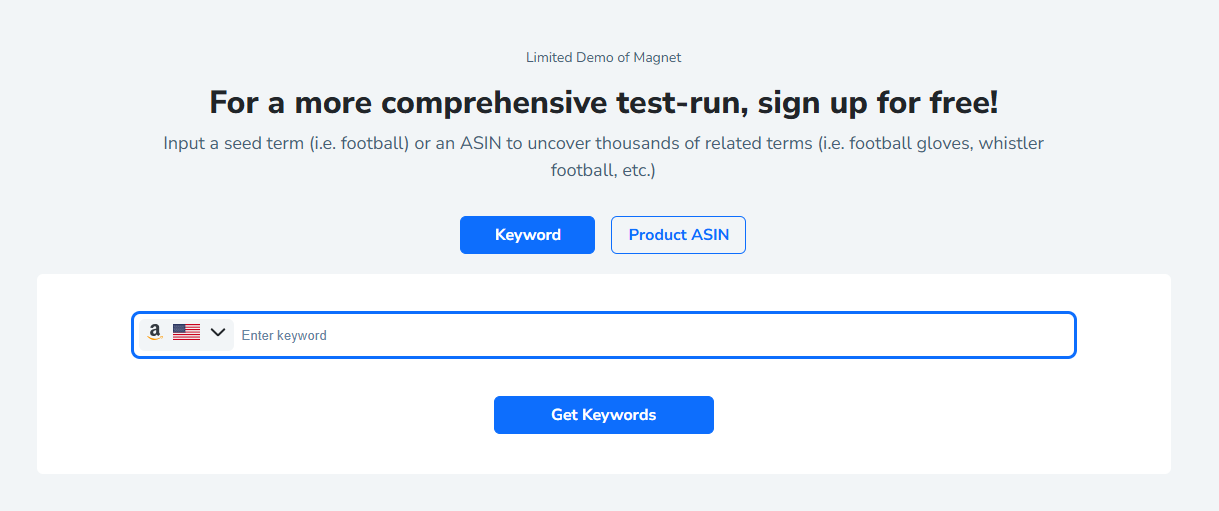
- Pull volume and related terms with a keyword tool. Helium 10 (its Cerebro and Magnet tools) and Jungle Scout both show search volume and keyword ideas pulled from Amazon data; Merchant Words is a lighter option for quick volume checks.
- Don’t sleep on low-volume long-tails. The same rule that holds on Google holds here: a specific, lower-volume phrase with clear buyer intent often converts better than a broad one everyone’s fighting over.
Worked example: say you’re selling a stainless steel drink bottle. Autosuggest hands you “stainless steel water bottle,” “insulated water bottle 1l,” “water bottle for gym,” “spill proof water bottle.”
That mix — one head term plus several intent-rich long-tails — is your keyword map for the whole listing.
Pick a Category You Can Win
Choosing the right category is a ranking decision, not an admin one.
Why it matters: “top 10 in a category” is how Amazon surfaces best-sellers, and shoppers browse those lists.
Pick a category so broad and crowded that you’ll never crack the top of it, and that visibility never comes. Pick a tighter, relevant one you can genuinely rank in, and you get seen.
How to do it: look at the best-seller ranks of the products already in a category. If the top sellers are shifting enormous volume, that category is a war you’ll lose early. Find the relevant sub-category where the top listings are beatable, and target that.
Write a Keyword-Rich Product Title
Your title is the strongest relevance signal you’ve got, so it earns the most important keywords.
Why it matters: Amazon leans heavily on the title to understand what your product is, and shoppers scan it first. It has to satisfy the algorithm and a human in the same breath.
How to do it: lead with your primary keyword, then work in brand, key feature, material, and size.
Keep it readable — a title that reads like a keyword pile-up gets ignored by shoppers even if Amazon indexes it.
A good title: Insulated Stainless Steel Water Bottle 1L — Leakproof, Keeps Cold 24hrs — Gym & Hiking Flask (Matte Black). A bad one: BEST Water Bottle!! Amazing Quality Buy Now. The first tells Amazon and the buyer exactly what it is. The second tells them nothing.
This is the same discipline behind on-page SEO for a website — say clearly what the page is about.
Write Bullet Points That Rank and Sell
Bullets do double duty: they carry secondary keywords and they close the sale.
Why it matters: this is where a shopper decides whether your product solves their problem. It’s also prime real estate for the keywords that didn’t fit the title.
How to do it: write five bullets, each leading with a real benefit, then fold in secondary and long-tail keywords naturally.
Cover the questions a buyer actually has — capacity, materials, what it fits, how it’s cleaned. Benefit first, keyword woven in, never a robotic keyword list.
Fill In Your Backend Search Terms
Backend search terms are hidden keywords Amazon reads but shoppers never see — and most sellers waste them.
Why it matters: it’s free relevance. You get roughly 250 bytes of hidden “search terms” that help you rank for phrases you couldn’t naturally fit into visible copy.
How to do it: in Seller Central, open your listing, go to the Keywords tab, and use the Search Terms field.
Fill it with synonyms, alternate spellings, and related phrases you haven’t already used — no commas needed, no repeating words that are already in your title, and no competitor brand names (against Amazon’s rules). Think British vs American spellings, slang, and adjacent uses.
Write a Strong Description and A+ Content
The description and A+ Content convince the shopper and support your relevance.
Why it matters: this is where hesitation turns into a purchase, and conversions feed straight back into ranking.
How to do it: write a clear, scannable description that expands on the bullets and works in remaining keywords.
If you’re enrolled in Amazon Brand Registry, use A+ Content — the enhanced module layout with images and comparison charts — to lift conversions. One honest note: not all A+ text is indexed for search, so its real job is persuasion, not keyword stuffing.
Sort Your Product Images
Images drive the click and the conversion, which is why they matter for ranking even though they carry no keywords.
Why it matters: your main image decides whether anyone clicks you in the results, and the rest decide whether they buy. Both feed the conversion rate the algorithm watches.
How to do it: use a clean, high-resolution main image on a white background (Amazon requires it), then add images that are zoomable and show the product in use, the size, and the key features.
If you’re brand-registered, use Manage Your Experiments to A/B test your main image — small changes to that first image can move your whole click-through rate.
Get Reviews Early
Reviews are a trust signal to shoppers and a ranking signal to Amazon.
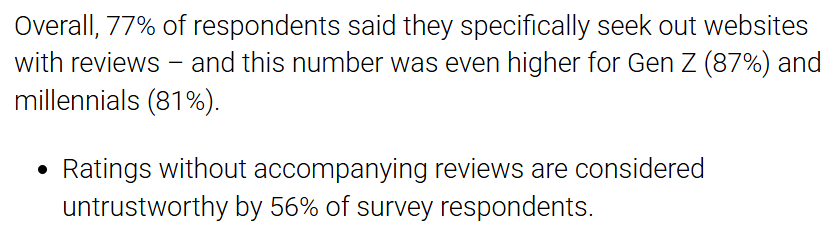
Why it matters: 77% of shoppers actively seek out products with ratings and reviews before buying. More reviews and a higher star rating lift your conversion rate, and Amazon reads strong-converting listings as safer bets to rank.
How to do it: get real reviews in early and honestly.
- Use Amazon’s built-in Request a Review button in Seller Central after each order — it’s compliant and automated.
- Never buy reviews or incentivise them. It breaches Amazon’s policy and can get your listing suppressed.
- Make it easy — a genuinely good product plus a polite, well-timed request is what compounds into a review base over months.
Price to Stay Competitive
Price shapes conversion, and conversion shapes rank, so pricing is quietly an SEO lever.
Why it matters: if you’re priced well above similar products without a clear reason, shoppers scroll past, your conversion rate drops, and your ranking follows it down.
Price also affects whether you win the Buy Box — the default “Add to Cart” button most sales go through.
How to do it: research what comparable products charge and land in a sensible range. At launch, a slightly lower “penetration” price can spike early sales velocity and reviews, then you ease it back toward your target margin once the listing has momentum.
How I Ranked My Kindle Book on Amazon
Enough theory. Here’s the whole method in practice, on a real product of mine.
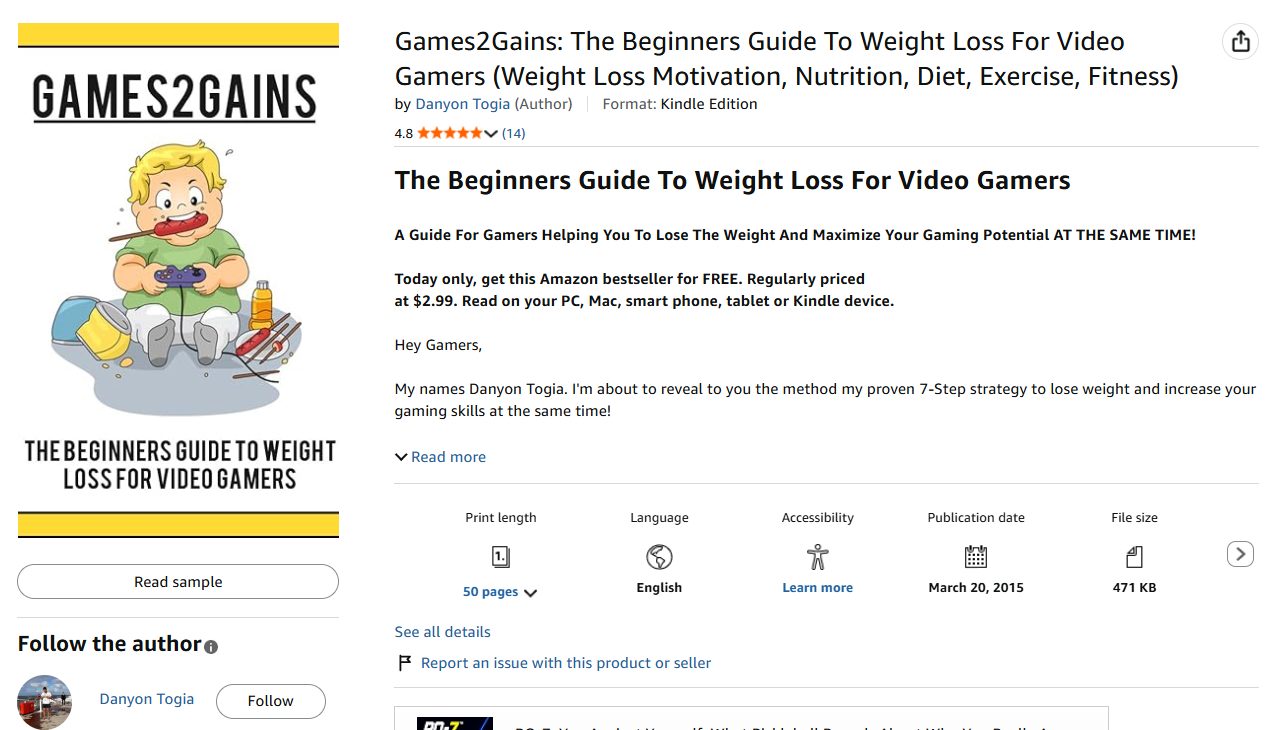
Years back — the old A9 days — I published a Kindle book called Games2Gains: The Beginners Guide to Weight Loss for Video Gamers. It climbed into the top 10 of a few Amazon category lists at the time.
Not because it was polished; the cover was genuinely rough. It ranked because I pulled a handful of specific levers in the right order.
One honest caveat before the how: Amazon has shifted since. The keyword-matching A9 era has given way to the sales-velocity, Rufus-driven world I described earlier. The levers still matter — they just weigh a little differently now, and I’ll flag what’s changed as I go.
I Picked a Category I Could Win
This was the biggest lever, and it’s the one most people get wrong.
I didn’t aim the book at a massive, bloodbath category where it’d sink without a trace. I chose a tighter, relevant one where a burst of early sales could realistically push it into the top 10.
That single decision did a huge amount of the heavy lifting — the same “pick a winnable category” call from the method above, made for real.
What’s changed: nothing. This one’s timeless. A winnable category is still where a launch lives or dies.
I Built a Keyword-Rich Listing (Ugly Cover and All)
I wrote the title and description around the words my readers were actually searching — weight loss, gamers, beginners — so Amazon knew exactly who the book was for, and so did the buyer.
A clear, benefit-led description did real work turning browsers into buyers.
Now the honest bit: the cover was bad. Genuinely rough. And it still ranked — which is the whole point. The category call, the keywords, and the sales underneath it carried the listing despite the cover.
What’s changed: I got away with a weak cover in the A9 days. I wouldn’t count on that now. Images move click-through and conversion harder than they used to, and both feed the algorithm — so today I’d fix the cover before launch, not after.
I Got Reviews In Early
I focused on getting genuine reviews in quickly, because reviews do two jobs at once: they reassure the next buyer, and they lift the conversion rate Amazon rewards.
Early reviews matter most. A listing with a handful of real reviews converts far better than a bare one, and that early conversion is what tells the algorithm the book is worth showing.
What’s changed: the tactics are tighter now — use Amazon’s Request a Review button and stay well clear of anything incentivised — but the principle is identical.
I Used My YouTube Channel to Kickstart Sales
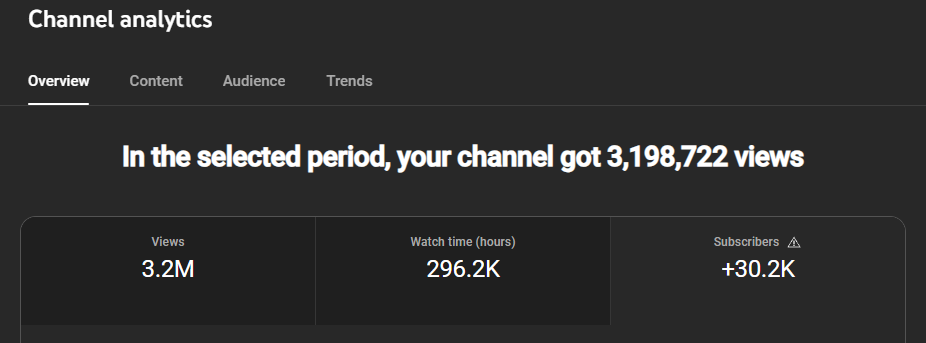
Here’s the lever that tied it all together. I had a YouTube channel, and I pointed it straight at the book.
That external traffic drove the early sales that lit up the algorithm. Buyers arriving from outside Amazon, converting, and proving demand is one of the strongest launch signals you can send — it spikes your sales velocity, and velocity is king. The book climbed into the top 10 off the back of it.
This was well before agencies were calling external traffic a “2026 ranking hack.” A Kiwi with a YouTube channel was doing it years ago.
It’s the same crossover muscle behind off-page SEO I mentioned earlier.
No channel of your own? The paid version of this exact move is Amazon Sponsored Products — ads that get your product in front of buyers early and build the organic sales history you need to rank on your own.
It’s the Amazon version of using paid to feed organic.

Which Amazon SEO Tools Are Worth Using?
You don’t need every tool — you need one keyword tool and Amazon’s own free data. Here’s what each does.
- Helium 10 — the all-rounder. Keyword research (Cerebro, Magnet), listing optimisation, and rank tracking in one place. The default for most serious sellers.
- Jungle Scout — strong for product and keyword research, especially validating demand before you launch.
- Merchant Words — a lighter, cheaper option for quick search-volume checks.
- Amazon’s own free tools — don’t overlook these. Autosuggest for keywords, Brand Analytics and the Search Query Performance dashboard (Brand Registry) for real search data, and Manage Your Experiments for A/B testing.
Start with one paid tool plus Amazon’s free data. That’s plenty until you’re scaling. It’s the same principle as building any SEO toolkit for Google — a lean stack you’ll actually use beats a shelf of subscriptions you won’t.
How Much Does Amazon SEO Cost?
Doing it yourself costs mostly your time plus a tool subscription — think NZ$50–150 a month for something like Helium 10. Hiring an agency runs a monthly retainer, often NZ$1,500+.
What it’s worth depends on your margins and your marketplace.
Here’s the honest part most guides won’t give you, because they’re trying to sell you Amazon SEO: for a lot of New Zealand businesses, Amazon isn’t the first place I’d spend a dollar.
If you’re a service business, or you sell to Kiwi customers who’d find you on Google, your money often works harder on your own website — a well-optimised Shopify store, say — where you own the customer and keep the full margin.
Amazon takes its cut and owns the relationship.
Amazon SEO earns its place when you’re genuinely committed to selling on Amazon as a channel — a product brand chasing the US or Aussie market, or a digital product with global reach.
If that’s you, it’s absolutely worth doing well. If it’s not, be honest with yourself before you pour time into it.
Common Amazon SEO Mistakes to Avoid
Most Amazon SEO failures aren’t exotic. They’re the same handful of avoidable mistakes:
- Keyword-stuffing the title. A title crammed with keywords reads like spam, kills your click-through, and Amazon’s moved on from rewarding it. Write for the human first.
- Targeting a category that’s too big. The mistake I deliberately avoided with my book. Chase a bloated category and you’ll never crack the visible best-seller lists.
- Ignoring backend search terms. Free relevance, left on the table by most sellers.
- Chasing volume over winnable long-tails. The specific, lower-competition phrases are often where the early wins live.
- Launching with no plan for early sales. A perfect listing with no velocity just sits there. Line up your first-sales push before you go live.
- Setting and forgetting. Amazon SEO is ongoing — reviews accumulate, competitors shift, and you A/B test your way to better over time.
Should You Do Amazon SEO Yourself or Hire an Expert?
If you’ve got one or two products and the time to learn, you can absolutely do this yourself.
This guide is the process. Follow it in order — keyword research, winnable category, tight listing, early sales — and you’ll beat most listings out there, because most sellers never go past “put some keywords in and hope.”
Where it gets worth outsourcing is scale, or when the real opportunity is the traffic feeding your listings.
If you’re running a full catalogue, or the game-changer is driving external and Google traffic into your Amazon products, that’s specialist territory — and that external-traffic crossover is exactly our lane.
We’re the search and traffic people; the YouTube-to-Amazon bump I used on that book is the kind of thing we do for a living now.
Most of what we do, though, sits on the Google side of that crossover — the done-for-you SEO that grows the organic traffic feeding everything else.
We help businesses rank right across New Zealand, whether you’re in Auckland, Wellington, Christchurch, Tauranga, or Queenstown.
If you want a second set of eyes on the strategy, that’s what an experienced SEO consultant is for — mapping where your effort actually pays off, whether that’s Amazon, your own store, or both. Get the foundations right and Amazon rewards you fast.
That’s the part I genuinely enjoy — and if you’d rather have it done properly the first time, that’s where we come in.
Amazon SEO: FAQ
What does Amazon SEO stand for?
Amazon SEO stands for Amazon search engine optimisation. It's the process of optimising a product listing so it ranks higher in Amazon's own search results.
What is an Amazon SEO specialist?
An Amazon SEO specialist optimises product listings to rank on Amazon — keyword research, titles, backend terms, images, reviews, and the sales strategy that drives ranking. Some work in-house for a brand, others agency-side across many sellers.
What are the 4 types of SEO?
The four commonly cited types are on-page SEO, off-page SEO, technical SEO, and local SEO — all aimed at ranking in Google. Amazon SEO is a separate, marketplace-specific discipline focused on ranking inside Amazon rather than a search engine.
How long does Amazon SEO take to work?
Faster than Google SEO. Because Amazon ranks on sales, a well-optimised listing that builds early sales velocity can move within days to a few weeks — far quicker than the months Google SEO usually takes.
Is Amazon SEO worth it in 2026?
Yes, if you're committed to selling on Amazon — most US product searches still start there, and the AI shift (Rufus) rewards clear, well-optimised listings. For many NZ businesses, though, Google or Shopify SEO is the better first investment.
Can you make money selling on Amazon from New Zealand?
Yes. There's no amazon.co.nz, so Kiwis sell on Amazon Australia or Amazon US, or via digital products through KDP. Physical products work too, but factor in freight, customs and GST before you start.