
Right now, someone near you is typing “plumber near me” or “café in Hamilton” into their phone. In about two seconds they’ll pick one of the three businesses Google shows them — and forget the rest exist.
Local search marketing decides whether that business is you.
Most Kiwi business owners have heard the terms — “local SEO,” “local search marketing,” “Google Business Profile” — but couldn’t tell you how they fit together, or what to actually do first. That’s the gap this guide closes. No jargon, no fluff. Just what local search marketing is, what it’s made of, and how to start showing up.
I’m not writing this from theory. We run Expert SEO here in NZ, and our own site ranks on page one for “SEO Hamilton” — and gets cited inside Google’s AI Overview as a source on local SEO. Same playbook you’re about to read.

Key Takeaways
- What local search marketing is: every way you get found by nearby customers on Google — the map pack, local results, reviews, listings and paid local ads. Local SEO is one part of it, not the whole thing.
- Local SEO vs local search marketing: local SEO is the free, organic slice; local search marketing is the umbrella that also includes paid ads, reviews and listings.
- It matters because local dominates. Around 46% of Google searches have local intent, and the map pack pulls roughly 42% of the clicks — miss it and the customer picks whoever showed up.
- Your Google Business Profile does the heavy lifting. The right primary category, real reviews and consistent name/address/phone details are the biggest levers.
- NZ wins come faster. Smaller markets mean less competition — expect early movement in 1 to 3 months and solid results by 3 to 6.
- AI search rewards the same signals. Do local search marketing well and you get named in AI Overviews and ChatGPT too — exactly like we do for “SEO Hamilton.”
- Most of it is DIY-able for free. The cost is time and consistency, not money.
What Is Local Search Marketing?
Local search marketing is how a business gets found by customers searching nearby. It covers everything that puts you in front of local buyers on Google — the map pack, local search results, your reviews, your business listings, and paid local ads. It’s the whole toolkit for turning “near me” searches into paying customers.
“Local search” just means any search with local intent. Sometimes it’s obvious — “electrician Tauranga,” “best flat white near me.” Sometimes it’s hidden: search “dentist” on your phone and Google already assumes you mean a dentist near you. Either way, Google shows local results — a map with businesses pinned to it, plus listings underneath.
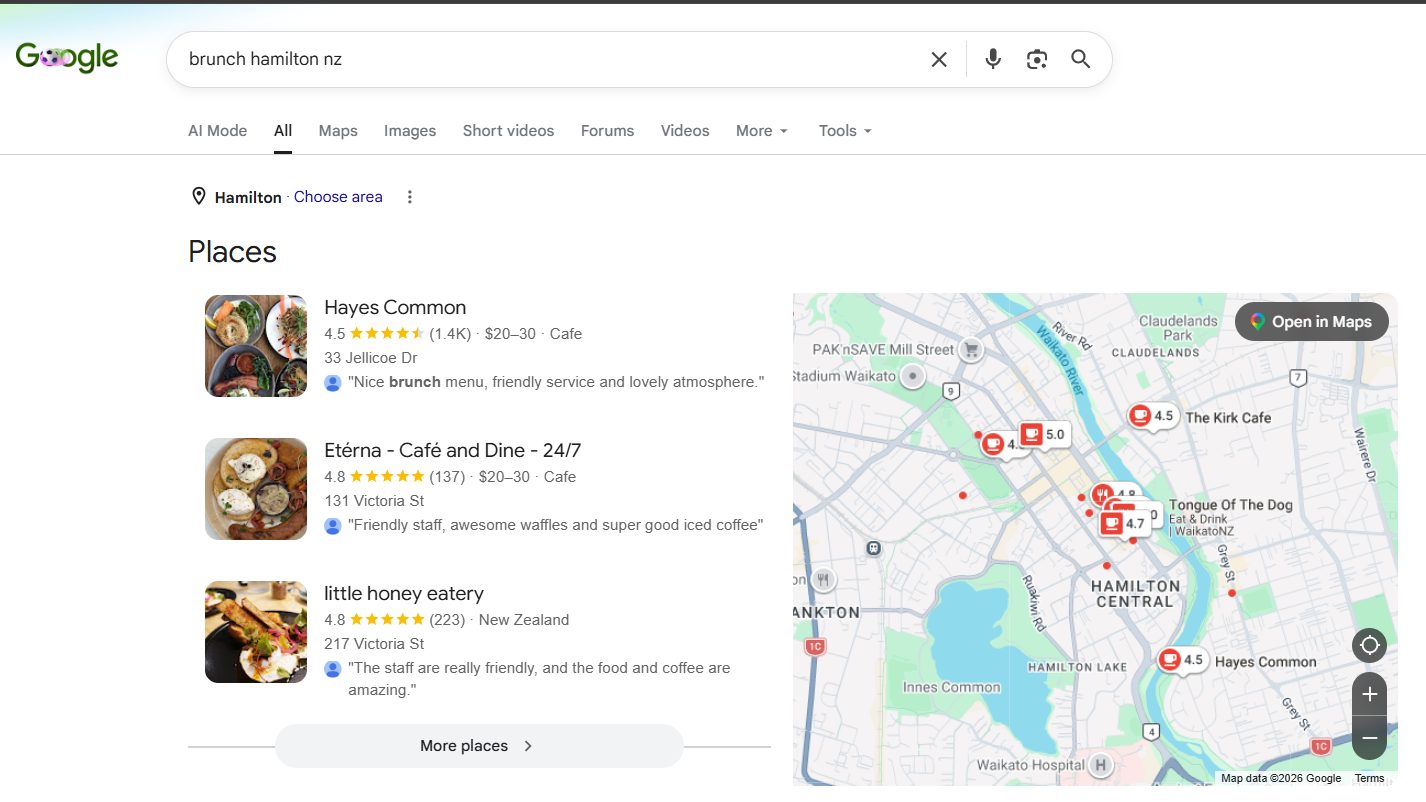
Here’s how it plays out. Someone searches “brunch Hamilton.” Google shows three cafés on a map, each with a star rating and review count. They tap the top one, check it’s open, and drive over. That entire journey — search to customer — happened inside Google, and local search marketing is what got that café into those three spots.
If you’ve heard the term “local SEO” and think this sounds similar — you’re right. But they’re not the same thing, and the difference matters.
Local Search Marketing vs Local SEO vs SEO
Local search marketing is the umbrella; local SEO is one slice of it. People use these three terms interchangeably — they shouldn’t. Here’s the clean version:
- SEO is the broad practice of ranking on search engines for any search, local or not.
- Local SEO is the slice focused on ranking organically in local results — the map pack and local listings. It’s free traffic, and it’s the engine room. We cover it in full in our guide to local SEO.
- Local search marketing is everything that wins local customers — local SEO plus paid local ads, review generation and listings management, paid and unpaid.
Think of it as nested circles. SEO is the biggest. Local search marketing sits inside it. Local SEO sits inside that. So if you only “do local SEO,” you’re playing half the game — and the rest of this guide walks through the whole board.
Why Local Search Marketing Matters for NZ Businesses
Local intent dominates search, it’s mostly on mobile, and it converts fast. Three numbers make the case.
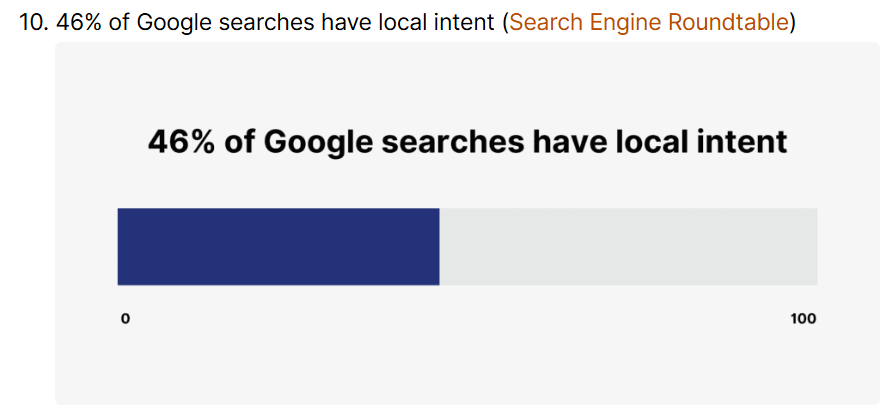
Nearly half of all Google searches are local. Around 46% have local intent — someone looking for a business, product or service near them. That’s not a niche. That’s half your market.
The map pack takes the lion’s share of clicks. For local searches, the top three map results — the “local pack” — pull around 42% of all clicks. If you’re not in those three, you’re fighting over scraps.

Local searches convert fast. Someone searching “emergency plumber Hamilton” isn’t researching for next month — they’ve got a leak now. Local intent is buying intent, and it moves quickly, often to a call or visit the same day.
Here’s the NZ angle the overseas guides miss: our markets are small. A plumber in Auckland competes with far fewer businesses than one in Los Angeles. So local search marketing works faster here, and costs less to win. The flip side is just as real — when a competitor shows up in the map pack and you don’t, that customer is simply gone. They don’t scroll looking for you. They call whoever showed up.
Not sure you even need this? If customers could realistically find and choose you based on where you are — a shop, a service area, a city you work in — then local search marketing applies to you. That’s most NZ businesses that sell to people.
The Channels That Make Up Local Search Marketing
There are four moving parts — organic, paid, reputation and listings. Before the how-to, here’s the map:
- Organic — ranking for free in the map pack and local search results (this is local SEO).
- Paid — local ads that buy you the top spot instantly (Google Ads location targeting, Local Services Ads).
- Reputation — your reviews, which drive both rankings and the decision to pick you.
- Listings — your citations: consistent business details across directories and Google itself.
Get all four working together and you own local search in your area. Most businesses do one — usually a half-finished Google profile — and wonder why they’re invisible. But first, one thing almost nobody explains.
You Can Rank #1 and Still Be Invisible
The map pack and the blue-link results are two separate races, ranked with different signals. You can sit at #1 in the normal web listings and still be nowhere in the map pack.
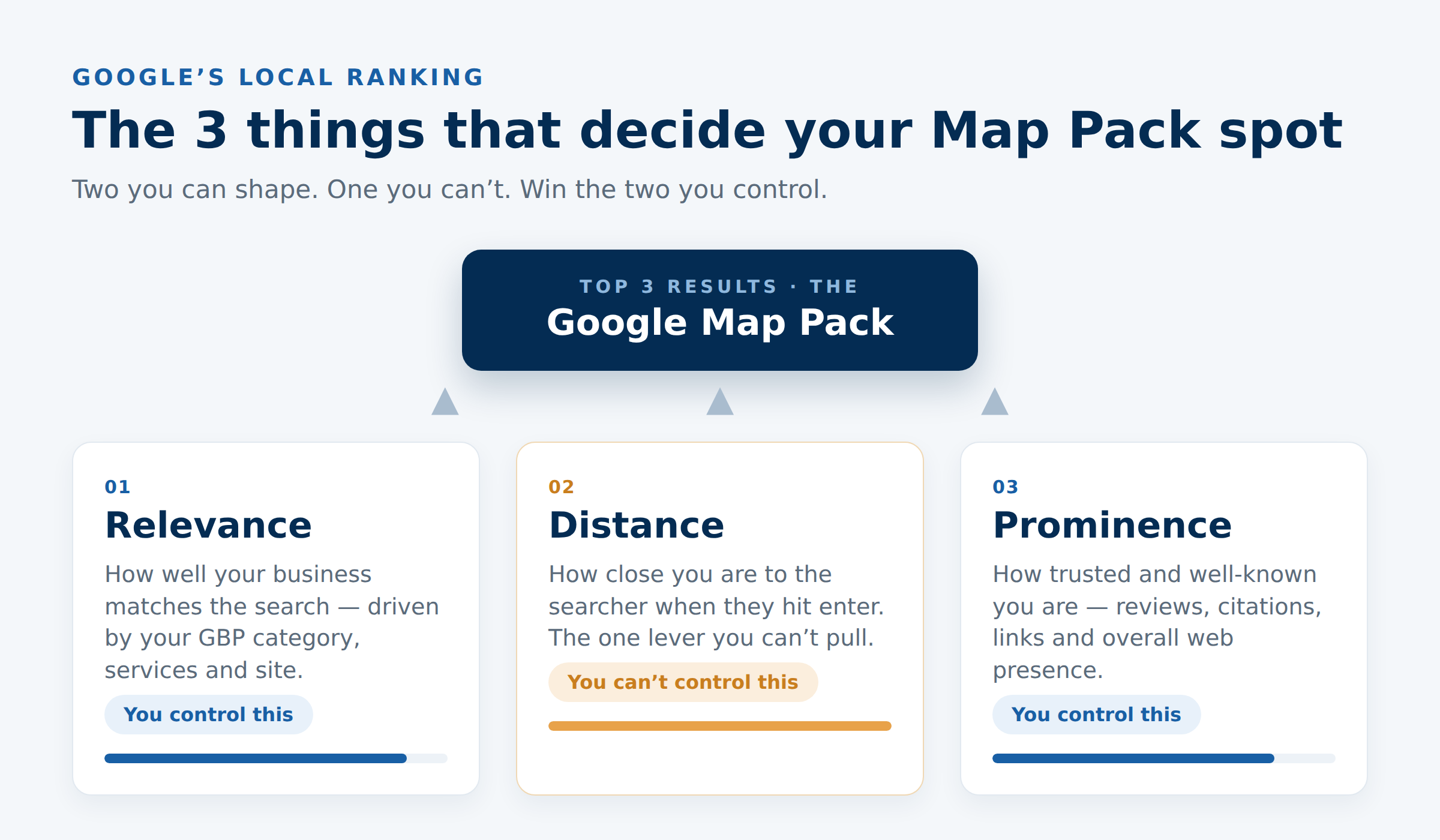
The blue links reward your website: content, links, on-page work. The map pack rewards your Google Business Profile: your listing, how close you are to the searcher, your reviews, your categories. A gorgeous website with zero reviews and a half-built profile can lose the map pack to a scruffy competitor who nailed their listing.
That’s why “we’ve got a great website” isn’t enough for local. You have to win both races. We know because we’ve done it — search “SEO Hamilton” and Expert SEO shows up in the organic results and gets pulled into Google’s AI Overview as a cited source. Most businesses aren’t even aware there’s more than one race to run.
How to Do Local Search Marketing
Here’s the full playbook, in the order that actually works. You don’t need all of it running on day one — you need it in the right sequence. Measure first, then build the free wins, then add paid once the foundations are in.
Start by Checking Where You Currently Rank
Before you change a thing, see where you stand — it takes five minutes.
- Open an incognito or private browser window (so your own history doesn’t skew results).
- Make sure your location is set to where your customers are.
- Search your main terms — “your service plus your town” (e.g. “electrician Tauranga”).
- Note where you appear: in the map pack, in the local results below, or nowhere.
Do it for your three or four most important searches. Missing from the map pack? That’s your first job. There but below competitors? You’ve got ground to make up. Want more than the eyeball test? A proper free website audit shows exactly what’s holding the profile and the site back.
Set Up and Optimise Your Google Business Profile
Your Google Business Profile is the free listing that puts you in the map pack — the single highest-leverage move in local search. Nothing else comes close.
The basics, done properly:
- Claim and verify your profile. Unverified profiles don’t rank.
- Get your details exact — name, address, phone, hours. These have to match your website and every other listing (more on that under citations).
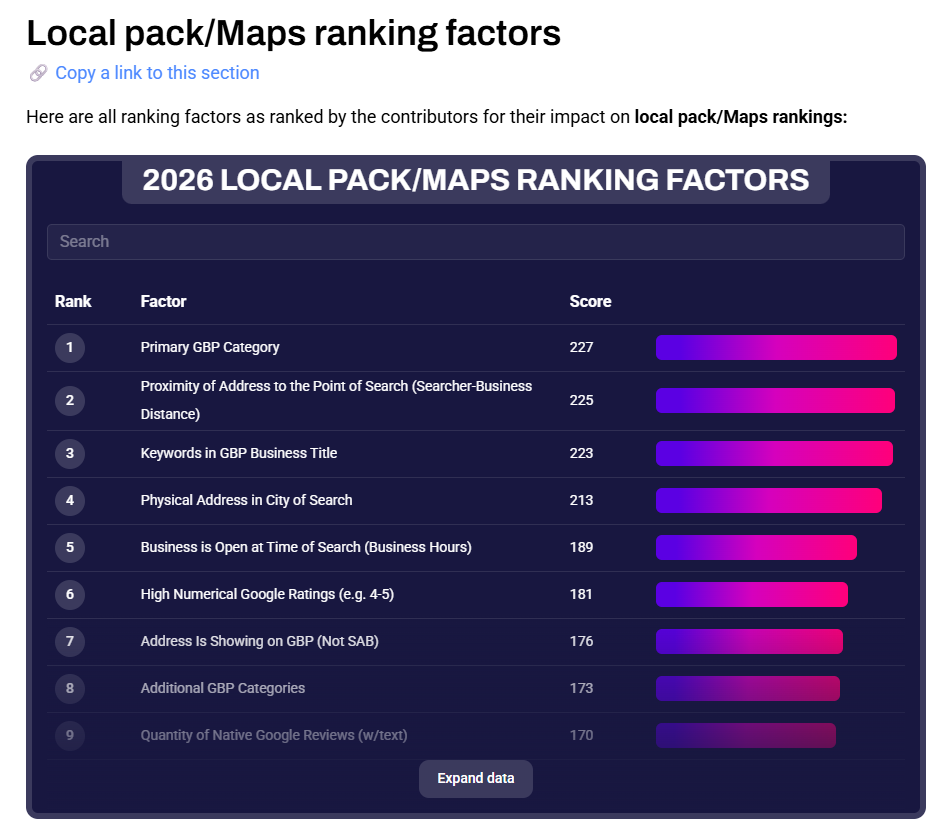
- Choose the right primary category. This is the biggest map-pack ranking factor there is. “Dentist” versus “Cosmetic dentist” changes who you show up for. Pick the one that matches what you actually want to rank for.
- Fill everything else — services, photos, opening hours, Q&A and regular posts. A complete, active profile beats a dormant one.
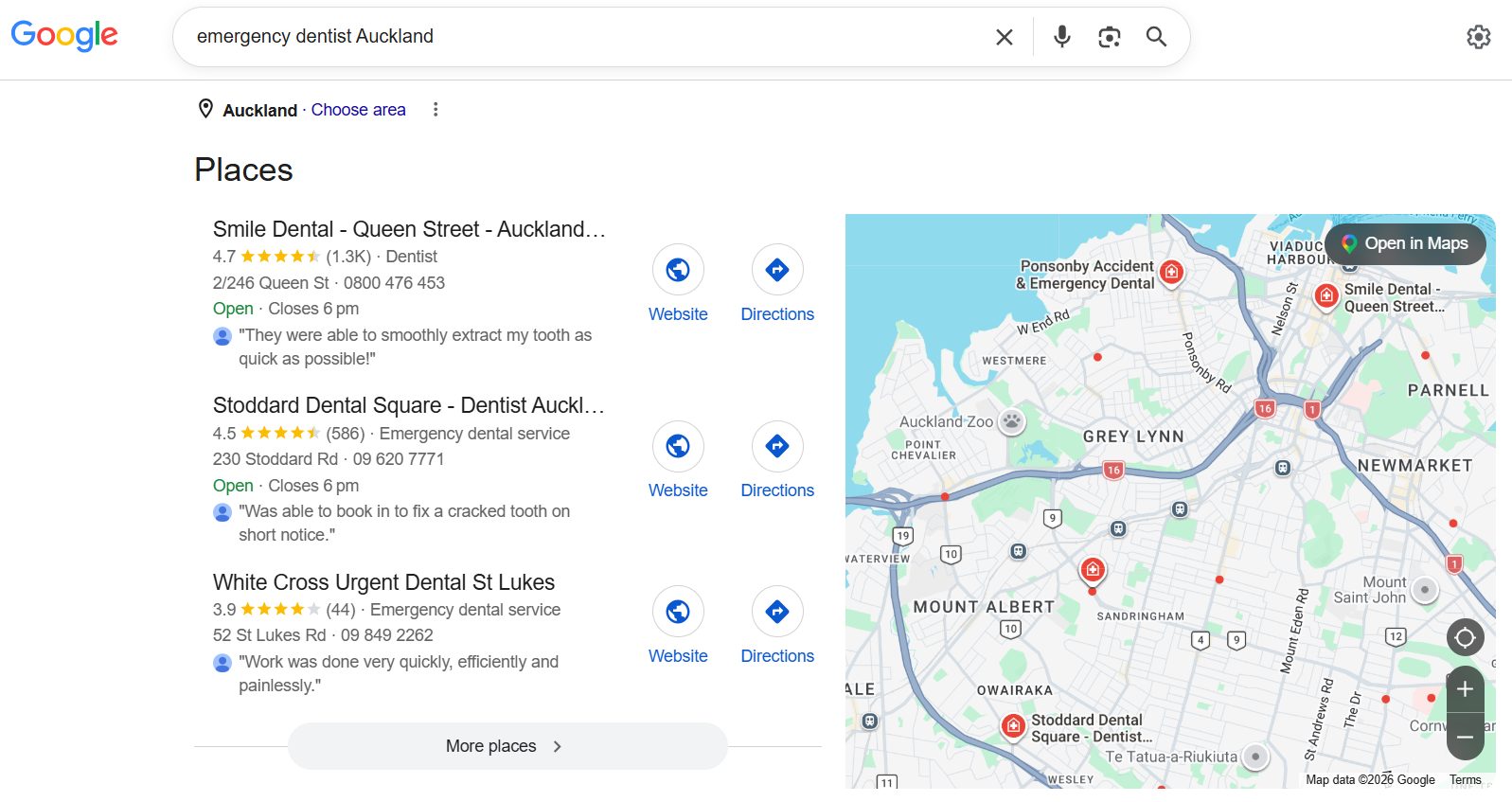
Take a dentist in Auckland. Two practices, similar websites. One picks the right category, loads real photos, keeps hours updated and replies to reviews. The other set theirs up in 2019 and forgot it. The first wins the map pack — and the steady stream of “dentist near me” bookings that comes with it. That’s the difference good SEO for Auckland businesses makes, and it starts with the profile.
No shopfront? You can still do this. Service-area businesses — a mobile mechanic, a plumber, a sparky who travels to jobs — set their profile to show a service area instead of an address. Google hides the address but you still rank across the areas you serve. It’s bread and butter for trades and mobile businesses.

Build a Steady Flow of Reviews
Reviews do two jobs at once — they help you rank in the map pack, and they’re usually the deciding factor when a customer picks between three listings. Volume, rating, recency and your replies all count.
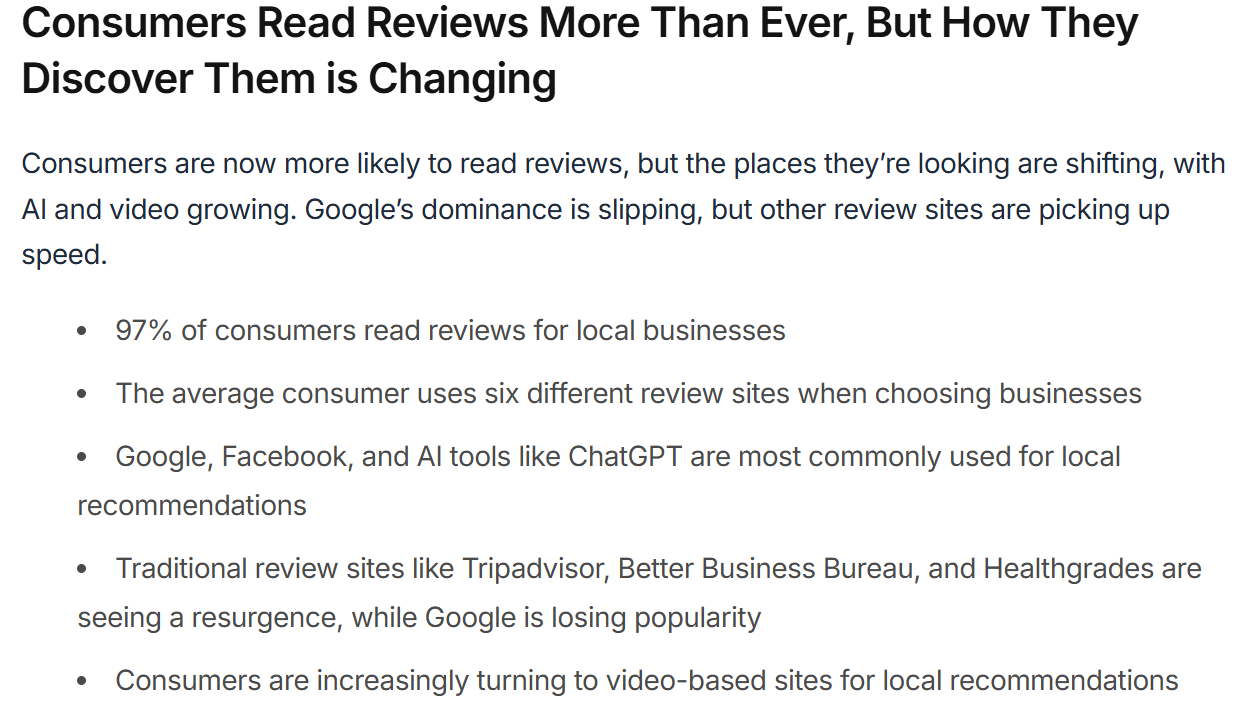
The numbers are hard to argue with. 97% of consumers read reviews for local businesses. Businesses in the top three local spots have 47 Google reviews on average. And 89% of people expect a business to reply to reviews — good and bad.
A simple system beats a heroic one-off push:
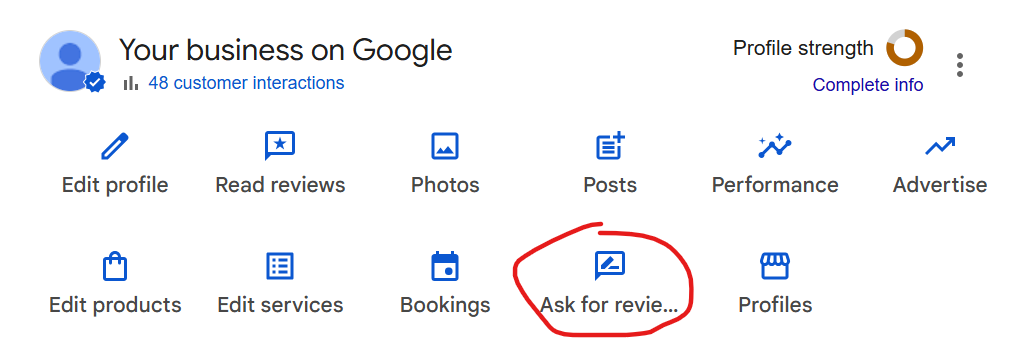
- Ask every happy customer, right after the job, while they’re pleased. Use Google’s “ask for reviews” link so it’s one tap for them.
- Reply to all of them — thank the good, calmly address the bad. Recency matters: 73% of people only trust reviews from the last month, so a steady trickle beats a big burst a year ago.
- Never buy or incentivise reviews. Google removed over 170 million fake reviews in one year and is getting sharper. Fake reviews get filtered or your profile suspended. Not worth it.
Picture a café in Tauranga with 250 genuine reviews at 4.8 stars, replying to every one. Against a rival with 12 reviews and no replies, it’s not a fair fight — the reviewed café wins the click before the customer’s even read a word.
That’s the kind of edge that makes getting found in Tauranga so achievable for businesses that just stay consistent.
Fix Your Citations and NZ Directory Listings
A citation is any online mention of your business name, address and phone (your “NAP”) — and consistent citations tell Google your business is real and where it operates. Every listing that doesn’t match chips away at that trust.
NAP consistency is the quiet killer. Around 50% of businesses that have checked their listings found incorrect information in them — an old address here, a wrong phone number there.
The average small business has about 37 directory citations feeding its local visibility, so the inconsistencies add up fast.

The fix is boring and effective: pick one exact version of your NAP and make it identical everywhere. The NZ directories worth being on:
- Localist, Finda, Yellow NZ and the NZ Business Directory
- Neighbourly (strong for suburb-level local trust)
- Your industry bodies and local chamber of commerce
A Hamilton plumber listed with three slightly different phone numbers across these sites is bleeding trust without knowing it.
Clean them up, keep them identical, and you strengthen everything else — it’s foundational work behind ranking a Hamilton business.
Create Local Content and On-Page Signals
Your profile gets you on the map; your website has to back it up. Google reads your site to confirm what you do and where you do it — that’s the on-page SEO side of local.
What actually moves the needle:
- Real service pages — one page per core service, written properly, not a thin list.
- Genuine location pages — if you serve multiple areas, give each a real page with real local detail. Not one page stuffed with fifty suburb names (that’s doorway spam, and Google penalises it).
- Local keyword research — write for what locals actually type. “Conveyancing lawyer Wellington,” not “property law solutions.”
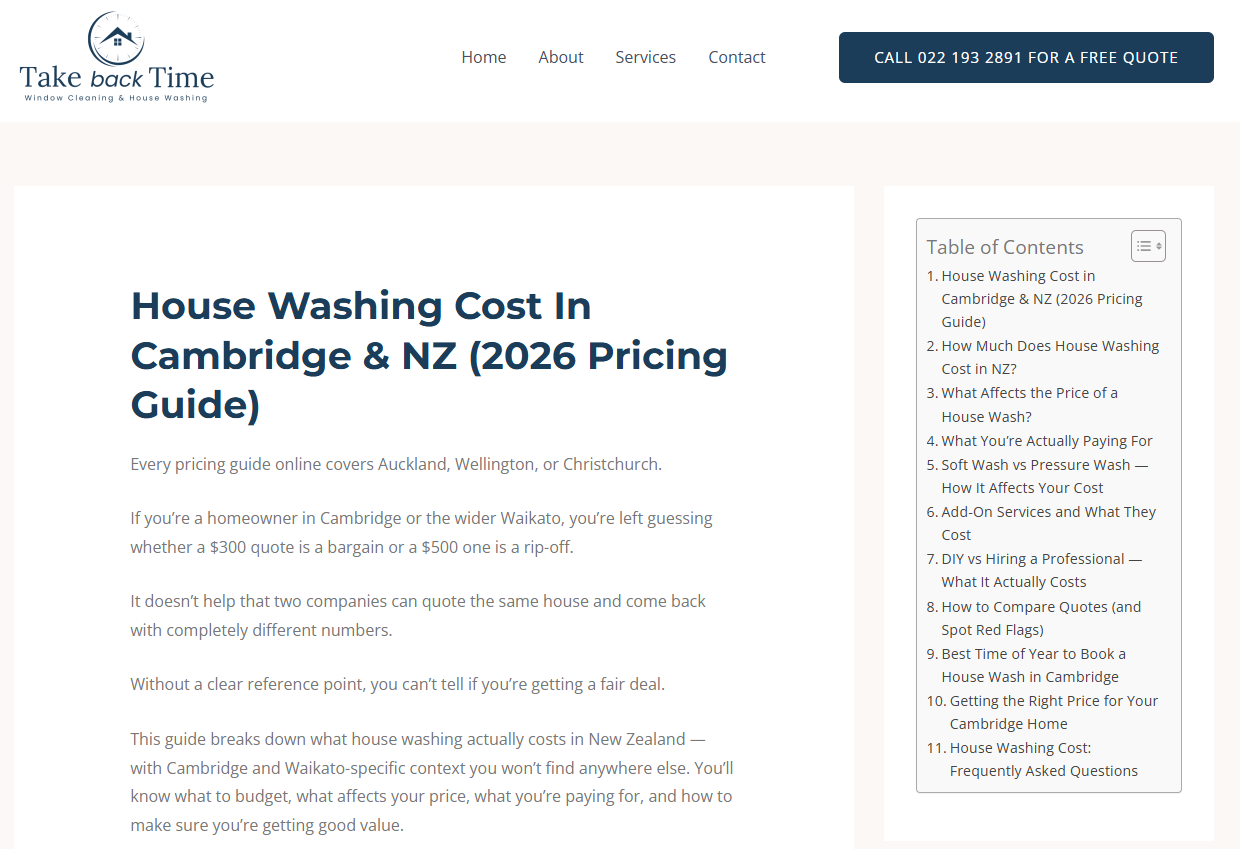
A Wellington law firm that publishes a clear “Buying a house in Wellington: the legal steps” page — answering the real questions locals ask — pulls in exactly the clients it wants. That’s how SEO for Wellington businesses compounds: helpful local content that earns the ranking and the trust at the same time.
Earn Local Links
Links from other local NZ sites tell Google you’re an established part of the community. For local, the local ones count most — and you don’t need hundreds, just relevant ones:
- Your chamber of commerce and local business associations
- Suppliers and partners who can list or mention you
- Local sponsorships — a sports club, a school gala, a community event
- Local press and community sites covering what you do
Quality beats volume every time. Ten genuine local links do more than a hundred cheap ones bought off a marketplace — those can actively hurt you. Same principle as proper link building, just pointed at your community.
Run Paid Local Ads (the Fast Lane)
Paid local ads put you at the very top instantly — the fast half of local search marketing while your organic presence builds. Two main options:
- Google Ads with location targeting — text ads shown to people searching your terms in your area. You control the radius, the budget, the message.
- Local Services Ads — the “Google Guaranteed” ads at the very top for trades and service businesses. You pay per lead, not per click, and get a verification badge that builds trust.
PPC versus SEO — which is better? Wrong question. Paid gives you leads today but stops the moment you stop paying. Organic takes months to build but keeps working for free once it ranks. The smart play for most NZ businesses: run ads to get leads flowing now, while you build the organic presence that lowers your reliance on ads later.
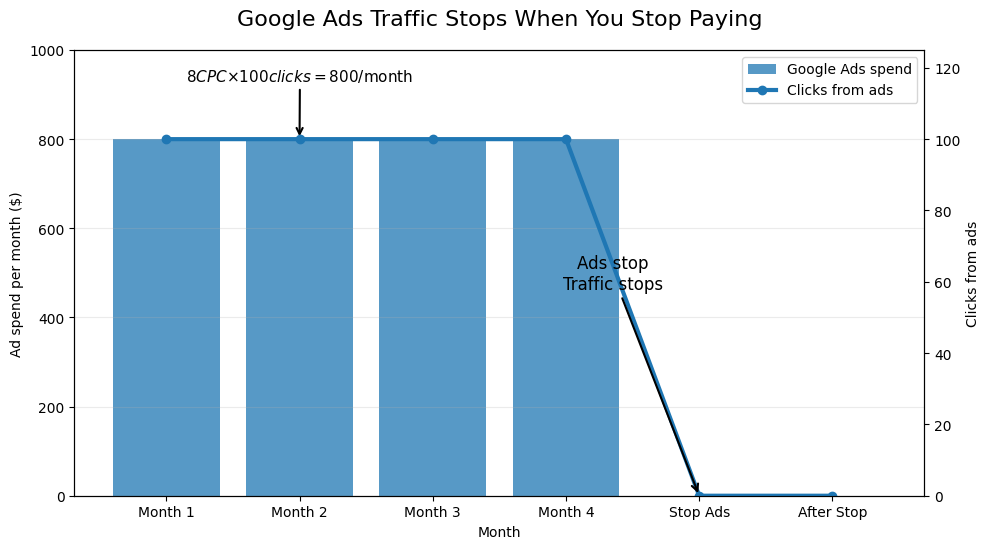
Budgets vary, but a local service business can get meaningful results from a few hundred dollars a week, scaling as the return proves out. That speed is paid’s real advantage — getting found in Christchurch can mean sitting at the top of local results within a day of launching, while the slower organic work matures. Plenty of owners start the ads themselves and bring help in as they scale.
Local Search Marketing in the Age of AI Search
AI changes the surface, not the fundamentals — and it rewards the same signals, so the businesses already doing local search marketing well are the ones getting named.
What’s actually changing. Google now shows AI Overviews on loads of local searches — an AI-written answer above the normal results.
Ask ChatGPT or Gemini “best plumber in Hamilton” and it names specific businesses. More and more, people get their answer without clicking a single website. That’s the “zero-click” reality.
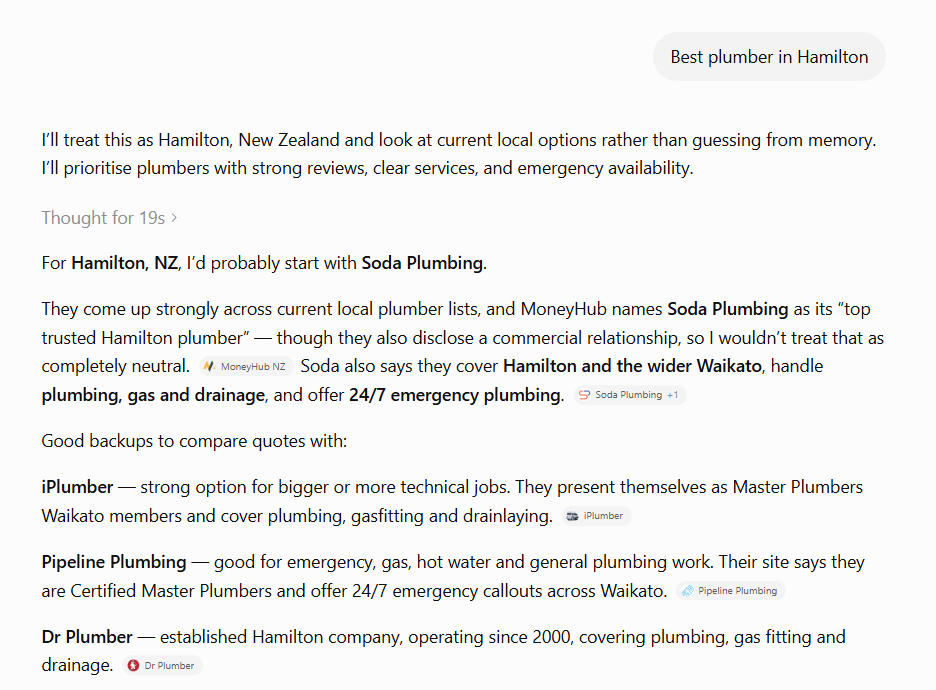
Here’s the good news, and it’s big. AI pulls from the exact same signals local search already runs on: a complete Google Business Profile, real reviews, consistent listings, clear and trustworthy content. You don’t need a separate “AI strategy” — you need the fundamentals done properly, because that’s the raw material AI reads.
Proof it works — our own results. Search “SEO Hamilton.” Expert SEO isn’t just ranking in the normal results — Google’s AI Overview cites us as a source on local SEO and AI search optimisation. That’s a New Zealand SEO business quoted inside the AI answer for its own money term. No competitor in our market can show that.
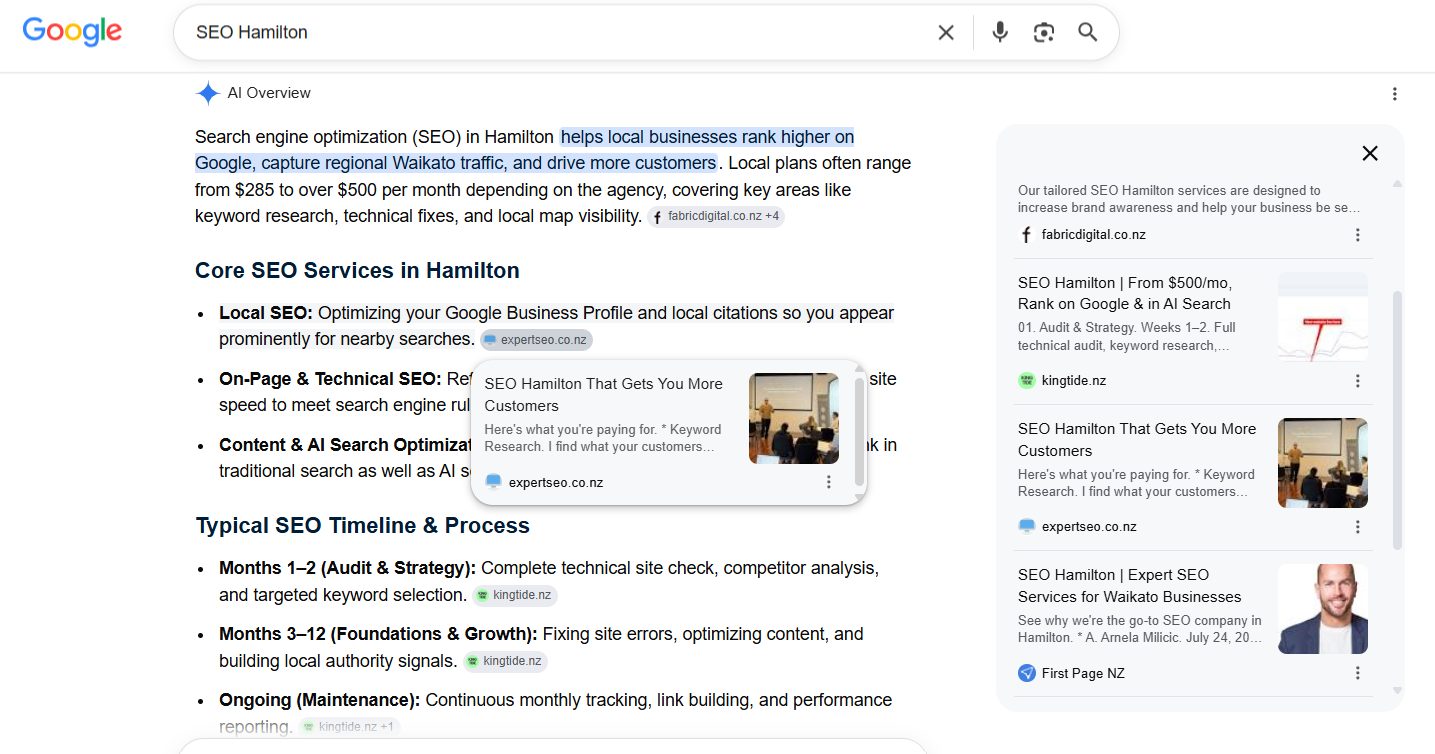
To give yourself the best shot at AI visibility, on top of the fundamentals: answer real questions clearly (question-and-answer content is what AI extracts), keep your entity consistent so AI trusts who and where you are, add structured data, and earn citations — be the source AI quotes, not just a page that ranks.
Even when the click disappears, being the named, recommended business is the new top spot. We help businesses get there with ranking in AI search — but it starts with everything in this guide.
The Local Search Mistakes That Quietly Kill NZ Visibility
Most local visibility problems trace back to a handful of avoidable mistakes. We see these constantly:
- Inconsistent NAP — different phone numbers or addresses across listings. Google loses trust; you lose rankings.
- Wrong or too-broad GBP category — the single biggest own-goal. Get it wrong and you’re invisible for the searches that matter.
- Buying or incentivising reviews — fastest route to a filtered or suspended profile.
- One thin page for five suburbs — doorway spam. Google ignores it at best, penalises it at worst.
- Ignoring the map pack because the website ranks — remember, they’re two separate races. Winning one doesn’t win the other.
None of these are hard to fix. Most businesses just never check.
What to Expect — Timelines and Costs in NZ
In most NZ markets you’ll see early map-pack movement in 1 to 3 months and solid results by 3 to 6 — faster than the overseas guides suggest, because our markets are smaller.
- Month 1: profile claimed and optimised, citations cleaned up, first reviews coming in. Early map-pack movement possible.
- Months 2 to 3: the profile strengthens, reviews build, local content starts to register. Real ranking movement for less competitive terms.
- Months 3 to 6: solid, stable results — map-pack presence for your core searches, steady enquiries.
Local SEO tends to pay off well, too — industry data puts the average return around 700% over a 6 to 12 month payoff, driven by low competition and high buying intent.

Costs (rough NZD). Three broad routes:
- DIY: free in dollars, but real in time — several hours a week, especially early.
- Done-for-you help: local SEO packages in NZ generally start around a few hundred dollars a month and scale with competitiveness and scope.
- Ads budget (separate): a few hundred dollars a week is enough for many local service businesses to see returns, scaling as it proves out.
If you’d rather not spend your evenings on this, that’s what our local SEO service exists for — but every tactic in this guide is something you can start yourself, today, for nothing.
Final Thoughts
The businesses that win local search aren’t the biggest, and they don’t have the flashiest websites. They’re the most consistent.
Profile claimed and complete. Reviews coming in every week and replied to. Listings that match everywhere. Content that answers what locals actually ask. Showing up the same, everywhere, all the time.
It’s not clever, and it’s not exciting — which is exactly why most of your competitors never do it. They set up a profile once, forget it, and hope. Consistency is the whole game. Do the boring things properly and, in a market the size of New Zealand’s, you’ll pull ahead faster than you’d think.
Local Search Marketing: FAQ
What is local search marketing?
Local search marketing is how a business gets found by nearby customers on Google — across the map pack, local results, reviews, listings and paid local ads. It's the full set of tactics for turning “near me” searches into customers.
What's the difference between local SEO and local search marketing?
Local SEO is ranking organically, for free, in local results. Local search marketing is the wider umbrella — it includes local SEO plus paid local ads, review generation and listings management.
Is local search marketing worth it for a small NZ business?
Yes. Around 46% of Google searches are local, and NZ's smaller markets mean less competition and faster, cheaper wins than overseas. For most local businesses it's the highest-ROI marketing there is.
Can I do local search marketing myself?
Absolutely — every tactic in this guide is DIY-able for free. The main cost is time and consistency. Many owners handle the basics themselves and bring in help once they want to move faster or scale.
How long does local search marketing take to work in NZ?
Expect early map-pack movement in the first 1 to 3 months and solid, stable results by 3 to 6 months for most local markets — faster than the US guides suggest, because our markets are smaller.
Is PPC better than SEO for local?
Neither is better — they do different jobs. Paid ads bring leads immediately but stop when you stop paying. Organic takes months but keeps working for free. Most businesses use both.
Do I need a physical shopfront?
No. Service-area businesses such as mobile mechanics, plumbers and electricians set a service area instead of an address on their Google Business Profile and still rank across the areas they serve.
What are the 4 types of SEO?
People usually mean on-page, off-page, technical and local SEO. Local search marketing leans hardest on local SEO, then layers reviews, listings and paid ads on top.