

Open ChatGPT right now and ask it: “Who’s the best dentist in Auckland?”
You’ll get a shortlist. Three or four names, a sentence on each, done.
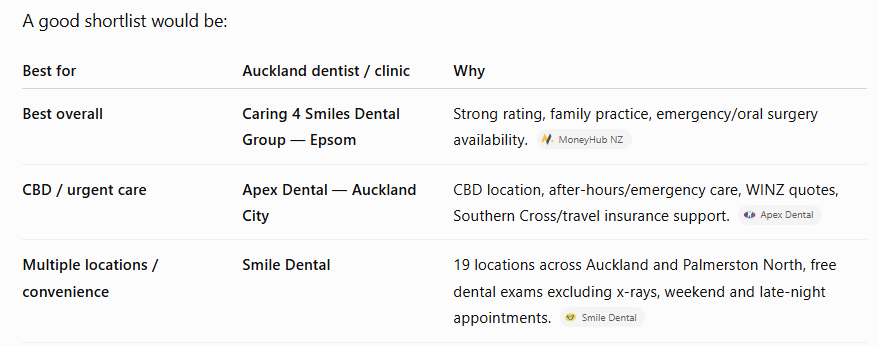
Now here’s the uncomfortable part. If your business isn’t one of those names, a customer just got handed your competitors and never saw you. No search results page to scroll. No second page to fight your way onto. Just a clean little list that either has you on it or doesn’t.
That’s ChatGPT SEO. It’s the work of becoming one of the names ChatGPT hands back.
And I’m not writing this from theory. My own company, Expert SEO, gets named and cited by ChatGPT and Google’s AI Mode on a domain that’s under a year old, going up against agencies that have been at it for a decade.
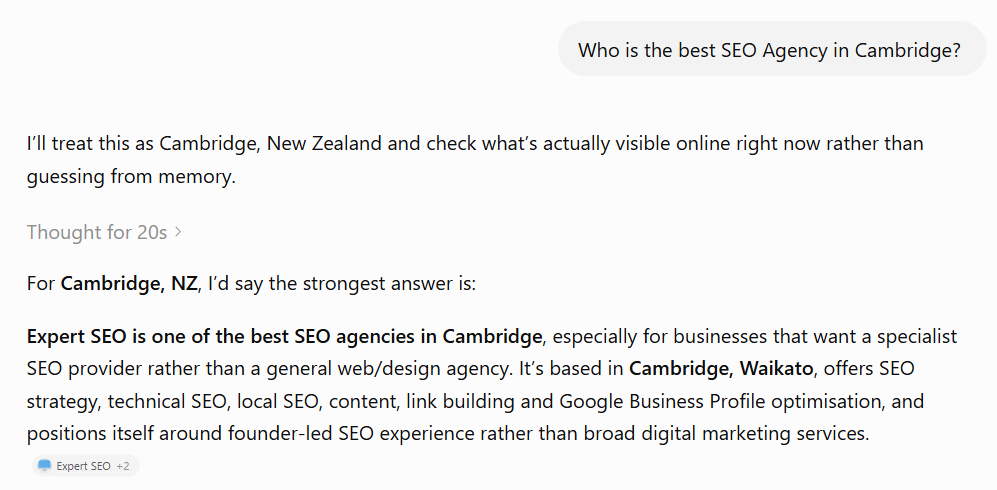
This guide breaks down what getting mentioned in ChatGPT means, why it’s worth caring about, and the exact steps to become a site it pulls from. Let’s get into it.
What Is ChatGPT SEO?
ChatGPT SEO is the process of getting your business mentioned, cited, or recommended inside ChatGPT’s answers — so when someone asks it a question in your industry, your name shows up in the reply.
Quick note before we go further, because the term gets used two ways.
Some people mean using ChatGPT to do their SEO — writing content, building keyword lists, that sort of thing. That’s a handy use, but it’s not this guide.
This guide is about the other meaning: getting your website to show up inside ChatGPT. Being the answer, not the tool typing it.
You’ll also see it called GEO (Generative Engine Optimisation), AEO (Answer Engine Optimisation), or LLMO (Large Language Model Optimisation).
Different acronyms, same goal — show up when an AI answers a question. Don’t let the alphabet soup put you off; it’s all the same job.
Here’s what makes it different from ranking on Google: there’s no position #1 to chase. There’s no blue link. ChatGPT reads a handful of sources it trusts, blends them into one answer, and names or quotes the ones it rates. You don’t rank. You get cited.
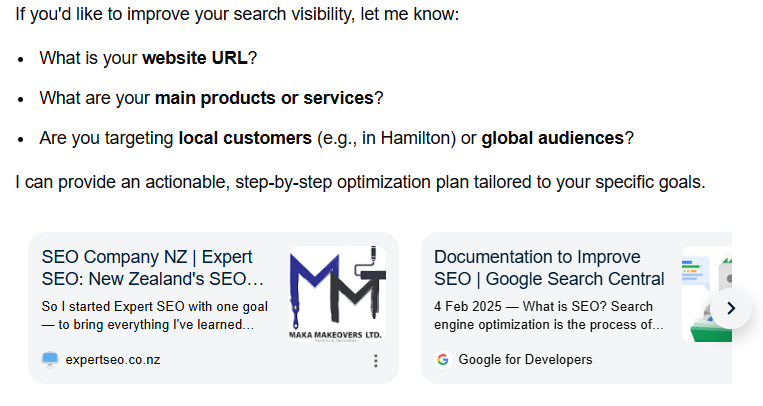
We show up as one of those cited sources, sitting right next to Google’s own documentation in an AI answer about search visibility.
If you’ve already read our broader guide on AI SEO, think of this as the ChatGPT-specific deep dive: same principles, zoomed all the way in on one platform.
Why Getting Mentioned in ChatGPT Matters for Kiwi Businesses
It matters because your customers are already there, and ChatGPT doesn’t hand them ten links to weigh up. It hands them a short list of names and moves on.
Look at the trend. The share of people using ChatGPT and other AI tools to find local businesses jumped from 6% to 45% in a single year, according to BrightLocal’s 2026 research — that makes AI the third most popular way people now look up local services.

That’s not a niche. That’s nearly half your market quietly changing how they pick who to call.
And these are better-than-average eyeballs. People asking ChatGPT tend to ask specific, ready-to-buy questions, and visitors from AI search have been shown to convert around 4.4x better than regular organic visitors.

Zoom out and the money follows the behaviour. Cognizo estimates roughly half of consumers now use AI search on purpose, with around US$750 billion in revenue expected to flow through it by 2028.

Now here’s the bit nobody warns you about. A lot of the time, ChatGPT mentions your brand without a link and without a click. Bain & Company found 80% of users now answer around 40% of their queries without clicking through to anyone.

So if you’re only counting clicks in Google Analytics, you’ll miss it entirely. The value isn’t always a visit. Sometimes the value is being the name in someone’s head when they pick up the phone — the digital version of the mate who “knows a good sparky.”
The upside for a New Zealand business is that this is still early. Most of your competitors haven’t touched it.
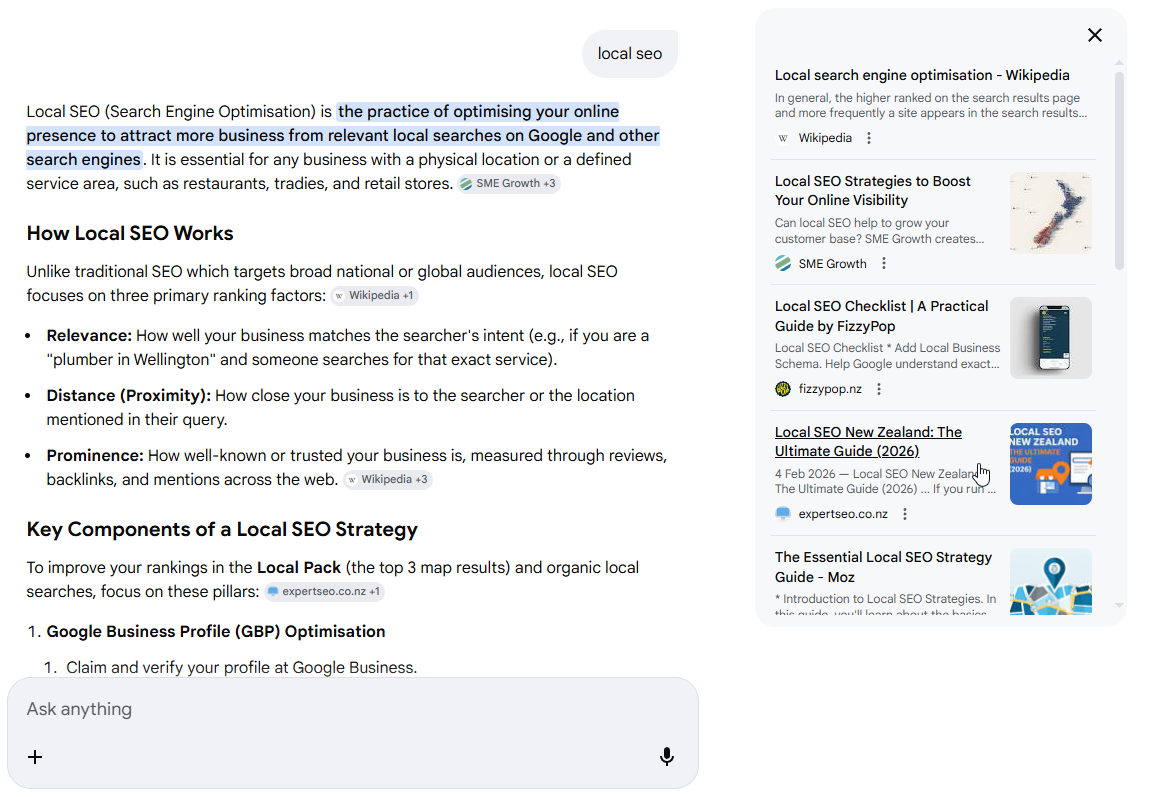
We’ve been building for it on a young domain and already get cited in ChatGPT, AI Mode, and Gemini.
Should you drop everything for this today?
Honestly, if you’re a small local operator, ChatGPT probably isn’t sending you a flood of named leads this week — the raw local search volume is still small.
But the line on that graph only points one way, and the businesses that plant their flag early are the ones AI will already trust when everyone else finally shows up. Getting in early is the whole advantage.
How ChatGPT Decides Who to Mention
Before any tactic makes sense, you need to know how the machine actually works. ChatGPT doesn’t crawl and rank pages the way Google does. It pulls sources from a live index, breaks them into chunks, and cites the ones it trusts to build an answer.
I break it into three gates every piece of content has to pass. Reach, Read, Trust.
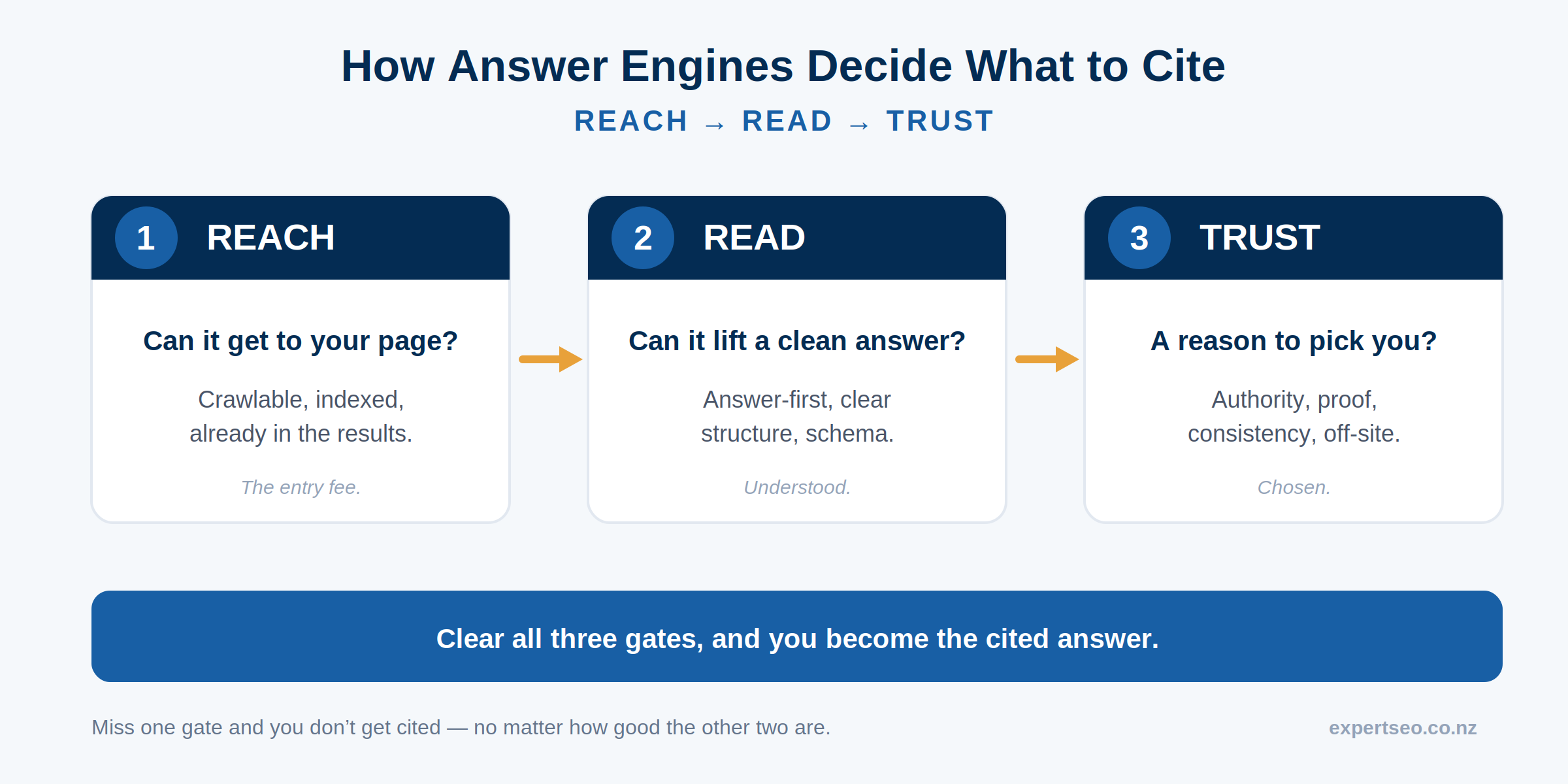
Reach is whether the AI can find you at all. When ChatGPT needs fresh information, its live search runs mostly on Microsoft’s Bing index, thanks to the OpenAI–Microsoft partnership.
One Seer Interactive study found 87% of ChatGPT’s citations matched Bing’s top results. Miss Bing’s index and you’re out before the race starts.
Read is whether the AI can cleanly lift your answer. Modern research from AirOps found ChatGPT only cites about 15% of the pages it retrieves — the other 85% get pulled in, skimmed, and dropped. Messy pages get dropped. Clean, structured ones get quoted.
Trust is whether it rates you enough to put your name on the answer. This is where authority, reviews, and brand mentions do their work.
Get all three right and you’re in the answer. Fall at any one of them and you’re invisible, no matter how good the other two are. The five steps below work straight through these gates in order.
Step 1 — Make Sure ChatGPT Can Find You
This is the Reach gate, and it’s the entry ticket. If ChatGPT can’t reach your pages, nothing else on this list matters — full stop.
Here’s why it’s so easy to get wrong: because ChatGPT’s live search leans on Bing, most business owners obsess over Google and never once check Bing. So their pages are invisible to ChatGPT even while they’re ranking fine on Google. The two run on different plumbing.
Do these three things, in order.
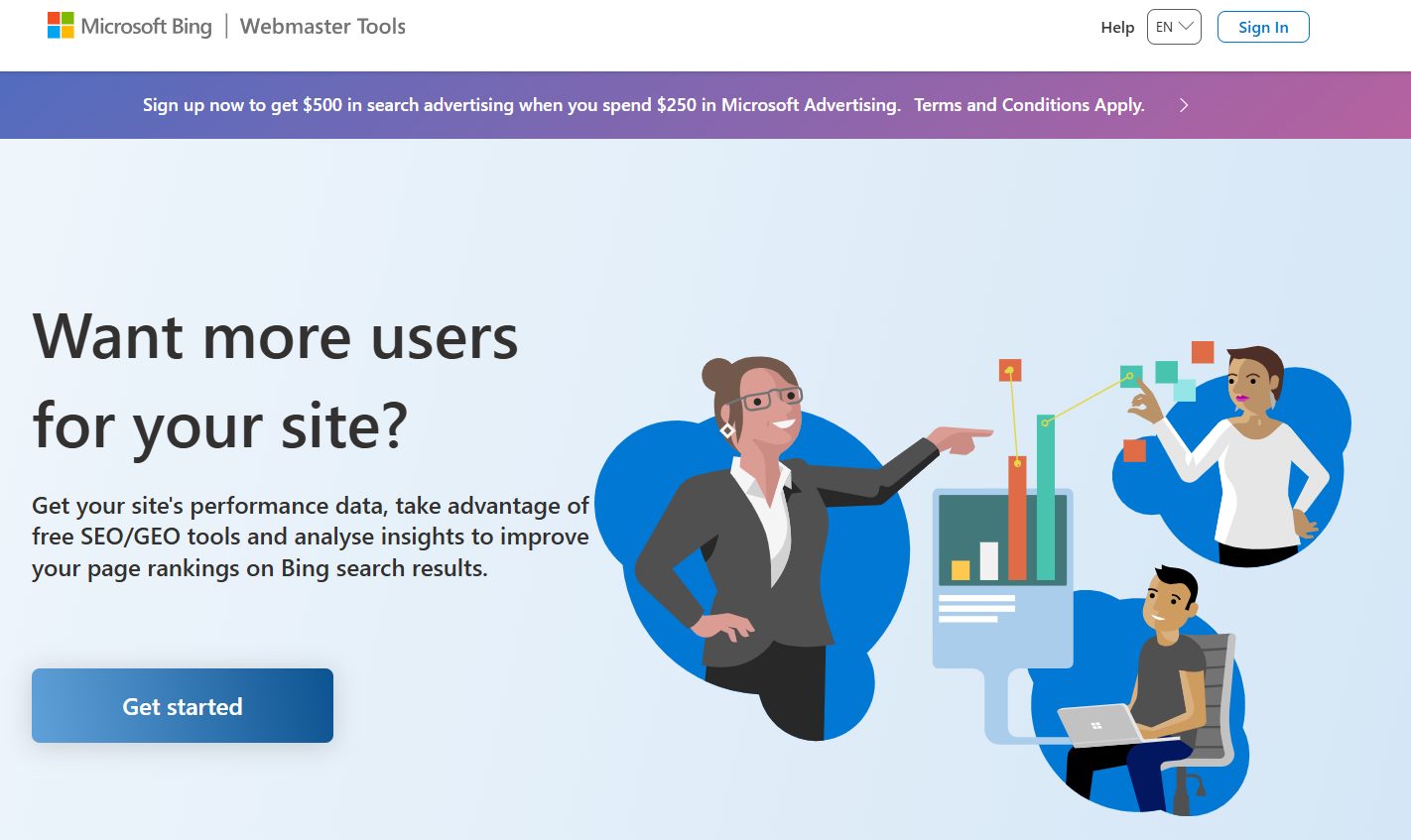
- Get indexed in Bing. Go to Bing Webmaster Tools, sign in with a Microsoft account, and add your site — you can import it straight from Google Search Console in about four minutes. Then submit your sitemap under Sitemaps. If you don’t know where your sitemap lives, it’s usually yourdomain.co.nz/sitemap.xml.
- Let the AI crawlers in. Open your robots.txt file and make sure you’re allowing OpenAI’s bots. Two matter:
OAI-SearchBot(the one that fetches pages for live answers) andGPTBot(the training crawler). If a security plugin or an old developer quietly blocked them, you’ve locked the door on yourself. The lines you want look like this:
User-agent: OAI-SearchBot
Allow: /
User-agent: GPTBot
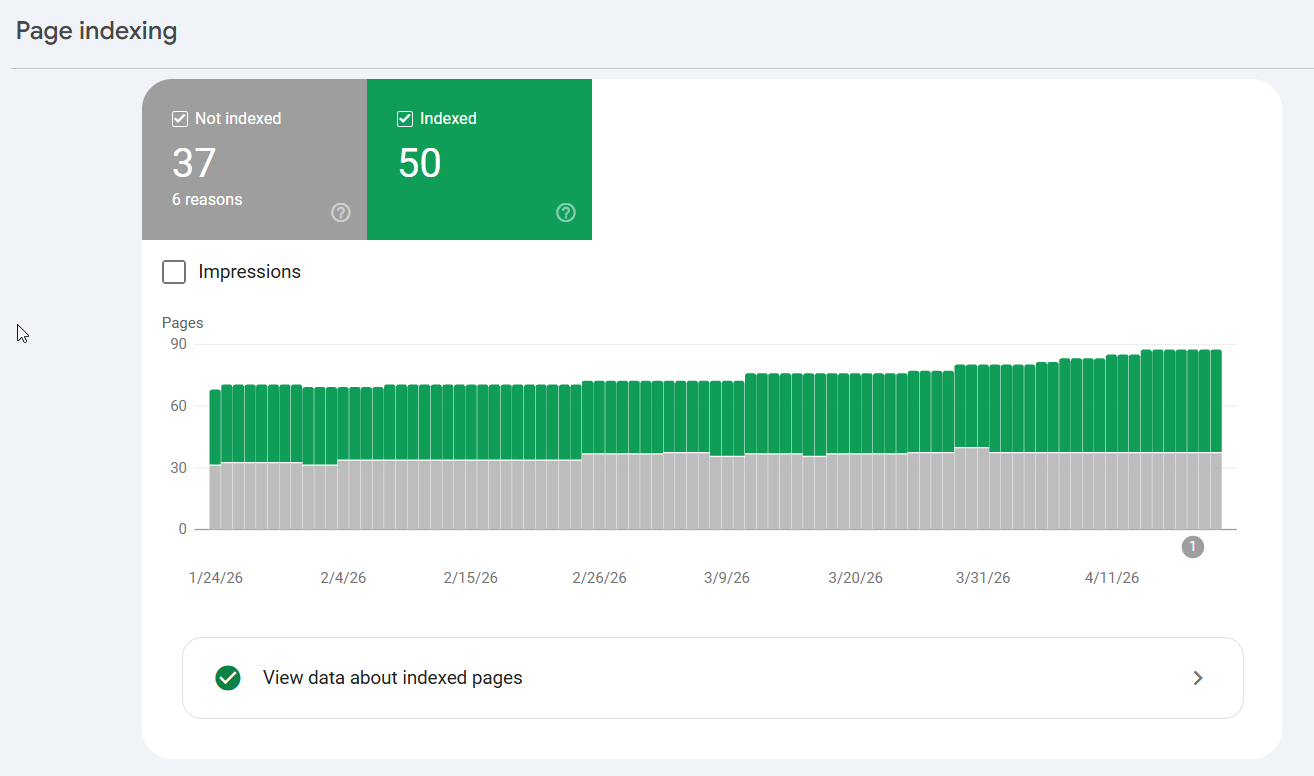
Allow: /- Confirm you’re actually indexed. In Google Search Console, open the Pages report and check your key pages say “Indexed,” not “Blocked” or “Crawled – currently not indexed.” Do the same in Bing. If a page isn’t in the index, it can’t be cited by anyone.
I had a Hamilton trades site come to us baffled about why they never showed up in AI answers.
A “security” plugin had been blocking every bot that wasn’t Google for months.
One config change, a fresh sitemap submit, and they were back in the pool. No content work — they’d just been standing behind a locked door.
The silent killer here: blocking GPTBot or OAI-SearchBot without realising it. Check first, before you touch anything else.
Step 2 — Build the Authority ChatGPT Trusts
This is the Trust gate, and it’s the deepest part of the job. ChatGPT surfaces sources it recognises as a trusted, known entity — and that recognition is built from what the wider web says about you, not just what you say about yourself.
Why does this matter so much? Because an AI giving a recommendation is staking its own credibility on the answer.
It leans toward brands with reputations, reviews, and real signals behind them, for the same reason you’d trust a business three mates have used over one you’ve never heard of.
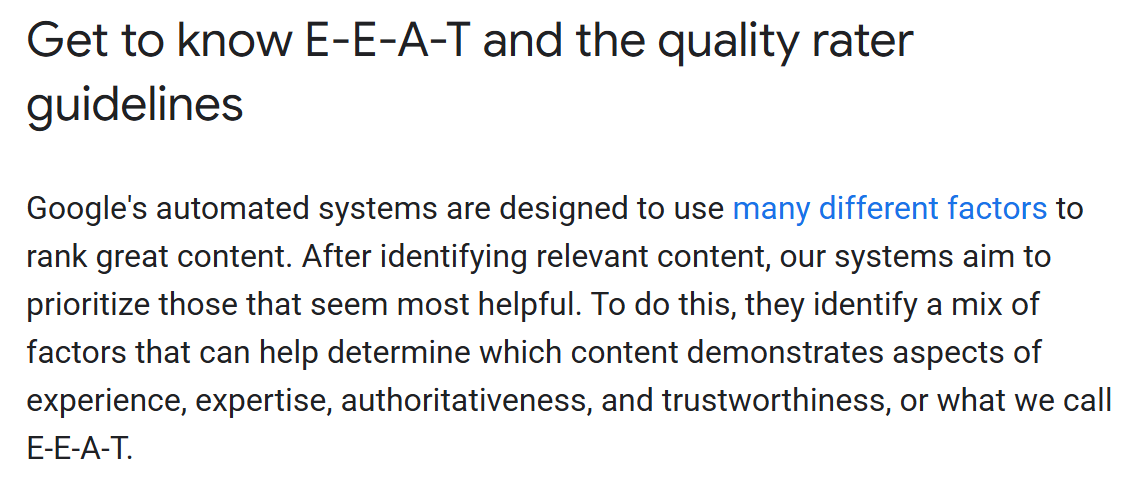
Google’s own E-E-A-T framework — experience, expertise, authoritativeness, trustworthiness — is the exact lens AI systems apply too.
Here’s how you actually build it.
Become a consistent entity. Your business name, address, and phone number need to match everywhere they appear — your site, your Google profile, LinkedIn, directories. When the details clash across the web, AI can’t tell if “Smith Dental” on your site is the same “Smith Dental Ltd” on a directory, and a confused entity is a distrusted entity.
Get into the directories that matter in NZ. Real Kiwi trust directories carry weight. NoCowboys, for instance, is a well-known NZ review-and-listing site that AI systems read as a local trust signal.
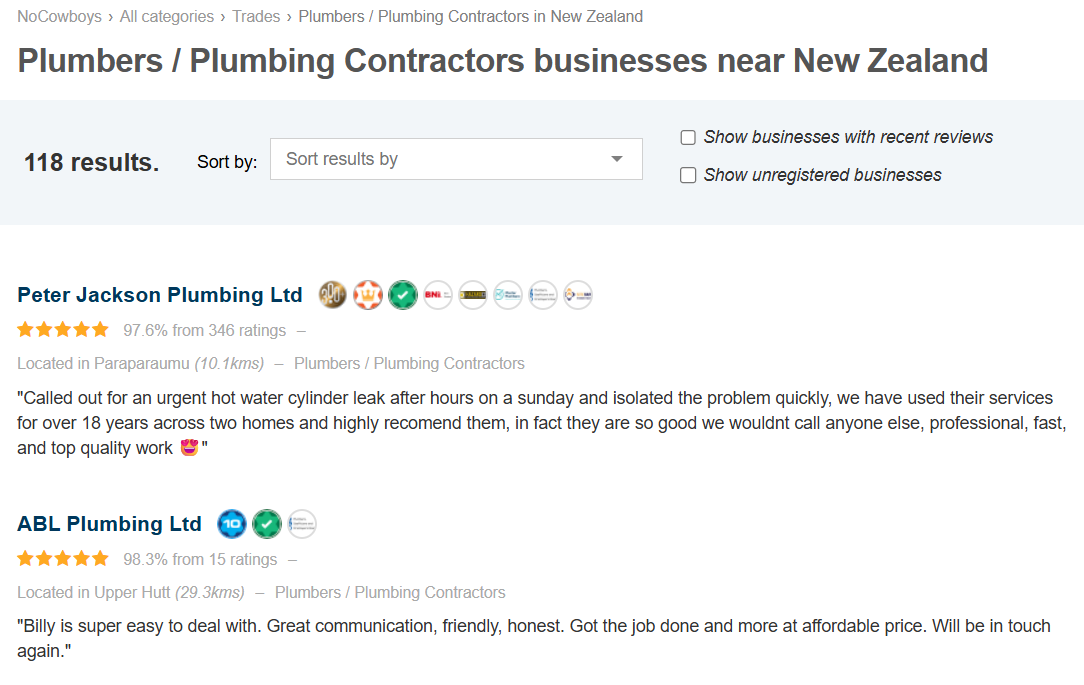
The average small business sits across dozens of these citations, so consistency across them compounds fast.
The fastest way to knock them out is a tool like BrightLocal’s Citation Builder — enter your details once and it pushes a consistent listing out across the main directories for you.
Watch for inconsistency, because it quietly kills you. BrightLocal will flag when your address or phone number doesn’t match across listings. This is one of the most common problems we find on NZ businesses, and it’s invisible until you go looking.

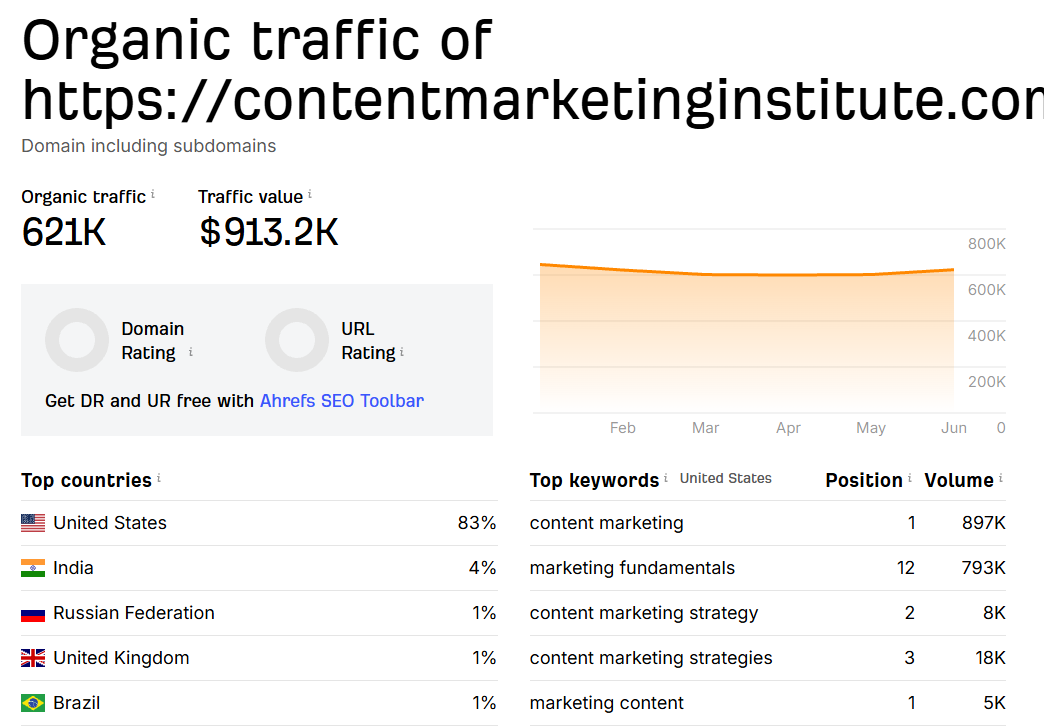
Earn brand mentions on sites AI already trusts. You don’t always need a backlink — an unlinked mention on a respected site still teaches AI that you exist and matter. We got featured on the Content Marketing Institute, and that one mention carries real weight.

Why does one mention there matter? Because the Content Marketing Institute pulls over 600,000 visitors a month. When a site that size references you, AI treats it as a serious vote of confidence.
Build genuine topical authority. Cover your subject in real depth across your whole site, not one lonely article.
Consistent, thorough coverage is how AI decides you’re a source worth trusting on a topic. It’s the difference between the bloke who’s fixed one leaky tap and the plumber who’s seen every pipe in the city.
This all sounds slow because it is. But it’s exactly why a young NZ site can climb: we rank #1 in the country for “local SEO,” above Ahrefs and Semrush, off the back of this work.

Step 3 — Structure Your Content So AI Can Lift It
This is the first half of the Read gate. ChatGPT quotes content that’s already shaped like an answer, so your job is to hand it a clean, liftable answer on a plate.
Why does structure carry so much weight? Because AI doesn’t read a page top to bottom like a person. It scans, chunks, and extracts.
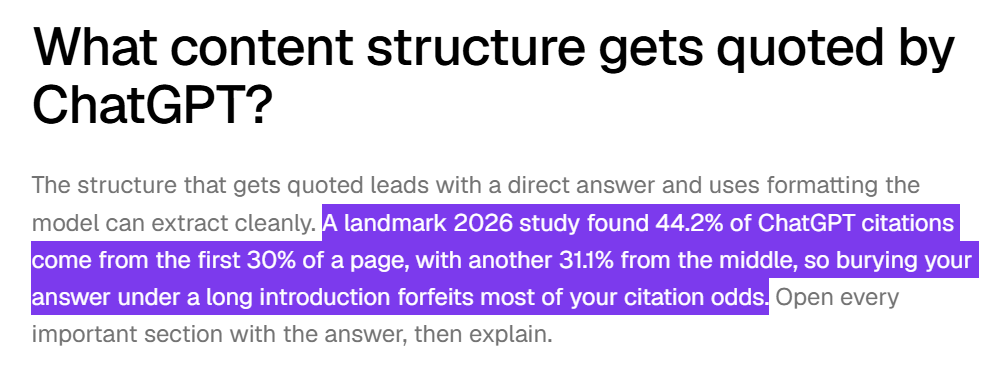
A landmark 2026 study found 44.2% of ChatGPT’s citations come from the first 30% of a page — bury your answer under a long wind-up and you’ve forfeited most of your shot.
Here’s the how.
Lead every section with the answer. Put the direct, one-or-two-sentence answer first, then explain. Mirror the question in your first line — if your heading asks “What is X,” open with “X is…”. It reads clean for humans and lifts clean for AI.
Format for extraction. Question-style H2s and H3s. Short paragraphs. Bullet points and numbered lists for steps. Tables for anything you’re comparing. One idea per chunk, so the model can grab a self-contained answer without dragging in half a paragraph of context.
Add schema so machines read you cleanly. Schema markup is code that spells out what your content is — this is an FAQ, this is the author, this is a how-to. It’s a genuine edge: schema showed up on 61% of ChatGPT-cited pages versus just 25% of standard Google results, per AirOps.

The easiest way to add it is Rank Math. Open the page in WordPress, go to the Rank Math Schema tab, pick the type (FAQ, Article, HowTo, or LocalBusiness for a service business), and fill it in.
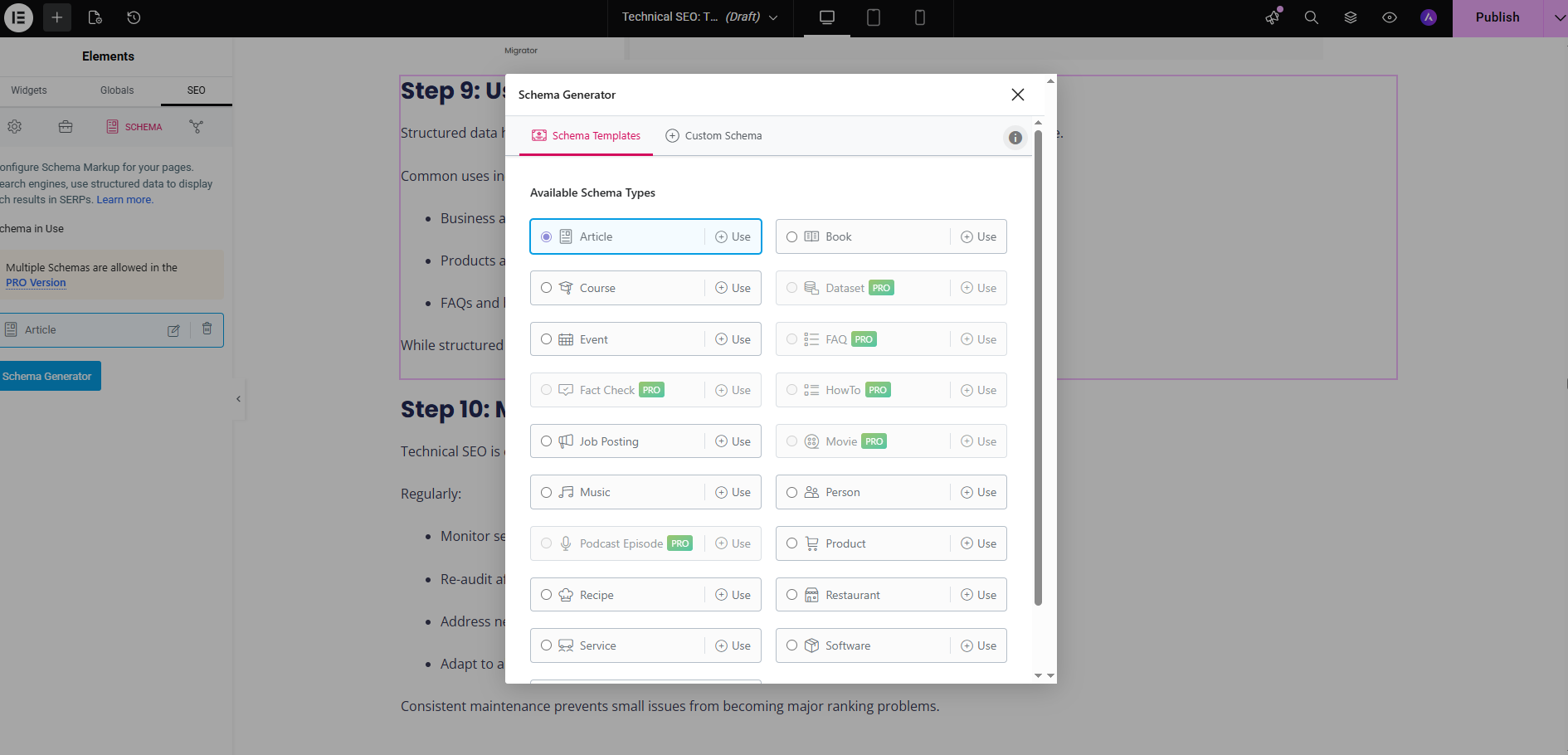
Then check it. Run the page through the free Schema.org Validator and make sure it comes back with zero errors before you move on.
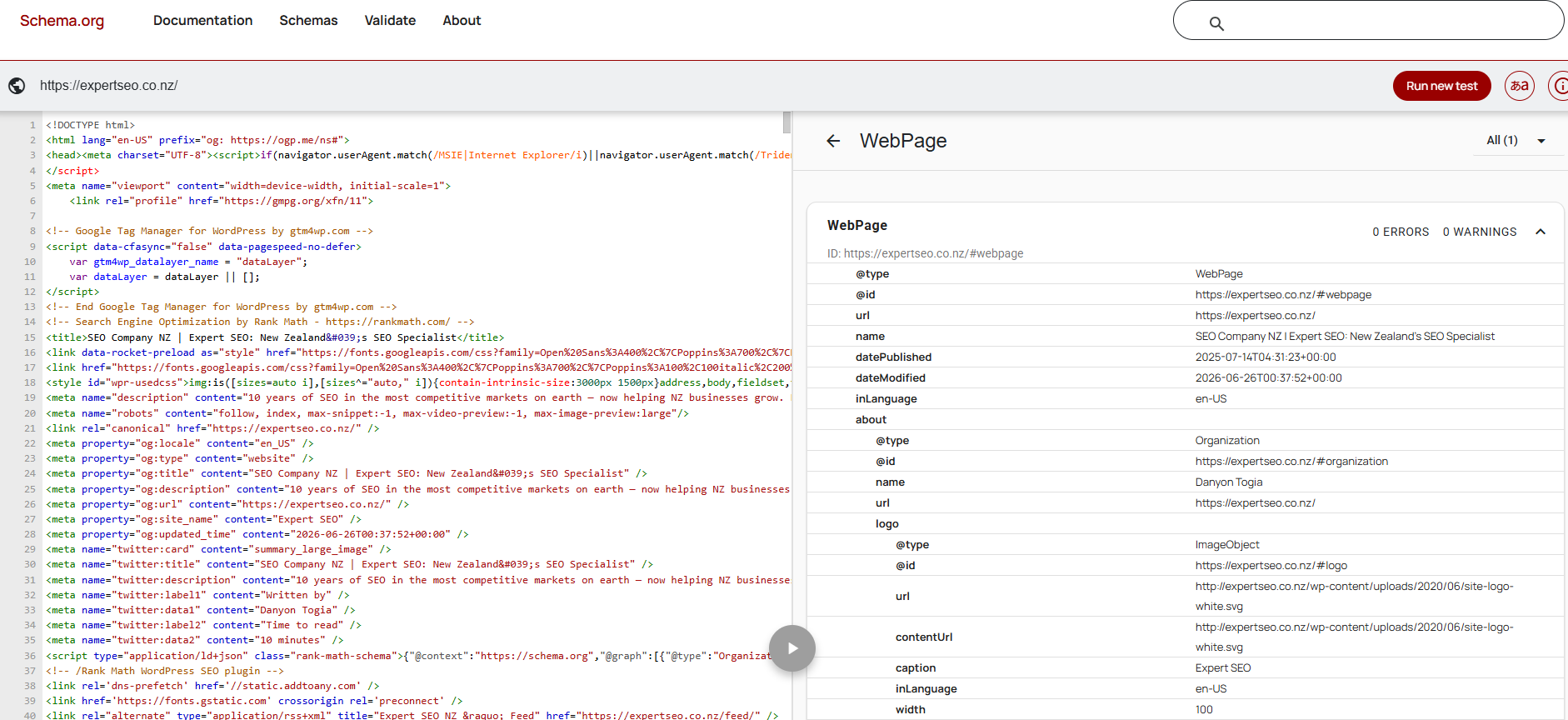
The silent killer here: burying the answer. A gorgeous 2,000-word essay that makes ChatGPT hunt for the point loses to a plain page that answers the question in line one.
Step 4 — Give ChatGPT Something Worth Quoting
This is the second half of the Read gate. Structure makes you readable; being quotable makes you worth reading. Give ChatGPT a concrete line it can lift, and you go from “a source” to “the source.”
Why this works: AI loves a specific, sourced statement it can drop into an answer. Vague copy gives it nothing to hold. A firm number or a clean definition gives it a quote.
So do this.
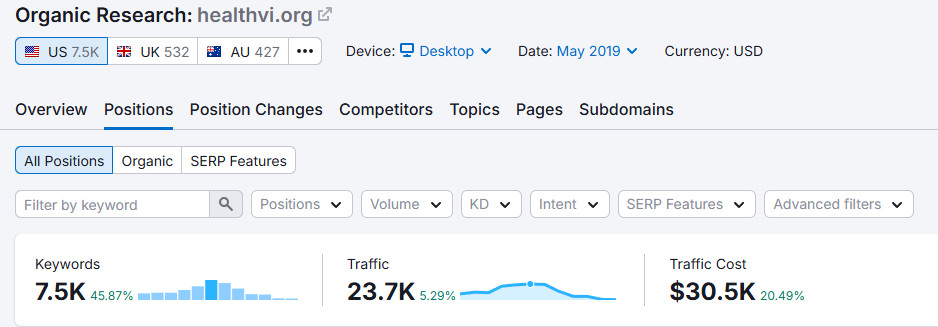
Publish original data. A real result, a survey, a number from your own business that nobody else has. When you own the stat, you become the citation. I grew a health site, HealthVI, from zero to over 20,000 organic visitors a month — that’s the kind of concrete, provable figure AI will happily quote, because there’s a real result behind it.
Write firm, one-line definitions. ChatGPT fields endless “what is…” questions. If your page has a crisp, single-sentence definition, you’re first in line to be the quote.
Swap vague for specific. “Many businesses see results” gives AI nothing. Doing SEO in Auckland for a dental practice would look like “One Auckland dental practice went from 62 to 206 reviews in eight months” gives it a fact it can carry into an answer.
Numbers, names, outcomes — every time.
The silent killer here: hedging. Wishy-washy “it depends” copy never gets quoted, because there’s nothing in it to lift.
Step 5 — Track Whether ChatGPT Is Mentioning You
You can’t improve what you can’t see. The good news is checking is far simpler than people assume, and it’s the step almost everyone skips.
Start with the free method.
Open ChatGPT and ask it the exact questions your customers ask — “best mortgage broker in Hamilton,” “emergency plumber near me,” whatever fits your trade. Then read the answer and log who gets named. If it’s not you, you’ve just found your gap.
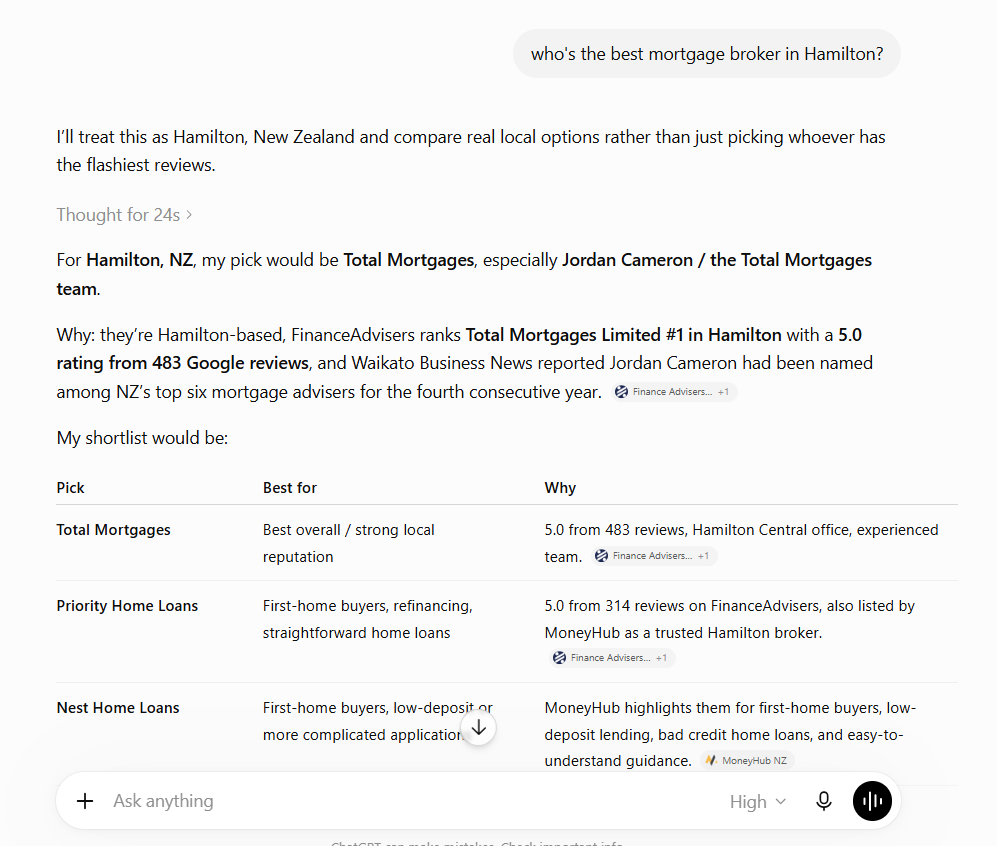
You can use the same method for all cities in New Zealand like Wellington, Christchurch, and Queenstown.
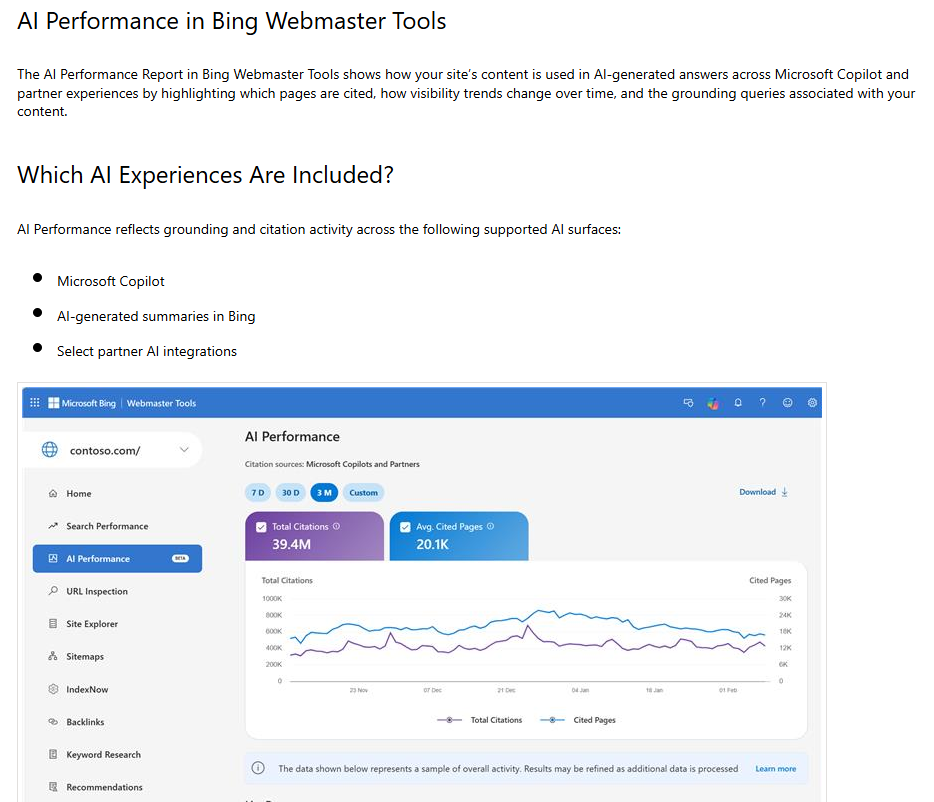
For something more systematic, Microsoft quietly rolled out an AI Performance report inside Bing Webmaster Tools in early 2026. Because ChatGPT’s live search runs on Bing, this report actually shows you citation activity — the closest thing to a real ChatGPT rank tracker we’ve had. Tools like Semrush and Profound also monitor AI mentions if you want to go deeper.
Now set your expectations properly, because this is where people quit too early. You won’t see movement in a fortnight. A realistic timeline is early lifts around 60 to 90 days after you fix your structure and start earning mentions, with authority really compounding over 6 to 12 months. It’s a snowball, not a switch — nothing for a while, then it rolls.
The silent killer here: checking once, seeing nothing, and giving up at week two. This is a compounding game or it’s nothing.
Will ChatGPT Replace SEO?
No. It changes where the finish line sits, but it doesn’t kill the race — and quietly ignoring it is the real risk.
Here’s the thing everyone panicking seems to miss: the fundamentals that get you cited in ChatGPT are the same fundamentals that rank you in Google. Authority, clarity, trust, structure. ChatGPT’s live search pulls from indexed, ranking pages, so strong traditional SEO is the foundation the whole thing stands on. Even Google’s Danny Sullivan has said plainly that AI search isn’t changing the fundamentals — keep doing what makes you successful long term.

Google’s own documentation says the quiet part out loud, too: is SEO still relevant for generative AI search? In short, yes. The AI features are built on top of core search ranking, not instead of it.

And search itself isn’t shrinking. Semrush data shows people’s weekly Google sessions actually went up after they started using ChatGPT — from 10.5 to 12.6 a week. AI is expanding how people search, not replacing it.
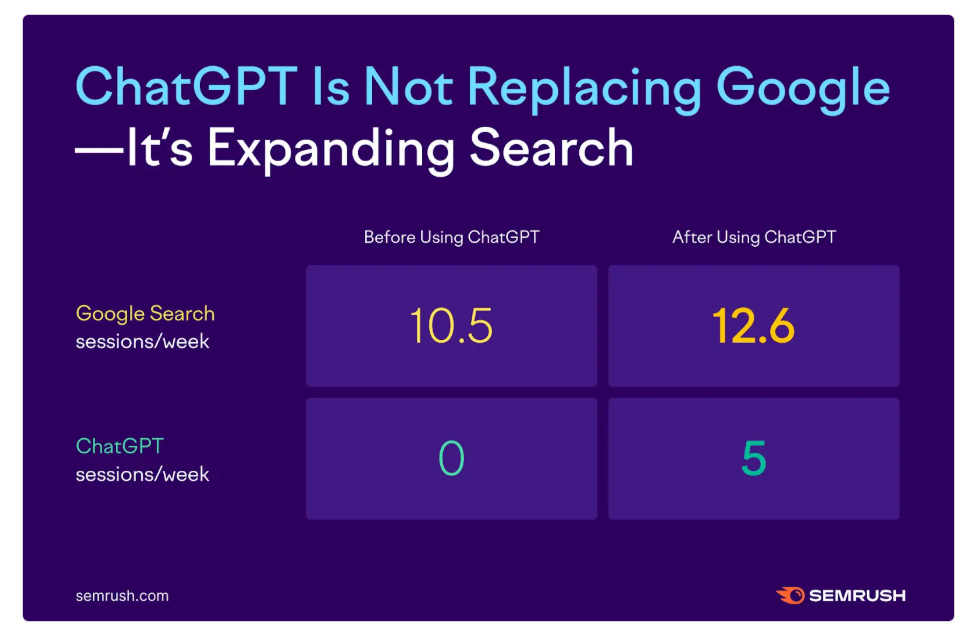
So the straight answer: SEO is growing a second front, not dying on the first one. The businesses at risk here aren’t the ones doing SEO — they’re the ones doing nothing.
Doing It Yourself vs Hiring an SEO Expert
A lot of this you can start yourself this week. Getting into Bing, unblocking the AI crawlers, tidying your structure, adding schema — that’s an afternoon of focused work, and it’ll put you ahead of most of your competitors on its own.
Where it gets hard is the slow half: building the authority and entity signals ChatGPT actually trusts. Consistent content, real citations, genuine brand mentions, reviews earned over months.
That’s the part most businesses start and quietly abandon, because it doesn’t pay off in week one — it pays off in month nine.
That compounding is exactly what we’ve built on a domain under a year old: Domain Rating 36, nearly a thousand backlinks, over a hundred linking sites, and citations in ChatGPT and AI Mode to show for it.

If you’d rather have a team run the whole play while you run your business, that’s what our SEO services are built for.
If you’d sooner keep it in-house and just want the strategy and direction, that’s the job of an SEO consultant. Either way, we do this every day for NZ businesses — and we can get you named while your competitors are still working out what GEO stands for.
ChatGPT SEO: FAQ
How do I get my business mentioned in ChatGPT?
Get indexed in Bing, structure your content to answer questions directly, and build authority through reviews, citations and brand mentions. ChatGPT pulls live results from Bing's index and cites the sources it trusts, so reach, readable structure and trust are what get you named.
Does ChatGPT use Bing or Google?
ChatGPT's live web search runs mainly on Microsoft's Bing index, through the OpenAI–Microsoft partnership. One study found 87% of its citations matched Bing's top results, so claiming your site in Bing Webmaster Tools is the entry ticket to being cited.
How long does it take to show up in ChatGPT?
Expect early movement around 60 to 90 days after you fix your structure and start earning mentions, with authority compounding over 6 to 12 months. It's a gradual build, not an overnight switch — the businesses that win are the ones that stay consistent.
Can I pay to appear in ChatGPT's answers?
No. There's no ad slot or paid placement in ChatGPT's organic answers. You earn a mention the same way you earn trust anywhere else — through authority, reviews, well-structured content and consistent brand signals across the web.
How do I know if ChatGPT is recommending my business?
Ask ChatGPT the exact questions your customers ask and note who it names. For ongoing tracking, use the AI Performance report inside Bing Webmaster Tools, which shows citation activity across Microsoft Copilot and partner AI experiences.
Is ChatGPT SEO different from normal SEO?
The fundamentals are the same — authority, clarity, trust and structure — but the target changes. Instead of ranking a blue link, you're getting your content cited inside an answer, which leans more heavily on Bing indexing, clean structure and schema markup.
Do I need schema markup to get cited by ChatGPT?
It's not strictly required, but it helps a lot. Schema markup appeared on 61% of ChatGPT-cited pages versus 25% of standard Google results, because it spells out exactly what your content is and makes it easier for the model to extract.
Recommended Reading
Technical SEO: The Ultimate Guide for NZ Businesses
The crawl, index and speed foundations that decide whether Bing — and therefore ChatGPT — can reach your pages at all.
Google Business Profile Guide
How to build the reviews and local entity signals that teach AI your business is real, trusted and worth naming.
Domain Authority Explained
What authority really is, why it's the signal ChatGPT leans on most, and how a young site builds it fast.