

This guide will teach you how to do dental SEO in New Zealand, step by step.
Not the American version. Almost every dental SEO guide online was written for US practices, and it shows.
They tell you to get listed on Yelp and Healthgrades. They price everything in US dollars. They recommend link campaigns built for companies with a marketing department.
None of it transfers to a three-dentist clinic in Tauranga.
So here’s what you’ll actually get.
What dental SEO costs here, in NZD. Real bands, what each one buys, and what moves the number. Only one page ranking for this term gives a price at all, and it’s in US dollars.
What a new patient is worth to your practice. Built from the New Zealand Dental Association’s own published fee data, not a US blog’s lifetime value figure. This is how you work out whether the maths stacks up before you spend anything.
A nine-step method you could start on Monday. Google Business Profile, reviews, keywords, treatment pages, on-page, technical, schema, citations, and turning the traffic into booked appointments. Every step with the actual clicks, the tools, and a New Zealand example.
What you’re legally allowed to say online. Your website is regulated advertising under the Dental Council’s standard, and some of the tactics in those imported guides will put you offside with it.
How AI search changed things — and how much it didn’t. The honest version, with the data, rather than the panic or the reassurance.
A realistic timeline, tied to how competitive your city actually is instead of a generic three-to-six months.
By the end you’ll know what to do, what order to do it in, what it should cost, and what to expect. Let’s get into it.
Key Takeaways
- What it is: Dental SEO is the work of getting your practice to appear when someone nearby searches for a dentist or a treatment — in Google’s map pack, in the organic results, and now in AI answers.
- What it costs: Most New Zealand dental practices spend between $1,500 and $4,500 a month, and the range is driven almost entirely by how many practices you’re competing against in your city.
- What it returns: Using the NZ Dental Association’s 2025 fee data, a single-tooth implant patient is worth around $5,747 before you count anything else they ever have done. At those numbers you don’t need much traffic for the maths to work.
- The compliance bit: Your website counts as advertising under the Dental Council’s Advertising Practice Standard, which rules out a few tactics the American guides recommend — including calling yourself a cosmetic dentistry “specialist”.
- The AI reality: AI Overviews take clicks, but Pew’s data shows only 8% of one- and two-word searches trigger one, compared with 53% of ten-word searches. “Dentist Ponsonby” is barely touched. “How much does a dental implant cost” is hammered.
- The market: 75% of NZ practices have three dentists or fewer and 93% are taking new patients — this is a local game, not an enterprise content game.
- How long: Two to three months for early map pack movement, six to twelve for meaningful organic results. Faster in a provincial town, slower in central Auckland.
What Is Dental SEO?
Dental SEO is the process of getting your practice to show up when someone in your area searches for a dentist or a dental treatment. It covers your Google Business Profile, your website, your reviews, and increasingly the AI answers that sit above everything else.
Here’s the part most guides skip. A dental search result is four separate contests stacked on one page, and each one is won differently.
The Four Battles on a Dental Search Result
Type “dentist Hamilton” into Google and look at what comes back, from the top down.
Paid ads. The two or three results with “Sponsored” above them. You buy these. No SEO involved, and if you stop paying they vanish that afternoon.
The map pack. Three business listings with a map beside them, pulled from Google Business Profiles. This is the prize for a dental practice — it sits above the normal results and it’s where most “near me” taps land. Ranking in Google Maps comes down to your Google Business Profile.
People Also Ask. The expanding questions in the middle of the page. These are won with clear, well-structured answers on your site.
Organic results. The standard blue links. Won with pages built around specific treatments and locations.
And now a fifth surface: the AI Overview that Google increasingly puts above the lot.
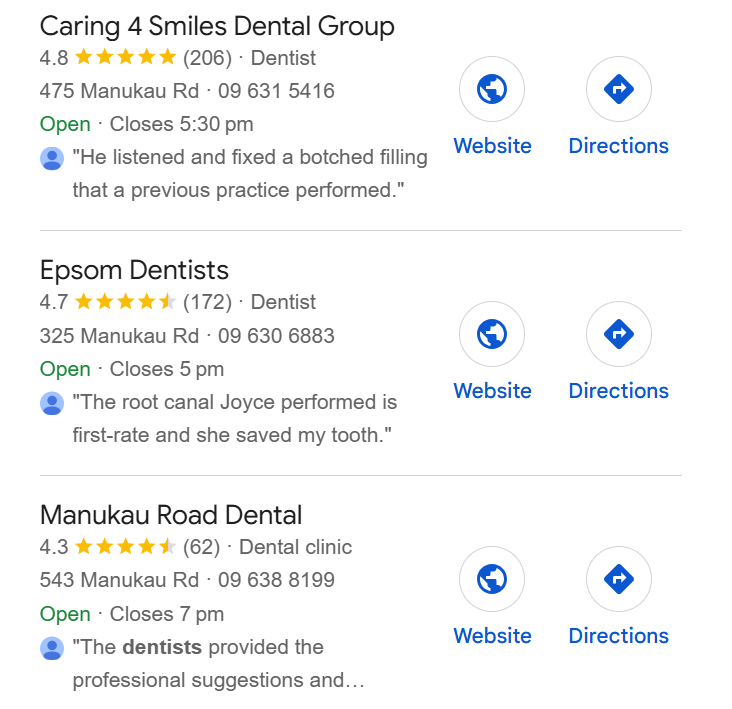
The map pack isn’t a minor slice of the attention either. It takes around 42% of the clicks on a local search, which is why it’s Step 1 of the method later on.

Most practices only compete for one of these without realising the other three exist. That’s why two clinics on the same street can have wildly different numbers of new patients coming through the door.
Why Dentistry Is Harder Than Ordinary Local SEO
Three things make dental different from ranking a café or a landscaper.
It’s YMYL. Google classifies health content as “Your Money or Your Life” and holds it to a higher standard, which puts experience, expertise, authority and trust under a much brighter light. Vague, unattributed content that would rank fine for a hardware store gets nowhere for a dental practice.
There’s a regulator. Your website is advertising under the Dental Council’s standard, which means some of the tactics in generic SEO guides are off the table entirely. More on that shortly.
It’s phone-first. Most dental bookings still happen on a call. That means local search can be working perfectly and you’d never know it, because the win happens on a phone nobody’s tracking.
Hold onto that last one. It comes back at the end and it’s where most practices quietly lose
Why Dental SEO Works Differently in New Zealand
Three facts about the New Zealand dental market decide your entire strategy — and none of them are true in the United States, which is where almost all dental SEO advice comes from.
Most Practices Here Are Tiny
The New Zealand Dental Association surveyed 491 dentists at the end of 2025. Seventy-five percent of them work in clinics with three dentists or fewer.

That single number kills half the advice you’ll read online.
American dental SEO guides recommend skyscraper link campaigns, content teams publishing weekly, and multi-location schema architecture. Fine if you’re a 40-clinic group with a marketing department. You have a practice manager who’s already doing recalls, ordering supplies and chasing an insurer.
So the strategy has to be built for a small team: the map pack first, a handful of treatment pages that actually pay, and a review system that runs itself.
Almost Everyone Has Capacity
The same survey found 93% of clinics are taking on new patients, 87% had an appointment available inside a week, and 62% could see someone the following Monday.

Read that again, because it’s unusual. In most industries the bottleneck is delivery. In New Zealand dentistry the bottleneck is demand.
You have chairs sitting empty. The question is only whether the people looking for a dentist can find you.
Forty Percent of Your Market Is Priced Out
Nearly four in ten New Zealand adults are priced out of seeing you, and that single fact reframes what your website needs to say.
The Ministry of Health’s New Zealand Health Survey found 39.8% of adults avoided going to a dental health worker in the past year because of the cost. Among 25 to 34 year olds it hits 50.7%.

Half the young adults in your catchment are avoiding you over money.
Here’s what that means for your website: a big chunk of your market isn’t searching for a dentist. They’re searching for a price. “How much does a filling cost NZ.” “Cheap dentist Auckland.” “Dental payment plans.”
Those are different searches, they need different pages, and almost nobody in New Zealand dentistry has built them. We’ll come back to whether you should publish your fees — it’s a real decision with a real trade-off, not a slogan.
When a Corporate Outranks You
If you’re an independent competing against Lumino or one of the other group practices, you’re up against a marketing budget and a domain that’s been around for fifteen years. On paper, no chance.
In practice, the map pack doesn’t care much about any of that.
Map pack rankings lean heavily on proximity to the searcher, the relevance of your profile, and your review profile. A corporate site can outrank you for a broad term like “dentist Auckland” and still lose the three-pack in Ponsonby to the practice that’s actually in Ponsonby with 180 reviews.
That’s your ground. Fight there first.
How Much Does Dental SEO Cost in New Zealand?
Most New Zealand dental practices spend between $1,500 and $4,500 a month on SEO. The range is driven almost entirely by how many other practices you’re competing against in your city.
Before the breakdown, an honest caveat that nobody else in this market will give you.
There is no independent survey of New Zealand SEO pricing. None.
Every number you’ll find — including mine, and including my breakdown of what local SEO costs in New Zealand — comes from agency rate cards and published pricing pages. That’s self-reported vendor data, not a benchmark.
The figures below cluster tightly enough across a dozen NZ agencies to be useful. Treat them as what agencies here charge, not what SEO is worth.
I’d rather tell you that than pretend I’ve got data I don’t.
What Each Band Buys
$500 – $1,500 a month. Google Business Profile management, citation cleanup, basic on-page fixes, some reporting. Realistically this is maintenance for a practice already ranking, or a starting point in a low-competition town. It won’t move you in Auckland.
$1,500 – $3,000 a month. The band most single-location NZ practices land in. Treatment pages being built and optimised, an active review system, technical fixes, local link work, monthly reporting that ties back to enquiries.
$3,000 – $5,000+ a month. Multi-location practices, or a single practice going after competitive treatment terms like implants or clear aligners in a main centre. More pages, more link acquisition, and usually a longer runway before it pays back.
What Moves the Number
City competition. The big one. Ranking a practice in central Auckland and ranking one in Whanganui are not remotely the same job.
In Auckland you’re competing against dozens of practices, several with a decade of domain history. In a provincial town you might be competing against four, two of which have websites built in 2014.
Number of locations. Every additional site needs its own Google Business Profile, its own location page, and its own review flow. Two practices isn’t twice the work, but it’s close.
Whether your website needs replacing first. If the site is slow, not mobile-friendly, or built on a platform you can’t edit, SEO spend gets burned propping up a bad foundation. Sometimes the honest answer is to fix the website before spending a cent on SEO.
Which treatments you’re chasing. “Dentist Tauranga” and “dental implants Tauranga” are different levels of difficulty. Implants, orthodontics and cosmetic work attract the most competition because they’re the most profitable — which is exactly why everyone’s fighting over them.
What You Can Do Yourself, and What It Costs You in Hours
A practice owner can genuinely do a meaningful chunk of this without hiring anyone. Being straight about it: here’s the free list, with a realistic time budget.
| Task | Realistic time | Ongoing |
|---|---|---|
| Claim and fully optimise your Google Business Profile | 2–3 hours | 15 min/month |
| Set up a review request system | 2 hours | 5 min/day |
| Fix your name, address and phone across the main NZ directories | 3–4 hours | Once |
| Add the schema block to your site | 1 hour | Once |
| Write and publish one proper treatment page | 4–6 hours | Per page |
| Set up Search Console and call tracking | 2 hours | 20 min/month |
Call it two solid weekends to get the fundamentals in place, then about an hour a month.
That’s not a token DIY list. Done properly, those six things put a small practice ahead of most of its local competition, because most of its local competition hasn’t done them either.
Where it stops being worth your time is the ongoing work — building out pages month after month, earning links, tracking rankings and diagnosing why something dropped. That’s when dental SEO services start making financial sense, and the maths in the next section is how you decide.
SEO or Google Ads?
This isn’t really a rivalry — it’s a sequencing question.
Google Ads puts you at the top tomorrow and stops the day you stop paying. It’s the right call when you have a specific chair to fill this month, when you’re launching a new treatment, or when you’re brand new and have no organic footing at all.
SEO takes months and then keeps working. It’s the right call when you want a steady flow of enquiries that isn’t tied to daily spend.
For most established practices with capacity, the honest recommendation is SEO as the base with ads layered on for whatever needs filling right now. If you can only afford one and you need patients this quarter, run ads. If you can afford one and you’re thinking about the next three years, do SEO.
Why the American Numbers Don’t Transfer
You’ll find US guides quoting $1,500 to $5,000 a month, $100 to $300 an hour, or $5,000 to $30,000 a project.
Those are US dollars, for a far denser dental market competing over search volumes many times higher than ours. A US practice might be fighting for a keyword with 8,000 monthly searches. You’re fighting for one with 90.
Same tactics, completely different scale of effort. Convert those figures directly and you’ll badly overestimate what you should be paying here.
What One New Patient Is Worth to Your Practice
Using the New Zealand Dental Association’s published 2025 fee data, a single new patient who stays with your practice is worth several thousand dollars — which is why SEO maths usually works here even when the search volumes look tiny.
Every ROI figure you’ll read in dental marketing content is American. The most commonly quoted one is $653 a year per patient, which then gets multiplied out to a $6,500 lifetime value. Others throw around $10,000 or $22,000. None of them publish a methodology and all of them are in US dollars.
So let’s build it properly, from your own association’s numbers.
The Real New Zealand Numbers
These come straight from the NZDA’s 2025 fee tables, published January 2026. National averages, GST inclusive.
| Treatment | Average fee |
|---|---|
| Examination only | $96 |
| Exam + bitewing X-rays | $128 |
| Exam + bitewings + scale and prophylaxis | $227 |
| Composite filling, 1 surface | $261 |
| Composite filling, 2 surface | $330 |
| Composite filling, 3 surface | $391 |
| Root canal, 1 canal | $1,032 |
| Root canal, 3 canals | $1,593 |
| Simple extraction | $313 |
| Surgical extraction | $526 |
| Ceramic crown | $1,735 |
| Porcelain veneer | $1,634 |
| 3-unit bridge | $4,360 |
| Implant fixture (surgical) | $2,887 |
| Implant crown | $2,860 |
| Full denture | $2,162 |
| In-office whitening | $740 |

Doing the Arithmetic Out Loud
Take a routine patient. One check-up with bitewings and a scale each year: $227.
Say they stay six years. That’s $1,362 in routine care alone, before anything goes wrong.
Now add one two-surface composite in that time — hardly a stretch — and you’re at $1,692.
That’s a patient who never has anything significant done.
Now take a single-tooth implant patient. Fixture at $2,887 plus the crown at $2,860 comes to $5,747 for one tooth. Add their routine care over the same six years and one implant patient is worth north of $7,000 to your practice.
Which brings up the part that matters most here.
Why Tiny Search Volumes Still Work
“Dental implants Tauranga” might show 30 searches a month. Every SEO tool will tell you that’s not worth chasing, and if you were selling $40 products they’d be right.
At $5,747 a patient, they’re wrong.
Rank in the top three for that term and you might see 8 to 10 of those searchers land on your page. Convert one in ten and that’s roughly one implant patient a month. One patient a month from one keyword is close to $69,000 a year in treatment value.
Our search volumes are small; our transaction values are large enough that they don’t need to be big.
Run that same calculation on your own numbers before you spend anything — take your two or three highest-value treatments, look up the local search volume, and see what one conversion a month would be worth. A dental SEO audit does that same maths for your city and your treatment list.
What NZ Dentists Are Legally Allowed to Say Online
Your website, service pages and social posts are advertising under the Dental Council’s Advertising Practice Standard. That means the Council’s rules apply to your page titles, your treatment descriptions, your before-and-after photos and your patient reviews.
Worth reading before you build anything, because a few of the tactics in those imported guides are off the table here.
Your Website Is Advertising, Legally Speaking
The Advertising Standards Authority defines advertising as any message whose content is controlled by the advertiser, with the intent to influence choice or behaviour. In its guidance note on advertising health services, the first two examples it lists are “websites and landing pages” and “social media content.”

Your treatment pages aren’t marketing collateral sitting outside the rules. They’re regulated advertising.
The “Specialist” Trap Every American Guide Walks You Into
Open any US dental SEO guide and it’ll tell you to put your specialty in your title tag. “Cosmetic Dentistry Specialist | Auckland.” Great for keywords.
Standard 6 of the Dental Council’s advertising standard:
“Avoid using the terms ‘specialist’, ‘specialist in’, or ‘specialising in’ for oral health practitioners who work in an area where there is no recognised specialist scope of practice. For example, implantology, cosmetic dentistry.“
The standard names the two areas by name. Implantology and cosmetic dentistry are precisely the two highest-value, most competitive terms in dental search — and they’re the two you cannot attach “specialist” to.
So write around it. “Cosmetic Dentistry in Auckland” is compliant and ranks just as well. “Dental Implants — Auckland” is compliant. You lose nothing in SEO terms and you stay inside the standard.
Testimonials and Reviews — Where Nearly Everyone Gets It Wrong
There’s a persistent belief that New Zealand dentists can’t use testimonials at all. That’s not right, and the truth is more useful.
The Medical Council of New Zealand and the New Zealand Chiropractic Board do ban them. The Dental Council does not. It conditions them. From Standard 2:
“Make sure if your advertisement contains or refers to any personal testimonial, that written permission to use the testimonial has been obtained and it can be verified as being genuine, current, and representative of the typical not the exceptional.”
So: written permission, verifiable, and typical rather than the best result you’ve ever had.
But there’s a second layer, and it’s the one with real legal teeth. The ASA’s health services guidance states that testimonials making therapeutic claims breach section 58(1)(c) of the Medicines Act 1981. That’s a statutory breach, not just a code one.
A review saying “they fixed my chronic jaw pain” is a therapeutic claim. A review saying “the whole team was lovely and the place was spotless” isn’t.
Helpfully, the ASA publishes what is acceptable. Comments describing the practitioner or the practice as:
- professional, kind, efficient
- relaxing, calming, soothing
- clean, tidy, friendly environment
That list is gold, and it turns directly into how you ask for reviews. We’ll build the actual script in Step 2 of the method.
Before-and-After Photos
Allowed, with conditions. The images must represent the treatment outcome honestly, be representative of the typical rather than the exceptional result, and written consent must be obtained.
Practical version: don’t only publish your career-best veneer case. Don’t retouch. Get the consent in writing and keep it on file.
You Can’t Take Shots at the Competition
Standard 4 says you must not advertise in a way that, directly or by implication, criticises other practitioners.
That rules out a tactic marketers love: the comparison page. “Why Choose Us Over [Other Practice].” It’s effective content in most industries. Here it’s a standards breach.
Same goes for “the best dentist in Auckland” — which implies every other dentist in Auckland is worse, and which you also couldn’t substantiate if asked.
Every Claim Must Be Substantiable
Standard 3 requires claims to be capable of substantiation. The standard also points out that an unsubstantiated advertising claim is an offence under the Fair Trading Act.
“Painless dentistry.” “Guaranteed results.” “The most advanced technology in the Waikato.” If you can’t produce evidence when asked, don’t publish it.
One Last Thing, If You’re Hiring Someone
There’s a clause in the standard most dentists have never read, and most marketers won’t mention.
From the Dental Council’s Advertising Practice Standard:
“When employing the technical expertise of others, take care to understand what your ‘expert’ is doing on your behalf, and that it does not result in inaccurate or misleading advertising. For example, when using forms of digital marketing to advertise your services. The doctrine of vicarious liability will be applied. This means you are responsible for the action or non-action of your advertising agent.“
And, plainly:
“You are responsible for the form and content of your advertising. You cannot delegate this responsibility.“

In practice that means an offshore content writer with no idea what the Dental Council is can put “New Zealand’s leading implant specialists” on your homepage because it tests well, and it’s still your name on the register.
So it’s a fair question to ask anyone you’re considering: have you read the Dental Council’s advertising standard?
Most haven’t. Takes ten minutes to find out, and it tells you more than any case study will. It’s the part of our SEO work that never shows up in a rankings report.
The Compliance Checklist for Your Website
Run your existing site through this before you touch anything else.
| Check | What you’re looking for |
|---|---|
| Page titles and H1s | No “specialist” or “specialising in” for implants or cosmetic work |
| Superlatives | No “best”, “leading”, “number one” you can’t substantiate |
| Comparison content | Nothing that criticises another practice, directly or by implication |
| Testimonials and reviews | Written permission on file; no treatment-outcome claims |
| Before-and-after images | Written consent on file; typical results, not retouched, not cherry-picked |
| Treatment claims | Every clinical claim backed by evidence you could produce |
| Titles | “Doctor” used correctly and qualified where required |
| Your agency | Have they read the standard? Ask them |
Get this right and everything that follows is built on solid ground. Get it wrong and a good ranking just means more people seeing something you shouldn’t have published.
How to Do Dental SEO
Dental SEO comes down to nine steps, and the order matters. The first two are deliberately at the top because they move the needle fastest for the least work — a practice that does nothing but Steps 1 and 2 properly will still beat most of its local competition.
Work through them in sequence. Don’t jump to the technical stuff because it feels more like real SEO; it isn’t where your patients come from.
Step 1: Optimise Your Google Business Profile
Your Google Business Profile decides whether you appear in the map pack — the three-listing block with the map beside it — and for a dental practice that’s the single highest-value position on the page.
It’s also free, it takes an afternoon, and roughly half the practices I audit haven’t finished setting theirs up.
Why it matters more than your website. When someone searches “dentist near me” on a phone, the map pack occupies most of the first screen. The blue links are below the fold. You can have the best website in the Waikato and still lose every one of those taps because you’re not in the three-pack.
What Google Weighs for Local Results
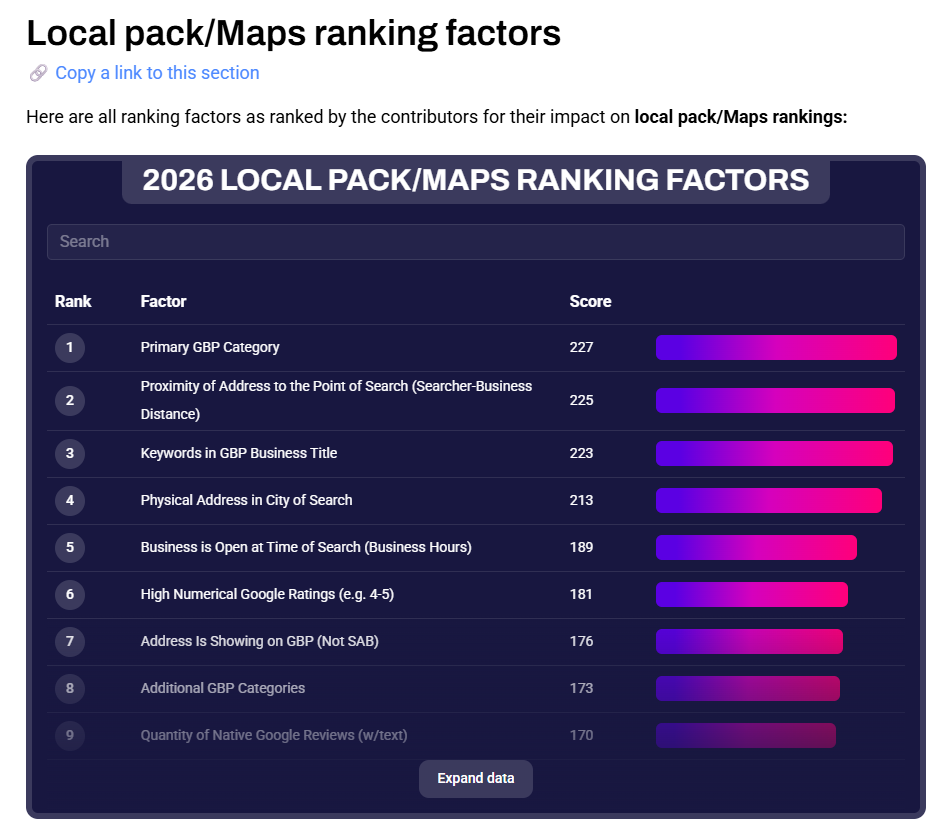
The local ranking factors come down to three things: relevance (does your profile match what they searched), distance (how close you are to the searcher), and prominence (how well-known and well-reviewed you are).
You can’t move your practice, so distance is fixed. Relevance and prominence are entirely in your hands, and that’s where the work goes.
Whitespark’s annual survey of local SEO practitioners puts Google Business Profile signals at roughly a third of what decides local pack rankings — more than on-page, reviews or links individually.
The Setup, Click by Click
Go to google.com/business, sign in, and either claim your existing listing or create one. Google will post a verification postcard or verify by phone or video — do it, because an unverified profile ranks nowhere.
Once you’re in, here’s the order I’d work through the profile.
Primary category. This is the highest-weighted single thing on your profile. Set it to Dentist. If you’re a dedicated orthodontic or paediatric practice, set it to the matching category instead — Orthodontist, Pediatric dentist. Then add secondary categories for what else you do: Cosmetic dentist, Dental implants periodontist, Emergency dental service.
Not sure what your competitors are using? Install the free GMB Everywhere Chrome extension, search your main term, and it shows you the categories on every listing in the results. Takes two minutes and it’s the fastest competitive research in local SEO.
Business name. Your real, registered practice name. Nothing else. Stuffing it to “Hamilton Dental — Best Cosmetic Dentist Waikato” violates Google’s guidelines and runs straight into the standards issues from the section above. Two regulators, one bad idea.
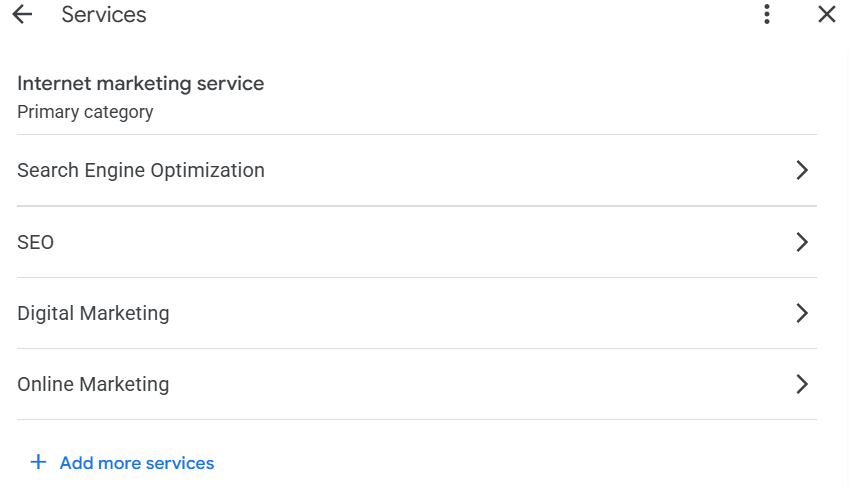
Services. Add every treatment individually — check-ups, hygiene, fillings, root canal, extractions, crowns, veneers, whitening, implants, aligners, emergency. Each one is a relevance signal, and most practices list four.
Hours, including holidays. Set your regular hours, then actually update the holiday hours over the Christmas break. Google surfaces “hours might differ” warnings on stale profiles, and there’s nothing like a patient turning up to a locked door to earn you a one-star review.
Photos. Exterior shot so people can find the building, reception, a treatment room, and the team. Real photos, not stock. Add a few every month — profiles with recent photos get more engagement, and engagement feeds prominence.
Booking link and phone number. NZ format on the phone number. If you have online booking, put the link in.
Products. Underused. You can list treatments here with a description and a price. If you’re comfortable publishing fees, this is one of the lowest-risk places to start — remember that 39.8% of adults avoiding the dentist over cost.
The NZ-Specific Bits Nobody Mentions
Address format. Use the format NZ Post uses, matching your website and directory listings exactly. “Level 1, 23 Victoria Street, Hamilton Central, Hamilton 3204.” Consistency is the whole game here — pick one format and use it everywhere.
Service areas for visiting dentists. If you’re mobile or you visit rest homes, set a service area rather than only a street address. Google handles service-area businesses differently and getting this wrong can hide you entirely.
Christmas. Dental emergencies over the NZ summer break are a genuine search spike and half of practices have unmaintained hours during it. Set your holiday hours in November.
A Strong Profile and a Weak One
(Both need a fresh live check before publishing — the audit these came from is around ten months old.)
Strong — MaxCare Dental, Auckland. Correct primary category, full service list, dozens of real photos including the practice exterior, complete hours, consistent NAP with their website, and an active review profile with replies. Nothing exotic. Just finished.
Weak — a practice in Christchurch. Generic category, four photos all uploaded on the same day three years ago, no services listed, no booking link, and 11 reviews with no replies. It’s not that they did anything wrong. They just stopped after the setup screen — which is exactly why the practice down the road holds the three-pack.
The Google Business Profile Checklist
| Element | Done properly means |
|---|---|
| Verified | Postcard, phone or video verification complete |
| Primary category | Dentist (or the matching specialty category) |
| Secondary categories | Every additional service area you genuinely offer |
| Business name | Registered name only, no keywords |
| Services | Every treatment listed individually |
| Address | NZ Post format, identical everywhere online |
| Phone | NZ format, matching your website |
| Hours | Current, with holiday hours set |
| Photos | Exterior, reception, surgery, team — real, and added monthly |
| Booking link | Live, if you have online booking |
| Products | Treatments with descriptions, prices optional |
| Reviews | Active flow in, every one replied to |
| Posts | Something monthly |
Work down that list and you’ll be ahead of most practices in your city, let alone a smaller centre.
Step 2: Build a Review System That Complies With NZ Rules
Reviews are one of the strongest signals in local search and the single biggest influence on whether someone picks you once they’ve found you. In New Zealand there’s a right and a wrong way to ask for them, and the wrong way has legal consequences.
Why they matter twice over. Reviews feed prominence, which feeds map pack rankings. Then they do a second job entirely: convincing a nervous person that you’re the one to call. BrightLocal’s 2026 consumer survey found 97% of consumers read reviews when evaluating a local business, with 41% saying they always do — up from 29% the year before. That’s a US sample, so treat the exact figures as directional, but the trend is unambiguous.
For dentistry it’s sharper than for most industries. People are frightened of the dentist. A wall of reviews saying “gentle, explained everything, didn’t hurt” does more selling than any page you’ll ever write.
The Compliant Ask
This is where the compliance work from earlier pays off. If your review requests nudge patients toward describing treatment outcomes, you’re collecting testimonials that breach the Medicines Act. If you steer them toward the experience, you’re fine — and the ASA has published exactly which words are safe.
Here’s the request I’d use. Send it by text, within an hour of the appointment.
Hi [name], thanks for coming in today — it was great to see you.
If you’ve got 30 seconds, would you mind leaving us a Google review? It genuinely helps other people in [suburb] find us.
Anything about how you found the team, the appointment or the practice itself is perfect. (We can’t publish comments about treatment results, so please keep it to your experience with us.)
[your review link]
Thanks so much — [practice name]
That parenthetical does the compliance work without sounding like a legal notice, and it steers the review toward the language the ASA explicitly permits: professional, kind, efficient, relaxing, clean, friendly.
Most practices are either not asking at all, or asking in a way that collects reviews they legally shouldn’t display.
Setting the System Up
Get your review link. Open your Google Business Profile, find “Ask for reviews”, and copy the short link. It’ll look like g.page/r/....
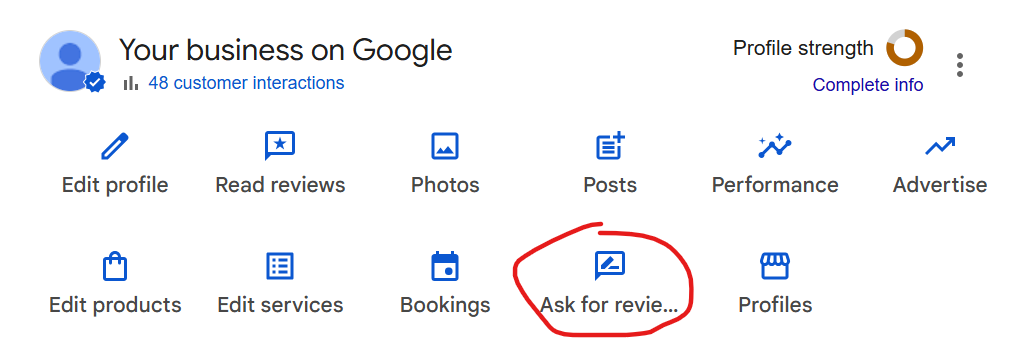
Turn it into a QR code. Any free generator works. Print it on appointment cards, stick it at reception, put it on the invoice. The QR code catches the people who won’t open a text.
Time it properly. Within an hour of the appointment, while they still feel good about it. Ask a week later and you’re competing with their entire week.
Ask everyone, every time. Not just the ones you think will say something nice. Selective asking is review gating, and it’s against Google’s policies.
One follow-up, then stop. A single reminder three days later. After that, leave it.
Replying — And the Privacy Trap
Reply to every review, good and bad. It’s a prominence signal, it’s visible proof you’re paying attention, and patients now expect it — BrightLocal’s research puts the share of consumers who expect a business to respond to reviews at 89%.

But here’s the trap almost every practice falls into. Replying to a review with “Thanks for coming in for your implant consult last week, John!” has just publicly confirmed that John is your patient and disclosed what he came in for. That’s a health information privacy problem, and you created it while trying to be friendly.
Keep replies warm and empty of detail:
Thanks so much for taking the time to leave this — really glad you had a good experience with the team. See you at your next visit.
For a negative review, don’t confirm they’re a patient, don’t argue, don’t explain:
Thanks for the feedback — we take this seriously and we’d like to sort it out. Could you please call the practice on [number] so we can talk it through properly?
Move it offline. Every time.
What Not to Do
Don’t gate. Surveying patients first and only sending the Google link to the happy ones violates Google’s policy and can get your reviews wiped.
Don’t incentivise. No discounts, no free whitening, no draw entries. Also a Google policy breach, and in a health context a bad look.
Don’t bulk blast. Twenty reviews landing in one afternoon after two years of nothing looks exactly like what it is. Steady and consistent wins.
Don’t write them yourself. Obvious, and yet.
Step 3: Find the Keywords Worth Chasing
The keywords worth your time are the treatments you actually want more of, in the areas you actually serve. The volumes will look alarmingly small — that’s normal here, and the maths from earlier is why it doesn’t matter.
First, Recalibrate What “Good Volume” Means
This trips up every practice owner who’s read an American guide.
New Zealand volumes are a tiny fraction of US ones — usually a percent or two. A term doing 8,000 searches a month in the States might do 90 here.
So when a keyword tool shows “dental implants Hamilton” at 40 searches a month and flags it as low priority, the tool is calibrated for a market many times our size.
A keyword with 20 searches a month can be an excellent keyword in New Zealand. At $5,747 an implant, it only has to work occasionally.
Judge keywords on value per conversion, not volume. That’s the whole recalibration.
The Three Types That Matter
General plus location. “Dentist Hamilton”, “dental clinic Ponsonby”, “dentist near me”. Highest volume, most competition, and mostly won through your Google Business Profile rather than your website.
Treatment plus location. “Dental implants Tauranga”, “Invisalign Wellington”, “teeth whitening Christchurch”. Lower volume, far higher intent, and much higher value. This is where the money is and where most practices have no pages at all.
Emergency and urgent. “Emergency dentist Auckland”, “toothache dentist open now”, “chipped tooth Saturday”. Highest intent on the board — someone in pain is not comparison shopping.
The Emergency Appointment Gap
The average New Zealand practice is holding emergency slots it never fills, and the searches to fill them are the easiest on the board.
Sixty-four percent of dentist clinics hold emergency appointments every weekday, averaging 2.5 a day. In the provinces it’s 74%. And 93% of clinics are taking new patients.

So the average NZ practice is holding roughly two and a half emergency slots a day, most of which go unfilled, while someone within five kilometres is typing “emergency dentist” into their phone at nine at night.
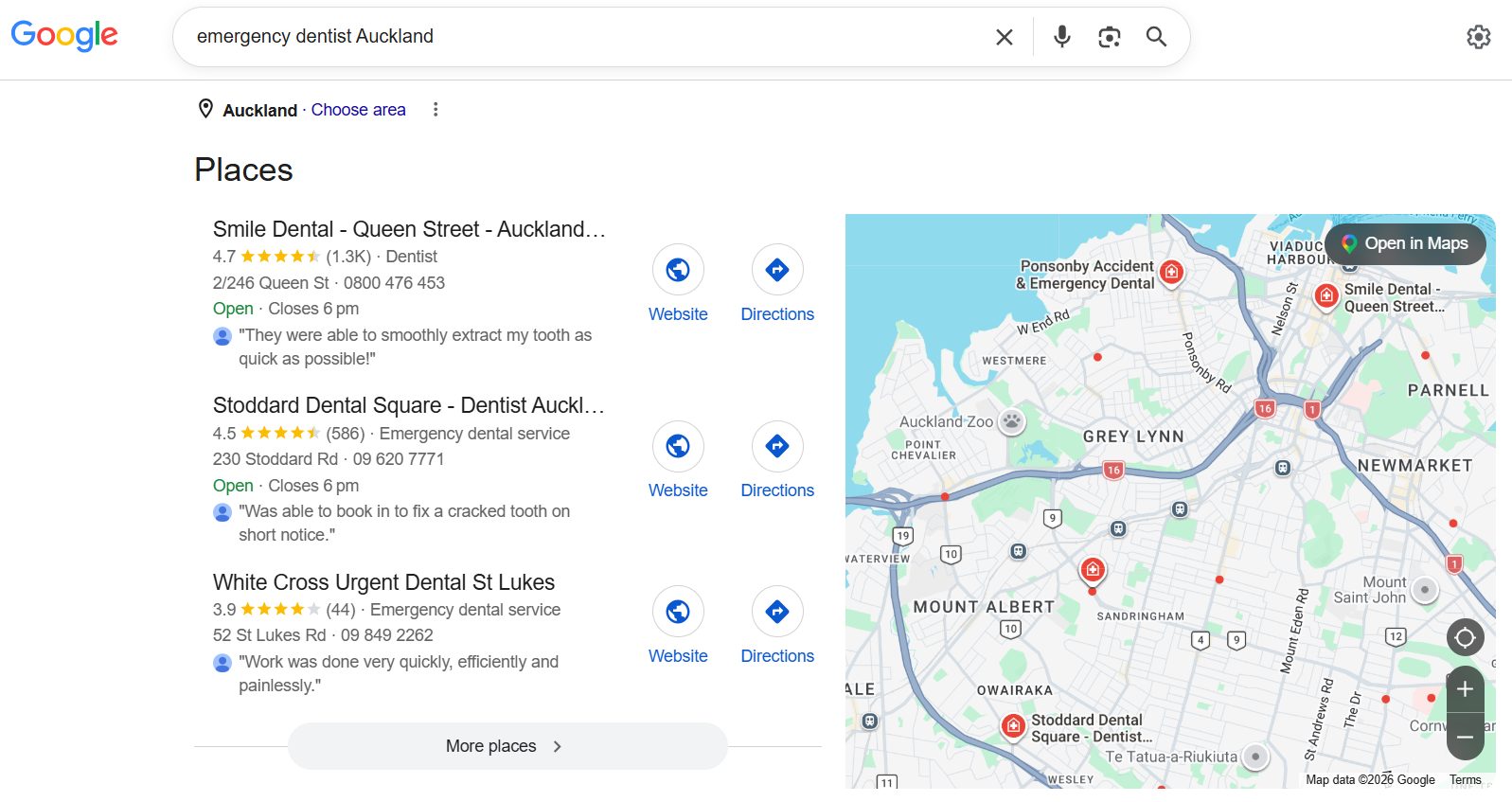
Build the page. “Emergency Dentist in [your city].” Put your phone number at the top, state your emergency availability plainly, explain what counts as a dental emergency, and say what happens after hours.
It’s the highest-intent, lowest-competition page a New Zealand practice can build, and it’s filling capacity you’re already holding open.
The New Zealand Queries Every Imported Guide Misses
These have real volume here and zero competition from international content, because they don’t exist anywhere else.
ACC dental claims. New Zealanders search for “ACC dentist”, “dental injury ACC”, “does ACC cover dental”. If you’re an ACC provider, that’s a page.
WINZ and MSD dental grants. “WINZ dental grant”, “emergency dental grant”. High volume, high need, and almost nobody explains the process clearly.
Free care for under-18s. “Free dental care NZ”, “free dentist for teenagers”. Parents search this constantly.
Health insurance cover. “Southern Cross dentist”, “nib dental cover”, “affiliated provider dentist”. If you’re an affiliated provider, say so on a page.
Every one of these is a genuine patient question with genuine local volume, and every American guide on this topic is structurally incapable of covering them.
Specialty Changes the Whole Strategy
Lumping “dental SEO” into one strategy is a mistake, because the treatment categories behave completely differently.
General dentistry is high volume, short decision cycle, won mostly in the map pack. Someone needs a check-up, searches, picks from the three-pack, rings.
Implants and cosmetic are low volume, long decision cycle, high value. People research for weeks. They read about the procedure, the recovery, the cost, and the alternatives before they ring anyone. That means content pages, not just a service page — and it means your content is exactly the kind of long, informational query that AI Overviews now intercept.
Orthodontics sits in between, with a strong parent-researching-for-teenager pattern and heavy price sensitivity.
If implants are your growth target, you need a genuine content cluster, not one page. If you just want more general patients, you need a great Google Business Profile and one strong location page. Different jobs.
How to See What Competitors Rank For, Free
You don’t need a paid tool for the first pass.
Open Google Keyword Planner (free with a Google Ads account, no need to run ads). Choose “Discover new keywords”, switch to the “Start with a website” tab, paste a competing practice’s URL, set the location to New Zealand, and hit go.
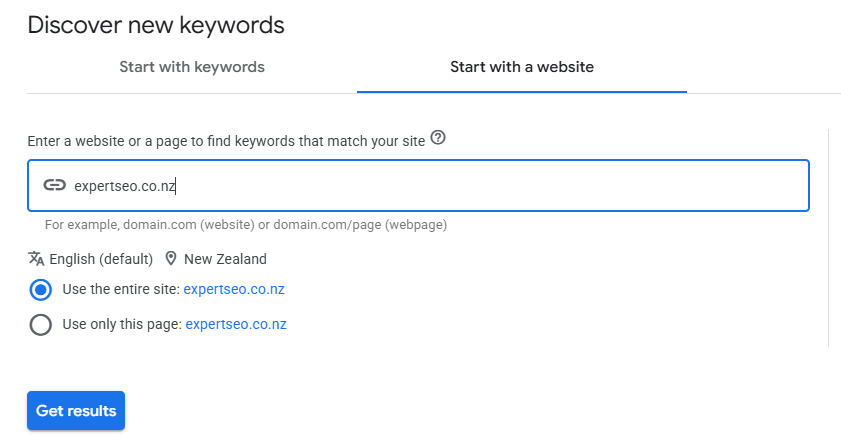
You’ll get the terms Google associates with their site, with volume ranges. Do it for the three practices ranking above you and you’ll have your target list in fifteen minutes.
Here’s what the output looks like for a straight dental term in New Zealand — note how modest the volumes are compared with anything you’d see quoted in a US guide.

For a second angle, use the Ahrefs free keyword generator, or type your main term into Google and read the “People also ask” and “Related searches” blocks at the bottom. Those are free, real, and current.
A Starter Keyword Map for a NZ Practice
Pull live volumes for your own city before you commit — these are the shapes, not the numbers.
| Keyword type | Example | Intent | Page to build |
|---|---|---|---|
| General + location | dentist [city] | Commercial | Homepage + GBP |
| Treatment + location | dental implants [city] | Commercial | Treatment page |
| Treatment + location | Invisalign [city] | Commercial | Treatment page |
| Emergency | emergency dentist [city] | Transactional | Emergency page |
| Cost | dental implant cost NZ | Informational | Cost/content page |
| Cost | how much is a filling NZ | Informational | Cost/content page |
| Funding | WINZ dental grant | Informational | Content page |
| Funding | ACC dental claim | Informational | Content page |
| Insurance | Southern Cross affiliated dentist [city] | Commercial | Content or service page |
| Suburb | dentist [suburb] | Commercial | Location page (if you genuinely serve it) |
Practices in Tauranga and other centres outside the main four often find the treatment-plus-location terms almost uncontested, because the local competition has one page called “Services” and nothing else.
Step 4: Build a Page for Every Treatment and Location
Google can’t rank a page that doesn’t exist. If you want to show up for “dental implants Tauranga”, you need a page about dental implants in Tauranga — not a line item on a services list.
Why one page per treatment beats one big services page. A page ranks for what it’s about. A “Services” page listing twelve treatments is about twelve things, which means it’s strongly about none of them. Split those into twelve pages and each one gets to be the definitive answer to its own search.
There’s a second reason, and it’s about the patient rather than the algorithm. Someone researching implants has questions — how long it takes, whether it hurts, what it costs, what the alternatives are. A bullet point on a services page answers none of them. A proper page answers all of them and books the consult.
The Structure That Works
Every treatment page, same skeleton:
- H1 with the treatment and the location. “Dental Implants in Tauranga.”
- A direct answer in the first two sentences. What the treatment is, plainly. This is what gets pulled into AI answers and featured snippets.
- Who it’s for. The situations that lead someone here.
- What the process actually involves, step by step, with realistic timeframes.
- What it costs, or at minimum the range and what moves it.
- Recovery and aftercare.
- The alternatives, honestly compared. Counter-intuitive, but it builds more trust than anything else on the page.
- FAQs — the real questions, pulled from People Also Ask.
- A clear next step. Phone number, booking link, both.
That’s a page that ranks and converts. Most dental treatment pages in New Zealand are three paragraphs and a stock photo.
Should You Publish Your Prices?
A genuine decision with a real trade-off, so here’s both sides.
The case for. Nearly 40% of New Zealand adults are avoiding the dentist over cost. Those people are searching for prices, and if your page doesn’t have one they’ll bounce to whoever’s page does. Publishing a fee also pre-qualifies enquiries — the people who ring have already accepted the number, which is a better conversation than the one where you break it to them.
The case against. You may be more expensive than the practice down the road, and a price with no context invites a comparison you’d rather have in person.
What I’d do. Publish a range with what moves it, not a single number. “Single-tooth implants at our practice typically range from $5,500 to $7,500 depending on whether a bone graft is needed.” You’ve answered the search, set the expectation, and kept room for the conversation.
If you’re an affiliated provider for Southern Cross or nib, say so on the same page. That’s a price signal without publishing a fee.
Location Pages — When and When Not
Location pages work when you genuinely serve distinct areas. They backfire when you spin up eight near-identical pages for eight suburbs with the name swapped.
Google’s been able to spot that pattern for years, and thin duplicate pages can drag down the site around them.
Build a location page when you have a second physical practice, or you serve a genuinely distinct area with something specific to say about it.
Don’t build one when the only difference between the pages would be the suburb name.
If you do build them, each page needs something real: local landmarks and parking, which suburbs you actually draw from, a team member based there, reviews from patients in that area, and genuine directions. Three hundred words of unique, useful content beats a template every time.
A Strong Page and a Weak One
(Both need re-checking live before publishing.)
Strong — Victoria Dentists, Hamilton. Dedicated pages per treatment with the treatment name in the URL, the title and the H1. The implant page explains the procedure in stages, gives an indicative cost, and answers the questions people actually have. You can tell someone wrote it to be useful rather than to hit a word count.
Weak — a practice in Wellington. One “Our Services” page with twelve treatments as bullet points, each three lines long, no individual URLs. Nothing to rank. Nothing to answer a question. The practice is excellent; the website tells Google nothing.
That gap costs the second practice every treatment search in its city, and it’s a weekend’s work to fix.
Step 5: Optimise Those Pages So They Rank
On-page SEO is making it unmistakably obvious to Google what a page is about. On most dental websites the treatment isn’t in the title, isn’t in the URL, and isn’t in the meta description — so Google is left guessing.
Why it matters even when the content is good. You can write the best implant page in the country, but if the title tag says “Services | Smile Dental” then the strongest signal on the page is pointing at nothing. On-page SEO is cheap, fast, and the most commonly skipped step in dental SEO.
The Elements, in Priority Order
1. Title tag. The biggest single on-page lever. Format: treatment, location, practice name, under about 60 characters.
Dental Implants in Tauranga | Bayside Dental
Not Home | Bayside Dental — Quality Dental Care Since 1998.
2. H1. One per page, matching the topic. Usually close to the title but written for a human.
3. URL. Short and readable. /dental-implants-tauranga/ beats /services/page-id-4471/.
4. Meta description. Doesn’t rank you directly, but it’s your ad copy in the results and it moves click-through. Around 155 characters. Say what the page covers and give a reason to click.
5. Headings. Break the page into H2s that match how people ask questions. “How much do dental implants cost?” as an H2 with the answer directly underneath is how you get pulled into featured snippets and AI answers.
6. Internal links. Link your treatment pages to each other where it’s genuinely relevant. Your implants page should link to your bone grafting page. Not because Google likes links, but because someone reading about implants often needs to know about grafting.
7. Image alt text. Describe the image plainly. “Dental implant procedure at our Tauranga practice” rather than “IMG_2841”.
Writing Title Tags That Stay Inside the Standard
Remember Standard 6. The obvious keyword-optimised title for a cosmetic page is the one you can’t use.
| Don’t | Do |
|---|---|
| Cosmetic Dentistry Specialist Auckland | Cosmetic Dentistry in Auckland |
| Implant Specialists Wellington | Dental Implants in Wellington |
| Best Dentist in Christchurch | Family Dentist in Christchurch |
| NZ’s Leading Invisalign Provider | Invisalign Clear Aligners in Hamilton |
Same keywords. Same ranking potential. No standards problem.
One Good Example, One Bad
Strong — Mcintosh Dental, Auckland. Treatment in the title tag, treatment in the URL, an H1 that matches, and a meta description that reads like it was written by a person. Straightforward, and it’s why they show up.
Weak — a practice in Christchurch. Homepage title is the practice name only. Treatment pages titled “Services”. URLs are numeric. The site itself is nicely designed and the content is decent — it’s just invisible, because every signal that tells Google what these pages are about is missing.
That’s the most common pattern I see in New Zealand dentistry: good practice, good site, no signals.
What the Rest Look Like
Rather than walk through another six examples that all land on the same three findings, here’s the pattern across a batch of NZ dental sites I audited.
| Issue found | How common |
|---|---|
| Treatment name missing from title tag | Most sites |
| Treatment name missing from URL | Most sites |
| Meta description missing or auto-generated | Around half |
| No H1, or multiple H1s on a page | Around a third |
| Images with no alt text | Most sites |
| No internal links between treatment pages | Most sites |
None of these are hard to fix. They’re just nobody’s job, so they don’t get done.
The Tools Worth Using
Rank Math (free, WordPress) — sets your title tag, meta description and schema per page, and flags what’s missing. If your site is on WordPress this is the one to install first.
Google Search Console (free) — shows which queries you’re already appearing for and where you sit. Often reveals you’re on page two for a term you never targeted, which is the cheapest ranking win available.
Screaming Frog (free up to 500 URLs) — crawls your site and lists every missing title, duplicate description and broken link in one table. A small dental site fits inside the free tier comfortably.
TinyPNG (free) — compresses images before you upload them. Dental sites are usually image-heavy and that’s usually why they’re slow.
Step 6: Fix the Technical Problems Holding the Site Back
Most dental websites have the same four or five technical problems, and you can diagnose every one of them yourself in about twenty minutes without touching a line of code.
Why bother. Technical SEO is checking under the bonnet. The car might still run with low oil and a slipping belt, but not well, and not for long. A slow, badly-indexed site can have perfect content and still not rank — Google can’t reward what it struggles to load or can’t find.
Speed, With Actual Numbers to Hit
Every guide tells you your site should be fast. Almost none tell you what fast means, which makes the advice useless.
Google measures three things, called Core Web Vitals, and it publishes the thresholds:
| Metric | What it measures | “Good” threshold |
|---|---|---|
| LCP (Largest Contentful Paint) | How long until the main content appears | 2.5 seconds or less |
| INP (Interaction to Next Paint) | How quickly the page responds when tapped | 200 milliseconds or less |
| CLS (Cumulative Layout Shift) | How much the page jumps around while loading | 0.1 or less |
Now you’ve got numbers to test against instead of a vibe.
Run your homepage and your busiest treatment page through Google PageSpeed Insights (free, no login). Test the mobile score, not desktop — that’s what most of your patients are on and it’s what Google indexes.

Nine times out of ten on a dental site, the problem is images. Unoptimised photos of the practice and the team, uploaded straight from a phone at 4MB each. Run them through TinyPNG, re-upload, and watch the score jump.
Check It on a Phone Like a Patient Would
Most dental searches happen on a phone. Open your site on your own phone and try to do what a patient would: find the phone number, find the hours, book an appointment.
If you have to pinch to zoom, if the phone number isn’t tappable, or if a popup covers the screen and the close button is off the edge — that’s your highest-priority fix in this whole guide, and it’s got nothing to do with Google.
Indexing — Can Google Even See Your Pages?
There’s no point optimising a page Google hasn’t found.
Type site:yourpractice.co.nz into Google. It lists every page of yours that’s indexed. Count them. If you have fourteen pages and Google shows four, something’s wrong.
Then set up Google Search Console — verify the site, submit your sitemap (usually at /sitemap_index.xml), and check the Pages report for anything marked “not indexed” with a reason.
Make Sure the Padlock Is There
Your site should load with a padlock. If it says “Not secure” in the browser bar, that’s a trust problem for a health business before it’s ever an SEO problem. Most hosts provide a free SSL certificate — it’s usually a switch in your hosting panel.
Broken Links and Old Redirects
Usually the wreckage of a website rebuild. The old site had /services/implants/, the new one has /dental-implants/, and nobody set up a redirect — so every link and every bookmark to the old page now hits a 404.
Run Screaming Frog across the site, sort by status code, and fix anything returning 404 or chained through multiple redirects. Any ranking those old pages had can usually be recovered with a proper 301.
The Twenty-Minute Check
- PageSpeed Insights on the homepage and one treatment page, mobile tab, note LCP, INP and CLS
- Open the site on your own phone and try to book an appointment
site:yourpractice.co.nzand count the indexed pages- Check for the padlock
- Screaming Frog crawl, sort by status code
Anything deeper belongs in a full technical SEO checklist, but for a small practice site those five catch almost everything.
If all five come back clean, technical isn’t your problem and you can spend the money on content instead. That’s worth knowing either way — and if the site fails several of them, the honest answer might be that it needs rebuilding rather than patching.
Step 7: Add Schema So Google and AI Know What You Are
Schema is a block of code that spells out your practice’s details in a format search engines and AI systems read directly, instead of trying to infer them from your page copy.
What it does and doesn’t do. It won’t rank you on its own — it isn’t a ranking factor. What it does is remove ambiguity. It tells Google in unambiguous terms that you are a dental practice, at this address, with these hours, this phone number, and these payment options. For a local health business where Google is trying to match you to “dentist near me”, removing that ambiguity is worth a lot.
It matters more now than it did two years ago, because AI systems lean heavily on structured data when assembling answers. Clean schema makes you easy to quote.
Which Type to Use
Use Dentist. It’s a recognised schema.org type that sits under MedicalBusiness and LocalBusiness, so you get the local business fields plus the medical ones. Plenty of dental sites use plain LocalBusiness, which works but throws away specificity for no reason.
The Block, With New Zealand Fields Filled In
Copy this, swap in your details, and paste it into your site’s <head>. On WordPress, Rank Math or a plugin like Header Footer Code Manager will do it without touching theme files.
{
  "@context": "https://schema.org",
  "@type": "Dentist",
  "name": "Bayside Dental",
  "url": "https://baysidedental.co.nz",
  "logo": "https://baysidedental.co.nz/logo.png",
  "image": "https://baysidedental.co.nz/practice-exterior.jpg",
  "telephone": "+64-7-555-0100",
  "email": "hello@baysidedental.co.nz",
  "priceRange": "$$",
  "currenciesAccepted": "NZD",
  "paymentAccepted": "Cash, EFTPOS, Visa, Mastercard, Southern Cross Easy-claim, nib, Q Card, Afterpay, ACC",
  "address": {
    "@type": "PostalAddress",
    "streetAddress": "23 Devonport Road",
    "addressLocality": "Tauranga",
    "addressRegion": "Bay of Plenty",
    "postalCode": "3110",
    "addressCountry": "NZ"
  },
  "geo": {
    "@type": "GeoCoordinates",
    "latitude": "-37.6878",
    "longitude": "176.1651"
  },
  "openingHoursSpecification": [
    {
      "@type": "OpeningHoursSpecification",
      "dayOfWeek": ["Monday","Tuesday","Wednesday","Thursday","Friday"],
      "opens": "08:00",
      "closes": "17:00"
    }
  ],
  "medicalSpecialty": "Dentistry",
  "availableService": [
    { "@type": "MedicalProcedure", "name": "Dental examination and hygiene" },
    { "@type": "MedicalProcedure", "name": "Composite fillings" },
    { "@type": "MedicalProcedure", "name": "Root canal treatment" },
    { "@type": "MedicalProcedure", "name": "Dental implants" },
    { "@type": "MedicalProcedure", "name": "Clear aligners" },
    { "@type": "MedicalProcedure", "name": "Emergency dental care" }
  ],
  "areaServed": [
    { "@type": "City", "name": "Tauranga" },
    { "@type": "City", "name": "Mount Maunganui" }
  ],
  "sameAs": [
    "https://www.facebook.com/yourpractice",
    "https://www.healthpoint.co.nz/your-listing"
  ]
}
The New Zealand-specific bits worth noting: NZD as the currency, the NZ address format with addressRegion as the actual region rather than a state, and — the one nobody includes — Southern Cross, nib and ACC listed under paymentAccepted. For a New Zealand patient, “do they take Southern Cross” is a real question, and this puts the answer somewhere machines can read it.
FAQ Schema
Still worth adding on treatment pages with a genuine FAQ block. It won’t always produce a rich result any more, but it’s clean structured Q&A data, which is exactly the shape AI systems prefer to lift from.
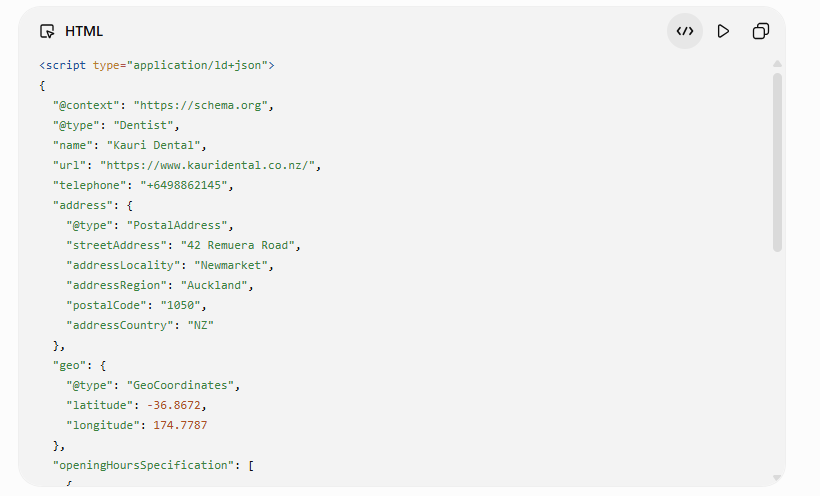
Validate It Before You Move On
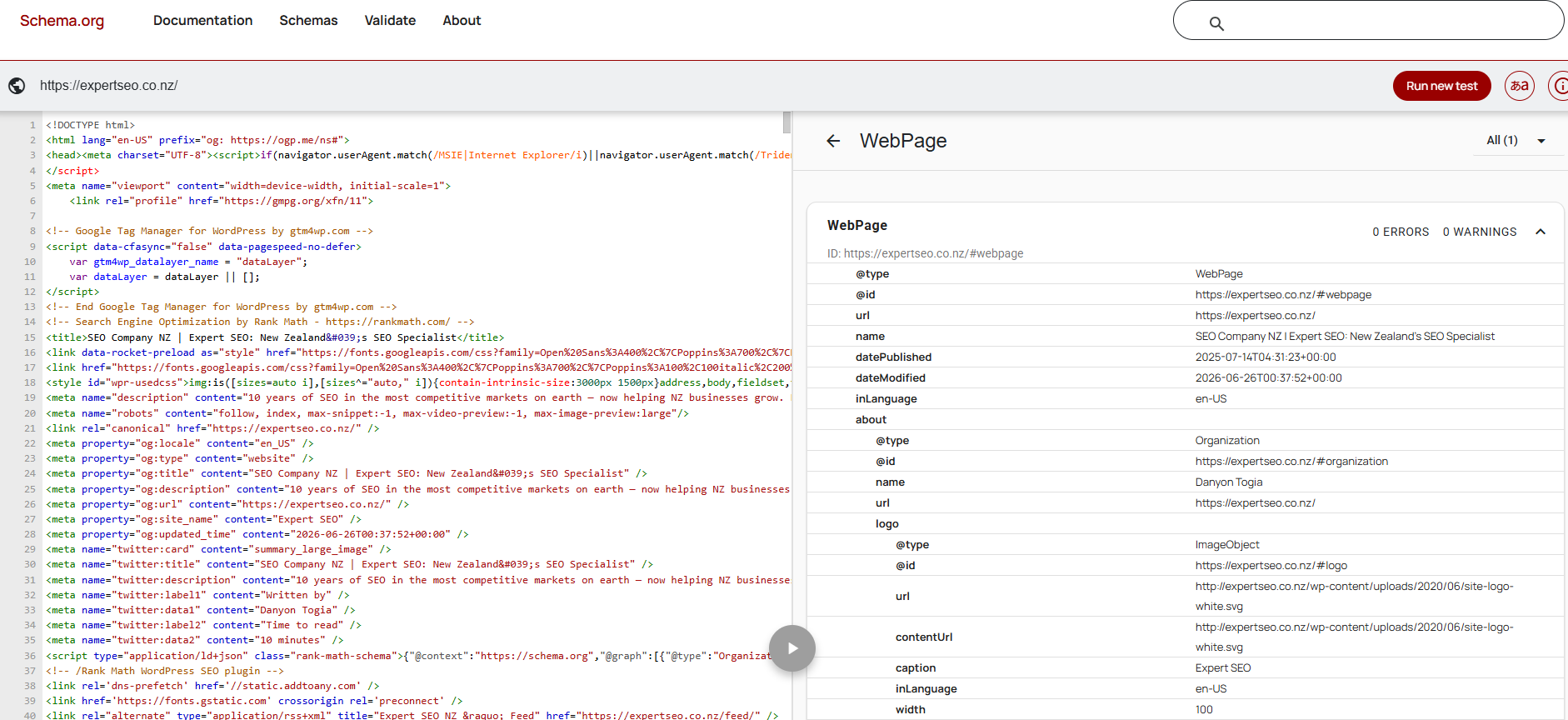
Paste your URL into Google’s Rich Results Test or Schema Markup Validator. Both are free. They’ll flag anything malformed. Fix whatever they catch and run it again.
You’re aiming for zero errors, like this:
Step 8: Get Listed and Linked in the Places That Exist in New Zealand
Every dental SEO guide you’ll read tells you to list on Yelp and Healthgrades. Neither matters in New Zealand. Here’s the list that does.
Why consistency matters. Google cross-references your practice details across the web. When your address is “23 Devonport Rd” in one place, “23 Devonport Road” in another and an old suite number in a third, that’s ambiguity — and ambiguity in local search costs you position. The fix is boring and it works: pick one format and use it everywhere.
The New Zealand Directory List
Start with these, in roughly this order of value for a dental practice.
| Directory | Why it matters |
|---|---|
| Google Business Profile | The one that actually drives patients. Done in Step 1. |
| Healthpoint | The main NZ health services directory. Patients and GPs genuinely use it. |
| Apple Maps (Apple Business Connect) | Every iPhone user searching Maps. Free, and almost no NZ practice has claimed theirs. |
| Bing Places | Small share, five minutes of work, and it feeds some AI systems. |
| Yellow NZ | Long-standing NZ citation source. |
| Localist | NZ local business directory. |
| Finda | NZ business directory. |
| NZ Dental Association | Member listing — a relevant, authoritative link in your exact field. |
| Southern Cross / nib provider directories | If you’re an affiliated provider, get listed. Patients search these directly. |
| Neighbourly | Suburb-level, and genuinely used for local recommendations. |
| Your regional chamber of commerce | Local, relevant, usually free with membership. |
Do those and you’ve covered the citations that matter here. Chasing another sixty low-quality directories adds nothing.
If you’d rather not do it by hand, BrightLocal’s Citation Builder lets you enter your details once and pushes consistent listings out, though its NZ coverage is patchier than its US coverage — check what it actually reaches before paying for it.
Links That a New Zealand Practice Can Genuinely Earn
International guides recommend skyscraper campaigns, digital PR and broken link building. Those are strategies for companies with a content team. Here’s what actually works for a three-dentist practice.
Sponsor something local. The school gala, the netball team, the surf club. Most list sponsors on their website with a link. It’s a genuine community link from a local domain, and it costs less than a month of ads.
Join the local business association. Membership usually includes a directory listing with a link.
Be a source for local media. Regional papers and community sites run health stories constantly. A dentist willing to comment on kids’ dental health before school starts, or sports mouthguards before winter season, is a story waiting to happen.
Partner referrals. If you refer to a local orthodontist, periodontist or oral surgeon, a mutual referral page is genuinely useful to patients and links naturally.
Your suppliers and software. Practice management platforms and dental suppliers often run “find a practice” directories or case studies. Ask.
One Compliance Note on Links
If a local publication writes about you, you don’t control what they publish — but if you supplied the claims, you may still own them. Standard 3 applies to what you say about yourself wherever it ends up. Give journalists accurate, substantiable information, and don’t hand them a superlative you couldn’t defend.
What to Avoid
Paid link packages. The $200-for-50-backlinks offers in your inbox. They’re low-quality at best and actively harmful at worst, and in a regulated profession you also don’t control what gets written next to your practice name.
Directory spam. Hundreds of listings on directories no New Zealander has heard of. It doesn’t help and it makes NAP consistency impossible to maintain.
Step 9: Turn the Traffic Into Booked Appointments
You can rank first and still lose the patient, because in dentistry the last three metres of the journey is a phone call somebody has to answer.
This is the step nobody writes about. Every guide on this topic — every single one I read while researching this — stops at “and then you get traffic.” Traffic isn’t the outcome. A booked appointment is.
The Phone Is Where Dental SEO Dies
Come back to that NZDA number: 64% of clinics hold emergency appointments every weekday.
Now picture the search. Someone cracks a molar at 4:45pm on a Thursday. They search “emergency dentist [city]”, they find you, they ring.
Nobody answers, because reception closed at 4:30.
You did the SEO. You got the ranking. You got the click.
And they’ve already rung the next practice on the list before your voicemail finishes playing.
What to actually do: know your answer rate. Most practice phone systems can report on missed calls — if yours can’t, call tracking will. Then decide what happens to a call that comes in after hours: a diverted mobile, an answering service, or at minimum a voicemail that gives the after-hours emergency number and is checked that evening rather than the next morning.
Online Booking
Divisive in dentistry, and the objection is legitimate — you don’t want someone self-booking a 15-minute check-up for what’s actually an hour of work.
The compromise most practices land on is booking new-patient exams and hygiene appointments online, and keeping everything else on the phone.
The reason to consider it: a meaningful share of searches happen outside business hours, and evening is when people finally get around to sorting out the tooth that’s been bothering them. A booking button captures those. A phone number doesn’t.
What Has to Be Above the Fold
On mobile, before anyone scrolls:
- Your phone number, tappable. Not an image, not text they have to copy. A
tel:link. - Whether you’re open right now.
- Where you are. Suburb at minimum.
- A price signal. “Check-ups from $95” or “Southern Cross affiliated provider.” Something that answers the cost question they were already worrying about.
How to Measure It
Three things to set up, all of them free or near enough.
Google Search Console. Which searches you appear for, your position, and your click-through rate. This is truth for how you’re doing in search.
Google Analytics 4. Set up a conversion event on your phone number tap and your booking button. Without this you’re measuring visits, which tells you nothing about patients.
Call tracking. A separate number on your website that forwards to your real line, so you can see how many calls came from organic search. This is the number that actually justifies the spend.
The Three Numbers to Watch Every Month
Forget rank tracking as your headline metric. Watch these:
- Calls and booking form submissions from organic search — the only number that matters
- Map pack impressions in your Google Business Profile insights — your local visibility trend
- Missed call rate — the leak
Most practices never set this up, which means they can’t tell whether SEO is working and end up judging it on gut feel. Setting it up once and reading it monthly is a large part of what an SEO consultant does for a practice.
How Dental SEO Works in AI Search
AI Overviews do take clicks. But they show up far less often on the short, high-intent searches that actually bring patients through your door — and that’s the part nobody in dental marketing is telling you.
Since Google started putting AI answers above the results, the dental forums have been asking the same question. There’s a thread on r/Dentistry from September 2025 titled “Is there a decline for Dental SEO”, and the honest answer isn’t the reassuring one agencies give or the doom-laden one you’d expect. It’s more interesting than either.
What Changed When AI Answers Arrived
Pew Research Center ran the best study we have on this. They tracked the browsing behaviour of 900 US adults across 68,879 Google searches in March 2025, 12,593 of which returned an AI summary.
The headline findings:
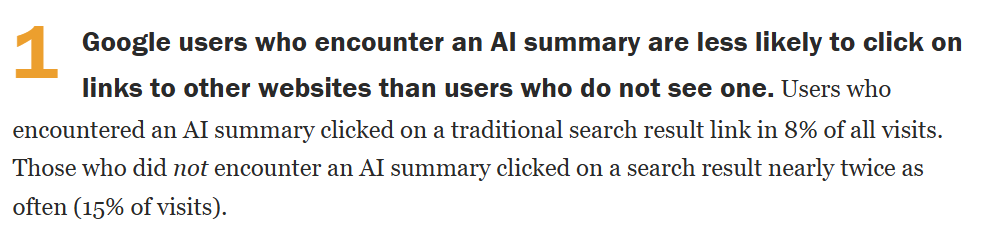
- Users clicked a traditional search result on 8% of visits where an AI summary appeared, versus 15% where it didn’t. Roughly half.
- They clicked a link inside the AI summary on just 1% of visits.
- They ended their browsing session entirely on 26% of pages with an AI summary, versus 16% without.
So yes — when an AI summary shows up, fewer people click through. That’s real and it’s not worth pretending otherwise.
The Number That Changes the Picture for Dentistry
One finding got buried, and for a dental practice it’s the most important one in the study.
Short searches barely trigger AI summaries at all. Only 8% of one- and two-word queries produced one. For searches of ten words or more, it was 53%.
Read that against how people search for a dentist.
“Dentist Ponsonby.” Two words. Barely touched by AI Overviews. Still a map pack and a list of blue links, exactly as it was three years ago.
“How much does a dental implant cost in Auckland.” Nine words, question-shaped. Prime AI Overview territory.
So the split is clean: AI answers are eating your informational content, not your booking-intent content.
The person ready to ring a dentist is typing two or three words and still seeing your Google Business Profile at the top of their screen. The person researching implant costs six weeks before they book might get their answer from an AI summary without ever visiting your page.
That reframes the whole strategy rather than ending it. Your map pack work — Steps 1 and 2, the highest-leverage things in this guide — is almost entirely insulated. Your cost and research content is exposed, which means it needs to be written to be cited rather than just to be read.
How to Get Cited by AI
Being quoted by an AI system is a different game from ranking — it’s the difference between SEO and GEO — and it comes down to being easy to lift.
Answer the question in the first two sentences. AI systems extract clean, self-contained answers. A section that opens with “Dental implants are titanium posts placed in the jawbone to replace a missing tooth root” is quotable. One that opens with “When it comes to replacing missing teeth, there are many options to consider” is not.
Use question-shaped headings. “How much do dental implants cost in New Zealand?” as an H2, answered directly underneath, is far more extractable than “Pricing Information.”
Be specific and verifiable. AI systems favour content with concrete, checkable detail. “$5,500 to $7,500 depending on whether a bone graft is needed” beats “costs vary depending on your needs” every time — and it’s more useful to the reader anyway.
Add the structured data. Step 7 wasn’t filler. Schema is machine-readable fact, and machine-readable fact is what these systems reach for first.
Be the source, not the summariser. Content that restates what everyone else already published gets ignored. Content with something original in it — your actual fees, your actual process, real local detail — gets cited because there’s nowhere else to get it.
This is what it looks like in practice: ask ChatGPT for the best dentist in Auckland and it returns a shortlist. Those practices didn’t get there by publishing more. They got there by being verifiable.
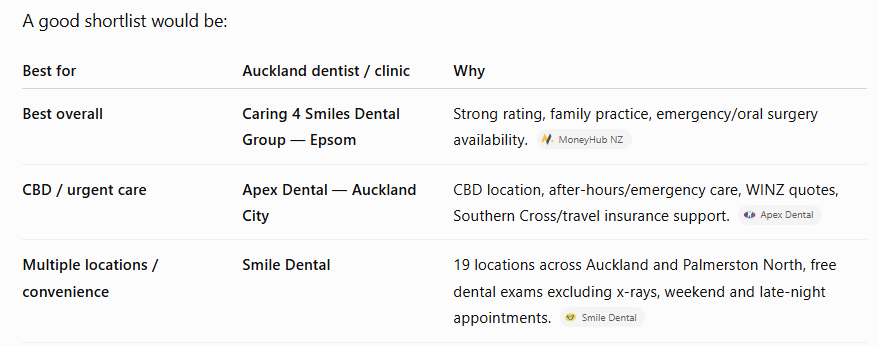
That last point is the whole game. On this page, the reason there’s a section on the Dental Council’s advertising standard is that no other page on this topic has one.
What I’ve Seen on My Own Site
I’ll be straight about the limits of this proof: it’s not a dental result.
Expert SEO is a domain under a year old competing against New Zealand agencies with a decade of history. It’s now cited in Google’s AI Mode and named by ChatGPT, ranking for 233 keywords with around $3,500 a month in traffic value.
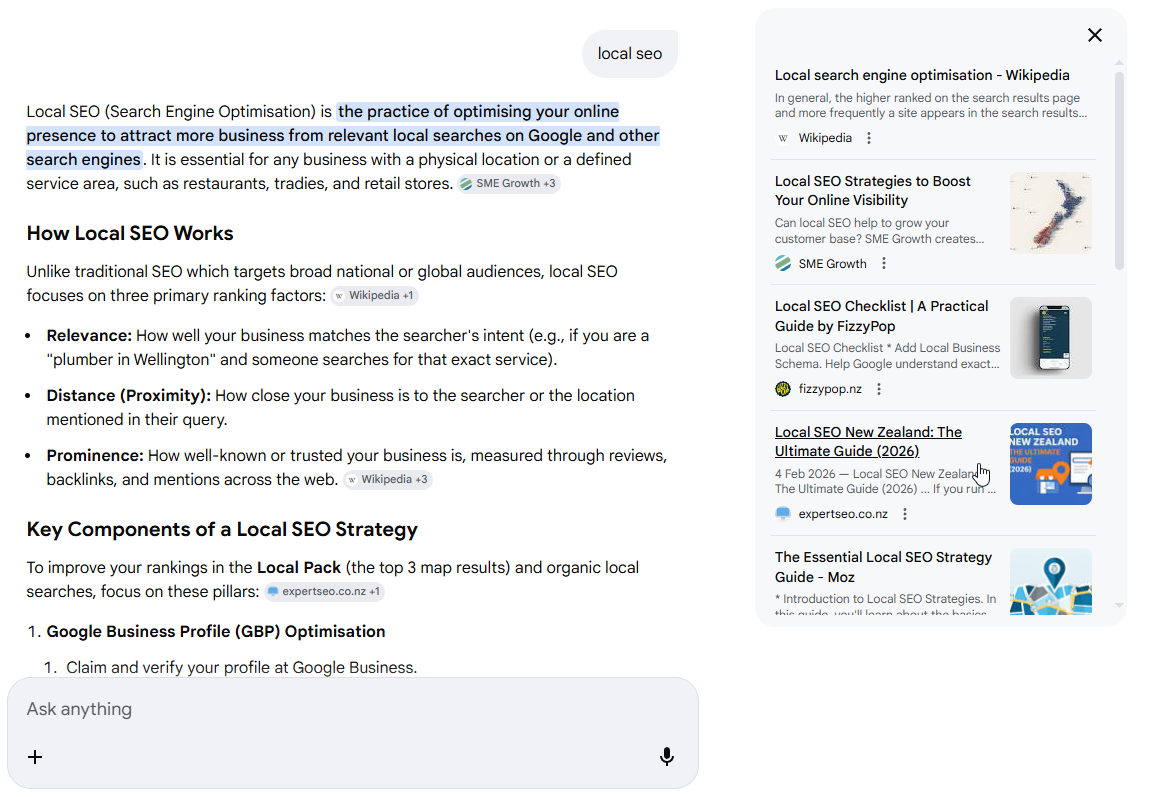
What made the difference wasn’t volume. It was publishing specific, New Zealand-anchored answers on topics where everyone else had generic international content — the same approach this page is built on, and the same one that works for a dental practice.
What Not to Bother With
Don’t generate your content with AI to feed AI. Beyond the quality problem, there’s a compliance problem that’s specific to your profession. An AI writing your implant page has no idea the Dental Council restricts “specialist” for implantology, no idea a testimonial claiming a treatment outcome breaches the Medicines Act, and no idea it can’t imply other practices are worse.
It’ll write all three, confidently, and the liability lands on you.
Use it to draft, if you like. Never to publish unread.
How Long Dental SEO Takes in New Zealand
Expect early movement in the map pack within two to three months and meaningful organic results somewhere between six and twelve. Faster in a provincial town, slower in central Auckland — and that variable matters far more than any industry average.
Why “3 to 6 Months” Is a Useless Answer
Every agency gives you a range and none of them tell you what it depends on. The honest answer is that timeline is a function of competition, and competition varies enormously across New Zealand.
Ranking a practice in central Auckland means getting past dozens of clinics, several of them corporate-owned, several with ten years of domain history and hundreds of reviews. That’s a twelve-month project.
Ranking a practice in a provincial town might mean getting past four practices, two of which have sites nobody’s touched since 2016 and no Google Business Profile worth the name. That can move inside two months.
Same work. Wildly different timeline. Anyone quoting you a number without asking where you are is guessing.
What Each Stage Looks Like
Month 1. Google Business Profile finished, review system running, technical issues fixed, keyword targets set. You’ll likely see nothing in rankings. You should already see something in review volume.
Months 2–3. Map pack movement usually starts here — it responds fastest because the profile and review signals are the quickest to change. Treatment pages are live and starting to get impressions in Search Console, mostly on page three or four.
Months 4–6. Treatment pages begin climbing. You should be getting your first enquiries traceable to organic search. This is where practices who tracked properly can see it working and practices who didn’t start getting nervous.
Months 6–12. Compounding. Pages that were on page three move to page one. The map pack position stabilises. Enquiry volume becomes predictable enough to plan around.
The Bit Nobody Warns You About
The first three months usually look like nothing is happening, and that’s when most practices quit.
Rankings are a lagging indicator. They move last, after everything else has already improved. So if you judge the first ninety days on rankings, you’ll conclude it’s failed right before it starts working.
Watch these instead:
- Review count and rating — should be climbing from week two
- Google Business Profile impressions — the earliest visibility signal you get
- Search Console impressions — you’ll be appearing for things before you’re ranking for them, and that’s the leading indicator
- Pages indexed — new pages being found and stored
All four move before rankings do. If they’re all trending up and rankings are flat, it’s working; you’re just early.
What Makes It Faster
- An existing website with some history, rather than a brand new domain
- A Google Business Profile that’s already verified with some reviews on it
- A less competitive city or suburb
- Treatments where the local competition hasn’t built pages — which, as we covered in Step 4, is most of them
The Dental SEO Mistakes That Cost NZ Practices Money
Most of the money wasted on dental SEO in New Zealand goes on the same handful of mistakes. Here they are, roughly in order of how expensive they are.
Following American advice. Getting listed on Yelp. Putting “cosmetic dentistry specialist” in the title tag. Budgeting off US dollar figures. Planning link campaigns designed for companies with content teams. Almost every dental SEO article you’ll find is written for a different market with fifty times the search volume and a different regulator, and it doesn’t transfer.
Chasing “dentist near me” and nothing else. It’s the highest-volume term, so it’s the one everybody wants. It’s also mostly won through your Google Business Profile, and it brings you check-ups. Meanwhile “dental implants [city]” sits there with almost no competition and a value per patient forty times higher.
Buying links. The $200-for-50-backlinks offers. Low quality at best, harmful at worst, and in a regulated profession you’re also handing control of what appears alongside your practice name to a stranger.
Publishing testimonials that mention treatment outcomes. Extremely common, and it breaches section 58 of the Medicines Act. “They fixed my chronic jaw pain” is not a review you can display, however lovely the patient was to write it.
Letting an agency publish claims you can’t back up. “New Zealand’s leading implant clinic.” “Painless dentistry, guaranteed.” Someone wrote it because it converts. The Dental Council standard says you own it, and the Fair Trading Act says an unsubstantiated claim is an offence.
Building thin suburb pages. Eight near-identical location pages with the suburb name swapped. Google worked this pattern out a decade ago, and thin duplicate content can drag down the pages around it.
Judging SEO on rankings instead of appointments. The rank tracker says position four and everyone’s pleased. Nobody has checked how many calls came from organic search, or how many of them went unanswered. Rankings are a proxy. Booked appointments are the point.
Stopping at three months. Covered above, and it’s the most expensive mistake on this list, because it means paying for the entire setup phase and quitting immediately before the return.
Final Thoughts
The practices that win New Zealand dental search over the next few years won’t be the ones publishing the most content. That race is already lost to AI, and it was never much of a race anyway.
They’ll be the ones whose website says something specific and true that a machine can verify — real fees, real availability, a real emergency service, a real answer to what ACC covers. Everything vague gets summarised and discarded. Everything concrete gets cited.
Which is a strange kind of gift for a regulated profession. The Dental Council’s standard forces you to be accurate, substantiable and honest about typical results rather than exceptional ones. Every marketer will tell you that’s a constraint.
It’s the exact thing Google and the AI systems are now rewarding.
Dental SEO: FAQ
What is dental SEO?
Dental SEO is the process of getting your practice to show up when someone nearby searches for a dentist or a treatment. It covers your Google Business Profile and the map pack, your website's treatment and location pages, your reviews, and increasingly the AI answers that sit above the normal results.
How much does dental SEO cost in New Zealand?
Most New Zealand dental practices spend between $1,500 and $4,500 a month, driven mainly by how many practices you're competing against in your city. Under $1,500 is realistically maintenance or a low-competition town; $3,000 and above suits multi-location practices or clinics chasing competitive treatment terms like implants.
How long does dental SEO take to work?
Expect early map pack movement within two to three months and meaningful organic results between six and twelve. A practice in a provincial town can move inside two months, while central Auckland is closer to a twelve-month project. The first three months usually look like nothing is happening because rankings move last.
Is dental SEO worth it for a small practice?
Usually yes, because dental transaction values are high enough that low search volumes still work. Using NZDA 2025 fee data, a single-tooth implant is around $5,747, so one extra implant patient a month from one keyword is close to $69,000 a year in treatment value — from a term that might only get 30 searches a month.
Can NZ dentists use patient testimonials in their marketing?
Yes, with conditions. The Dental Council requires written permission, and the testimonial must be verifiable, current, and representative of the typical rather than the exceptional result. Separately, testimonials that make therapeutic claims breach section 58 of the Medicines Act 1981, so reviews should describe the experience and the practice rather than treatment outcomes.
Am I responsible if my SEO agency publishes something misleading?
Yes. The Dental Council's Advertising Practice Standard states that the doctrine of vicarious liability applies, meaning you are responsible for the action or non-action of your advertising agent, and that you cannot delegate that responsibility. It's worth asking anyone you hire whether they've read the standard.
How do I choose a dental SEO company?
Ask whether they've read the Dental Council's advertising standard, who owns the website and content if you leave, what reporting you get, and whether anything is locked into a contract. Walk away from guaranteed number-one rankings, and be sceptical of any agency quoting contradictory ROI figures on its own website.
Do I need a separate page for every suburb I serve?
No, and building near-identical pages for each suburb can hurt you. Build a location page when you have a second physical practice or something genuinely specific to say about an area — local landmarks, parking, team members based there, patients you actually draw from it. If the only difference would be the suburb name, don't build it.
Is SEO still worth it now that Google shows AI answers?
Yes, particularly for the searches that bring patients in. Pew's research found only 8% of one- and two-word searches trigger an AI summary, compared with 53% of ten-word searches. So "dentist Ponsonby" is barely affected, while long research questions like implant costs are heavily affected — AI hits your informational content, not your booking-intent content.
Should I put my prices on my website?
There's a strong case for it in New Zealand, where 39.8% of adults have avoided dental care because of cost. Those people are searching for prices, and a page without one loses them. Publishing a range with what moves it — rather than a single number — answers the search and pre-qualifies enquiries while leaving room for the conversation.
What's the difference between dental SEO and Google Ads?
Google Ads puts you at the top tomorrow and stops the day you stop paying. SEO takes months and then keeps working. For an established practice with capacity, SEO usually makes sense as the base with ads layered on for whatever needs filling right now.
Recommended Reading
 Google Business Profile Optimisation
The full walkthrough behind Step 1 — every setting that moves you in the map pack.

