

You saw the phrase “unnatural links” somewhere. Maybe in a warning inside Google Search Console. Maybe in a scary blog post. Maybe a tool flagged some of your backlinks as “toxic.” And now you’re worried you’ve done something wrong and Google’s about to tank your rankings.
Take a breath. For most New Zealand businesses, this is a non-issue.
Here’s the short version: unless you’ve been buying cheap links, you almost certainly don’t need to do anything. Every article online treats unnatural links like a five-alarm fire. Most of the time, there’s no fire.
Let me explain what unnatural links actually are, clear up the panic, and show you the handful of situations that genuinely matter. Then you can close the tab and get back to running your business.
Key Takeaways
- What they are: Unnatural links are backlinks built mainly to manipulate rankings rather than earned on merit — a breach of Google’s spam policies.
- For most NZ businesses it’s a non-issue. You don’t control who links to you, so the random low-quality links you didn’t create aren’t your problem.
- The only unnatural links that can actually hurt you are the ones you buy — Fiverr packages, link farms, PBNs.
- Google agrees. John Mueller says most sites never need the disavow tool, because Google’s systems already ignore junk links automatically.
- Chasing removals is usually a waste of time. If you do pick up spam, counter it with more quality links and content.
- There’s one place to check for a real problem: Search Console → Manual Actions.
What are unnatural links?
Unnatural links are backlinks created mainly to manipulate search rankings, rather than earned because your content deserves them. Google treats them as a breach of its spam policies.
Think of a backlink as a vote of confidence. When another website links to yours, it’s telling Google, “this business is worth pointing people to.”
Earn enough genuine votes and Google trusts you more, so you rank higher. Unnatural links are the fake votes — the ones someone manufactured to trick the system instead of earning them honestly.
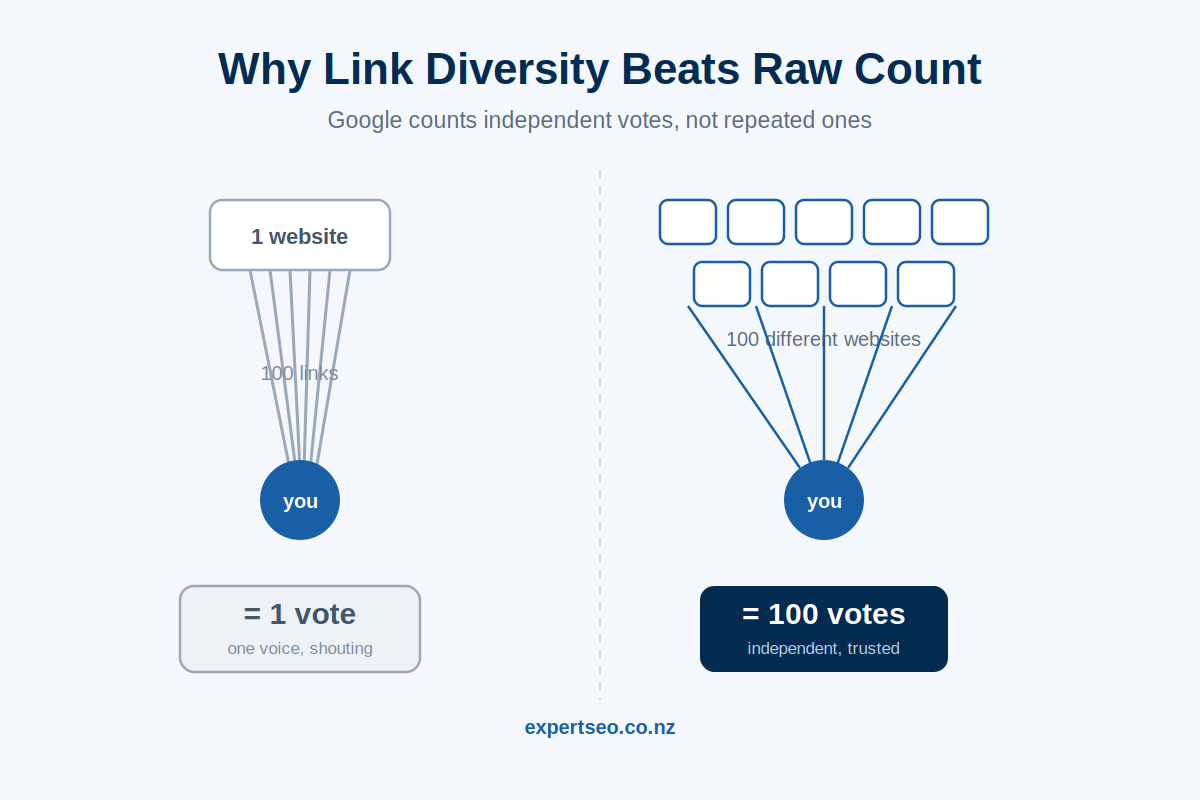
You’ll see these called a few different things: “toxic links,” “spammy backlinks,” “manipulative links.”
They’re all pointing at roughly the same idea — links that exist to game Google rather than to genuinely recommend you.
For most small NZ business owners, the only place you’ll ever bump into the term is a line in a report or a warning in Search Console. That doesn’t automatically mean you’re in trouble. Stick with me.
The main types of unnatural links
Here’s what actually counts as an unnatural link:
- Paid links — buying backlinks purely to inflate your rankings.
- Link farms and PBNs — networks of low-quality sites that exist just to link to each other.
- Blog comment and forum spam — dropping your link into random comment sections.
- Excessive link exchanges — “you link to me, I’ll link to you,” done at scale purely for SEO.
- Junk directory and bookmark spam — bulk-submitting your site to hundreds of worthless directories.
- Cheap gig-site link packages — the classic “500 backlinks for $20” trap on Fiverr and similar sites.
Notice what every single one of these has in common. They’re all things you’d have to actively choose to do.
Nobody accidentally buys a link farm package. That’s the whole point, and it’s where nearly every other article on this topic quietly misses the plot.

That price list above is what buying unnatural links actually looks like — a menu of sites and a flat fee per link. If you’ve never seen a list like that, you’re almost certainly fine.
Natural vs unnatural links
The easiest way to understand unnatural links is to hold them up against natural ones.
Natural links are earned. A journalist quotes your data. A supplier lists you on their partners page. A blogger references your guide because it’s genuinely useful. You didn’t pay for it or beg for it — your work earned it.
Here’s a real example. Content Marketing Institute — a site pulling in over 600,000 visitors a month — linked to my website. I didn’t pay for it, and I didn’t ask for it.
They linked because the guide was genuinely worth pointing their readers to. That’s a natural link in a nutshell: earned, not manufactured, from a high-authority site that chose to reference my work.

Unnatural links are manufactured. You paid, traded, or spammed your way to them, and the only reason they exist is to nudge the algorithm.

Here’s the distinction that matters most, and it’s the one that runs through this entire article: control.
You earn natural links by doing good work. You choose to buy unnatural ones. But there’s a third category most people forget — the links you can’t control at all.
Random sites will link to you out of nowhere. You’ll never ask for them, and you can’t stop them. Hold that thought, because it changes everything about how much you should worry.
If you want a fuller picture of what healthy backlinks look like, I’ve written about how many backlinks you actually need to rank.
The truth most SEO articles won’t tell you
Ready? Here it is:
If you’re not buying links, you don’t need to worry about unnatural links. Full stop.
Let me walk you through why, because this is the part that gets buried under all the fear-mongering.
You don’t control who links to you. Random low-quality sites will link to your website all the time — scrapers, junk aggregators, spam blogs, sites you’ve never heard of in languages you don’t speak. You didn’t ask for those links.
You can’t stop them. And because you had no hand in creating them, Google doesn’t hold them against you. It knows any website on earth can point a link at yours. Punishing you for that would be insane, so it doesn’t.
The good links come from doing the work. A real link-building strategy — outreach, relationships, digital PR, genuinely useful content — earns you quality links from sites that matter. Those you do influence, and those are the ones that grow your rankings.
The only behaviour that actually gets you in trouble is buying low-quality links. That’s the one thing that’s both within your control and against the rules. If you’re not doing that, this entire topic doesn’t apply to you.
And here’s something that surprises people: you can run an aggressive, active link-building campaign and pick up links at a pace that looks almost unnatural — and that’s completely fine. Building links quickly isn’t against the rules.
Buying spammy links is. There’s a difference, and I’ve explained the nuance in my guide on link velocity.
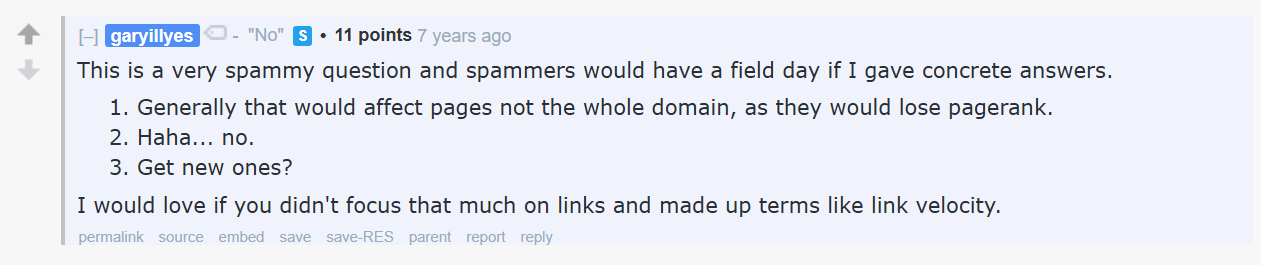
Don’t just take my word for it — Google agrees. Google’s own John Mueller has said the disavow tool (the thing everyone panics about) is not a normal part of running a website, and that most sites never need it.
Google’s spam systems already spot and ignore low-quality links automatically. In other words, the search engine itself is telling you to relax.

So the real question isn’t “do I have any low-quality links pointing at me?” You do. Everybody does. The question is: did you pay for them? If the answer’s no, you’re fine.
How to tell if you actually have a problem
Instead of auditing every link in a panic, let’s figure out whether this is even relevant to you. There are only three situations you can be in.
1. Nothing’s wrong. This is almost everyone. You never bought links, you’ve got no warning from Google, your rankings are fine. There’s nothing to fix. Carry on.
2. Google’s just ignoring the junk. Some spammy links point at your site (see above — you can’t stop that), but you’ve got no penalty and your rankings are healthy. Google’s systems have already quietly discounted those links. Again, nothing to fix.
3. You’ve got a manual action. This is the one that actually matters, and it only happens if you’ve earned it — usually by buying links or running link schemes.
So how do you check for that manual action? It takes two minutes:
- Open Google Search Console.
- Go to Security & Manual Actions → Manual Actions.
- If you see a message like “Unnatural links to your site,” you’ve got a confirmed penalty. If it’s clear, you don’t.
That’s it. That report is the only thing that tells you, straight from Google, whether you have a real link problem.
One more thing: ignore the “toxic score” panic. Third-party tools love slapping a scary “toxic” rating on your backlinks — it makes their product look essential.
Those scores are not Google penalties, and they’re often wrong. Never take action just because a tool waved a red flag at you.
What to actually do about it
Match your response to which of those three situations you’re in. Here’s the ladder.
If you never bought links: do nothing. Seriously. Keep publishing good content and earning links the honest way. That’s the entire plan.
If you’ve got some spammy links but no manual action: still basically nothing. Your best move is to play offence — build more high-quality links and create better content so the good signals massively outweigh the noise.
Google’s already discounting the junk, so pouring energy into “cleaning up” links it’s ignoring is wasted effort.
If you have a manual action: now, and only now, you roll up your sleeves. Identify the paid or scheme links, try to get them removed, disavow the ones you can’t, then submit a reconsideration request to Google. This is real work, and if you’re here because you bought links in the past, it’s worth doing properly — or getting help with.
For the vast majority of NZ businesses, though, the correct action is no action. Just better fundamentals.
Why chasing link removals is usually a waste of time
Let’s say you decide to be thorough and email the owners of those junk sites, asking them to remove their links to you.
Good luck.
In my experience, most of them never reply. The site’s abandoned, or run by someone who couldn’t care less, or it’s an automated spam operation with no human on the other end.
You’ll spend days writing polite removal requests into the void and get almost nothing back. It’s a sunken ship.
The only time it’s genuinely worth the effort is when you’re under an active manual action and you need to show Google you made a real attempt.
Outside of that, the hours you’d burn chasing removals are far better spent creating content and earning quality links — the stuff that actually moves your rankings.
When (and how) to use Google’s disavow tool
The disavow tool lets you tell Google, “ignore these specific links to my site.” It sounds like a safety blanket. For most sites, it’s a loaded gun.
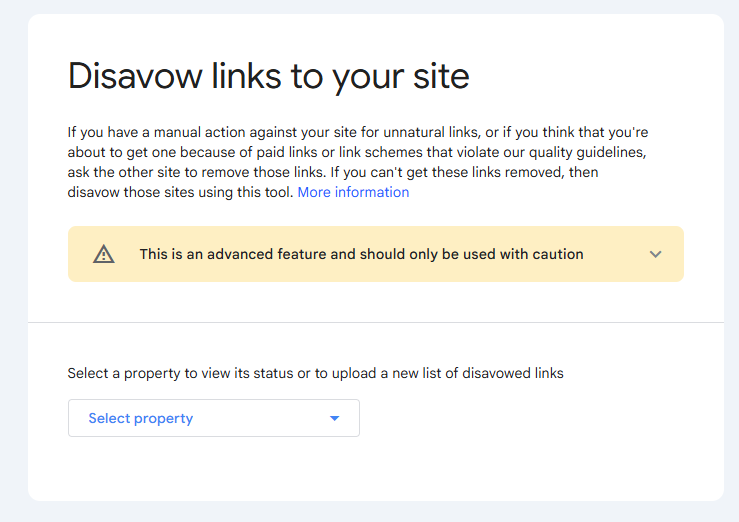
Here’s the honest headline: most websites should never touch it. Google has been clear that disavowing isn’t routine maintenance, and using it wrong can actually drop your rankings — because people constantly disavow good links by mistake, thinking they were bad.
The tool is really only for two situations:
- You have an active manual action for unnatural links, or
- You strongly believe one’s coming because you know you bought links or ran schemes.
If neither of those is you, don’t use it.
For the small number of people who genuinely need it, the process is: export your links from Search Console, identify the paid or scheme links, put them in a disavow text file, submit it through the disavow tool, then request reconsideration.
Keep it surgical — only disavow links you’re confident are manipulative.
And this bears repeating: never blindly disavow links just because a third-party tool called them “toxic.” That’s exactly how businesses accidentally kill their own good backlinks and watch their rankings slide.
How to avoid unnatural links in the first place
Here’s the genuinely useful bit, and it’s refreshingly simple: just do SEO properly.
- Publish content that’s actually worth linking to.
- Earn links through real work — digital PR, outreach, building relationships in your industry.
- Ignore anyone selling you “100 backlinks for $20.” That’s the one path that creates the problem in the first place.
The mindset shift is this: stop playing defence against bad links and start playing offence by building good ones.
Quality links and quality content are both your growth engine and your insurance policy. Get them right and unnatural links simply never become your problem — while your domain authority climbs the honest way.
For NZ businesses specifically, “quality links” means local relevance — links from New Zealand media, industry bodies, suppliers, and directories that actually mean something here, not a pile of anonymous foreign spam.
Final Thoughts
Unnatural links are a problem people create for themselves. Avoid the one mistake — buying cheap links — and the whole issue never touches you. Don’t buy links, don’t panic about the random junk you can’t control, and focus on the fundamentals.
Because here’s the thing: the real answer to unnatural links was never “disavow everything and panic.” It’s doing SEO the right way — quality content plus a proper link-building strategy that earns you links worth having. That’s exactly what I do for New Zealand businesses.
If you’d rather stop worrying about backlinks altogether and just have your SEO done properly, that’s what our SEO services handle for businesses across New Zealand.
And if you are one of the few with a manual action or a history of buying links, that’s fixable too — start with a free SEO audit and we’ll sort out exactly where you stand.
Unnatural Links: FAQ
Are unnatural links the same as toxic links?
Loosely, yes. "Toxic" is usually a label a third-party tool invents, not an official Google term. Both point at manipulative, low-quality links built to game rankings rather than earned honestly.
Will random spammy links hurt my rankings?
Almost never. Google ignores links you didn't create, because it knows any site on earth can link to you and you can't stop them. If you didn't build it or buy it, it's not your problem.
Should I disavow toxic links?
Only if you have a manual action, or you know you bought links and expect one. Google's own guidance is that most sites never need the disavow tool, and misusing it can actually hurt your rankings. Otherwise, leave it alone.
Can I fix unnatural links myself?
Yes, if there's anything to fix at all. But most people have nothing to fix, so the honest answer is usually that there's nothing to do. If you have a genuine manual action, that's when cleanup work becomes worth it.
Is it worth paying for backlinks?
No. Buying cheap links is the single thing that actually turns "unnatural links" into a real problem for you. Earn links through good content and legitimate outreach instead.
Are backlinks still important in 2026?
Yes — quality ones absolutely still matter and remain one of the strongest ranking factors. Bought, spammy ones are still a liability. That hasn't changed.
How do I check if I've got a penalty?
Open Google Search Console and go to Security & Manual Actions → Manual Actions. If it says "Unnatural links to your site," you have a confirmed penalty. If it's clear, you don't. That's the only source of truth.
Recommended Reading
 How Many Backlinks Do You Need to Rank?
The honest answer on how many links you actually need — and why quality beats raw count every time.
 Link Velocity: How Fast Should You Build Links?
The companion piece — why building links fast won't get you penalised, and what Google actually cares about.
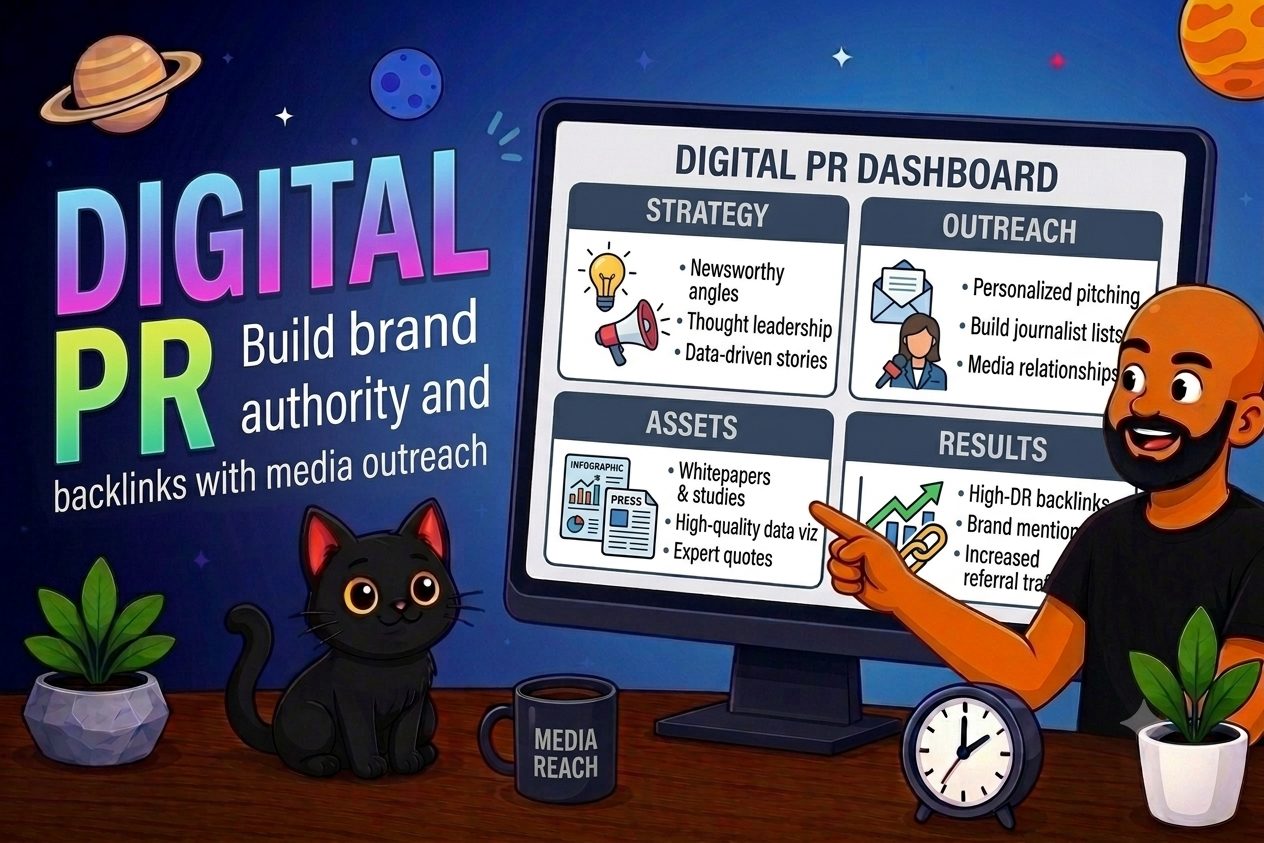 Digital PR: How to Earn Links the Right Way
The offence strategy — how to earn high-quality links that make unnatural ones irrelevant.