

Half the questions people type about SEO right now have nothing to do with strategy. They’re pure panic.
Is SEO dead? Will AI replace it? Should I even bother?
I get it. Search is changing faster than it has in a decade.
Google isn’t the only game anymore, ChatGPT is answering questions that used to send people to your website, and every second post on LinkedIn is telling you the old playbook is finished.
Some of that panic is fair. A lot of it isn’t.
I’ve been doing SEO for over ten years.
I’ve worked through nearly every era of it — the keyword-stuffing days, the Panda and Penguin cleanouts, the mobile shift, the content-quality reckoning, and now the AI one.
And through all of it, one thing has never once changed. Get that one thing right and you don’t have to fear the next era, or the one after that.
This is the full breakdown: what’s actually shifting, what isn’t, and exactly what a New Zealand business should do to stay visible no matter where search goes next. With proof, not predictions.
Here’s What’s Currently Happening In SEO
Search is splitting into more places than ever, and Google is answering more questions itself instead of sending the click to you.
That’s the honest state of it. Not “SEO is dead” — but the ground genuinely is moving, and pretending it isn’t will cost you.
Four shifts are real and worth your attention. Everything else is noise.
Search isn’t just Google anymore. Your customers are asking ChatGPT, searching YouTube, reading Reddit threads, and typing questions into Bing and Perplexity.

Google still owns the lion’s share of search, but it’s no longer the only front door to your business.
If you only exist on Google and your own blog, you’re invisible everywhere else people are now looking.
Zero-click search is the new normal. More searches now end with no click at all — the person gets their answer right there on the results page.
In the US, around 68% of Google searches ended without a click in early 2026, up from roughly 60% two years earlier. On mobile it’s higher again. The answer box, the knowledge panel, and now the AI summary are eating the click.

AI Overviews and AI Mode now sit above the blue links. Google’s AI summary reads the web and hands the searcher a synthesised answer before they scroll to a single website.
When one of those appears, the click rate collapses — on searches that trigger an AI Overview, around 83% end without a click, and in Google’s AI Mode it’s closer to 93%. Ranking #1 doesn’t mean what it did when #1 was the top of a plain list.

Queries are getting conversational. People aren’t typing “plumber Hamilton” anymore.
They’re asking “who’s a good emergency plumber in Hamilton that can come out on a Sunday” — full, natural-language questions, often out loud. Content that answers the real question in plain English wins; content stuffed with the exact keyword doesn’t.
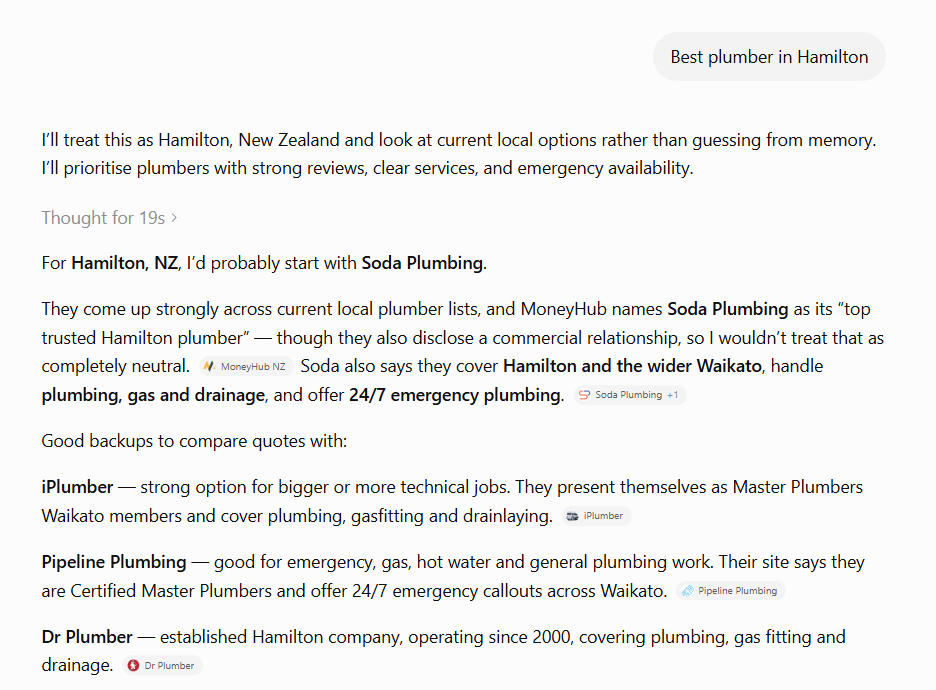
Look at what ChatGPT does with a query like that: it reads the current web, weighs reviews and services, and hands over a shortlist — no Google, no blue links, no click to anyone’s homepage.
That’s the new front door, and your business either shows up in that answer or it doesn’t.
Put those four together and you can see why everyone’s asking whether SEO is dead. It isn’t. But it is widening — from ranking in classic search into a second lane: getting your business referenced and cited by AI.
The businesses that panic and freeze lose ground. The ones that adapt end up winning in both lanes.
The Future Everyone Predicts Is Already Here
Every “future of SEO” article on the internet predicts the same world: one where a brand gets cited by AI, and where a smaller, sharper business can out-rank far bigger names through sheer authority and relevance.
I don’t have to predict that world. I’m already living in it, and I can show you.
Expert SEO is under a year old. On a domain that young, it already ranks #1 in New Zealand for “local SEO” — above Ahrefs and Semrush, two of the biggest names in the entire industry, with domains a decade older and thousands of times the backlinks.

That’s the thing the trend pieces keep circling: authority and genuine usefulness beating raw size. It’s not a 2030 prediction. It happened on a Kiwi website less than a year old.
It goes further. That same guide gets pulled into Google’s AI Mode and cited in ChatGPT answers — the exact “get referenced by AI” outcome every article says is coming.
The reason I lead with this isn’t a flex (okay, maybe a small one). It’s the point of the whole article: the new rules already reward the right approach. So the smart move is to stop bracing for the future and start working out what earns that result today.
So let me tell you the one thing that earns it in every era.
The One Thing That Never Changes in SEO
Every search engine, in every era, has exactly one job: hand the searcher the best possible solution to their problem. Build your business around being that solution and no algorithm change can touch you.
I know it sounds almost too simple after ten years of updates and acronyms. But sit with it, because it’s the closest thing to a law that this industry has.
Think about why Google won in the first place. It didn’t beat Yahoo and AltaVista on marketing. It won because it served better results — the best solution to what you were searching for.
The day it stops doing that is the day it loses to whatever serves better ones. Same story with ChatGPT: people flocked to it because for a lot of questions, it hands over a better answer, faster.
Here’s the part that makes it a safe harbour: every algorithm update is just the engine getting better at spotting the best solution.
Panda hunted thin content because thin content wasn’t the best solution. Penguin killed spammy links because they faked authority the site hadn’t earned. The helpful-content updates went after stuff written for robots instead of humans.
AI Overviews pull from sources the model trusts most. Different mechanics, same target every single time.
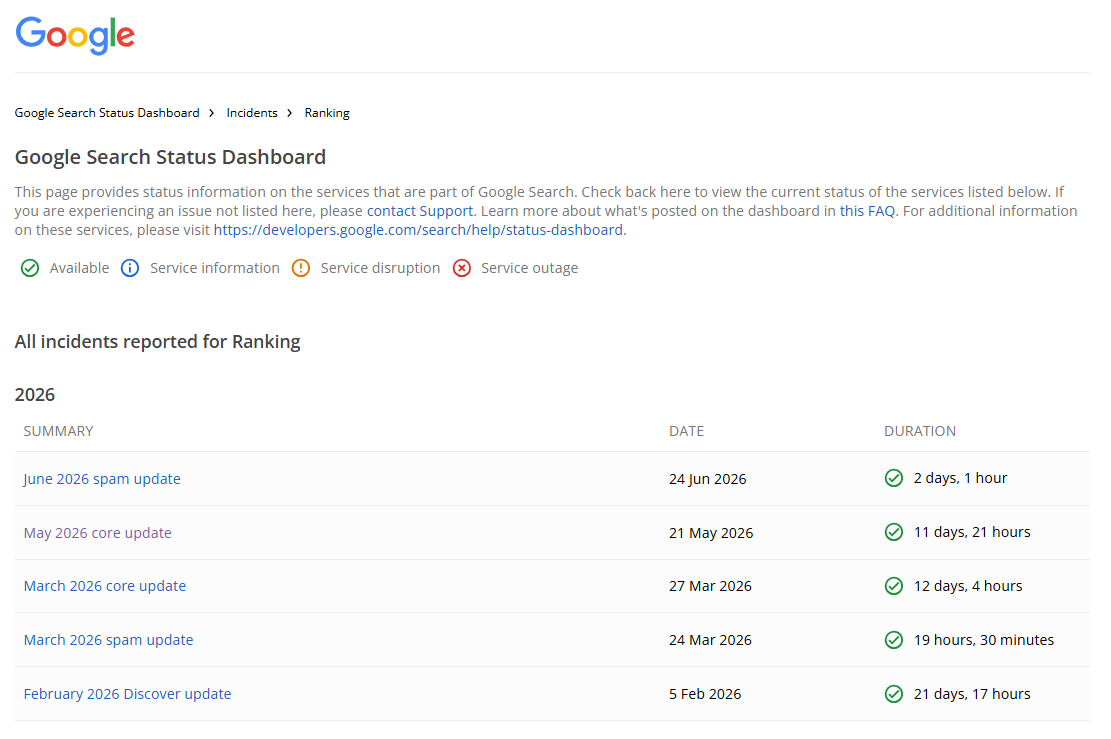
So the formula that survives every era looks like this:
Be the genuine best solution in your market. Learn to communicate that value clearly. Bolt it onto the fundamentals — real content, real links, a site that works.
Do that and you never have to fear the next shift, because you’re aligned with the one thing the shift is always trying to reward.
Be the best solution. Communicate the value. Do the fundamentals. No era of search can touch you.
What does “best solution in your market” actually mean on the ground? Take a Tauranga accountant. Cramming “Tauranga accountant” into the title tag a dozen times doesn’t make you the best solution.
Actually answering what a stressed small-business owner needs does: clear pricing, a real explanation of provisional tax, an easy way to book, proof you’ve done it before.
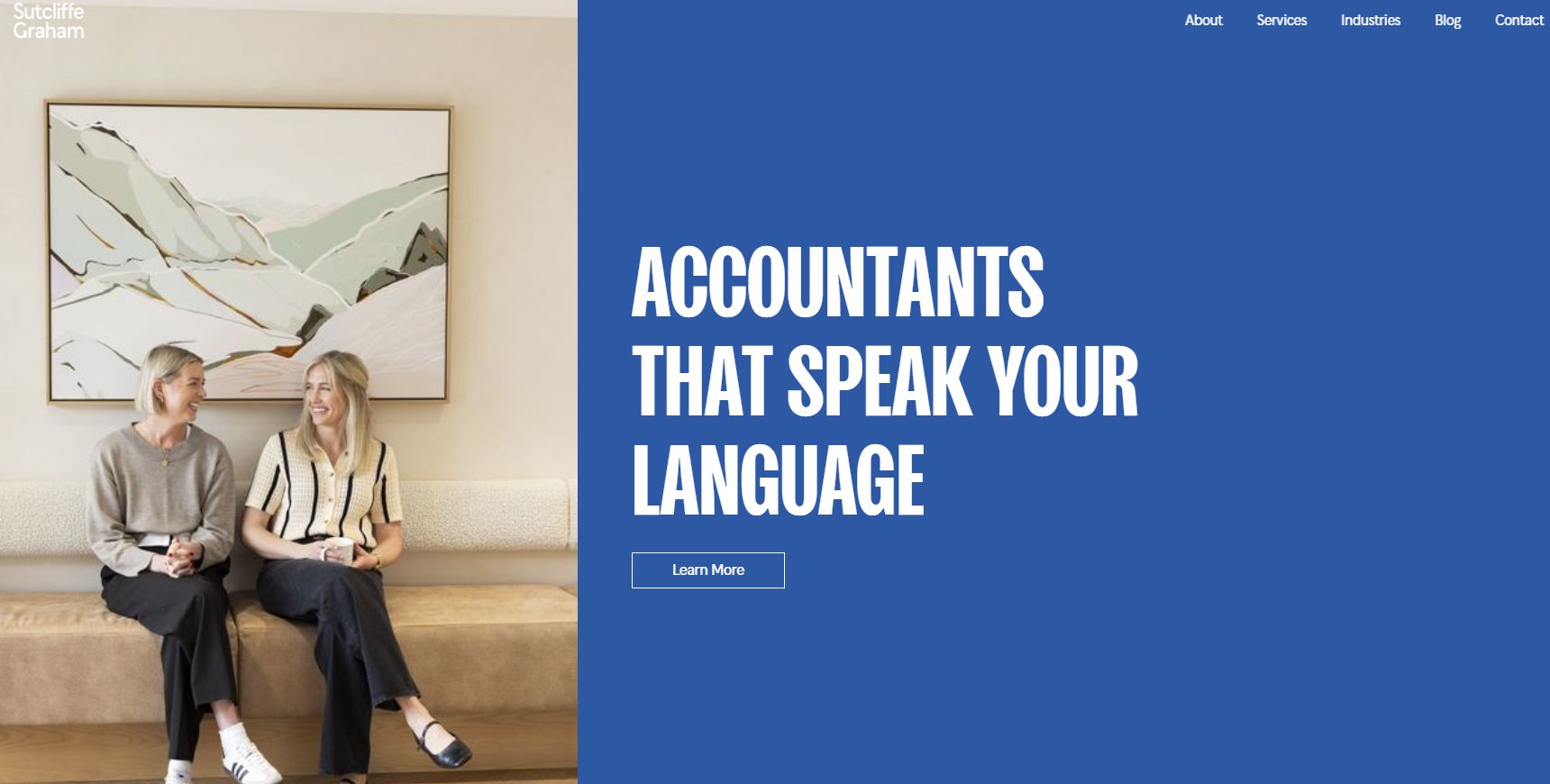
Serve that person better than every other accountant in the Bay, communicate it clearly, and you’ve built something no algorithm wants to bury.
Everything else in this guide is just how to pull that off in practice, in 2026 and beyond.
What Still Works No Matter How Search Changes
For all the noise about everything being different, the fundamentals haven’t moved. High-quality content, genuine backlinks, a technically sound site, and real topical authority still decide who wins — in Google and in AI answers.
This is the part the doom posts skip. They’re so busy telling you the old rules are dead that they forget to mention the ones that still run the whole show.
Here’s why the fundamentals didn’t die: AI engines lean on the same trust signals Google always has.
When ChatGPT or an AI Overview decides whose content to cite, it’s pulling from sources the model already sees as credible — sites with authority, expertise, and a track record.
E-E-A-T (experience, expertise, authoritativeness, trustworthiness) didn’t get less important when AI arrived; it got more important, because now it decides whether you get quoted, not just where you rank.
Off-site validation — who mentions and links to you across the web — is exactly how AI systems judge that credibility.
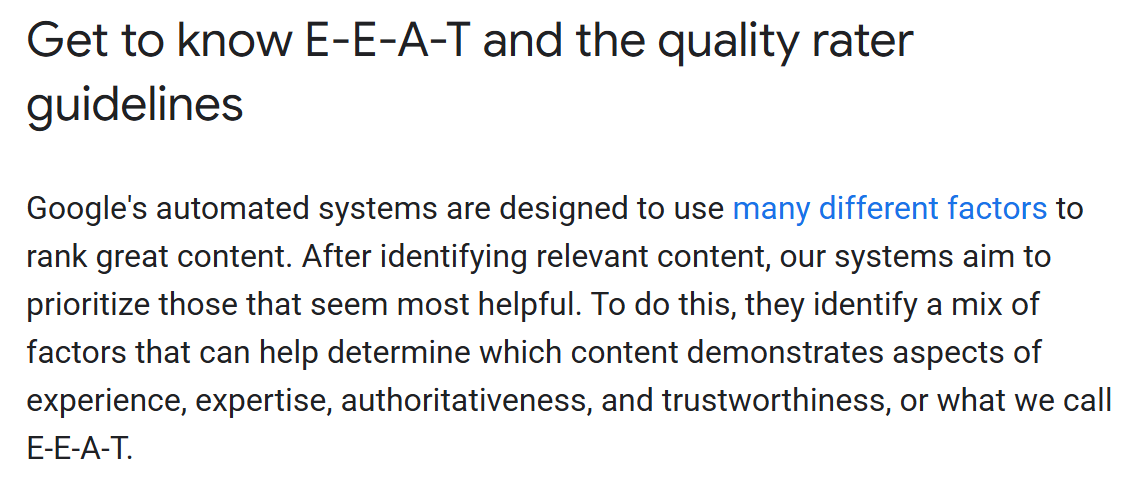
So the boring, load-bearing stuff still carries the weight:
Link building still matters, because links are still how the web votes for who’s credible — and those votes now feed both Google’s rankings and the AI’s trust model.
A genuine link from a respected New Zealand business does double duty in a way it never used to — like this one, earned naturally to our local SEO guide.
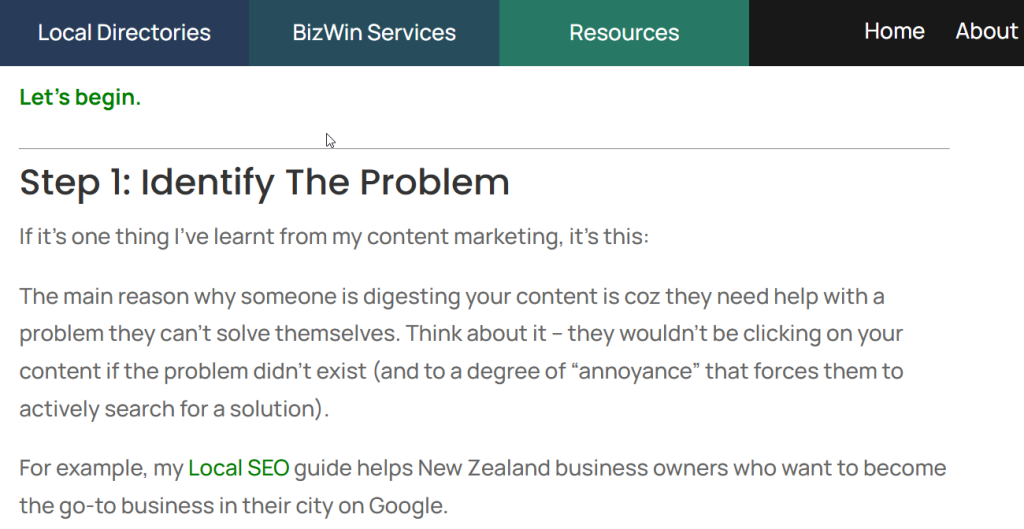
Quality content still wins, because a page that actually solves the problem is what both a human and a language model are looking for. The bar just got higher: “good enough” content is now worthless, which I’ll get to.
A technically sound site still matters, because if Google can’t crawl it cleanly, the AI can’t read it to cite it. Speed, structure, clean code — none of that stopped counting.
And topical authority — genuinely covering your subject from top to bottom rather than dabbling — is arguably more powerful now than ever.
It’s the holistic SEO approach: become the most complete resource on your topic, and you become the obvious source for both a ranking and a citation.
I’ve watched this compound with my own eyes. Back in 2017 I started HealthVI with my former business partner and SEO mentor, Ian Pribyl.
No tricks, no shortcuts — just relentless useful content, real links, and a technically clean site, applied consistently. It went from zero to over 20,000 organic visitors a month.
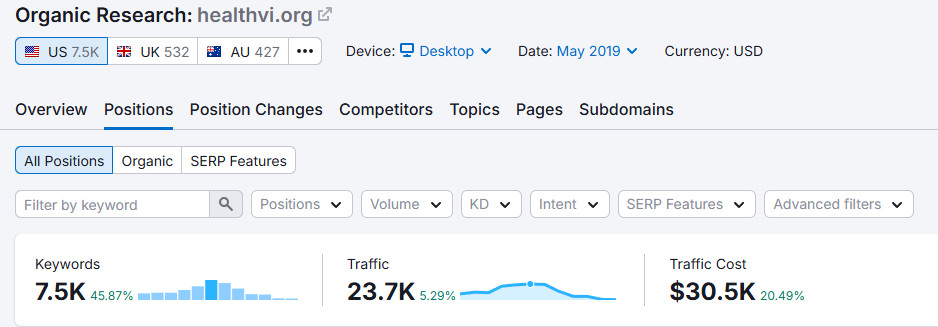
That growth was built entirely on fundamentals — and those same fundamentals are what’s earning the AI citations I get today. The tools change. The foundations don’t.
How to Survive Every Era of SEO
Here’s the playbook. Five moves that keep you visible no matter how search shifts — because every one of them ladders back up to being the best solution in your market.
None of these are hacks. They’re the opposite of hacks. They’re the things a language model can’t fake and a competitor can’t copy overnight, which is exactly why they hold their value while everything around them changes.
Be the Best Solution in Your Market
Everything starts here, because this is the thing every search engine is ultimately trying to reward.
Being the best solution goes way beyond your website. It runs through your actual product or service, your customer experience, the reviews you earn, the way you make people feel after they’ve dealt with you.
A dentist with a warm front desk, honest pricing, and hundreds of genuine five-star reviews is a better solution than the one with a slicker homepage and forty reviews — and over time, search figures that out.
Look at the “dentist Auckland” map pack: the top spots go to the practices with the deepest, most genuine review counts, not the prettiest logos.
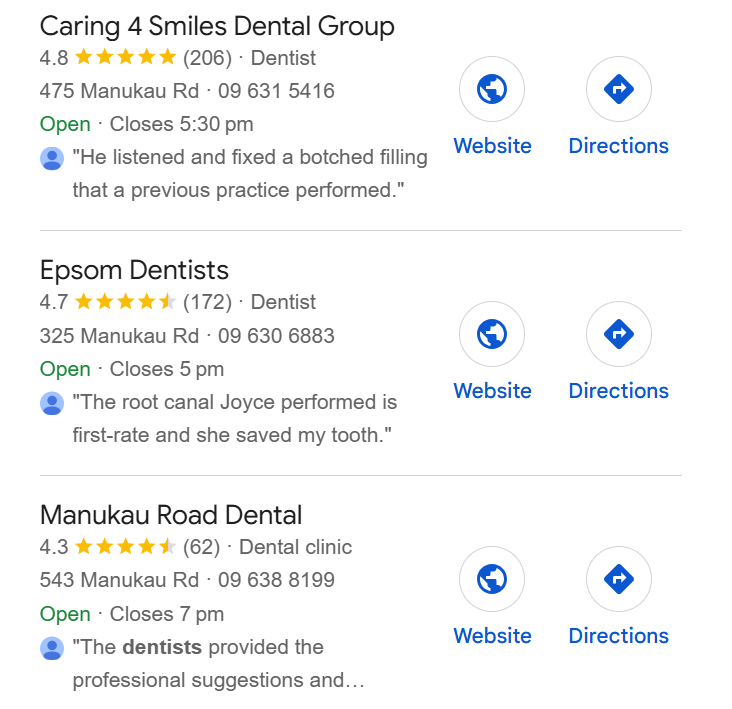
Here’s why it matters for SEO specifically: the signals of a great business — reviews, repeat searches for your brand name, people recommending you by name in forums and to AI tools — are signals search engines increasingly read.
Amazing customer service quietly feeds your rankings, whether you planned it to or not.
So the practical move: obsess over being genuinely excellent at the thing you do, then make it stupidly easy for happy customers to say so.
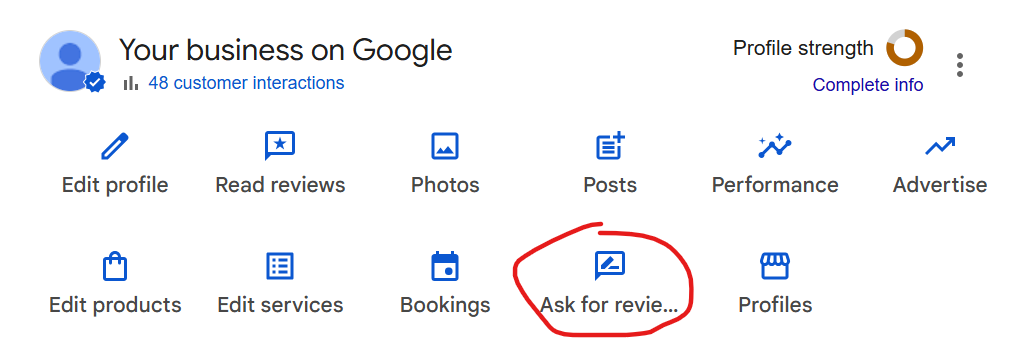
Ask for the review at the emotional high, right after you’ve nailed the job — your Google Business Profile even has a button that generates a direct review link for you.
Reply to every one. Fix the thing people complain about. It’s slower than a growth hack, and it’s the only foundation that never stops paying.
Create Content Only You Could Create
Anyone can generate a passable article in ChatGPT in under a minute. Which means passable is now worthless.
The only content that stands out is what an AI can’t produce: your real experience and your genuine point of view.
Think about what that flood of AI content actually did. It made “decent” content infinite and free. When everyone can produce a competent 1,500-word explainer on demand, competent stops being a differentiator — it’s the floor, not the ceiling.
Google and the AI engines are now actively hunting for the opposite: content with first-hand experience, original data, a real opinion, a lived story. The stuff that can only come from someone who’s actually done the thing.
That’s your moat. Not writing about your topic — writing about it in a way that puts you in a field of your own. The plumber who shows you the three most common Hamilton villa pipe failures with photos from real jobs.
The accountant who shares the actual numbers from a client turnaround (with permission). The SEO who screenshots his own rankings instead of theorising about someone else’s.
Here’s a concrete example of unique execution, and it’s one of my own competitive advantages. When we build a website design for a client, we build the SEO foundations in from day one — structure, speed, the technical groundwork, all of it.
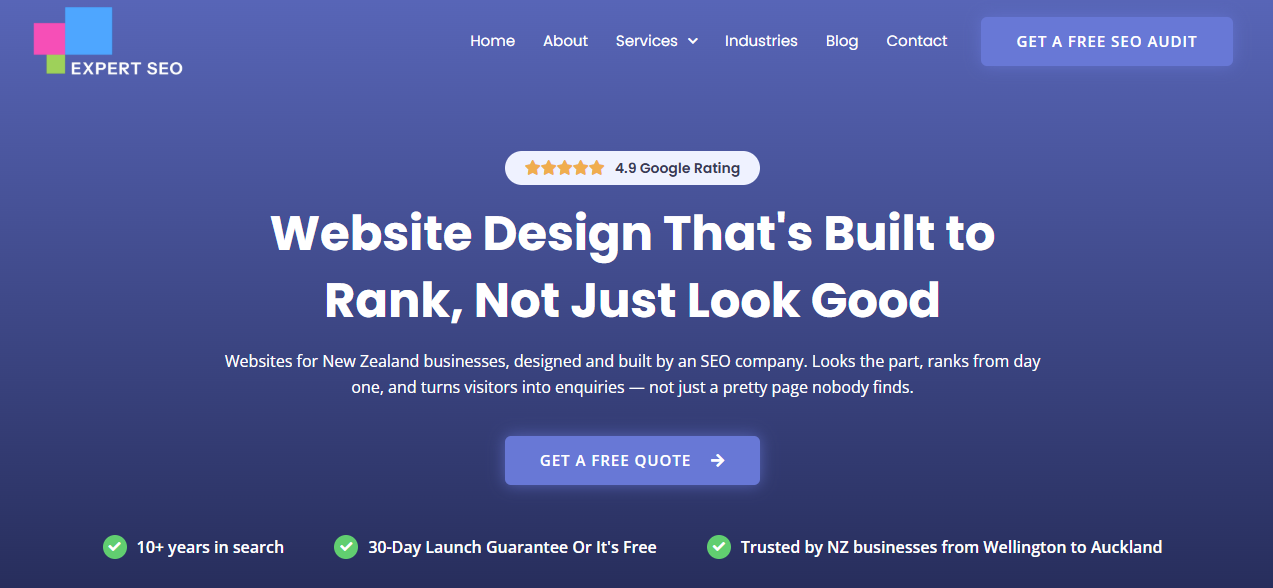
Sounds obvious. It isn’t. Around 85% of the clients who come to me were told their existing site was built with SEO baked in, by whatever agency designed it — and when I look under the hood, the foundations are almost never there.
A pretty website that converts visitors into customers and is engineered to rank from the first line of code is a genuinely different product, and most people have never actually been given one.
That’s the point: find the version of your service that’s unmistakably yours, then build your content around proving it. AI can copy a template. It can’t copy your receipts.
Build Clear Competitive Advantages and Actually Communicate Them
You need real reasons someone should choose you over every competitor in your market — and you need to say them out loud, everywhere, in plain language.
Loads of businesses have advantages they never actually articulate. They are better in some specific way, and they bury it under generic “quality service, competitive prices” waffle that every competitor says too.
If a searcher — or an AI trying to summarise your market — can’t tell what makes you different, you become interchangeable. And interchangeable businesses compete on price and lose.
So do the work most people skip: write down the two or three things you genuinely do better than anyone in your patch. Not slogans — specifics. Then make those the spine of your website, your Google Business Profile, your social, your everything.
Here’s one of mine, so you can see what I mean.
A researcher from Harvard University reached out to interview me for their research into AI — off the back of the work we’ve been doing in AI search and the results it’s produced. I didn’t go looking for that; it landed in my inbox.
Being sought out by Harvard is a credibility marker no competitor can copy and no AI can fake, and it’s exactly the sort of thing you put front and centre when you tell your market why you’re the one to choose.

Take a mortgage broker in a crowded market. “We find you the best rate” is what all of them say. But SEO for mortgage brokers works when the broker leads with something real and provable — “we specialise in self-employed and contractor lending, the deals the banks make hardest,” backed by real client stories.
That’s a competitive advantage, clearly communicated. It ranks better because it matches a real, specific search, and it converts better because it speaks directly to a real, specific person.
Clarity of value is a survival trait. In an era where AI is summarising who’s good at what, the businesses with a sharp, well-communicated advantage are the ones that get summarised favourably.
Get in Front of Your Market Everywhere It Searches
Your customers aren’t only on Google. They’re on YouTube, LinkedIn, Reddit, ChatGPT. If your entire presence is your own blog, you’re invisible in most of the places search now happens.
This is the shift a lot of NZ businesses haven’t caught up to. Search fragmented. One blog and a Google ranking used to be a strategy — now it’s one channel out of many.
An all-encompassing presence has stopped being a nice-to-have; it’s how you stay visible when any single channel wobbles.
There’s a bonus most people miss: being everywhere feeds your AI visibility directly. When AI systems judge whether you’re credible, they look at the whole web — the off-site mentions, the YouTube presence, the third-party references.
A brand that shows up across trusted platforms is a brand the AI trusts enough to cite. Multi-platform presence and getting quoted by AI are the same move.
I’ve lived this one too. My YouTube channel went from 2,000 subscribers to over 30,000, with more than 3 million views — a genuine second search engine sending people my way, and a trust signal that reinforces everything else I do.
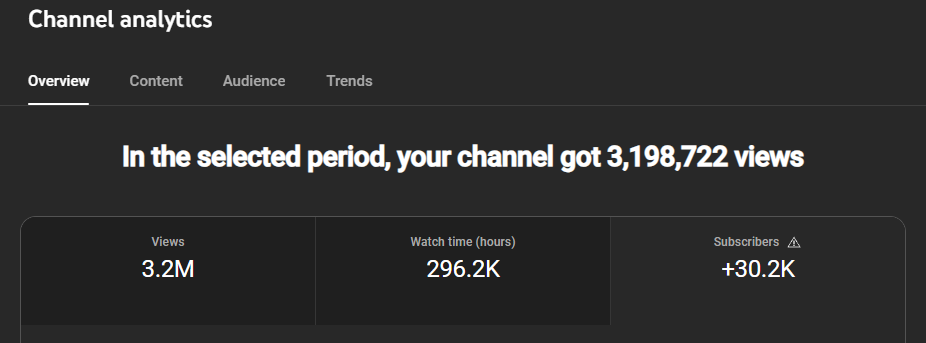
The practical version: pick the platforms your specific market actually uses, and show up on them properly.
A B2B service might live on LinkedIn. A visual trade might win on YouTube and Instagram. A local shop needs its Google Business Profile humming. You don’t need all of them — you need the right two or three, done well, all pointing back to the same clear message.
How to Get Cited by AI, Not Skipped Over
Generative Engine Optimisation (GEO) is about being the source AI quotes, not just a link it ignores. It runs on the same trust foundations as SEO, with a few new moves layered on top.
This is the new lane I mentioned at the start. Classic SEO gets you into the ranked list of links. GEO gets you inside the answer — cited when ChatGPT, Perplexity, or Google’s AI Overview synthesises a response.
And it matters more every month: 43% of marketers are actively doing GEO in 2026, up from near zero the year before. Early movers are getting cited while everyone else is still arguing about whether it’s real.
Here’s what actually earns the citation.
- Structure your content so it’s easy to extract. AI engines love a clear question with a clear, self-contained answer right underneath it. Put the direct answer in the first sentence or two, then expand. Use headings that mirror real questions. Keep the answer-block tight enough to lift whole. If a model can grab a clean two-sentence answer from your page, you’re a far easier source to quote than a rambling wall of text.
- Build off-platform trust. AI decides who’s credible by looking at the wider web — the Reddit threads, the YouTube videos, the digital PR, the brand mentions. This is where “be everywhere” and GEO shake hands. The more trusted places reference you, the more the model treats you as a source worth citing.
- Feed the entity, not just the keyword. Cover your topic comprehensively so the AI understands you as a genuine authority on the whole subject, not a page that happened to mention a phrase. Depth and topical completeness are how you become the obvious pick.
I’m not describing theory here. This is exactly what I did with the local SEO guide — structured for extraction, backed by real authority — and it’s why it gets pulled into AI answers.
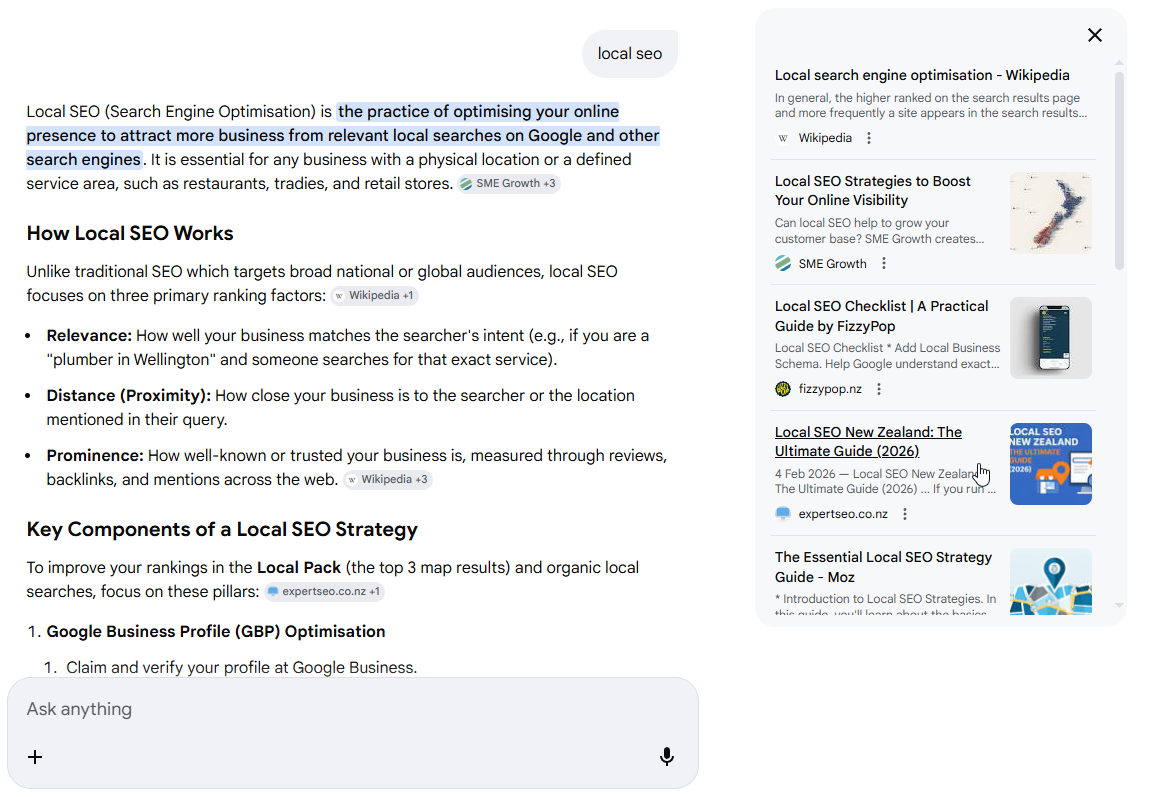
And it’s not only Google’s AI. Ask ChatGPT about SEO in New Zealand and Expert SEO comes up there too — same content, doing its job across two different answer engines.
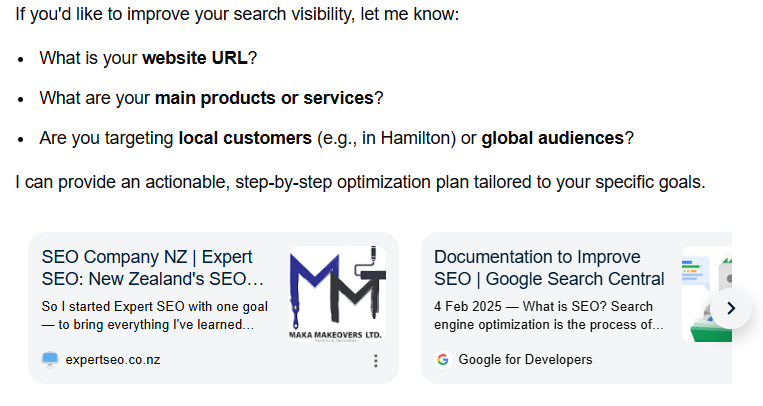
If you want the full, step-by-step version of this, it’s its own discipline — my complete guide to AI SEO breaks down exactly how to rank in ChatGPT and AI Overviews. The short version: earn genuine authority, then package it so a machine can quote it.
What a New Zealand Business Should Do This Quarter
Enough theory. Here’s the future of SEO turned into a to-do list you can start this week — in priority order, fundamentals first.
- Start with an honest audit of where you stand. You can’t fix what you can’t see. Run your site through an SEO audit to surface the technical problems, thin pages, and missed opportunities holding you back. Most NZ sites I look at are carrying a list of fixable issues the owner had no idea existed.

- Get the fundamentals solid. Clean up the technical issues, make sure your best pages genuinely answer the searcher’s question better than anyone else’s, and start earning real links. This is unglamorous and it’s non-negotiable — it’s the base everything else sits on. If you want the full sequence, my how to do SEO guide walks the whole process end to end.
- Sharpen and publish your unique angle. Work out the two or three things you genuinely do better, then build content that proves them with real experience, real numbers, and real stories. This is what beats the flood of AI-generated sameness.
- Structure for AI extraction. Add clear question-and-answer blocks, direct answers up top, clean headings. It costs you almost nothing and it’s how you start showing up in AI answers.
- Expand beyond Google. Pick the two or three platforms your market actually uses — YouTube, LinkedIn, wherever — and start building a real presence. It’s a second and third front door, and it feeds your AI credibility.
Be realistic about the timeline. SEO has never been an overnight play, and it still isn’t. For most NZ businesses you’re looking at a few months for early traction and six-plus for solid, compounding results.
The upside is that it stacks — the work you do this quarter keeps paying long after you’ve done it. When I signpost an example to SEO for Auckland businesses or any competitive market, that’s the honest arc: slow, then steady, then hard to catch.
When to Do It Yourself vs Hire an SEO Expert
You can genuinely do a lot of this yourself — especially the fundamentals. The question is whether the AI era is the moment to go it alone.
Plenty of this is DIY-able. Cleaning up your Google Business Profile, asking for reviews, writing content that draws on your real experience, keeping your site tidy — you know your business better than any agency, and that first-hand knowledge is exactly the unique-experience edge that now wins.
If you want to run it yourself, my guide to doing your own SEO lays out the whole path.
Where experience changes the outcome is when the game gets faster and more technical.
Adapting to AI search, competing in a crowded market, diagnosing why rankings stalled, doing GEO properly — that’s where the years matter, and where a wrong turn costs you months.
An SEO consultant earns their keep by getting you there faster and skipping the expensive mistakes.
That’s where Expert SEO comes in. We bring genuine United States market experience to New Zealand — competing in one of the most brutal SEO landscapes on earth — and I can say with a straight face that most NZ agencies simply don’t have that depth.
Combine it with done-for-you SEO that’s built around real proof rather than recycled predictions, and you get a team that’s already living the future everyone else is still writing think-pieces about.
The future of SEO isn’t something to survive by luck. It rewards the same thing it always has — being the best solution, communicated clearly, everywhere your market looks. Nail that, and every era that comes next is just another chance to win.
Future of SEO: FAQ
Will SEO exist in 5 years?
Yes. As long as people use search engines to find products, services, and answers, businesses will need to be visible in those results — and that is what SEO does.
The tactics will keep changing, but the core need won't. What we call SEO in five years will simply include getting cited by AI answer engines alongside ranking in classic search.
Will AI replace SEO?
No. AI is changing how search works, not removing the need to be found in it.
AI Overviews and tools like ChatGPT still pull their answers from web content, so the businesses that get referenced are the ones with strong, authoritative, well-structured pages. That is SEO, just aimed at a new surface.
What is the future of SEO in 2030?
More answers delivered directly by AI, more searching happening across platforms like YouTube, Reddit, and ChatGPT, and less reliance on the classic blue-link list.
But the fundamentals that decide winners — being the best solution, genuine authority, and showing up everywhere your market looks — will still hold in 2030, just like they do now.
Is SEO still a good career or investment in 2026?
Yes — with a caveat. The people treating SEO as a bag of tricks are in trouble; the tricks are dying.
But the people who understand the real job — making a business genuinely findable and genuinely the best solution — are more valuable than ever, because that skill now spans Google and AI. Even now, ranking still matters to the vast majority of marketers. The discipline is expanding, not shrinking.
Is SEO a high-paying skill?
Increasingly, yes. SEO now directly drives revenue and spans both Google rankings and AI visibility, which makes people who can do it well genuinely valuable.
The pay follows the results: someone who can make a business findable and turn that into real leads and sales is worth a lot to any company.
What's replacing SEO?
Nothing is replacing it — it's expanding. Classic SEO now sits alongside GEO (Generative Engine Optimisation): getting your business cited inside AI-generated answers.
Same foundations, new surface. The businesses that decide SEO is dead lose ground; the ones that adapt win on both fronts.
Recommended Reading

SEO for Business Growth
How to turn SEO into a real, repeatable growth channel for a New Zealand business.

How Long Does SEO Take?
Realistic timelines for when SEO actually starts working for NZ businesses.

Digital Marketing in NZ
Where SEO fits inside a wider, all-encompassing digital marketing strategy.