
The numbers at a glance
- 911,624 organic visitors a month at its peak (March 2020).
- 433,559 keywords ranked on Google — 14,421 of them in the top 3.
- Ranked for high-value buying terms worth tens of thousands of searches a month.
- Still cited by ChatGPT and Google’s AI answers today, years after the peak.
- That traffic put it in the top 0.01% of all websites on earth.
A while back, I was part of the SEO team behind one of the most popular sleep sites on the internet. At its peak, it pulled 911,624 organic visitors a month from Google.
I’ll be straight with you: a result like this is never a one-person job.
I was one of the people on the SEO team that built it — and being in that room, competing at that level, is where I learned to do what I now do for New Zealand businesses.
Not paid ads. Not social. Just people typing something into Google and landing on the pages the team built.
To put that number in perspective: there are around 1.5 billion websites out there. The top ~150,000 is the top 0.01% — roughly 1 in every 10,000 sites on the planet. This site sat inside it.
This is the story of how it got there, and what it proves about the way I approach SEO.
First, how big is 911,000 visitors a month, really?
911,624 organic visitors a month puts a website in the same tier as major media brands. Most New Zealand businesses would be thrilled with a few thousand a month; a strong local site might do 5,000 to 10,000.
This site did 911,624.
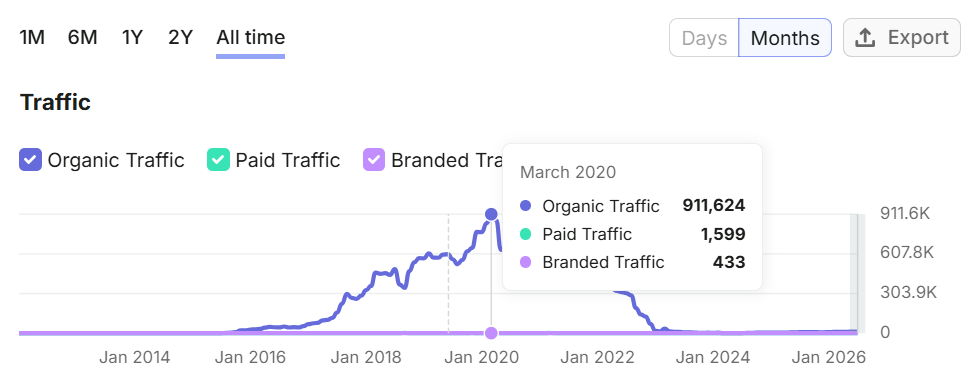
The climb is the part that matters. That line didn’t spike from a viral moment and crash. It built, month after month, and held — because it was built on content people were actually searching for, not tricks.
That’s the whole game with SEO. You’re building an asset that keeps working while you sleep. This one just happened to be about sleep.
So how does a sleep site get that big?
Two things did it: an old, trusted domain, and genuinely the best content in the niche — stacked consistently for years.
First, the domain was old. It had been registered back in 2014, so by the time it peaked it had years of history and trust behind it. Google leans on that. An established domain doesn’t have to fight for credibility the way a brand-new one does.
Second, and this is the real one: the content was the best in the niche. Not close to the best. The highest-quality sleep and sleep-health content on the internet — every major question a person could ask about sleep, answered more thoroughly and more usefully than anyone else was doing it.
Put those together — an old, trusted domain and the best content in the space, stacking up consistently — and honestly, it gets hard not to rank.
That’s the boring truth most people don’t want to hear. There was no clever hack. It was quality, at scale, on a domain with age behind it, for long enough that nobody could catch up.
What “best in the niche” actually looked like
The content wasn’t thin, keyword-stuffed filler. It took real questions and answered them properly — in plain English, with a bit of personality.
Take sleep and diet. Most sleep advice stops at “dim the lights, put your phone away.” This piece went after the angle almost nobody bothered to cover — how what you eat actually changes how you sleep.

That’s the difference. A real answer to a question people were quietly Googling and not finding covered well anywhere else.
Then there’s the piece on eating right before bed.
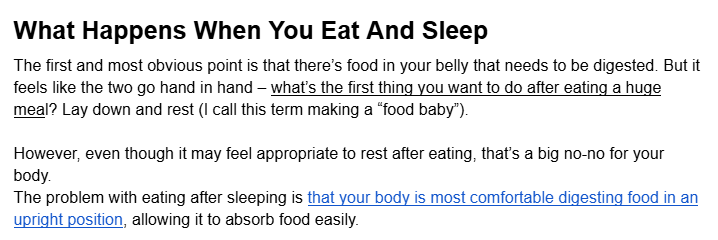
It explains the actual mechanism — your body digests best upright, so lying down on a full stomach works against you — and it does it with a bit of personality (it calls a full-belly food coma “making a food baby”).
Useful and human at the same time. That combination is exactly what Google rewards.
Or take the article on indoor plants that clean the air in your bedroom.

Completely different topic, same standard: a genuinely useful answer, sourced (it cites NASA’s research on air-cleaning plants), written in plain English with a bit of character.
That range — covering every corner of the niche to the same depth — is what stacked up into 433,000 keywords. One genuinely useful article at a time.
433,559 keywords — and where the money was
At its peak the site ranked for 433,559 keywords, 14,421 of them in Google’s top 3 — and crucially, it ranked at the top for high-value commercial buying terms, not just informational ones.
Traffic is the headline. Keywords are the engine underneath it.

Ranking for one big keyword is luck. Ranking for four hundred thousand is a system.
It means the site had genuinely useful content covering nearly every question a person could ask in that niche — from “why can’t I sleep” all the way to someone ready to buy a $2,000 mattress.
And that last part is where the revenue lived. The site ranked at the top for commercial buying terms — premium mattress and pillow brand searches pulling 33,100 and 18,100 searches a month on their own.

This is the difference between traffic that looks good and traffic that pays. Informational keywords build authority. Commercial keywords build revenue. This site did both — and that balance is what made it a machine, not just a popular blog.
Still cited by AI, years later
Years after its peak, the site is still cited by ChatGPT and Google’s AI answers — 26 mentions across 594 pages — because the same depth that ranked it on Google is what AI trusts.
SEO used to be about ranking on Google. Now there’s a second game: getting cited by AI. ChatGPT, Google’s AI Overviews and AI Mode all pull answers from a small set of trusted sources — and they name them. This site is still one of those sources.

26 AI mentions across 594 cited pages. That’s not an accident. AI tools cite the sources they trust most — the deep, genuinely helpful ones. The exact same thing that made this site rank on Google made it the thing AI quotes now.
Good SEO didn’t just survive the shift to AI search. It’s what wins it.
Why this matters for your business
You don’t need 911,000 visitors a month — but the method that built them is the same one that ranks a New Zealand business.
Most of that traffic would be irrelevant to a local NZ business anyway. But the method is identical whether you’re ranking a global sleep site or a panel beater in Hamilton: understand what your customers search, build content that answers it better than anyone locally, earn Google’s trust, and compound it over time.
The reason I can rank a New Zealand business fast is that I cut my teeth in the toughest markets on earth — on a team going up against the biggest sites in the world, and winning.
After competing at that level, ranking in a local NZ market is a much easier fight. If you’d rather hand that off to someone who’s done it at the top end, that’s what my SEO agency is for.
Final Thoughts
SEO isn’t a trick you pull. It’s an asset you build.
This site was still pulling traffic — and getting quoted by AI — years after the heavy lifting was done. Try getting that from an ad: the second you stop paying, the traffic dies. SEO keeps paying you back long after the work.
Most businesses want the result without the build. The ones that win are the ones who understand the build is the result.
Sleep Site SEO Case Study: FAQ
How did the sleep site get 911,624 visitors a month?
Through content and SEO, nothing else. The site published genuinely useful, in-depth content covering nearly every question in the sleep niche, on a domain with years of authority behind it. That combination stacked up into 433,559 ranked keywords and, at its peak, 911,624 organic visitors a month.
Was the traffic from paid ads?
No. Every one of those 911,624 monthly visitors came from organic search — people typing a query into Google and landing on the site’s pages. No ad spend, no social. That’s the difference between SEO and ads: it keeps working long after the money’s spent.
Did you build the whole site yourself?
No, and I won’t pretend otherwise. I was one of the people on the SEO team that grew it. A result at this scale is always a team effort — but working at that level, against the biggest sites in the world, is exactly where the experience comes from.
Does SEO like this still work now that everyone uses AI?
Yes, arguably more than ever. This site is still cited by ChatGPT and Google’s AI answers years after its peak, because AI tools pull from the sources they trust most. The same depth and quality that ranked it on Google is what gets it quoted by AI now.
Can this work for a small New Zealand business?
Yes. You don’t need 911,000 visitors — most of that traffic would be irrelevant to a local business. But the method is identical: understand what your customers search, answer it better than anyone locally, earn Google’s trust, and compound it over time. In a smaller market like NZ, that’s an easier fight.
How long does it take to see results from SEO?
It compounds slowly. The traffic on that chart didn’t show up in month one — it built over time, then accelerated once the site earned authority. For most NZ businesses, expect early movement in a few months and meaningful results over six to twelve, not overnight.
Recommended Reading
 HealthVI Case Study
How a content-led SEO strategy grew a site from zero to 1,500+ daily organic visitors.