SEO (Search Engine Optimisation) is the process of getting your website to show up on Google when people search for things related to your business.
When someone types in something like “dentist Auckland” or “best gym near me”, SEO determines whether your business shows up or gets buried on page 5.
Instead of paying for every click like ads, SEO focuses on earning your position in the organic results. You do that by creating useful content, optimising your website, and building authority so Google trusts you.
The goal is to get consistent traffic, attract the right people, and turn that traffic into leads and customers.
Once you’re ranking, that traffic continues without ongoing ad spend, which is why SEO is often seen as a long-term asset rather than a short-term marketing channel.
SEO Example (In New Zealand)
Here’s an example of SEO in action in New Zealand.
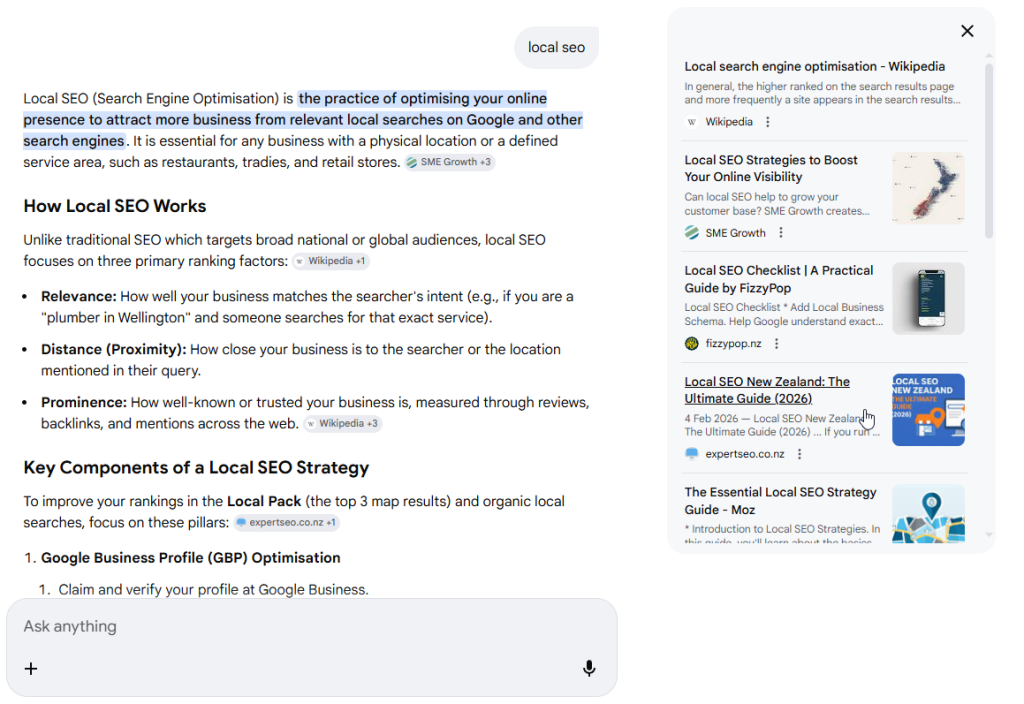
When you type in “local SEO” into Google, my local SEO guide shows up first in the organic results.
Not only that, it’s also mentioned multiple times in AI-generated results. This is often referred to as GEO (Generative Engine Optimisation) or AI SEO.
Because of this, I have qualified people landing on my website every day. People who are actively searching for help, reading the guide, and presents the opportunity of turning into paying clients.
SEO Pros and Cons
Pros
Cons
Consistent, compounding traffic over time
Takes time to see results (usually 3 to 6+ months)
No cost per click once you’re ranking
Requires ongoing effort and optimisation
Builds long-term authority and trust
Competitive in high-value industries
Attracts high-intent, qualified traffic
Google algorithm updates can impact rankings
Higher ROI over the long run
Not ideal if you need leads immediately
Supports other channels (content, email, brand)
Requires strategy, not just random content
What Is PPC?
PPC (Pay-Per-Click) is a form of online advertising where you pay each time someone clicks on your ad.
When someone searches for something like “dentist Auckland” or “emergency plumber near me”, those top sponsored results are PPC ads.
Instead of earning your position like SEO, you’re paying for immediate visibility. As soon as your campaign is live, you can start getting traffic, leads, and sales.
The trade-off is simple:
You get results faster, but you pay for every visitor, and the moment you stop spending, the traffic stops too.
PPC Example (In New Zealand)
Here’s a New Zealand example of pay-per-click ads in action.
When you type in “plumber New Zealand” into Google, one of the top results is Magenta Plumbing and Gas.
The “cheat code” of PPC is that they’re able to jump straight to the top because they pay for the spot.
They don’t need to build rankings over time like SEO. As long as they’re willing to spend and their ads are set up properly, they can appear in front of potential customers instantly.
Pros and Cons of PPC
Pros
Cons
Immediate traffic and results
You pay for every click
Can target specific keywords, locations, and audiences
Costs can add up quickly, especially in competitive industries
Easy to track performance and ROI
Traffic stops the moment you stop spending
Great for testing offers and keywords quickly
Requires ongoing management and optimisation
Works well for high-intent, ready-to-buy searches
Can become expensive over time compared to SEO
Full control over budget and scaling
Click fraud and wasted spend can occur if not managed properly
What's The ROI of SEO vs PPC?
When it comes to ROI (return on investment), SEO and PPC work very differently.
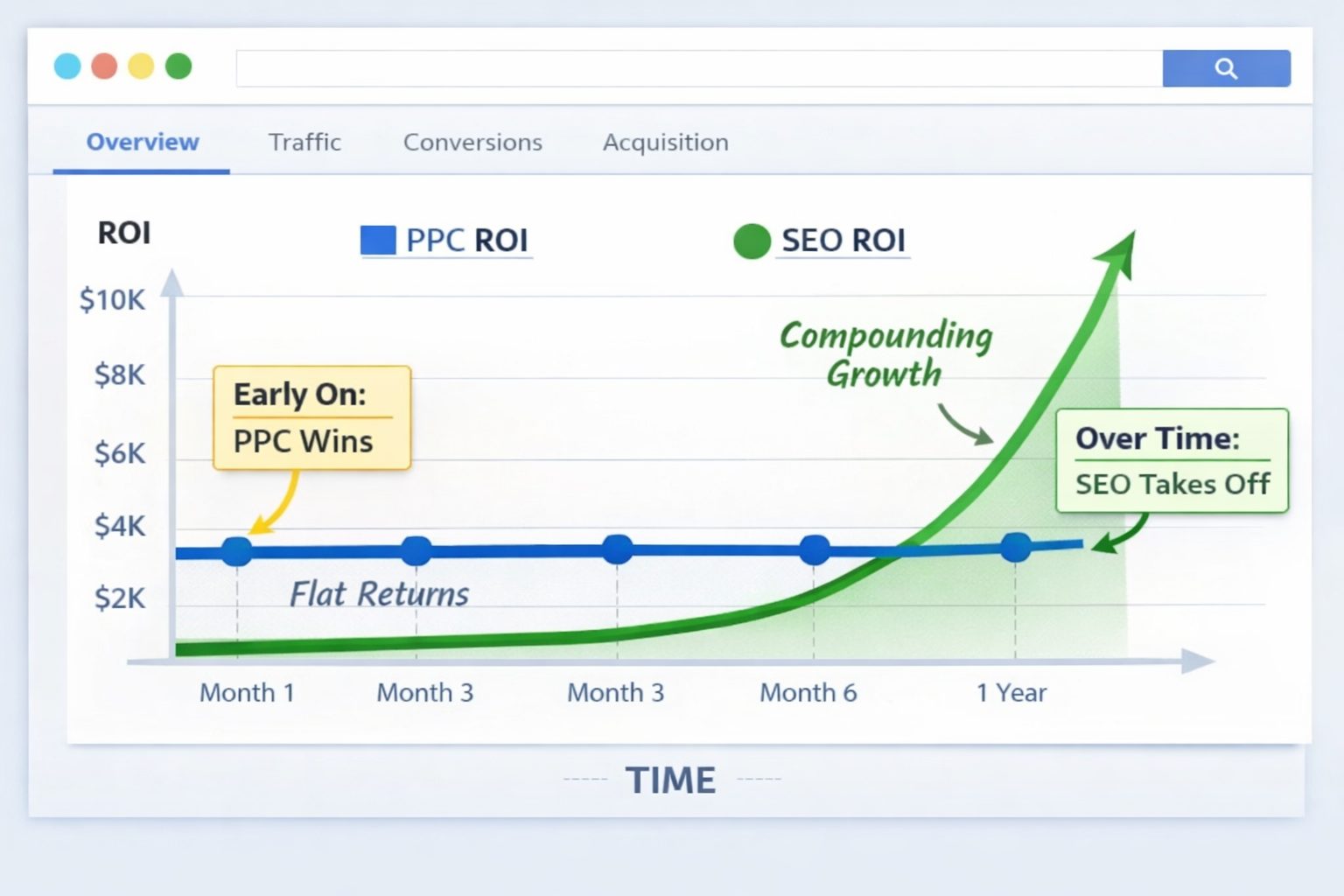
PPC gives you fast, predictable returns. SEO gives you slower, compounding returns.
Both can make money, but the way they make money is completely different:
PPC has quicker ROI, but capped and ongoing whereas SEO has slower ROI, but higher and compounding.
SEO vs PPC ROI Statistics
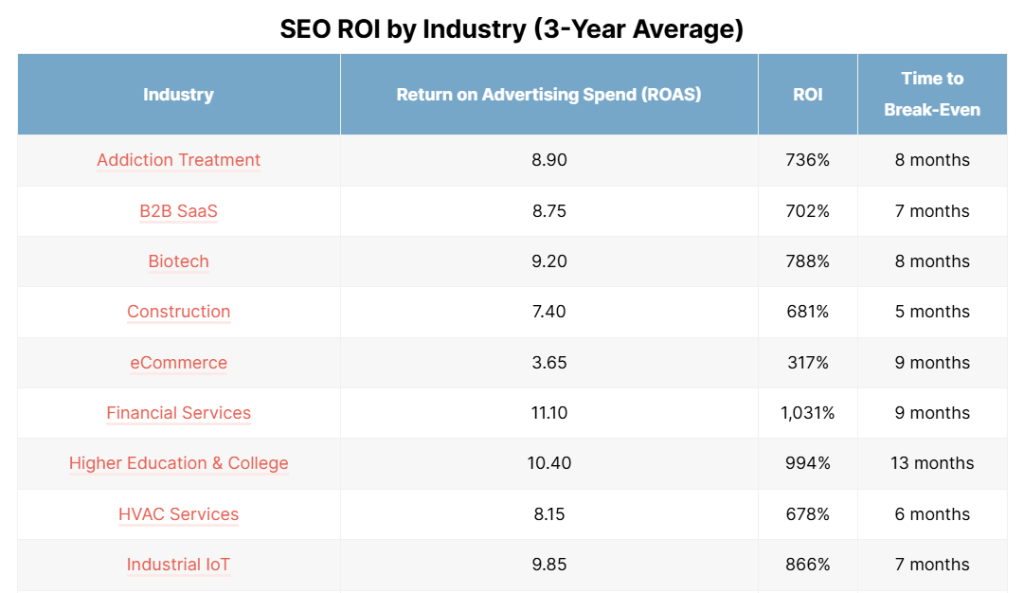
SEO can generate over 500% ROI within 6 to 12 months, with some industries seeing returns exceed 1,000%(Source: ninepeaks.io)
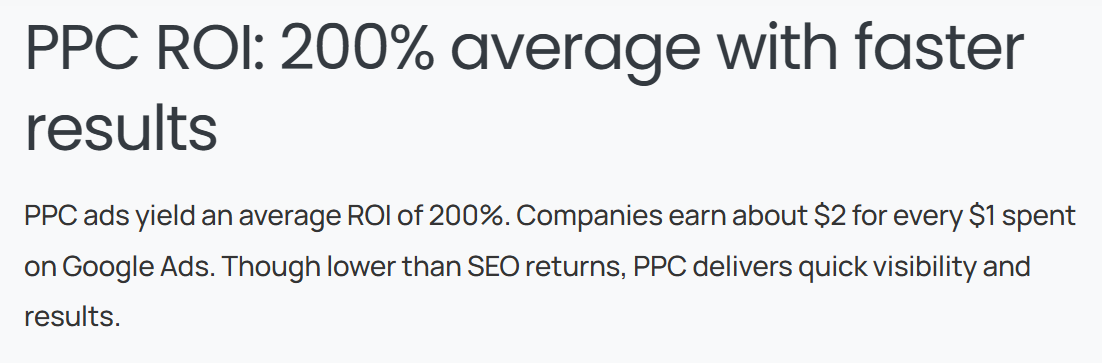
In comparison, PPC campaigns typically average around 200% ROI, meaning businesses make about $2 for every $1 spent
Organic traffic also tends to convert better. On average, SEO sees conversion rates of around 14.6%, compared to roughly 10% for PPC traffic (Source: seo-match.com). This is largely because organic results often build more trust with users.
In terms of traffic share, SEO dominates. Around 53% of all website traffic comes from organic search, while only about 27% comes from paid search ads (Source: click-vision.com).
Over time, this compounds. In fact, SEO can deliver up to 3.7 times higher ROI than PPC when measured long-term (Source: visionary-marketing.co.uk).
What This Actually Means
With PPC, your ROI is linear.
You spend $1,000, you get results. Next month, you spend another $1,000, same result.
With SEO, your ROI is compounding.
You invest in content and rankings once, and it keeps bringing traffic, leads, and sales over time.
What's The Cost of SEO vs PPC?
The cost of SEO and PPC is one of the biggest differences between the two.
PPC is straightforward. You pay for every click.
SEO is different. You invest upfront, and the traffic comes over time without paying per visitor.
SEO vs PPC Cost Statistics
In New Zealand and similar markets, PPC costs can add up quickly. The average cost per click across industries is around $2 to $5, but in competitive industries like legal, finance, or dental, this can jump to $10 to $30+ per click(Source: wordstream.com).
That means if you want 100 visitors, you could be spending anywhere from $200 to $3,000 depending on your industry.
SEO works differently. Most businesses typically invest between $1,000 to $5,000+ per month on SEO services depending on competition and scope (Source: ahrefs.com).
Globally, businesses are also increasingly investing more into SEO over time, with SEO budgets growing year over year as companies shift toward long-term acquisition channels (Source: hubspot.com).
What This Means
With PPC, your costs are directly tied to your traffic.
If you want more clicks, you increase your budget. If you stop spending, your traffic stops immediately.
With SEO, your costs are front-loaded. You invest in content, optimisation, and authority early on, and over time your cost per visitor decreases as your rankings improve and traffic grows.
PPC is essentially renting traffic. Every click has a cost attached to it.
SEO is building an asset. The content, rankings, and authority you build continue to generate traffic long after the initial investment.
This is why PPC is often better for short-term results and immediate leads, while SEO becomes significantly more cost-effective over time.
SEO vs PPC - Which Is Better For Your Business?
Which one is better depends on what you need.
If you’re a startup or a new business and you want leads fast, PPC is your go-to.
You get instant visibility and you can start generating leads as soon as your campaign goes live.
It’s also not overly expensive upfront, and you can start with a smaller budget, get results, then reinvest what you make back into your ads and keep scaling from there.
The downside is you’re not building anything long-term. You’re completely reliant on ads, and the moment you stop spending, everything stops.
On the other hand, if you want to build an asset, SEO is what you’re looking for.
It’s something that can generate leads for your business long-term without paying for every single click.
That said, SEO takes time. You can invest money for months and see little to no results in the beginning, which is the reality of it.
If you get it right and work with someone who’s done it before and knows how to execute, SEO becomes one of the most powerful growth channels you can have. You’re building authority, building visibility, and creating something that continues to bring in leads long after the initial work is done.
That’s why it’s important to work with an SEO company in New Zealand that knows what they’re doing and can actually deliver results, not just promises.
If you’re looking for SEO services you can trust, we help businesses all over New Zealand grow their traffic, leads, and revenue through proven SEO strategies.
The best approach for most businesses is to use both.
PPC gives you immediate visibility and allows you to start generating leads straight away, while SEO works in the background building your long-term authority and organic traffic.
Instead of choosing one or the other, you use PPC for speed and SEO for sustainability.
One of the biggest advantages of running both is that PPC gives you data fast. You can see which keywords convert, which offers work, and what messaging actually gets clicks. You can then take that data and apply it to your SEO strategy, so you’re not guessing what to create content around.
At the same time, your SEO efforts start building momentum.
As your rankings improve and your organic traffic grows, you become less reliant on paid ads. Over time, you can reduce your PPC spend or become more selective with where you use it.
Another benefit is visibility. When you appear in both paid ads and organic results for the same keyword, you dominate more of the search results page, which increases trust and click-through rate.
Used together, PPC drives immediate results and insights, while SEO builds a long-term asset that compounds over time.
How To Use PPC
PPC is best used for transactional keywords, meaning keywords where the person is ready to take action or buy.
These are the searches that have clear buyer intent behind them. For example, something like “dental implants Auckland” or “emergency plumber near me” shows that the person is actively looking for a service and is likely ready to convert.
Instead of trying to rank organically for these keywords straight away, which can take time, PPC allows you to capture that demand immediately.
How To Use SEO
While your PPC campaigns are targeting transactional keywords and bringing in immediate leads, SEO should be focused on building your authority through informational keywords.
These are searches where people are looking to learn, research, or understand something before making a decision. For example, “how to do SEO for New Zealand websites” or “what is the cost of dental implants in NZ”.
What you do here is build a content marketing and link building strategy around these types of keywords. You create helpful, relevant content that answers these questions and positions your business as the authority in your space.
Over time, this content starts ranking, bringing in consistent organic traffic, and building trust with potential customers before they’re ready to buy.
Then when they are ready to take action, your business is already top of mind.
SEO vs PPC: Frequently Asked Questions
SEO vs PPC: which is better for small businesses in New Zealand?
It depends on your goals and timeline. If you need leads quickly, PPC is usually the better option because you can start generating traffic as soon as your ads go live. If you’re thinking long-term and want to build a consistent flow of leads without paying for every click, SEO is the better investment. Most small businesses get the best results by using both, with PPC for short-term wins and SEO for long-term growth.
What are the key differences between organic search visibility and paid advertising?
The main difference is how you get traffic. Organic search visibility comes from SEO, where you earn your rankings on Google over time without paying per click. Paid advertising, like PPC, lets you appear at the top of Google instantly, but you pay every time someone clicks on your ad. SEO builds long-term authority, while PPC delivers immediate results.
Top platforms for managing SEO and PPC campaigns effectively
For SEO, tools like Google Search Console, Google Analytics, and Ahrefs are some of the most commonly used for tracking performance and improving rankings.
For PPC, Google Ads is the main platform for search advertising, while tools like Microsoft Advertising can also be used to expand reach. These platforms allow you to manage budgets, track conversions, and optimise campaigns.
When should a small business prioritise SEO over paid advertising?
A small business should prioritise SEO when they want to build a long-term source of leads and reduce their reliance on paid ads. If you have time to invest and want to create a sustainable marketing channel that compounds over time, SEO is the better choice. It’s especially valuable once your business has some cash flow and can afford to invest consistently.
How to choose between SEO and PPC for online marketing budgets
It comes down to your goals, timeline, and budget. If you need immediate leads and have money to spend, PPC makes sense. If you’re willing to wait and want a lower cost per lead over time, SEO is the better option. A balanced approach is often the smartest move, using PPC to generate quick results while building SEO in the background.
Compare the typical cost structures for ongoing SEO services versus a monthly paid campaign budget
SEO usually involves a monthly retainer or project-based pricing where you’re paying for work like content creation, technical optimisation, and link building. PPC is based on ad spend, where you’re paying for each click plus any management fees. SEO costs are more upfront and fixed, while PPC costs scale directly with how much traffic you want.
Which analytics platforms are best for evaluating return on investment from both organic and paid channels?
The most widely used platforms are Google Analytics for tracking traffic and conversions, and Google Search Console for SEO performance. For PPC, Google Ads provides detailed data on clicks, costs, and conversions. Together, these give you a clear view of ROI across both channels.
Cost comparison of SEO and PPC advertising in New Zealand markets
In New Zealand, PPC costs can vary widely depending on the industry, with clicks ranging from a few dollars to $20+ in competitive niches. SEO typically involves a monthly investment, but over time it becomes more cost-effective because you’re not paying per click. PPC is more predictable short-term, while SEO becomes cheaper long-term.
Is PPC harder than SEO?
PPC is generally easier to start but harder to master. You can launch a campaign quickly and start getting traffic straight away, but optimising it properly to get a strong return on investment takes skill. SEO, on the other hand, takes longer to see results, but once you understand the fundamentals, it becomes more about consistency and execution over time.
Is PPC a part of SEO?
No, PPC is not part of SEO. They are two separate marketing channels. SEO focuses on improving your organic rankings on Google without paying for clicks, while PPC is paid advertising where you pay to appear at the top of search results. They work alongside each other, but they are not the same thing.
Is PPC still relevant?
Yes, PPC is still very relevant, especially for businesses that want immediate results. It’s one of the fastest ways to get in front of potential customers and generate leads. It’s also useful for testing keywords, offers, and landing pages before committing to long-term SEO strategies.
What is the difference between SEO and PPC?
The main difference is how you get traffic. SEO focuses on earning your position in the organic search results through content, optimisation, and authority. PPC allows you to pay for visibility at the top of Google and get traffic instantly. SEO is a long-term strategy that builds over time, while PPC delivers immediate results but stops as soon as you stop spending.
Danyon Togia is the founder of Expert SEO with over 10 years of experience helping businesses grow online. He’s built his own websites to over 1,000 daily visitors and helped client websites reach over 100,000+ visitors per month.