

Here’s what happens when you try to find out what SEO costs in Australia.
You land on an agency’s page, read a thousand words about “the factors that affect pricing,” and at the very bottom, where the number should be, you get this:
“Contact us for a custom quote.” You came for a price. You left with a range and a sales call.
So let’s do it differently.
This guide gives you the real 2026 numbers — what SEO actually costs by business size and pricing model, what separates a $1,000 package from a $6,000 one, why the cheapest option is almost always the most expensive, and the one question that makes the whole decision simple: what is a customer worth to you?
And unlike everyone else, I’ll show you a real, published price — mine — so you’re not guessing.
The short version
- Most Australian businesses pay $1,500–$5,000/month for ongoing SEO in 2026. Small local from ~$1,500; national and enterprise $6,000–$15,000+.
- Be very careful with full-service SEO under ~$1,000/month — it can put you backwards, not just nowhere.
- A specialist costs more than a generalist marketing agency — and is usually worth it, because they do one thing and do it better.
- The price only means something next to what a customer is worth. Good SEO returns a multiple, which is exactly why it isn’t cheap.
- My packages are published: $2,500 / $6,000 / $10,000+ a month, month-to-month, backed by a written guarantee.
How Much Does SEO Cost in Australia?
In 2026, most Australian businesses pay between $1,500 and $5,000 a month for ongoing SEO. Where you land inside that range comes down to your business size and how competitive your market is.
Here’s the honest breakdown by business size:
| Business type | Typical monthly cost | Who it’s for |
|---|---|---|
| Local / small business | $1,500 – $2,500 | One location, one city — a clinic, a firm, a trade |
| Growing / multi-location | $3,000 – $6,000 | Competitive niches, or a few locations at once |
| National / enterprise | $6,000 – $15,000+ | Category leaders competing across the country |
Those are monthly retainer figures, which is how most SEO is sold. You’ll also see hourly rates (around $100–$300/hour) and one-off project fees ($2,000–$10,000+) — more on those next.
One warning before we go further: if you see “full-service SEO” advertised for a few hundred dollars a month, be careful. That’s not a bargain, it’s a trap — and I’ll explain exactly why below.
SEO Pricing Models Explained
SEO is sold four ways in Australia. Most established businesses are best served by the first one, because SEO is ongoing work, not a job you do once and forget.
| Model | Typical price | Best for |
|---|---|---|
| Monthly retainer | $1,500 – $5,000+/mo | Ongoing growth — the standard for most businesses |
| Hourly | $100 – $300/hr | One-off advice, audits, troubleshooting |
| Project / one-off | $2,000 – $10,000+ | A specific job — an audit, a site migration, a rebuild |
| Performance-based | Varies | Sounds great; usually a red flag (see below) |
Why is SEO billed monthly? Because rankings need continuous work — new content, fresh links, technical upkeep — and they stop compounding the moment the work stops.
A retainer keeps the momentum going. A one-off “SEO project” gives you a burst and then slowly fades as competitors keep working.
And be wary of performance-based deals where you “only pay for results.” They sound risk-free, but they push the provider toward easy, low-value keywords they know they can rank, or toward risky shortcuts to hit a target fast. You want someone building an asset, not gaming a bonus.
What You Actually Get at Each Price Point
The gap between a $1,000 package and a $6,000 one isn’t “more SEO.” It’s scope — how much content gets made, how many links get built, how many locations you’re going after, and whether a specialist or a junior is doing the work.
Here’s what each level realistically buys.
Around $1,000/month. Usually thin. A little on-page tinkering, a few directory listings, an automated report, and often a junior or an offshore team you never speak to.
At this price nobody can afford to do the deep work that actually moves rankings — so most of it doesn’t.
Around $2,500/month. A real program for one established local business — the tier most small businesses should aim for.
Technical fixes that unblock your rankings, proper on-page optimisation, local SEO and Google Business Profile work, genuine content, foundational authority links, and reporting written in plain English. This is the floor for work that actually shifts the needle.
Around $6,000/month. For competitive markets or a few locations at once.
Everything above, scaled — a real content programme, ongoing link building, AI-search visibility, and conversion work on the pages that make you money.
$10,000+/month. National, category-leadership SEO. Aggressive content and link velocity, digital PR, a full AI and entity strategy — the works.
The thread running through all of it: price buys scope and seniority, not magic. Cheap scope, done by a junior, is exactly why cheap SEO underdelivers.
Why SEO Prices Vary So Much
Let’s address the thing everyone’s quietly thinking: why won’t anyone just tell me the price? The honest answer is that a fair price genuinely can’t be set until someone’s seen your market and your website — the work really does vary that much.
The less honest answer is that “it depends” is also a convenient way to price you by the size of your budget rather than the size of the job.
Either way, the same handful of things move every quote:
- How competitive your market is. SEO for a suburban dentist and a national e-commerce brand are completely different jobs.
- The state of your website. A clean, modern site costs less to work with than a slow, broken or previously-penalised one that needs fixing first.
- How much ground you want to cover. One location, several locations, or the whole country.
- Your industry. High-value niches cost more, because the competition is fiercer and the reward is bigger — SEO for cosmetic surgeons or personal injury lawyers sits right at the top end, a local trade nearer the bottom.
Specialist vs generalist: why the specialist costs more
Here’s a distinction that explains a lot of the price gap.
A specialist SEO agency will almost always cost more than a generalist marketing agency that “also does SEO.” And there’s a good reason for it.
The specialist does one thing, all day, for years. They’re not splitting their attention across ads, social media, web design and email newsletters.
That focus means deeper experience, more credibility, and better results in the one discipline you’re actually paying for.
With a generalist, SEO is one of five services on the menu — and it’s often the one quietly handed to the most junior person in the building.
So when a specialist quotes higher, you’re not paying more for the same thing. You’re paying for someone who is genuinely expert at the exact thing that moves your rankings — not someone doing it on the side.
Why Cheap SEO Is the Expensive Option
If you take one thing from this whole guide, make it this: never pay for cheap SEO.
Full-service SEO advertised under about $1,000 a month doesn’t just underdeliver — it can actively put you backwards. At that price, the provider can’t afford to do real work.
So they lean on automated tools, spun content, and cheap link schemes — the exact tactics that earn Google penalties. Then you pay twice: once for the cheap SEO, and again to undo the damage and climb back to where you started.
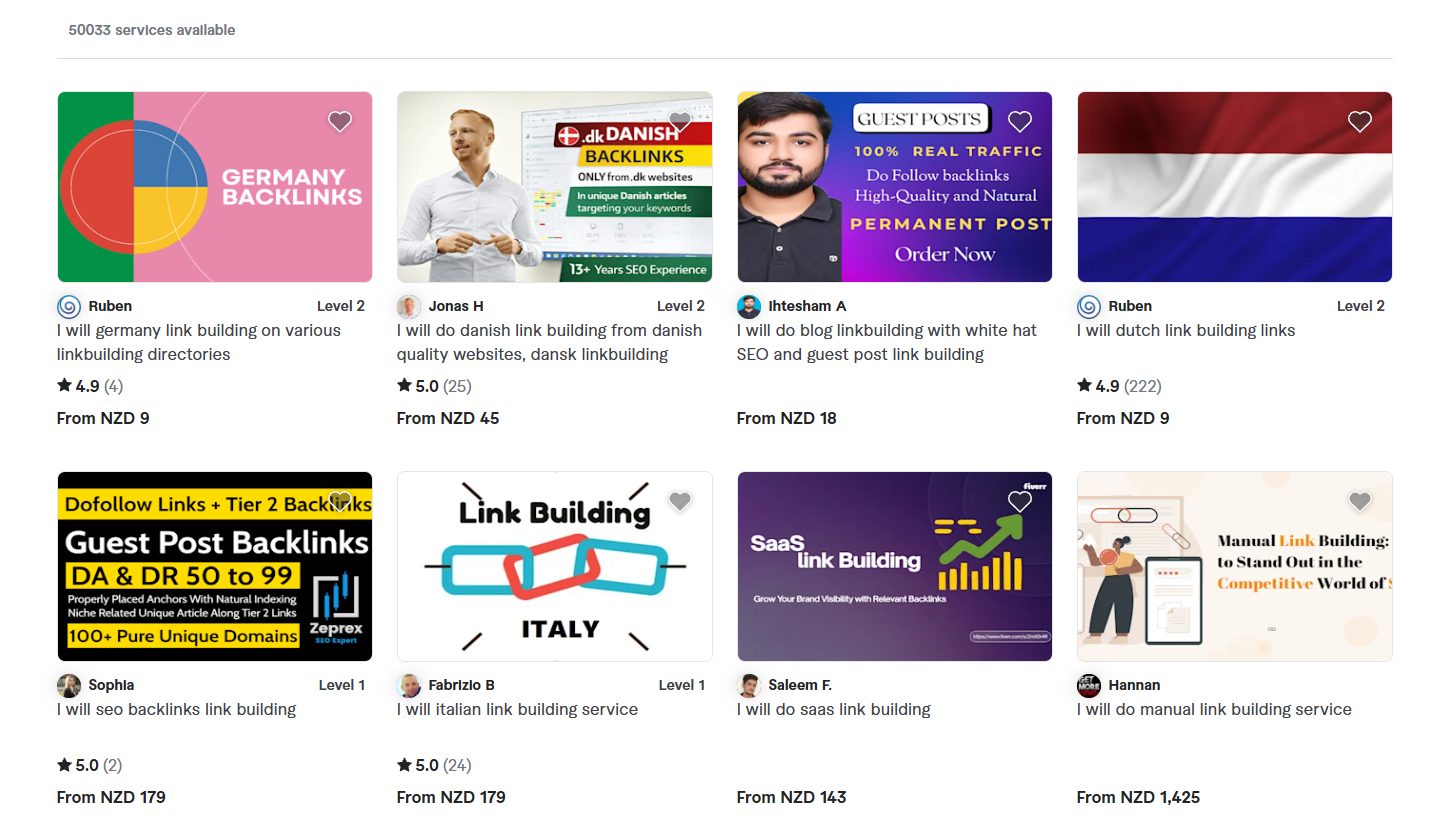
That’s the part people miss. Bad SEO isn’t a $0 outcome — it’s a negative one. You can lose rankings you already had, burn months you’ll never get back, and hand your competitors a head start while you clean up.
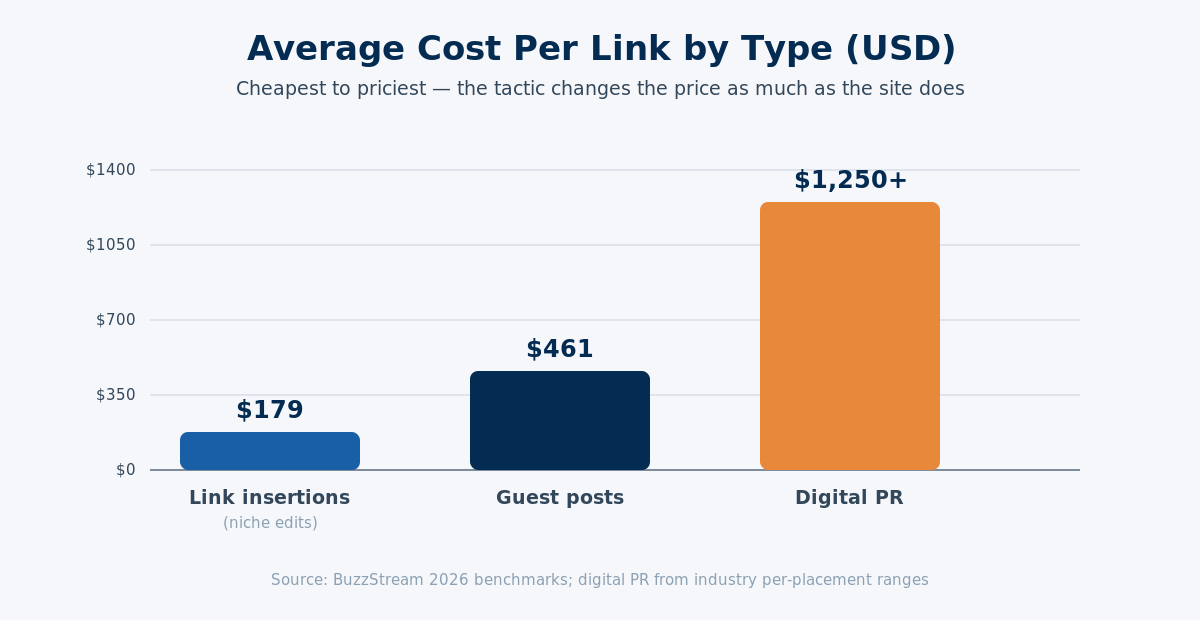
There’s also a hard floor on what real SEO costs. A single quality authority link runs anywhere from around $179 to well over $1,000 — so a $500-a-month budget simply can’t buy them honestly. It buys the junk above instead.
Now, the flip side — and this is just as important. A good SEO knows exactly what their work is worth, so they price accordingly.
That’s not greed; it’s confidence. As long as they can actually get you the results, you make that money back and more. Good SEO isn’t a cost to be minimised. It’s an investment in your own business — and the return is the whole point (which is the next section).
This, by the way, is exactly why my own floor is $2,500 a month, not $500. I won’t sell SEO I know can’t work, because when it goes wrong, it’s your rankings — and your money — that pay for it.
(A genuine freelancer at a modest rate can still be good value. A $500 “full-service agency package” almost never is.)
What I Charge — And Why It’s Published
Here’s the number everyone else hides. My SEO packages and pricing are published right on the site — no sales call required to find out what things cost:
| Package | Price | Who it’s for |
|---|---|---|
| Local | $2,500 / month | One established local business ready to take over its city |
| Multi-Location | $6,000 / month | A brand growing across several locations at once |
| National | $10,000+ / month | A business going all-in on leading its category nationally |
Every one is month-to-month, with no lock-in contract. And every one is backed by a written 6-month guarantee: if your organic rankings and traffic haven’t measurably grown in six months, I keep working free until they do.
Most agencies won’t put that in writing. I will.
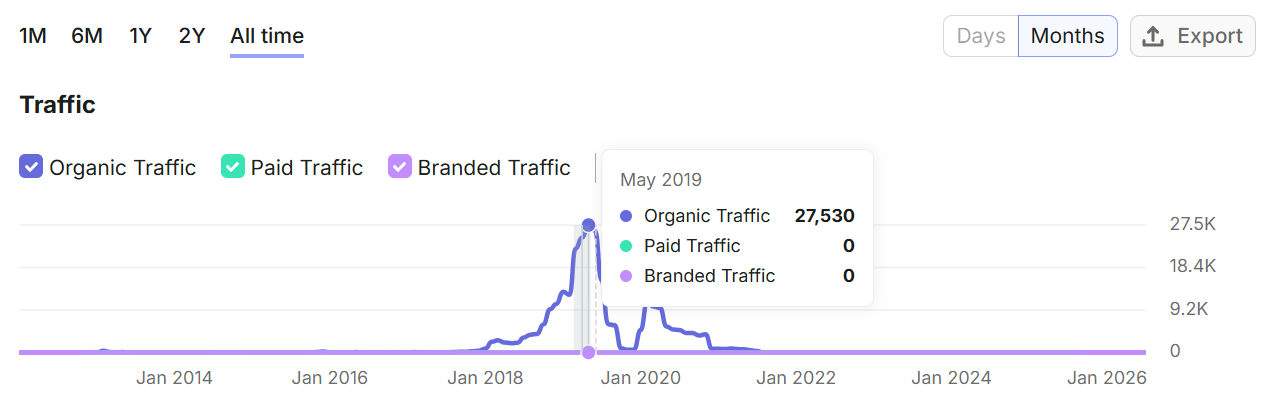
And before you wonder whether I practise what I charge for — here’s a brand-new site of my own, ranking for 233 keywords and pulling roughly $3,500 a month in traffic value inside eight months, on a domain that didn’t exist a year ago.
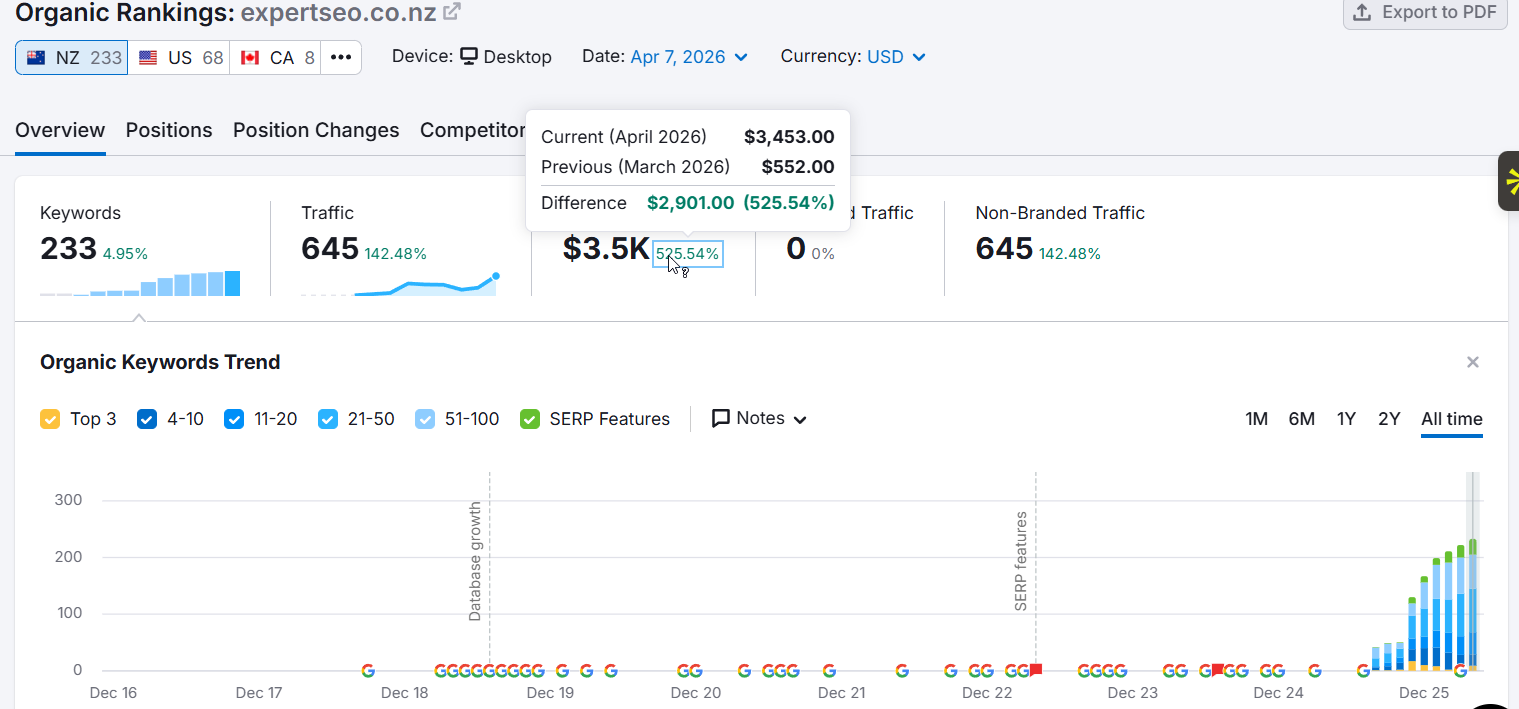
Two things worth calling out. First, there’s no bargain tier on purpose — the floor is $2,500 because that’s the honest minimum for work that actually moves the needle (see the cheap-SEO section above).
Second, these packages include AI-search visibility as standard — getting you recommended inside ChatGPT and Google’s AI answers, not just the blue links — so you’re paying for how search works now, not how it worked three years ago.
The reason I publish all this is simple: you shouldn’t have to sit through a pitch to learn a price. Transparency is the point.
The Real Question: What Is a Customer Worth to You?
The price of SEO only means something next to what it brings back. And what it brings back is the reason good SEO isn’t cheap: done properly, it’s one of the highest-return channels in marketing.
A well-run SEO campaign returns a median ~748% ROI (First Page Sage).

Part of the reason it’s so high: organic leads close far better than cold outreach — 14.6% versus 1.7% (Search Engine Journal).
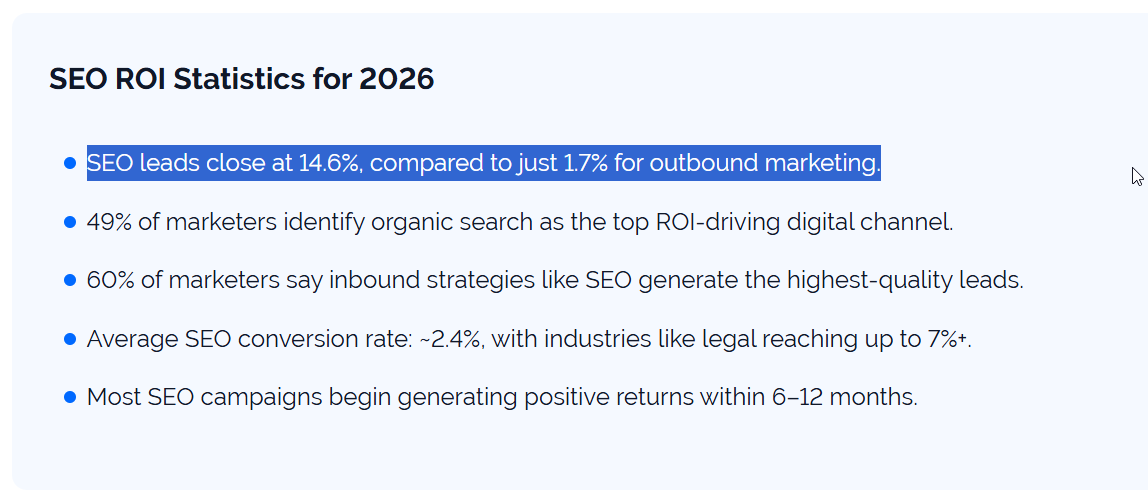
And they’re cheaper to win: about $31 per organic lead versus $181 for a paid one (First Page Sage).

By industry, the returns skew highest exactly where high-value businesses live — legal around 526%, B2B SaaS around 702%, financial services around 1,031%. Overall, SEO tends to return around 8× versus 4× for paid ads.
Read that again, because it reframes the whole “how much does it cost” question. Good SEO commands a premium because it returns a multiple on your money. You’re not buying hours. You’re buying an outcome.
Here’s the calculation that actually matters:
New leads × your close rate × what a customer is worth − the cost = your return
Let’s run it. Say you’re a cosmetic clinic in Sydney, and one procedure is worth $12,000 to you. You take the $2,500/month package — $30,000 a year.
SEO starts sending you a steady stream of “cosmetic surgery Sydney” searchers, and you close just one extra procedure a month from it.
That’s $144,000 a year in new revenue against $30,000 in cost. The SEO has paid for itself nearly five times over — on a single procedure a month. Close two, and the maths gets silly.
It works the same for a law firm in Melbourne where one case is worth $8,000, or a trade where one job is worth $5,000.
The higher your customer value, the more obviously SEO pays — and the less the monthly price should scare you. The only honest caveat: run the numbers over twelve months, not week one, because SEO builds before it pays. Which brings us to timing.
How Long Before SEO Pays for Itself?
SEO isn’t a switch you flip — it’s a curve. You pay from month one, but meaningful results usually take three to six months to show, and they keep compounding well beyond that.
Positive ROI typically lands in the 6–12 month window and peaks in year two or three. Anyone promising you page one in a few weeks is either lying or about to get you penalised.
Here’s the realistic Australian timeline:
- Month 1–3: foundations — audit, technical fixes, the first content and links. Early movement, not fireworks.
- Month 3–6: real traction. Rankings climb, leads start arriving.
- Month 6–12+: compounding. The content and authority you built keep working and stacking.
The important mindset shift: the cost is front-loaded and the return lags. The first few months can feel like spending with little to show — that’s normal, not failure. It’s also, frankly, why so many agencies use twelve-month lock-in contracts: they’re banking on the lag to keep you paying through the slow bit.
Month-to-month pricing with a guarantee is the honest alternative — you stay because it’s working, not because a contract says you have to.
Agency vs Freelancer vs In-House: What Each Really Costs
You’ve got three ways to get SEO done — a freelancer, an agency or specialist, or hiring someone in-house — and the sticker price hides the real cost. Outsourcing almost always wins, and here’s the number that settles it.
The average in-house SEO specialist in Australia earns $87,202 a year.
Add superannuation, software and overheads, and the true cost of that hire is north of $100,000 a year — before they’ve delivered a single result. Compare that to the Local package above at $2,500 a month: $30,000 a year.
| Route | Real annual cost | What you actually get |
|---|---|---|
| In-house hire | ~$100,000+ (salary + super + tools + overheads) | One person’s skill set, plus months of ramp-up |
| Freelancer | Varies (cheapest hourly) | Good value, but variable quality and limited capacity |
| Outsourced specialist | From ~$30,000 | Agency-level skill and a full toolkit, no employment overhead |
For less than a third of one salary, you get a specialist with a whole toolkit and years of experience — not a single junior you have to hire, train, equip and manage.
That’s the part the “should we just hire someone” conversation usually misses: once you count the true cost of each route — salary, super, tools, management time and risk — outsourcing to a specialist is usually the cheapest way to get the best work.
How to Compare SEO Quotes Without Getting Burned
Two quotes at the same price can be worlds apart. Judge them on what’s included, what’s promised, and what proof sits behind them — not on the number at the bottom.
What should be included in any real package. An audit and roadmap, technical SEO, on-page optimisation, content, authority links, local SEO and Google Business Profile work, and reporting you can actually read. If a package is vague about what you’re getting, that’s your first answer.
The red flags:
- Guaranteed #1 rankings (nobody can promise Google’s positions)
- Pay-per-keyword pricing — it games a metric instead of growing your revenue
- Twelve-month lock-in contracts
- No reporting, or “secret” methods they won’t explain
- A price that only appears after a sales call
- Results with no screenshots — just testimonials and vibes
The questions to ask. Can you show me real results — screenshots of traffic and rankings, not just testimonials? Who actually does the work? Can I leave if it’s not working? What happens in month one? The answers separate the pros from the cowboys fast.
Above all, apply the proof test. Anyone can claim results. Make them show you rankings and traffic they’ve genuinely driven. This is the bar I hold myself to — here’s the kind of thing I mean:
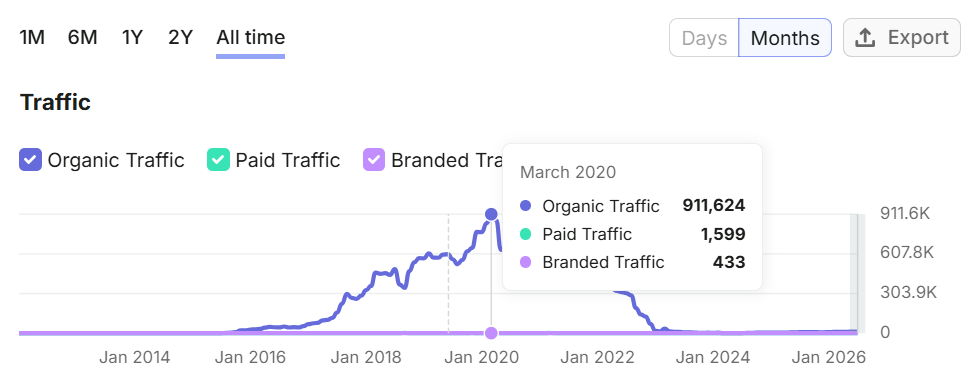
That’s the standard to hold any SEO to. If they can’t show you something real, keep looking.
Final Thoughts
The cheapest SEO is almost always the most expensive in the end.
The number at the bottom of a quote tells you very little on its own — what matters is who’s doing the work, whether they’ll show you real results, and whether they’ll put a guarantee in writing.
Sort those three things out and the “how much does it cost” question mostly answers itself. You’re not buying SEO by the dollar — you’re buying an outcome.
Pick the wrong person and any price is too much, because you’re paying for something that doesn’t work.
Pick the right one and it becomes the best money you spend, because a handful of new customers a month pays for the whole thing and then keeps paying, long after the invoice is forgotten.
If it were my money? I’d ignore the bargains, shortlist on proof, and back the one person willing to stand behind the work.