
The numbers at a glance
- 118,600 organic visitors a month from Google, at its peak.
- 101,100 keywords ranked on Google — and it has held that level for years.
- Ranked #1 and top 3 for supplement terms worth tens of thousands of searches a month.
- Still cited by ChatGPT, Gemini and Google’s AI answers today — 248 mentions across roughly 1,900 pages.
- All of it in one of the hardest, most competitive niches in SEO.
A while back, I was part of the team that ran content and SEO for one of the biggest sports-nutrition retailers online. At its peak it pulled 118,600 organic visitors a month from Google.
I’ll be straight with you: a result at this scale is never a one-person job. I was one part of the team that built it — and being in that fight, at that level, is where I learned to do what I now do for New Zealand businesses.
Not paid ads. Not social. Just people searching for something and landing on pages built to answer them.
Here’s the part most people miss, though. That traffic didn’t come from an easy niche. It came from one of the hardest, most competitive, most heavily-policed corners of the entire internet. Supplements are SEO on hard mode.
This is the story of what that site pulls off — and why the difficulty is the whole point.
First, how hard is the supplement niche, really?
Before the big numbers mean anything, you need to understand what they’re up against — because ranking in supplements is far harder than ranking almost anywhere else.
Google treats health and supplement content as “Your Money or Your Life.” That’s the category for anything that could affect someone’s health, safety or finances, and Google holds it to a far higher bar of trust than almost anything else on the web. You can’t fake your way to the top of it. The content has to genuinely earn it.
On top of that, most ad platforms restrict or outright ban supplement advertising. So paid traffic isn’t a reliable lever the way it is in other niches. For a store like this, organic search isn’t a nice-to-have. It’s the lifeline.
Then add the competition. Thousands of near-identical stores fighting over the same terms, the same customers, the same few positions on page one.
So ranking a store this size, here, isn’t luck. It’s a system that survives the toughest filter Google applies to any content anywhere. That’s why this number matters more than the same number would in an easy niche. If it works here, it works anywhere.
118,600 visitors a month — and what that number really means
118,600 organic visitors a month puts a store in the same tier as major media brands — and it did it in a niche where most sites never get off the ground.
Big numbers lose meaning fast, so let me ground it. Most New Zealand businesses would be thrilled with a few thousand organic visitors a month. A strong local site might do 5,000 to 10,000. This site did 118,600.

The climb is the part that matters. That line didn’t spike from a viral moment and crash. It built, month after month, and held — because it was built on content people were actually searching for, not tricks.
That’s the whole game with SEO. You’re building an asset that keeps working while you sleep.
101,000 keywords — and it built, then held
At its keyword peak the site ranked for roughly 109,000 keywords on Google, with 3,409 of them in the top 3 — and years later it’s still up around 101,100.
Traffic is the headline. Keywords are the engine underneath it.

Ranking for one big keyword is luck. Ranking for a hundred thousand is a system. It means the site had genuinely useful content covering nearly every question a person could ask in the niche — from “what does this ingredient do” all the way to someone ready to buy.
And notice the shape of it. This didn’t spike and crash. It built, month after month, and held — for years. That’s the difference between a trick and an asset. Tricks fade. Assets compound.
Where the money actually was
The site ranked at the very top for both the informational terms that build authority and the buying terms that build revenue — and that blend is what makes a site a machine, not just a popular blog.
Big traffic looks good. But the keyword mix is what pays. This site held:
- #1 for “epicatechin” and “laxogenin” — specific ingredient searches from people who know exactly what they’re after.
- Top 3 for “sarms” — 40,500 searches a month.
- Top 3 for “mr olympia” — 22,200 searches a month.
- Top 4 for “high calorie foods” — 18,100 searches a month.

Look at the mix. The broad informational terms — high calorie foods, mr olympia — pull huge top-of-funnel traffic and build authority. The ingredient terms — sarms, laxogenin, epicatechin — sit right next to the buy button. That’s the difference between traffic that looks good and traffic that pays.
Still cited by AI, years later
Years after its peak, the site is still one of the sources ChatGPT, Gemini and Google’s AI answers reach for — 248 mentions across roughly 1,900 cited pages — because the same depth that ranked it is what AI trusts.
SEO used to be one game: rank on Google. Now there’s a second — get cited by AI. ChatGPT, Gemini, Google’s AI Overviews and AI Mode all pull answers from a small set of sources they trust, and they name them. This site is still one of them.
That’s not an accident. AI tools cite the sources they trust most — the deep, genuinely helpful ones. The exact same thing that made this site rank on Google made it the thing AI quotes now. Good SEO didn’t just survive the shift to AI search. It’s what wins it.
So what did the team actually do?
This is the part people expect me to dress up. I won’t. And I’ll say it plainly first: nobody builds a site this size solo. This was a team effort, and I was one part of it. But the approach — the thing that actually moved the numbers — is the same one I bring to every project.
Content. Done properly, at scale — and built to pass the hardest trust test Google has.
Not spun articles. Not thin 500-word posts stuffed with keywords. Real, in-depth content built around what people were actually searching for, answering the question better and more completely than anything else ranking.
This is exactly what Google itself tells you to do. Its own guidance on creating helpful, reliable, people-first content is the whole playbook — write for the human, demonstrate real expertise, answer the question fully. Most people read it and nod. Very few actually do it. In a YMYL niche like supplements, doing it is the only thing that works.
Here’s the process, roughly: find every question people ask in the niche, map it against search intent (is this someone learning, or someone buying?), build content that fully answers it, back it with the on-page and trust foundations Google needs to believe you — then do it again, and again, across hundreds of topics.
That’s it. It’s not flashy. It’s the boring, unglamorous truth about how big sites actually get built. Most people quit because it’s slow at the start. The traffic on that chart didn’t show up in month one. It compounded — which is exactly why, once it took off, competitors couldn’t catch it.
Why this matters for your business
You don’t need 118,600 visitors a month — but the method that built them is the same one that ranks a New Zealand business.
You probably don’t even want that many; most of that traffic would be irrelevant to a local NZ business. But the method is the same whether you’re ranking a global supplement store or a panel beater in Hamilton: understand what your customers search, build content that answers it better than anyone locally, earn Google’s trust, and compound it over time.
The reason I can rank a New Zealand business fast is that I cut my teeth in one of the hardest niches on earth — as part of a team taking on the biggest, most competitive sites in the world, under the strictest scrutiny Google applies. After a fight like that, ranking in a local NZ market is a much easier one.
If you’d rather hand that off to someone who’s worked at the top end, that’s what my SEO agency is for.
Final Thoughts
SEO isn’t a trick you pull. It’s an asset you build.
Years after the heavy lifting was done, that site is still pulling six-figure monthly traffic — and still getting quoted by AI. Try getting that from an ad: the second you stop paying, the traffic dies. SEO keeps paying you back long after the work.
And it did it in a niche most people wouldn’t touch. That’s the proof. Anyone can look good in an easy market. Winning the hard one is what tells you the method is real.
Most businesses want the result without the build. The ones that win are the ones who understand the build is the result.
Sports Nutrition SEO Case Study: FAQ
Which site is this case study about?
It’s one of the biggest online sports-nutrition retailers — a major supplement store. I keep the client anonymous, but the numbers are real and pulled straight from Semrush: 118,600 organic visitors a month at its peak and 101,100 keywords ranked on Google.
Did you do all of this yourself?
No, and I won’t pretend otherwise. A site this size is always a team effort, and I was one part of the team that ran its content and SEO. Working at that level, in a niche this competitive, is exactly where the experience comes from.
Why is the supplement niche so hard for SEO?
Google treats health and supplement content as “Your Money or Your Life,” so it’s held to a much higher trust bar than almost anything else. On top of that, most ad platforms restrict supplement advertising, so organic search carries the whole load — and thousands of near-identical stores are fighting for the same terms. Ranking here is SEO on hard mode.
How did the site get to 118,600 visitors a month?
Content and SEO, at scale. The team found the questions people were actually searching in the niche, then built genuinely useful, in-depth content that answered them better than anything else ranking — across hundreds of topics. That stacked up into 100,000+ keywords and six-figure monthly traffic.
Does SEO like this still work now that everyone uses AI?
Yes — arguably more than ever. This site is still cited by ChatGPT, Gemini and Google’s AI answers, with 248 mentions across roughly 1,900 pages, because AI tools pull from the sources they trust most. The same depth that ranked it on Google is what gets it quoted by AI now.
Can this work for a small New Zealand business?
Yes. You don’t need 118,600 visitors — most of that traffic would be irrelevant to a local business. But the method is identical: understand what your customers search, answer it better than anyone locally, earn Google’s trust, and compound it over time. After competing in a niche this brutal, ranking in a local NZ market is a much easier fight.
Recommended Reading
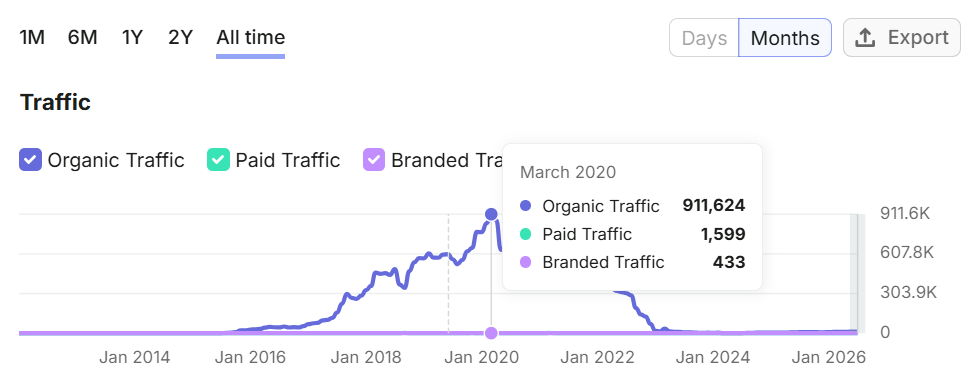
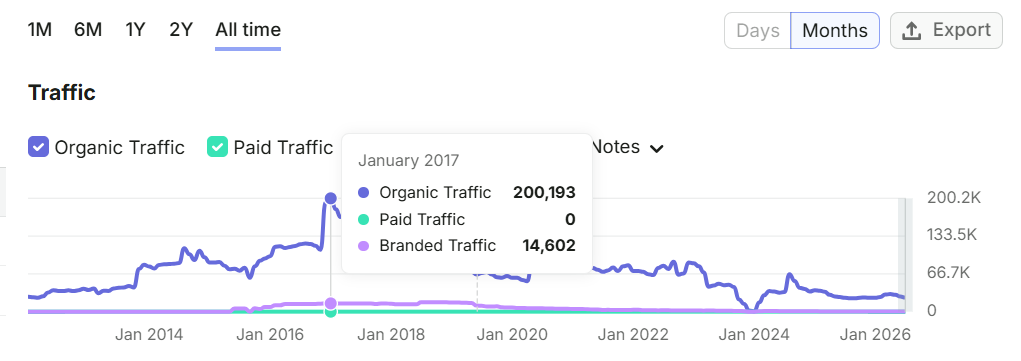 Bodybuilding Case Study
200,193 organic visitors a month for one of the biggest fitness sites online.