
Google’s own AI Overview will tell you pogo sticking “can cause your website to drop in search rankings.”
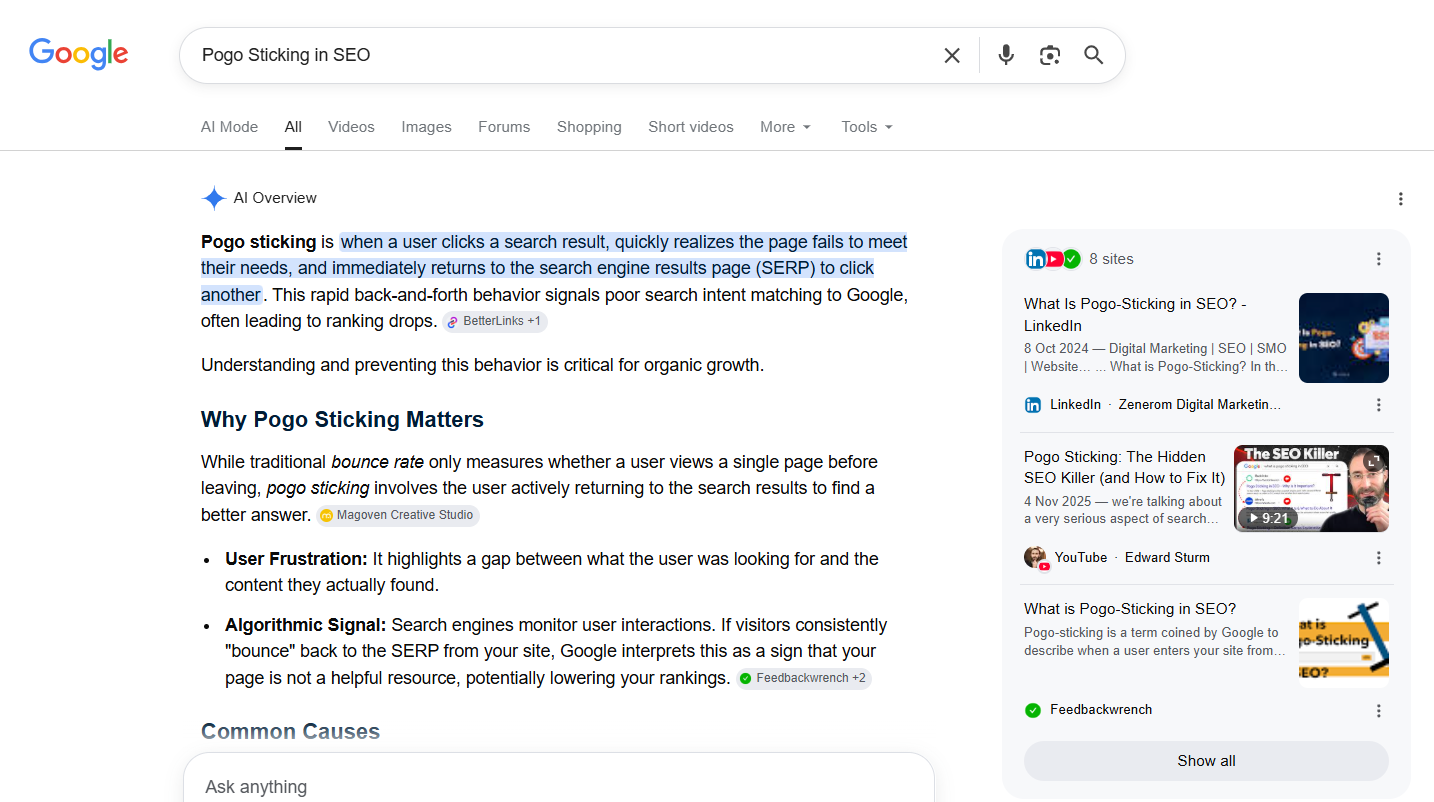
Scroll down two inches, and the top-ranking pages under it — Ahrefs, Seobility — tell you the exact opposite.
So which is it?
That’s the mess this article clears up. You’ve probably heard the term thrown around in an SEO audit or a YouTube video, half-defined and dressed up as something to be scared of.
I’m going to give you the plain-English version of what it is, the honest answer on whether it actually moves your rankings (the honest answer changed in 2024, and most articles haven’t caught up), and exactly how to spot it and fix it on your own site.
I’ll show you a page of my own that was bleeding visitors straight back to Google — and what happened three days after I fixed it.
Key Takeaways
- What it is: pogo sticking is when someone clicks your site from Google, doesn’t get what they wanted, and hops straight back to the results to try a different one.
- It’s not the same as bounce rate. Bounce rate is leaving without a second action; pogo sticking is specifically returning to the search results.
- Google says pogo sticking is not a direct ranking factor — and that’s still technically true.
- But the 2024 Google API leak revealed a click signal literally called “badClicks” — a click where the user bounces back to the SERP. So the “don’t worry about it” advice is out of date.
- The real takeaway: don’t chase the metric, fix the cause. Pogo sticking is a symptom of a page that didn’t match what the searcher wanted.
- The number one fix is search intent. When I re-matched one of my pages to its intent, it jumped from position 52 to position 26 in three days.
What Is Pogo Sticking?
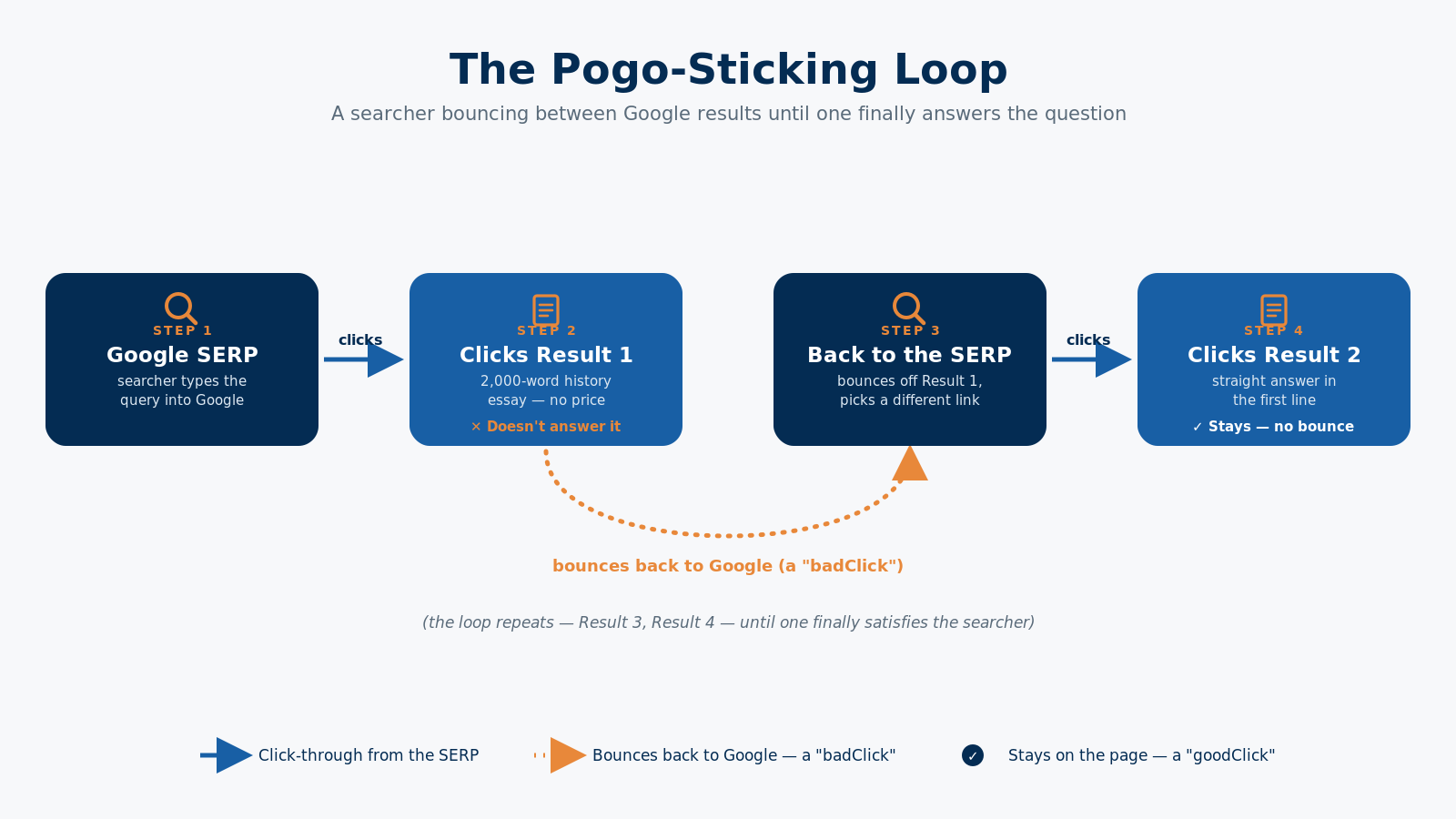
Pogo sticking is when a searcher clicks a result, doesn’t find what they were after, and bounces straight back to Google to click a different one.
Picture it like a kid on an actual pogo stick. Boing — onto result one. Nope. Boing — back to the results. Boing — onto result three. They keep hopping until something finally answers their question.
Here’s a real version. Someone in Auckland searches “how much does a builder charge per hour.” They click the first result — a builder doing everything right on SEO for an Auckland business, except answering the question.
It’s a 2,000-word essay on the history of the building trade. No prices. Back button. They click the next one, spot a straight answer in the first line, and stay. That first page just got pogo-sticked.
The term comes from Google’s own engineers. In Steven Levy’s book In The Plex, he describes how they watched for “short clicks” — a user following a link and immediately bouncing back to try again — as one of the earliest signals that a result wasn’t making people happy.
One thing to nail down early, because Google’s results for this exact term are a mess: we’re talking about pogo sticking in SEO, not the spring-loaded toy you jumped around on as a kid. Same word, completely different search.
Pogo Sticking vs Bounce Rate vs Dwell Time
These three get mixed up constantly, so let’s draw clean lines. Bounce rate is leaving without a second action. Dwell time is how long you stay before going back. Pogo sticking is specifically returning to the search results to pick another result.
The difference actually matters, because people panic about the wrong one.
Bounce rate is the most misunderstood. A “bounce” just means someone landed on a page and left without clicking anything else.
That can be a good thing. If a plumber running SEO for Wellington businesses has a customer search “Wellington plumber phone number,” land on the page, grab the number and leave — that’s a bounce, and it’s a win. They got what they came for.
Dwell time is the stopwatch. It’s the gap between clicking your result and hitting the back button. Long dwell suggests the page held them. A quick return suggests it didn’t.
Pogo sticking is the one that’s always bad news for your page, because it’s defined by the return trip. The searcher didn’t just leave — they went back to Google and picked someone else.
| Term | What it measures | Is it always bad? |
|---|---|---|
| Bounce rate | Leaving without a second action, from any traffic source | No — can mean they got what they needed |
| Dwell time | How long between the click and the return to search | Short dwell is a warning sign |
| Pogo sticking | Returning to the SERP to click a different result | It’s the clearest sign the page missed |
The takeaway: bounce rate is a site metric, pogo sticking is a search metric. Only one of them involves the searcher going back to Google and voting for someone else.
Why Does Pogo Sticking Happen?
Nearly every case of pogo sticking traces back to one thing: the page didn’t match what the searcher actually wanted. Everything else is a variation on that theme.
Let me break down the usual culprits, roughly in order of how often they’re the real problem.
Search intent mismatch. This is the big one. The searcher wanted a price and got a history lesson. They wanted a quick how-to and got a sales page.
The words on the page might be great — they’re just not the words this searcher needed. This is the root cause behind most of the others, and it’s the one we’ll spend the most time fixing later.
Clickbait. The title promised something the page doesn’t deliver. “The one trick that fixes your rankings overnight” — you click, it’s 800 words of waffle and no trick. You feel tricked, so you bounce. We’ve all done it.
The answer is buried. Sometimes the information is genuinely there, just locked behind a wall of text, a “sign up to read more” gate, or three paragraphs of throat-clearing before the point. The searcher can’t find it fast enough, so they give up and go back.
The page is slow. People won’t wait. Google’s own research found that as a page’s load time goes from one second to three, the probability of a bounce jumps 32%. Push it to five seconds and 53% of mobile visitors are gone before the page even finishes loading.
Clunky UX. A pop-up that covers the screen the second you arrive. An ad that shoves the text down as you’re reading. A layout that looks dodgy on a phone. Any of it can send someone straight back to the safety of the search results.
Sometimes it’s nothing you did. The searcher was just browsing, comparing a few options, or fact-checking across sites. That looks identical to pogo sticking but means nothing was wrong with your page. More on that next, because it changes how much you should actually worry.
Is Pogo Sticking a Google Ranking Factor?
Here’s the honest answer: pogo sticking is not a direct ranking factor by Google’s own word — but treating it as harmless is a mistake, and the reason changed in 2024.
Let me give you both halves, because this is where nearly every other article stops too early.
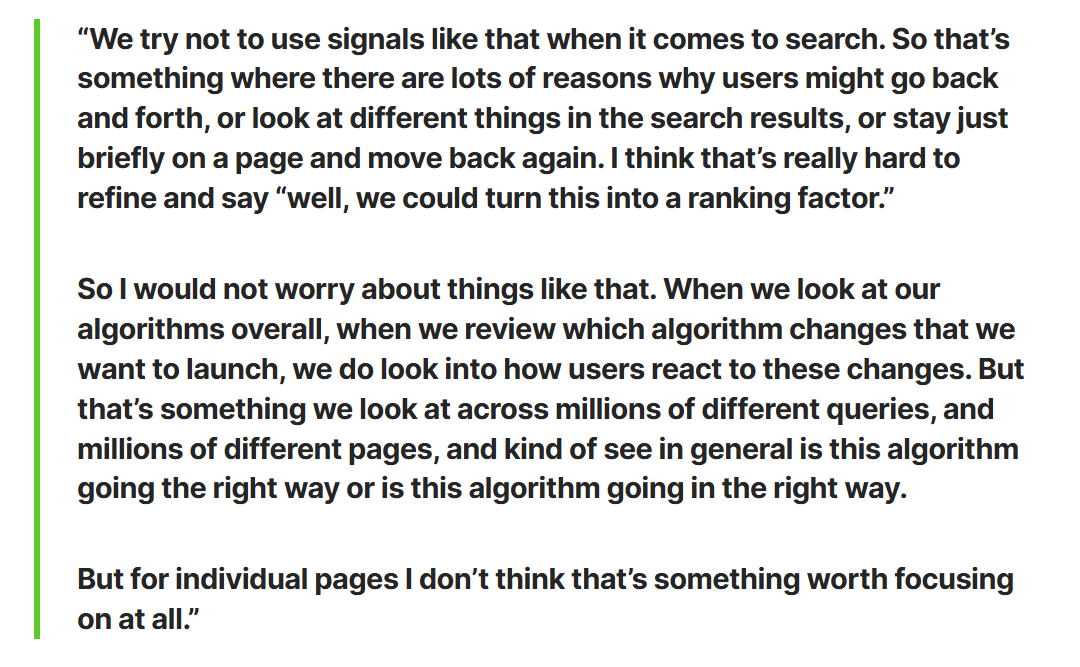
For years, the official line held firm. Back in a Google Webmaster hangout, John Mueller was asked about it directly and said Google does not use pogo sticking as a ranking factor.
His reasoning was fair: there are too many innocent reasons a person bounces between results for it to be a clean signal. So the SEO world settled on “don’t worry about it,” and most of the articles ranking today still say exactly that.
Then two things happened that the old advice never accounted for.
In 2023, during the US antitrust trial, Google’s own head of search ranking, Pandu Nayak, testified under oath about a system called Navboost.
Navboost re-ranks results based on clicks — it remembers how people clicked on a query over the past 13 months and shuffles the results accordingly. For years Google had publicly played down click data as a ranking input. Under oath, that framing didn’t hold.
Then in 2024, over 2,500 pages of Google’s internal Search documentation leaked. Buried in it were the click signals Navboost actually tracks. Three of them matter here:
- goodClicks — you clicked a result, stayed a while, and didn’t come back.
- badClicks — you clicked a result and quickly returned to the search results.
- lastLongestClicks — the result you finally settled on and dwelled the longest.
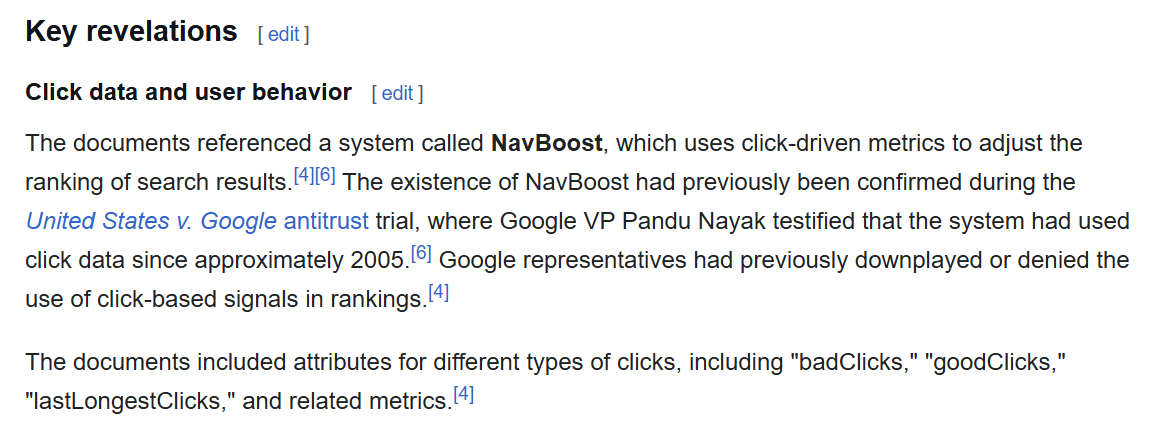
Read that middle one again. A “badClick” is a click where the user bounces back to the SERP.
That is pogo sticking. Google has a name for it, and it’s sitting inside a system its own engineer described under oath as one of the most important in ranking.
So how do you square that with Mueller? Like this: Google almost certainly doesn’t sit there counting individual back-clicks on your page and docking you points. That part’s still true.
But the thing pogo sticking represents — a searcher clicking your result and not being satisfied — is exactly what these systems are built to notice, in aggregate, across millions of queries.
Pogo sticking isn’t the dial Google turns. It’s the symptom of the thing that turns the dial.
That’s the reframe that beats both camps. The fear-mongers who say every back-click tanks you are wrong. And the “don’t worry about it at all” crowd is working off a quote that predates everything we learned in 2023 and 2024.
The practical upshot is the same either way: don’t chase the metric, fix the cause. And when you do fix it — genuinely satisfy the search — you get rewarded.
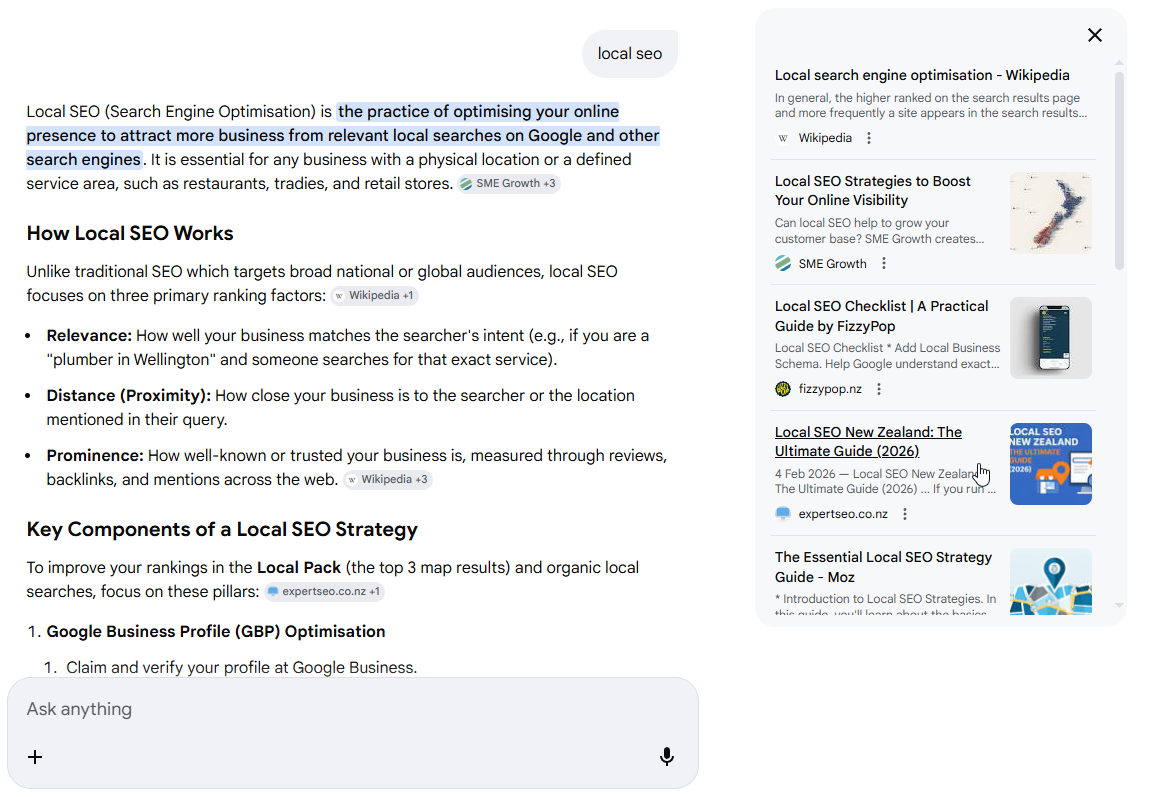
My own site — Expert SEO — gets pulled into Google’s AI answers for competitive SEO terms, and it’s not because I gamed a click metric. It’s because the pages actually answer the question.
Is Pogo Sticking Always Bad?
No. Sometimes a searcher bounces back to Google and it means absolutely nothing about your page — and knowing the difference stops you from “fixing” a page that was never broken.
Think about how you actually use Google. You search “best cordless drill NZ,” open three or four results in a row, and skim each one.
You’re comparison shopping. Every one of those is technically a pogo stick, and not one of them is a complaint about the page.
Same with fact-checking. Someone reads a claim, wants a second opinion, and clicks back to check it against another source.
Ahrefs uses a great example: you Google whether WD40 stops car door seals freezing, get a different answer on each result, and hop between them to work out who’s right.
The pages didn’t fail. The searcher just wanted to verify.
Here’s the mistake this saves you from. You open your analytics, see a page with a high exit rate, and assume it’s a disaster. So you tear apart a page that was ranking fine, for people who were only ever browsing.
The rule of thumb: worry about pogo sticking when it lines up with a page that should be answering a clear question and isn’t. Ignore it when the query is the browsing, comparing, “just looking” kind. One’s a red flag. The other’s just how people use search.
How to Reduce Pogo Sticking on Your Site
The fix isn’t a bag of tricks — it’s matching the page to search intent first, then clearing everything that stands between the reader and the answer. Get the intent right and most of the rest sorts itself out.
Here’s the order I actually work in.
Match search intent first
This is the whole game. Before you touch a single word, go to Google — in an incognito window so your history doesn’t skew it — and search the exact keyword the page targets.
Look at what’s ranking. Are the top results how-to guides? Comparison lists? Product pages? Google has already decided what searchers want for that term. Your job is to match it, then beat it.
If the top ten are all step-by-step guides and your page is a sales pitch, no amount of speed or formatting saves you. You’re answering the wrong question.
I’ll show you exactly what this looks like, because I did it recently on my own site.
I had a page targeting “what is SEO.” It was underperforming — sitting way down the rankings, barely getting seen.
So I did the thing I’m telling you to do. I ran a proper competitor analysis on the keyword, looked hard at what the ranking pages actually covered, and rebuilt mine to match the intent.
I stripped out the fluff that was burying the answer. I added the things searchers clearly wanted that I’d left out.
The day I pushed the change live, it moved. On the 12th of July, that page had 67 impressions and sat at an average position of 52.8. By the 15th — three days later — it had 195 impressions and an average position of 26.3.
That’s a jump from the sixth page of Google to the third, in three days, off one change: matching the search intent better. I didn’t build a single link. I didn’t touch the site speed. I just made the page actually answer what people were searching for.
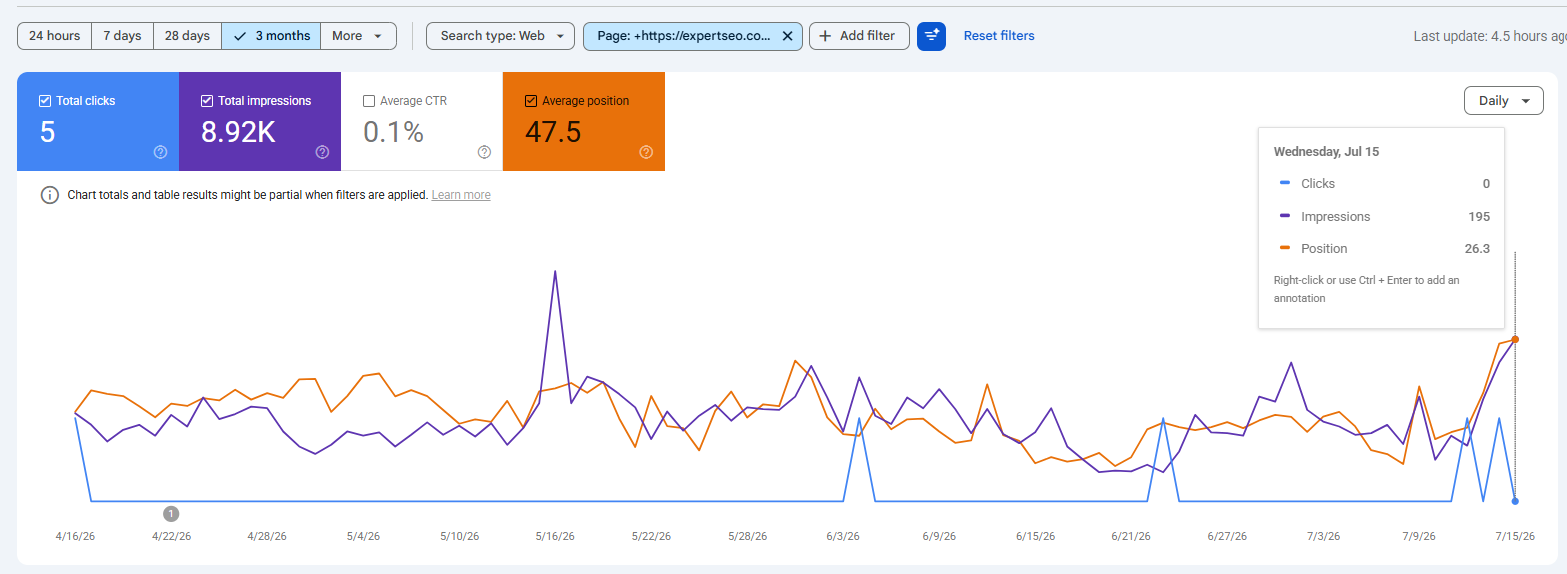
That’s the root-cause fix. Everything below is about removing friction once the intent is right.
Answer above the fold
Lead with the answer. If someone searches a question, the first line they see should start answering it — not warm up to it with three paragraphs of context. Journalists call it the inverted pyramid: need-to-know first, nice-to-know later. Give people the payoff up top and they’ve got no reason to bounce.
Cut the fluff
Every sentence that doesn’t teach, clarify, or answer is a sentence pushing your reader toward the back button. That “what is SEO” page climbed partly because I deleted things. The padding wasn’t adding value — it was hiding the value underneath it.
Speed it up
A slow page loses people before they read a word. Run the URL through Google’s free PageSpeed Insights, see what’s dragging your page speed down — usually oversized images or bloated scripts — and fix the biggest offenders first. Remember the numbers: one to three seconds of load time adds 32% to your bounce probability. Speed isn’t a nice-to-have.

Make it scannable
Nobody reads online — they skim. Break the page up with clear headings, short paragraphs, and the odd image or list.
A wall of text is exhausting on a desktop and brutal on a phone. If a reader can’t skim your page and find their answer in seconds, they’ll skim someone else’s instead.
Put your internal links high
Placing your internal links higher on the page does two things: they send people deeper into your site instead of back to Google, and they signal there’s more here worth reading.
If a reader finishes a section with a question, the right link answers it before they think to search again.
Kill the intrusive pop-ups
The sign-up box that covers the screen the moment you land. The chat bubble that eats half the phone.
Get rid of anything that gets between the reader and the content the second they arrive — especially on mobile, where over half your traffic now lives.
Keep it fresh
An article that’s visibly out of date gets a fast back-click, especially for anything where the answer moves.
Update it, and show that you have — a current “updated” date tells both the reader and Google the page is still looking after them.
How to Spot Pogo Sticking in Your Own Data
No tool has a button that says “pogo sticking.” But you can get close by reading two free tools together: Google Search Console and GA4. The trick is spotting pages that win the click but lose the visit.
Here’s the workflow.
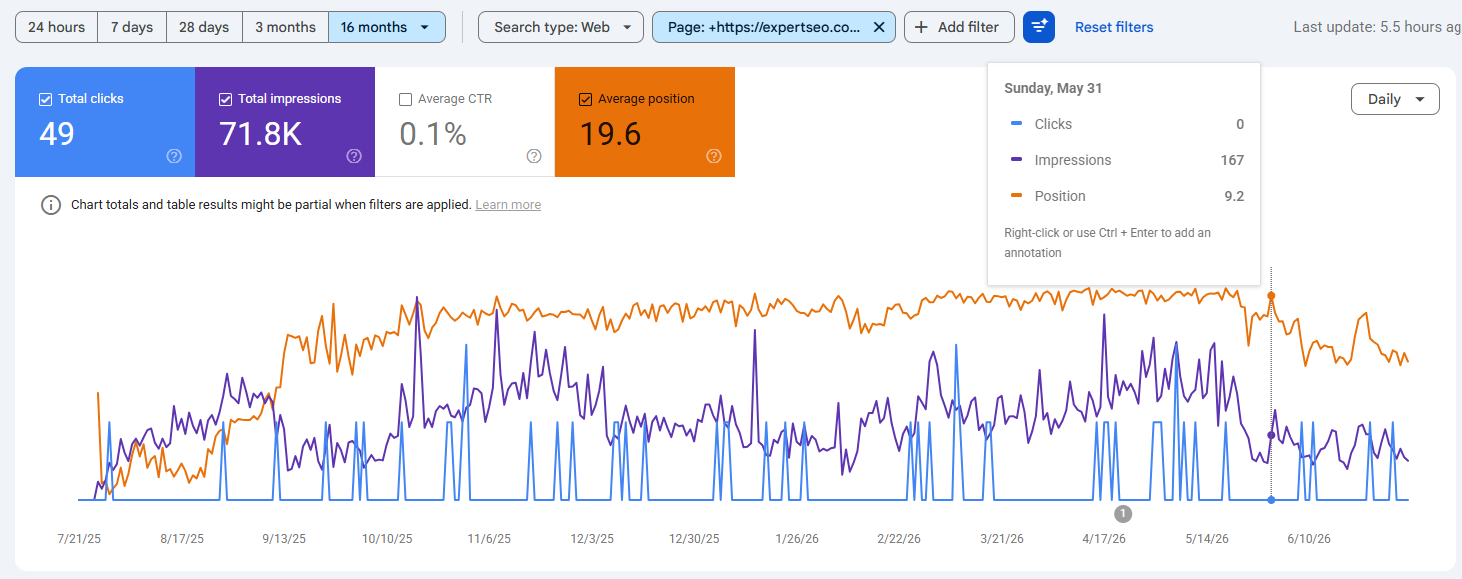
Start in Search Console. Open the Performance report, then filter to a single page. Look at three numbers together: impressions, average position, and click-through rate.
The pattern to hunt for is a page ranking decently — say position 8 or better — with a click-through rate that’s oddly low for that spot. That combination often means your title and description win the click, but something about the page isn’t holding people once they arrive.
Then jump into GA4. Look at the landing pages report and check engagement rate and average engagement time for pages that get organic traffic.
A page people land on from Google and leave almost immediately — low engagement time, low engagement rate — is your suspect.
Put the two together and you’ve got a shortlist. Pages that rank, get clicks, and then can’t keep anyone. Those are the ones to run back through the fix list above, starting with intent.
A couple of tools help around the edges. Microsoft Clarity gives you free heatmaps and session recordings, so you can literally watch where people rage-click or give up. But be honest about what these are — proxies.
None of them measure pogo sticking directly, because only Google can see the return trip to the SERP. You’re reading the shadow it casts on your own data.
Pogo Sticking on Ecommerce Sites
On an online store, pogo sticking usually means the product page didn’t answer the buying question fast enough — no price, no stock status, thin description, no reviews — so the shopper bounces back to compare.
Ecommerce SEO has its own intent split, and it trips people up. A category page (“running shoes”) is browse intent — the shopper’s comparing.
A product page (“Brooks Ghost 15, size 10”) is closer to buy intent — they want the specifics. Match each page to its job.
The usual reasons a product page gets pogo-sticked are boringly consistent. The price is missing or buried. There’s no clear “in stock” signal. The description is three generic lines the manufacturer wrote. There are no reviews to build trust.
Or the page is a stack of huge images that takes an age to load on mobile. Any one of them sends a ready-to-buy shopper straight back to the results to find a store that makes it easier.
I worked with an ecommerce client through SEO consulting — a product you’d know from Shark Tank, though I’ll keep them anonymous and call it running shoes — where the whole strategy hinged on this.
We mapped the keywords by intent: the direct, commercial ones pointed at product and category pages, and the informational ones (“how to choose running shoes for flat feet”) pointed at content that fed those money pages.
Match the page to the intent behind the search, and shoppers stop bouncing because the page finally meets them where they are.
Final Thoughts
If you take one thing from this, make it this: stop treating pogo sticking as a metric to chase. It’s a symptom, not a disease.
Every hour you’d spend obsessing over back-clicks in a report is an hour better spent on the one thing underneath all of it — genuinely matching, and satisfying, what the searcher wanted.
Fix that, and the back-clicks, the rankings, and even the AI citations all start moving in the same direction. That’s not theory. That’s what one page of mine did in three days, off one change, when I finally made it answer the question people were actually asking.
The fear-mongers overcomplicate it and the “don’t worry about it” crowd undersell it.
The truth sits in the middle: nobody’s algorithm punishes you for a back-click, but everybody’s algorithm rewards you for the page that didn’t need one.
You can run every fix in this guide yourself — the intent research, the fluff cut, the speed check. None of it needs specialist tools.
Where it gets hard is the bit before the fix: reading a SERP properly, working out exactly what intent you’re missing, and rebuilding a page around it without guessing.
That’s the part most people get stuck on, and it’s the part professional SEO services is built for.
Get the intent right, and pogo sticking mostly fixes itself. That’s where we come in.
Pogo Sticking: FAQ
What is pogo sticking in simple terms?
Pogo sticking is when someone clicks your website from a Google search result, doesn't find what they're after, and clicks straight back to try a different result. It's one of the clearest signals that a page didn't answer the search.
What's the difference between pogo sticking and bounce rate?
Bounce rate is leaving a page without taking a second action, from any traffic source — it can be a good thing, like someone grabbing a phone number and leaving satisfied. Pogo sticking is specifically returning to the Google search results to click a different page, which is a stronger signal the page missed the mark.
Does pogo sticking hurt SEO?
Not directly, by Google's own word — but the 2024 Google Search documentation leak revealed a click signal called "badClicks" that tracks exactly this behaviour inside the Navboost ranking system. Pogo sticking isn't a dial Google turns on its own, but the dissatisfaction it represents clearly feeds systems that do affect rankings.
What causes pogo sticking?
The leading cause is search intent mismatch — the page doesn't match what the searcher actually wanted. Clickbait titles, buried answers, slow load times and clunky mobile UX are the other common triggers.
How do I reduce pogo sticking on my site?
Match the page to search intent first, then remove friction: answer the question above the fold, cut the padding that buries the point, speed up the page, make it scannable, and place internal links high so readers go deeper instead of back to Google.
Which tools measure pogo sticking?
No tool reports pogo sticking by name. The closest you'll get is pairing Google Search Console (impressions, position and click-through rate) with GA4 (engagement rate and engagement time) to spot pages that win the click but lose the visit.
Recommended Reading
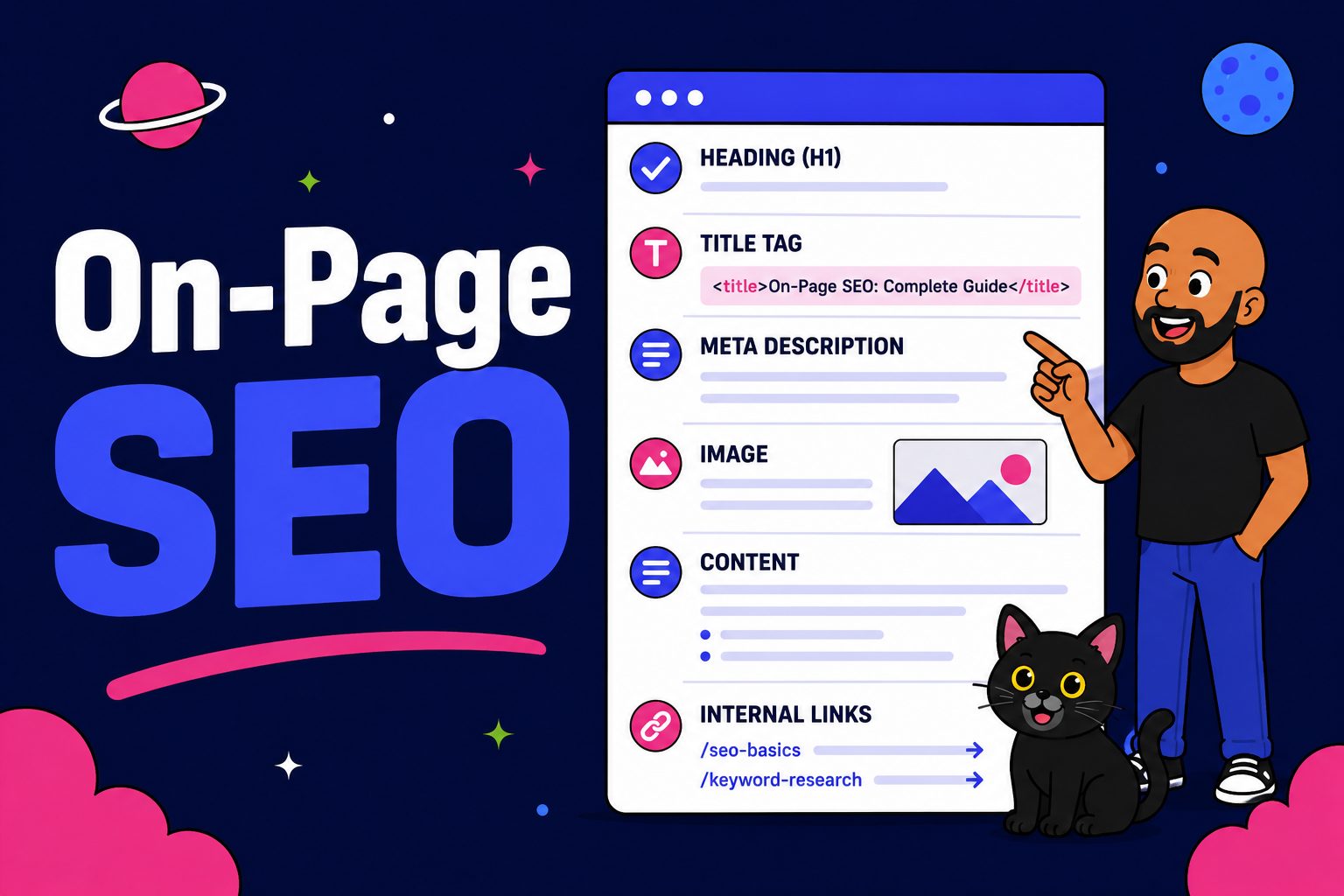 On-Page SEO
The complete guide to optimising individual pages so Google — and searchers — understand them fast.