

Vary your anchor text. Don’t over-optimise. Keep it natural.
You’ve probably been told all three.
What nobody explains is what any of it actually means when you’re not a full-time link builder running a thousand placements a month — you’re a business owner with a website, a phone that needs answering, and about twenty minutes spare to think about SEO.
Quick note before we start, because this term gets messy: this guide is about anchor text in the SEO sense — the clickable words inside a link.
Not the “anchor” tool in Word or InDesign, and not the anchor charts teachers stick on classroom walls. If you came here for one of those, wrong room.
For everyone else: here’s what anchor text is, the types worth knowing, and how to actually use it well. Most of the focus sits on your internal links — because that’s the part you fully control, and it’s where this stuff genuinely pays off for a normal business.
What Is Anchor Text?
Anchor text is the visible, clickable text of a link — the words you see and click, not the web address sitting behind them.
Let’s say I link to a page about KiwiSaver. The words you’d click — “KiwiSaver basics” — are the anchor text. The URL they point to is hidden in the code.
In raw HTML it looks like this:
<a href="https://example.co.nz/kiwisaver/">KiwiSaver basics</a>The first part is the destination. The bit between the tags — the part a reader actually sees, usually blue and underlined — is the anchor text. That’s the whole concept. Everything else in this guide is about choosing those words well.
Why Anchor Text Matters (And How Google Uses It)
Anchor text tells two audiences what’s on the other end of a link: your reader, and Google.
For the reader, it sets an expectation. Click “KiwiSaver basics” and you’d better land on a page about KiwiSaver basics, not a contact form.
For Google, it’s a context clue. The words you link with help Google work out what the linked page is about.
Anchor text was baked into Google from day one — this goes right back to the start.
In the original 1998 paper that introduced Google, the founders wrote that anchors “often provide more accurate descriptions of web pages than the pages themselves.”
Nearly three decades on, Google’s own link documentation still tells you to make anchor text “descriptive, reasonably concise, and relevant.”
Here’s the part worth holding onto, though: anchor text is one signal, not a magic lever.
It works alongside the page’s actual content, the site’s authority, and a few hundred other factors. We’ll come back to exactly how much weight it carries later, because that’s where most advice goes off the rails.
The short version: anchor text helps Google understand context. It doesn’t single-handedly decide rankings.
The 7 Types of Anchor Text (With NZ Examples)
Most anchor text falls into one of seven types, and which one you reach for depends on what you’re linking and why.
Here’s each type, with a real NZ example and when a normal business would actually use it.
| Type | What it is | NZ example | When to use it |
|---|---|---|---|
| Exact match | The exact keyword the page targets | “family lawyer Wellington” | Sparingly — it’s the most over-used and risk-prone |
| Partial match | Contains the keyword plus extra words | “our guide to choosing a family lawyer” | Your workhorse — natural and flexible |
| Branded | Your business or brand name | “Expert SEO” | Constantly — the safest, most natural anchor there is |
| Compound | Brand plus a keyword | “Expert SEO’s local SEO service” | When you want brand and relevance in one |
| Generic | Non-descriptive filler | “click here”, “read more” | Almost never — it tells Google nothing |
| Naked URL | The raw web address | “https://expertseo.co.nz” | Citations and resource lists |
| Image | The image’s alt text becomes the anchor | A mortgage broker’s photo linking to a service page | Any time an image is the link |
A couple of these deserve a closer look.
Exact match is the one everyone reaches for and the one that causes the most trouble.
If a Wellington firm links to its services page with “family lawyer Wellington” every single time, that pattern starts to look engineered. Used once in a while, on the right page, it’s fine. Used everywhere, it’s a flare gun.
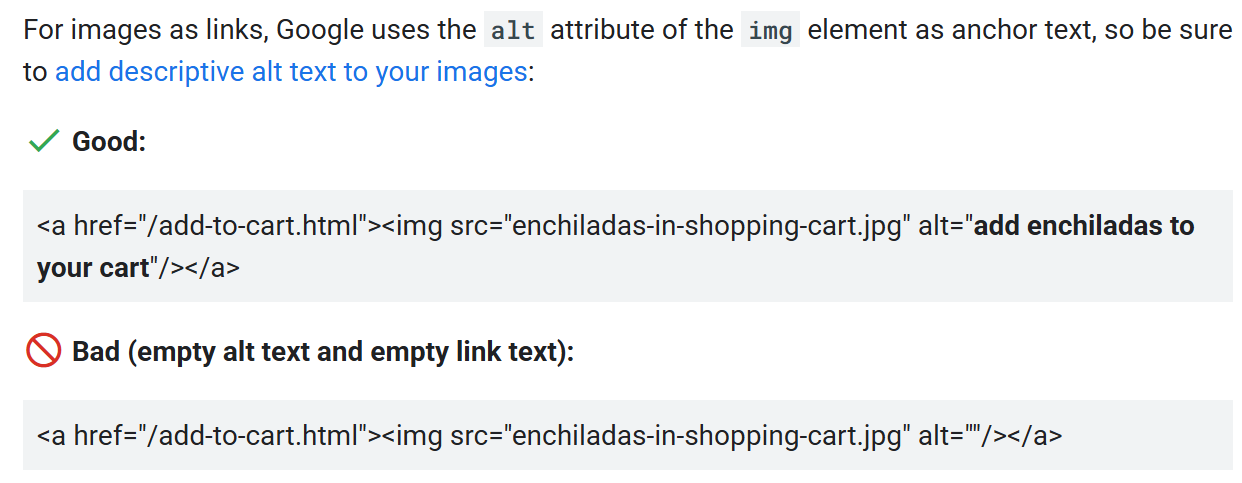
Image anchors are the type most people forget exists. When you use an image as a link, Google reads the image’s alt text as the anchor.
So a mortgage broker linking from a photo on their blog to their main page is passing anchor text through that alt attribute — whether they realise it or not.
Get the alt text right and you’ve got a working link with proper on-page optimisation attached.
Leave it blank and you’ve wasted the signal entirely. (If you run a site in a competitive trade, this is exactly the kind of detail SEO for mortgage brokers lives or dies on.)
The takeaway: a healthy site uses a mix of these types, leaning hard on branded and partial-match, and treats exact match like hot sauce.
What Good Anchor Text Actually Looks Like
Good anchor text describes the page it points to, reads naturally in the sentence, and never tricks the reader.
That’s it. Three tests, and Google’s guidance backs all three.
It’s descriptive. “Click here” tells nobody anything. “Our KiwiSaver guide” tells the reader and Google exactly what’s coming.
A financial adviser writing about retirement should link on the topic, not on a generic phrase — it’s a small thing that makes SEO for financial advisers work harder with no extra effort.
It fits the sentence. The best test I know: write the sentence as if the link weren’t there. If the words you’d anchor are already sitting in it, link them. If you had to bolt on a clause to house the link, that added text is the problem — not the link.
Here’s the difference in practice:
Forced: “If you want to learn more about our services, click here to check out our services page.”
Natural: “Most clients we take on had already tried this themselves and run out of hours.”
The second one carries the link inside a sentence that earns its place. The first exists only to house a link, and both readers and Google can smell it.
It’s honest. If the anchor says “KiwiSaver guide,” it leads to a KiwiSaver guide. Mislead the reader and you lose trust on the spot — and Google’s gotten very good at spotting the gap between what a link promises and what it delivers.
Good anchor text reads like a human wrote it for another human. That’s the bar.
Anchor Text for Internal Links: The Part Most Guides Skip
Here’s the bit nearly every anchor text guide glosses over, and it’s the most useful part for a business like yours.
On your own site, you control every single anchor. Every link from one of your pages to another is a decision you get to make.
That makes internal links the one place where anchor text strategy is fully in your hands — and for most NZ businesses, getting it right here matters more than anything you’ll ever do with backlinks.
Three rules carry most of the weight.
Vary the anchor across pages. Don’t point five different articles at your services page using the identical phrase.
That’s the same over-optimisation pattern people warn about with backlinks, just pointed at your own site. Spread the phrasing around: “our SEO service” on one page, “done-for-you SEO” on another, “professional SEO help” on a third. Same destination, different words.
Link each page once per article. Linking to the same page three times in one article doesn’t triple the signal. It clutters the page and splits the reader’s attention.
And there’s a specific reason it doesn’t help, which brings us to the rule almost nobody mentions:
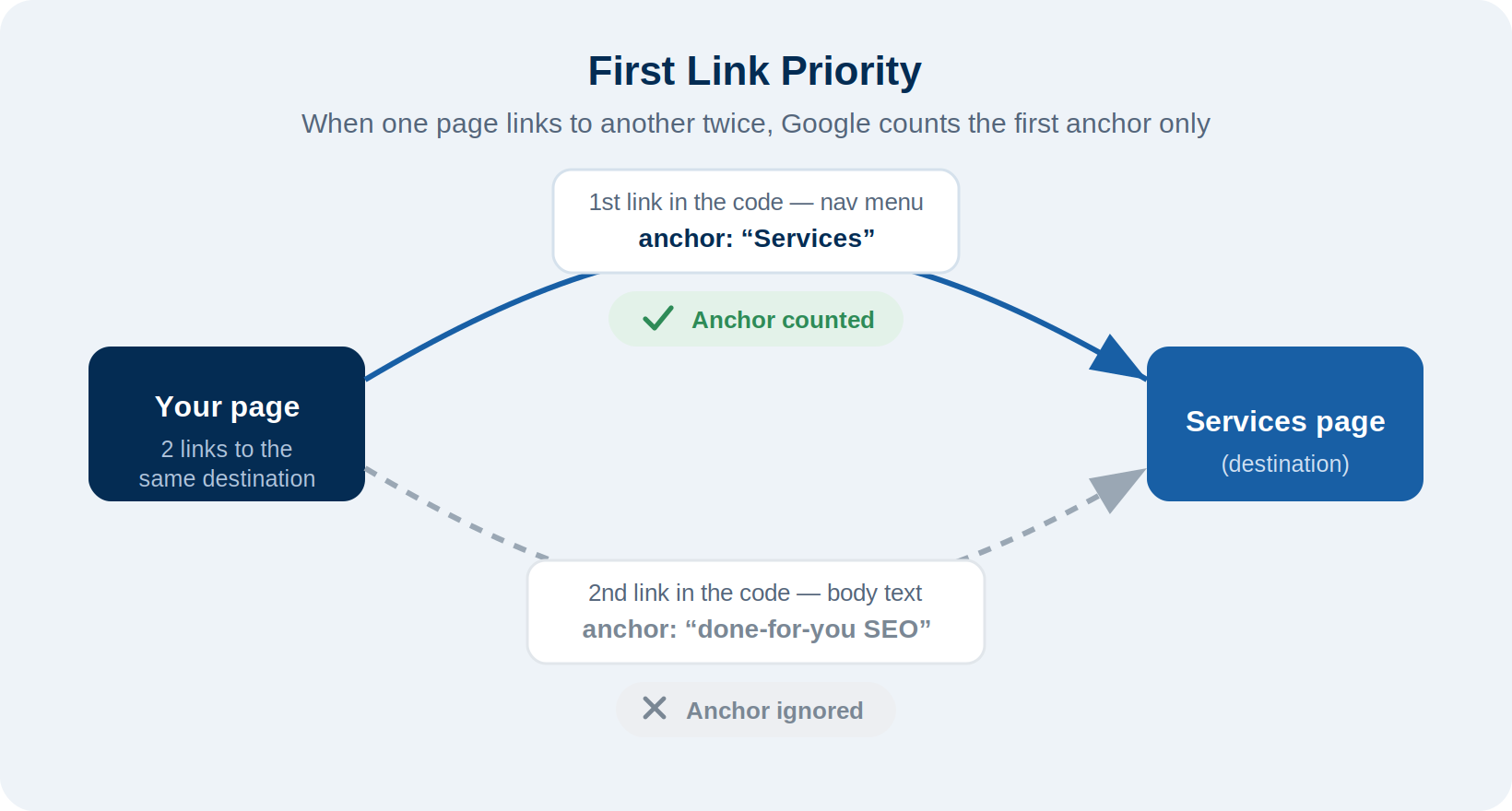
First Link Priority. When a single page links to another page more than once, Google generally only counts the anchor text of the first link. The second and third anchors to that same destination are largely ignored for anchor-text purposes.
So if your menu links to your services page with the bare word “Services,” that navigation link can claim the first slot — and the carefully chosen anchor you used down in the body counts for less.
It’s worth knowing where your first link to each important page actually sits.
While we’re here — a blind spot worth naming. Your menu, footer, and button text are anchor text too. “Home”, “Services”, “Contact”, “Get a Quote” — every one of those is an anchor, and they’re identical on every page of your site.
That’s a lot of repeated, generic, exact-match-ish anchor text most owners never think about.
You can’t always change navigation labels (nor should you make them weird for SEO’s sake), but it’s worth knowing they’re part of the picture when you’re auditing your internal link structure.
This is exactly the system behind our own SEO company — every internal link logged, anchors varied deliberately, each page linked once per article. It’s not complicated.
It’s just disciplined. And it’s the moat: anyone can publish a page, but a site where every internal link has been chosen on purpose reads as authoritative to both Google and the people landing on it.
The principle to bank: the anchors you control completely are your internal links, so that’s where the care pays off.
The Anchor Text Mistakes That Quietly Hurt Your Rankings
Most anchor text damage comes from a short list of habits. Once you can spot them, they’re easy to avoid.
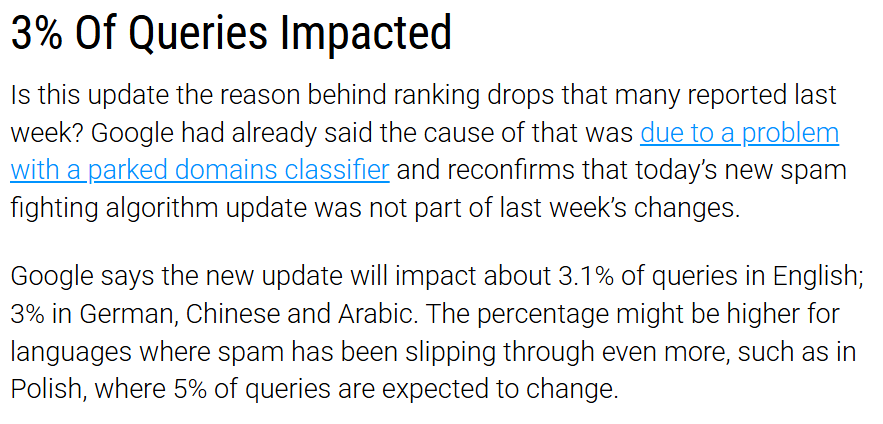
Over-using exact match. This is the big one. In April 2012, Google rolled out the Penguin update, which hit roughly 3.1% of search queries and specifically targeted manipulative, keyword-stuffed link patterns.
Sites that had been aggressive with exact-match anchors saw rankings tank overnight.
Penguin’s now baked into Google’s core algorithm, running constantly. The lesson held: a link profile that looks like a spreadsheet of your target keyword is a profile that gets discounted.
Identical anchors site-wide. Covered above, but it bears repeating because it’s so common. A Tauranga tradie pointing every blog post at the same page with the exact same phrase is the textbook version of it.
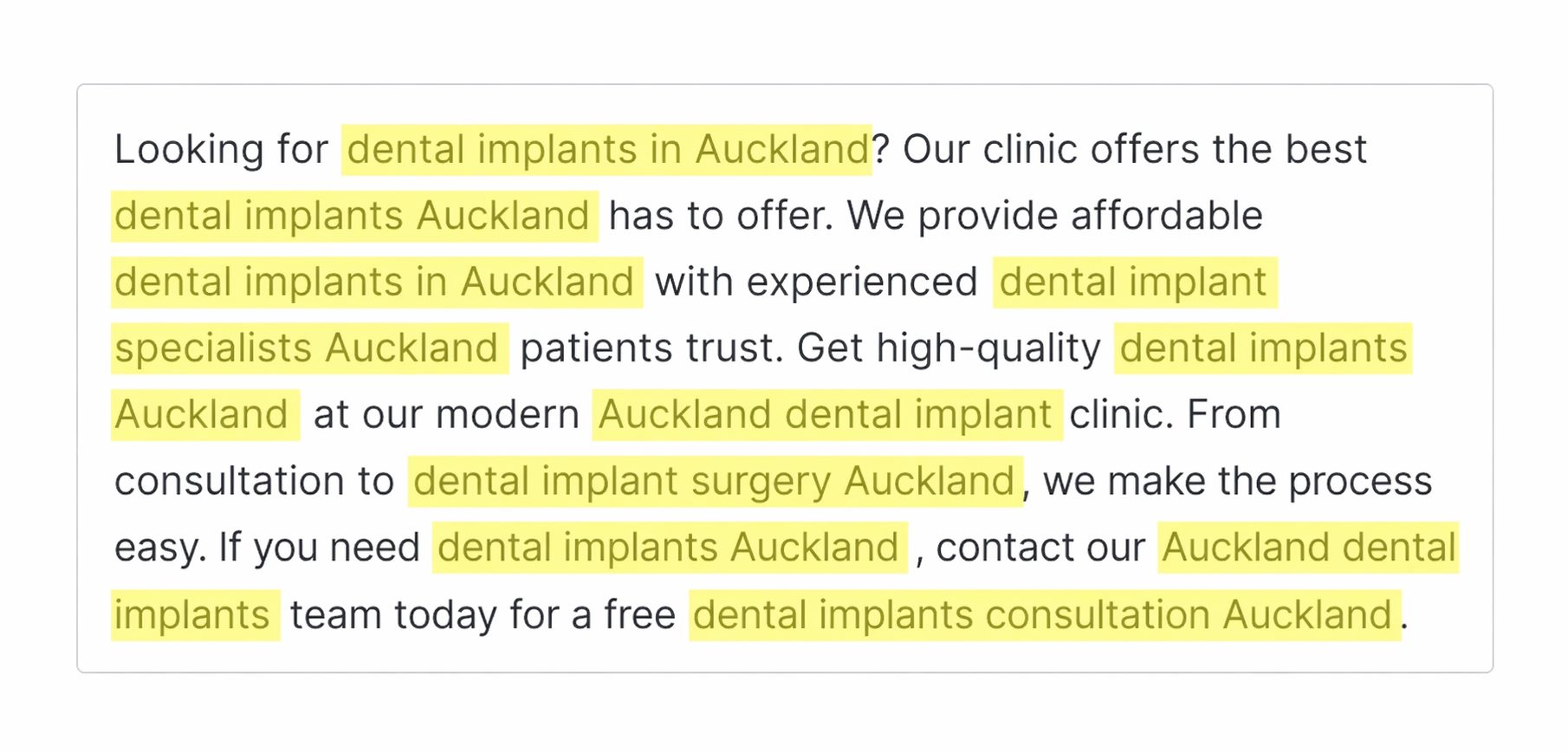
Stuffing keywords into links. Cramming your keyword into every anchor, or piling links one after another, is a pattern Google’s spam policies call out directly. Five linked keywords jammed into one sentence is a footprint Google has built systems to catch.
Generic everywhere. A page full of “click here” and “read more” hands Google nothing to work with. Each one is a wasted chance to add context.
The fastest way to catch these on your own site is to actually look at your link patterns — which is what a proper SEO audit is for. You can’t fix a pattern you can’t see.
How Much Does Anchor Text Actually Matter for Your Business?
Here’s the honest answer most guides won’t give you: there’s no magic ratio, and for most businesses, the external side is largely out of your hands anyway.
Let me unpack both halves, because this is where you either waste hours or focus where it counts.
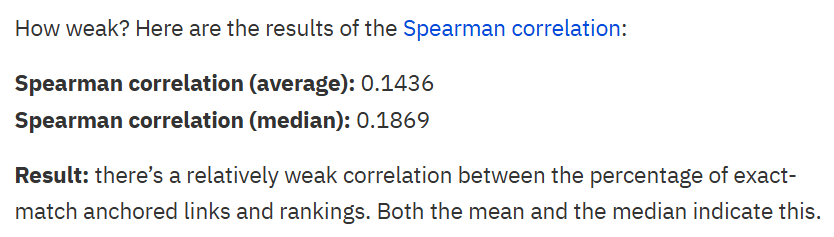
The “ideal ratio” is mostly a myth. You’ll find blog posts insisting you need exactly 5% exact match, 30% branded, 20% partial, and so on. The trouble is the data doesn’t support a universal number.
Ahrefs studied the backlink anchors of 384,614 web pages and found only a weak correlation between exact-match anchors and rankings. What’s “natural” for a Wellington law firm looks nothing like what’s natural for a national e-commerce brand.
Chasing a fixed percentage is solving a problem most businesses don’t have.
You can’t control most of your backlink anchors anyway. When another site links to you, they pick the words. With nearly every legitimate way of earning links, you don’t get to choose the anchor.
So fretting over your backlink anchor ratios is fretting over something you can’t directly set. The healthier the profile looks naturally, the better — and “natural” is exactly what you get when you stop trying to engineer it.
For a normal business, attention belongs in two places:
- Your internal links — where you control every anchor (see the section above).
- Your branded mentions — when you do earn backlinks, branded and natural anchors are the safest and most common in any healthy profile.
The aggressive ratio-juggling you read about is written for people running large, deliberate link campaigns in cut-throat niches. For an Auckland café doing its own SEO, it’s noise.
The takeaway worth banking: focus on the anchors you control, keep everything else natural, and don’t lose sleep over ratios built for a game you’re not playing.
When to Do Your Own Anchor Text (And When to Get Help)
You can absolutely handle your own anchor text. The concepts aren’t hard — pick descriptive words, vary them, don’t over-do exact match, and keep your internal links tidy.
Where it gets fiddly is scale. On a five-page site, you can hold the whole link structure in your head.
On a hundred-page site that’s been growing for two years, keeping anchors varied, links un-duplicated, and patterns clean becomes a real job — the kind of thing that quietly slips when you’re busy running the actual business.
That’s the point where it’s worth weighing up professional SEO help.
Sometimes a single session — a chance to work with an SEO consultant to set up a sensible internal linking system — is all a growing site needs, and after that you maintain it yourself.
Either way, the goal’s the same: a site where every link looks like a human chose it on purpose, because that’s exactly what Google rewards. If sorting that out yourself isn’t the best use of your week, that’s where we come in.
Anchor Text: FAQ
Does nofollow anchor text carry any weight?
A nofollow link tells Google not to pass ranking authority, so its anchor text carries little to no direct ranking weight. It still matters for the reader, though — descriptive anchors help people regardless of the link attribute.
What's the best length for anchor text?
Keep it short and descriptive — usually two to five words. Long enough to describe the destination, short enough to read cleanly inside a sentence. A whole sentence crammed into one link is too much.
Can anchor text actually hurt my rankings?
Yes, but mostly through over-optimisation — the same exact-match keyword repeated across many links, internal or external. A varied, natural mix is your protection.
Is anchor text more important for internal or external links?
For most businesses, internal links — because you control every one of them. External anchors are largely chosen by the sites linking to you, so there's less to manage there.
Recommended Reading

The white-hat ways to earn links worth having, and why the anchor usually isn't yours to pick.

How links and signals from beyond your own site shape your rankings.
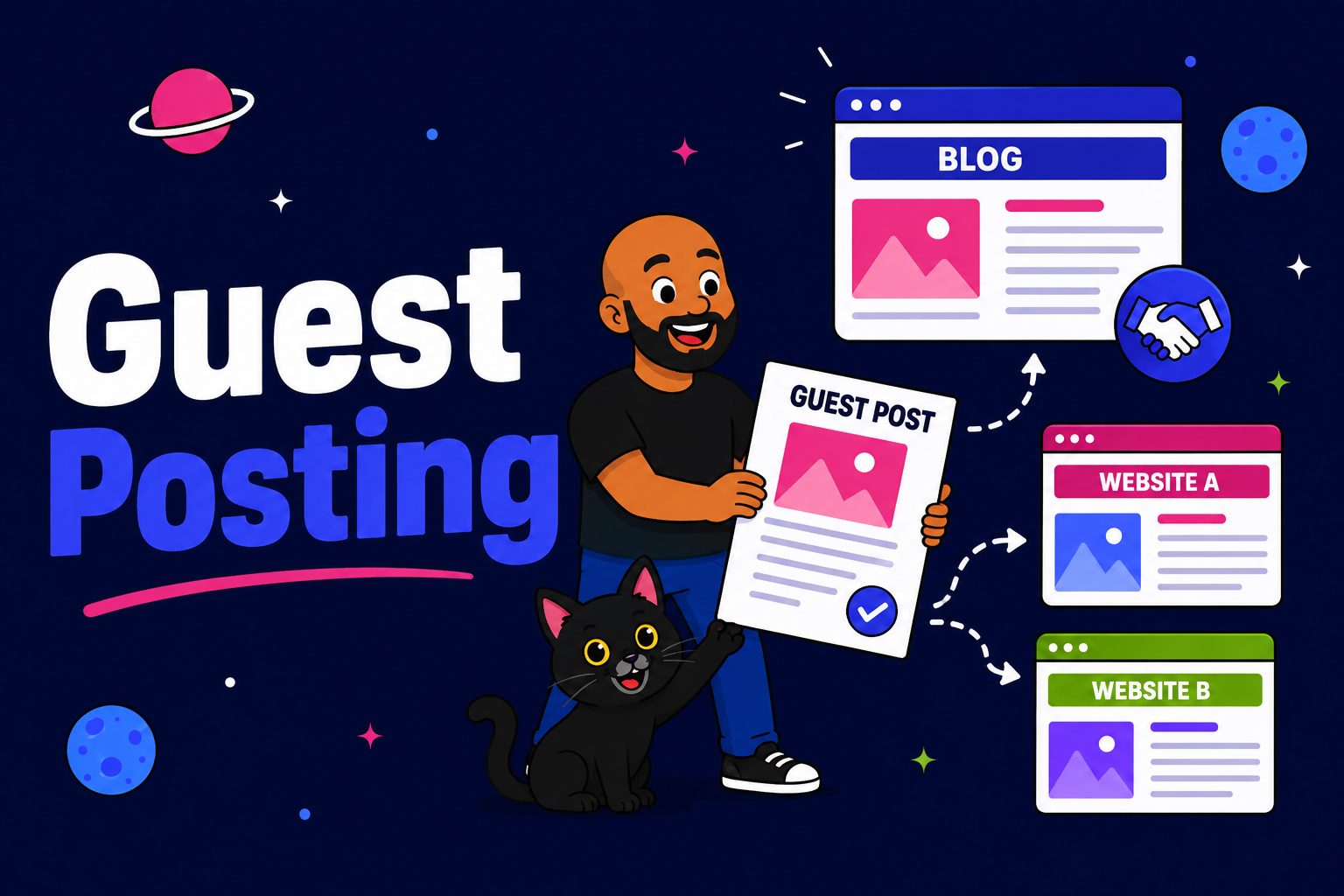
The one link type where you usually do get to choose your own anchor text.