
Refreshing your content is the closest thing SEO has to a free lunch.
Every other way of pulling traffic back to your site starts from zero. A content brief. A gap analysis. Keyword research. Hunting down studies to back your claims. Writing the thing, then editing it until it’s good.
Hours of work before a single visitor turns up.
A content refresh skips all of it.
You take a page that already ranks, find what’s gone stale, and make it better. That’s the whole job.
But there’s a catch nobody mentions — and if you’re a new site, it’s the difference between an easy win and a wasted afternoon.
So here’s what fresh content actually is, whether you’ve earned the right to bother with it yet, and exactly how to do it when you have.
What Is Fresh Content?
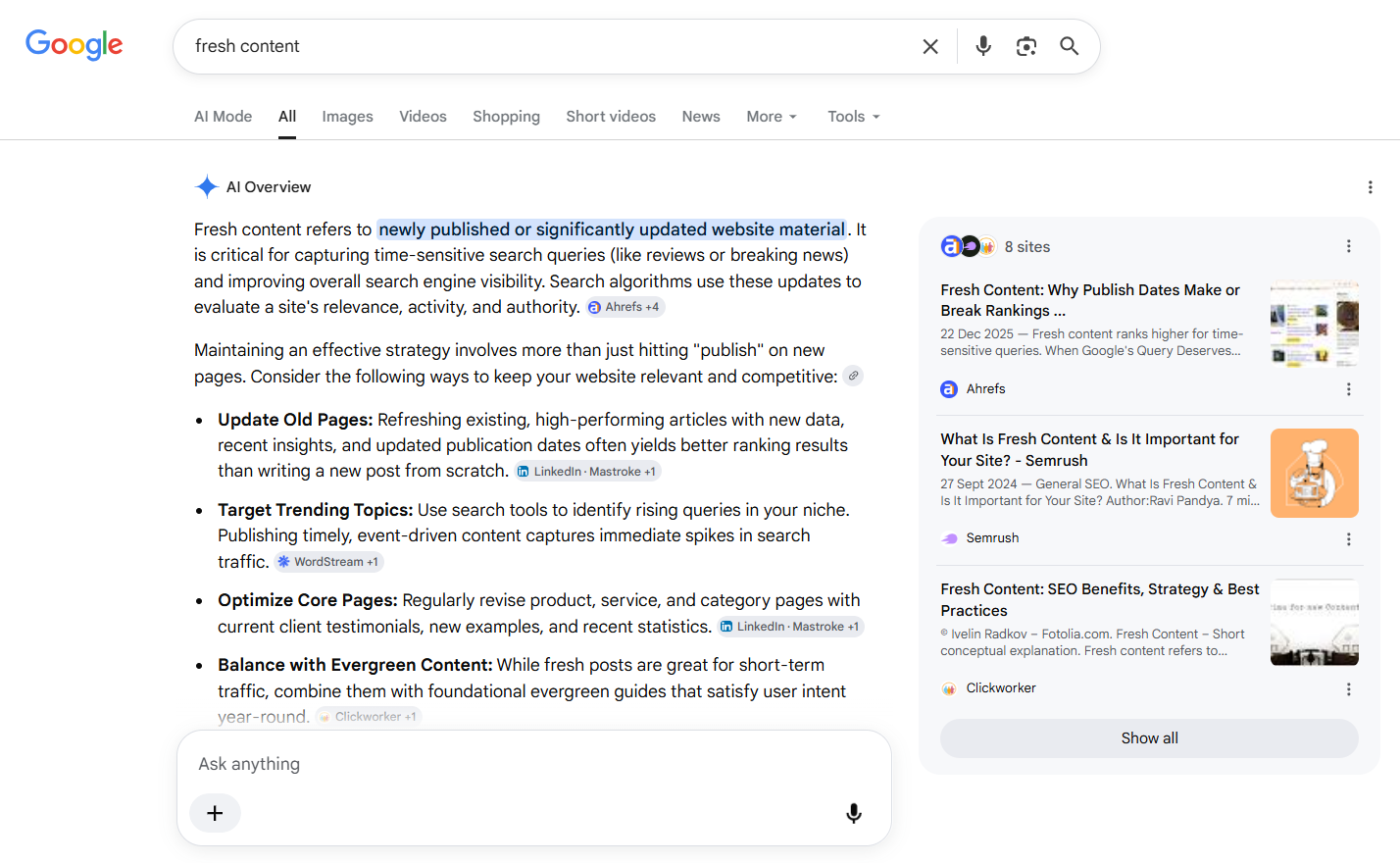
Fresh content is any page that’s newly published or recently updated to reflect current information.
Two forms, that’s it. A brand-new article you’ve just put live, or an older one you’ve gone back into and brought up to date. Both count as fresh in Google’s eyes.
The reason it matters is simple: the internet rots. Prices change, tools get renamed, last year’s “latest stats” become this year’s embarrassment.
A page that was perfect eighteen months ago can quietly drift out of date without you touching a thing — and Google notices.
Where people trip up is thinking “fresh” means “changed the date.”
It doesn’t. Swapping 2024 for 2026 in your title while leaving the words underneath untouched is just a costume change. Google sees straight through it (we’ll get to how, and why it can bite you).
And freshness on its own won’t save a weak page. A recently-updated article that answers the question badly still loses to an older one that answers it well. Fresh is a tiebreaker, not a trump card.
Why Is Fresh Content Important?
Google and AI answer engines both reward recent information — Google when it decides the query needs it, AI almost all the time.
Start with Google. It doesn’t chase freshness on every search, because it doesn’t need to. Nobody typing “how to tie a tie” wants the 2026 edition.
But for topics where the right answer moves, Google has a system called Query Deserves Freshness — QDF — that pushes recently-updated pages up the results.
Semrush traces it back to a 2007 explanation from the head of Google search: when a topic starts trending, news sites cover it, and search volume spikes, Google reads that as “people want the current answer” and favours fresh pages.

Picture a tour operator ranking in Queenstown for “things to do this winter.” That query is soaked in freshness — the season changes, the operators change, last winter’s guide is half wrong by June. Google knows it, and it’ll quietly favour whoever updated most recently.
The same operator’s “how to get from Queenstown airport to town” page? That barely moves. Freshness matters for one and not the other, on the same site.
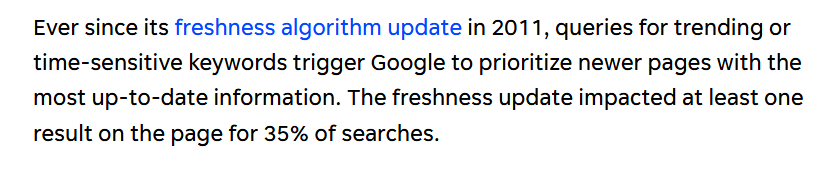
This isn’t new, either. When Google rolled out its freshness update back in 2011, Wordstream notes it touched at least one result for roughly 35% of all searches. A third of the internet’s results, reshuffled around how recent they were.
Then AI search showed up and turned the dial harder.
AI assistants like ChatGPT don’t answer from memory — they pull live results at the moment you ask, which means recency is baked into how they pick sources.
Ahrefs points to research uncovering a “URL_freshness_score” inside ChatGPT’s own configuration, and a study where simply adding recent dates to content shunted it up as many as 95 places across seven different AI models. Ninety-five places, from a date.
And that AI traffic is worth chasing. Visitors who arrive from AI search convert around 4.4 times better than regular organic visitors — so the pages that stay current don’t just get cited more, they pull in the traffic that actually buys.

Put the two together and the “why” is easy. Google rewards freshness when the topic demands it; AI rewards it nearly always. Keeping a page current is one of the highest-return jobs in SEO, because the same update pays you twice — better rankings and more AI mentions off a single afternoon’s work.
That’s the upside. Now the part nobody tells you.
Should You Refresh Your Content Yet?
If your site is under a year old with a thin catalogue, don’t refresh anything. You’ve got nothing worth maintaining yet — build the library first.
Here’s the logic, and it’s the whole reason this section exists.
A content refresh improves pages that already rank. That’s the mechanism — you take something with existing authority and traffic, and you sharpen it. But a brand-new site has no ranking pages to sharpen.
Refreshing three articles that were never going to rank in the first place is like repainting a car with no engine. Looks busier. Goes nowhere.
Even the freshness crowd admits this quietly. As Wordstream puts it, if your content didn’t rank in the first place, an update is hardly enough to lift it to the top.
So here’s the line I draw, and it’s the same one I use when I’m running SEO services for a client: under a year old, or under about fifty pieces of content, keep building. Past that, start maintaining.
For a new site, “keep building” means catalogue. Breadth. You’re trying to show Google you’re an actual authority on your subject, and you do that by covering the topic properly — not by fussing over the five pages you’ve already got.
This is also where all that “how do I find fresh content ideas” energy should go: into new pages that fill gaps in your coverage, not into re-touching thin ones.

I’m not theorising here. I spent the last year doing exactly this with Expert SEO.
Instead of circling back to update articles, I built the catalogue out — cluster after cluster, covering the topic wide enough that Google started treating the site as a genuine authority (it’s six months old and already outranking NZ agencies a decade deep, so the approach holds up).
Only now, with the catalogue built and the earliest pieces coming up on a year old, am I switching into refresh mode.
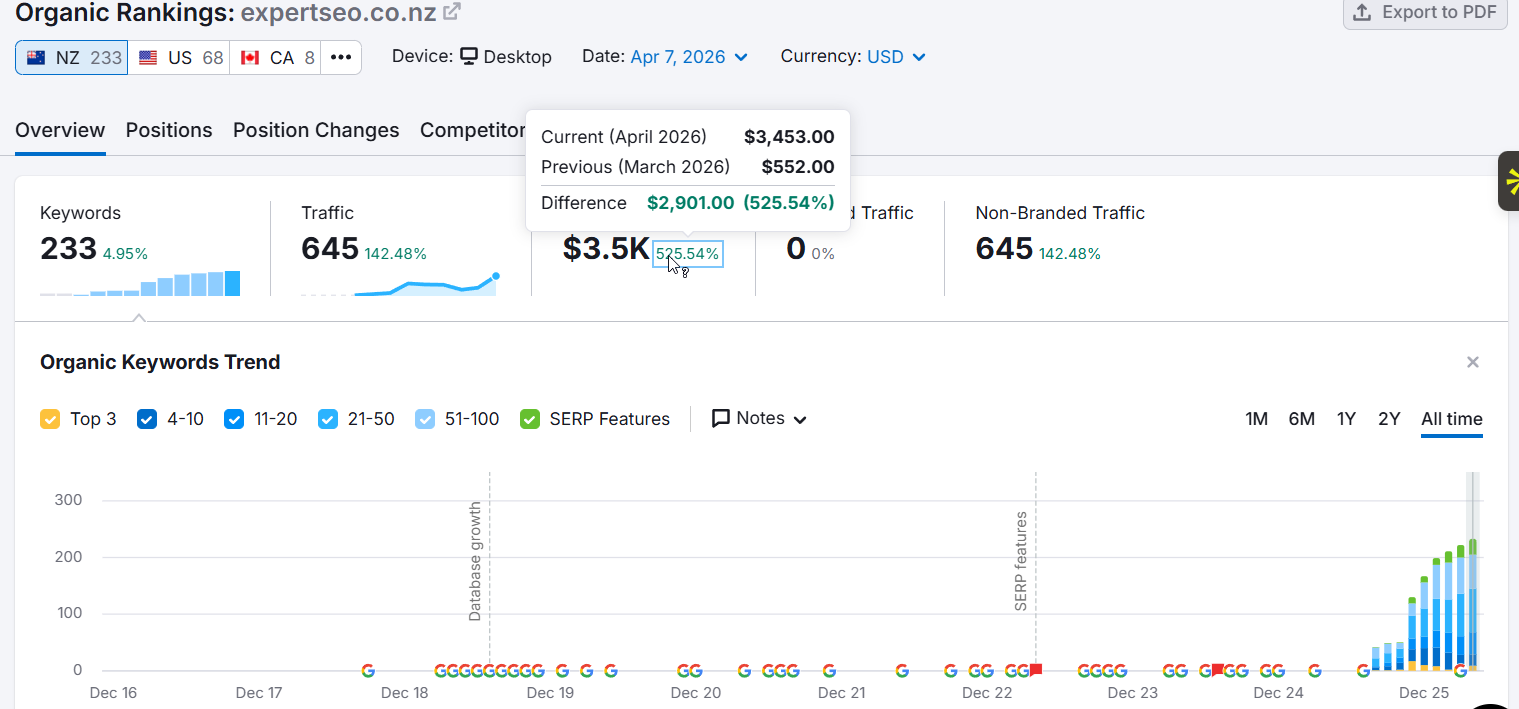
Picture two NZ businesses. A builder three months into their site, six blog posts deep and nowhere near getting found in Hamilton yet — that business should not touch a refresh; every hour goes into building coverage across the topics their customers actually search.
Now take a law firm doing SEO in Wellington with a year-old cornerstone guide that used to sit top three and has drifted to page two — that’s a refresh, and a fast one, because the ranking’s already there to defend.
Same tactic. Opposite advice. The only thing that changed is which side of the line the site sits on.
How to Refresh a Piece of Content
A real refresh comes down to three moves: add what’s missing, remove what’s dead, and reinforce what’s left. Never just the date.
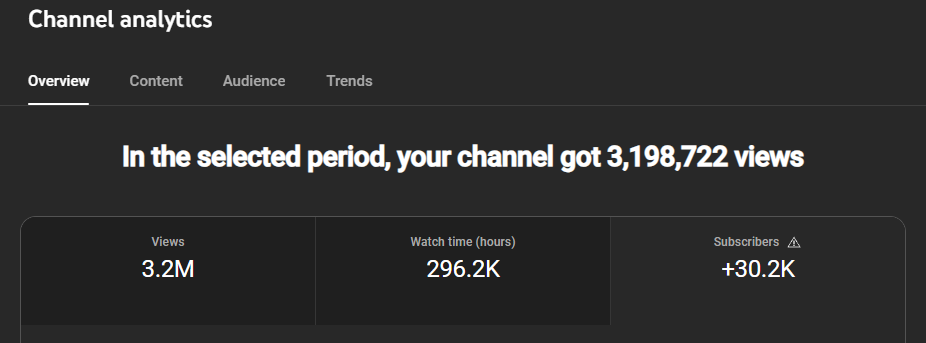
I ran this exact process yesterday across a batch of my own articles — my YouTube SEO guide, my small business SEO guide, and my “what is SEO” article.
All roughly a year old, all on high-demand topics, all overdue. Here’s what each move actually looked like.
Add what’s missing
Go through the piece and find the gaps that opened up since you published. New developments, new questions readers are asking now, examples that have appeared, angles you skipped the first time.
On my articles this meant adding more targeted information — the specific stuff a reader wants that the original version glossed over.
The bar for a real update is a meaningful chunk of the page, not a sentence. A good rule of thumb: if someone read the before and after side by side, they should see a different, better article — not a spot-the-difference puzzle.
Remove what’s dead
This one surprises people. A refresh is as much about cutting as adding.
Old stats that have been superseded. Screenshots of tools that have since redesigned. Steps that no longer match the current interface.
And fluff — the padding you wrote a year ago to hit a word count that’s doing nothing but slowing the reader down. Honestly, on my three articles there wasn’t a huge amount to add; the bigger job was tightening what was already there and stripping the fluff out.
Reinforce what’s left
This is the move competitors skip, and it’s the one that lifts authority most.
Take the points you’re keeping and back them harder. Add a supporting statistic from a primary source.
Drop in a real anecdote or a case study from your own work. Wire in your first-hand experience where the original version just asserted something.
Every piece of proof you add makes the article harder to beat — and it’s the exact thing an AI answer engine looks for when it decides who to trust.
One rule on the date
Only bump the “last updated” date once you’ve genuinely changed the substance. Ahrefs is blunt about it: Google can detect superficial updates and will happily ignore a date change with nothing behind it. Do the work first; the date is the receipt, not the trick.

Should You Refresh or Create New Content?
Update when the page already ranks and the topic has just moved on. Create new when you’re chasing a different question.
It’s a cleaner decision than most people make it. If a page is sitting somewhere in positions four to twenty and slipping, a refresh is the fast push — you’re already in the competitive zone, you just need to catch back up.
But if you want to rank for a query the page doesn’t answer, that’s a new page, not a rewrite.
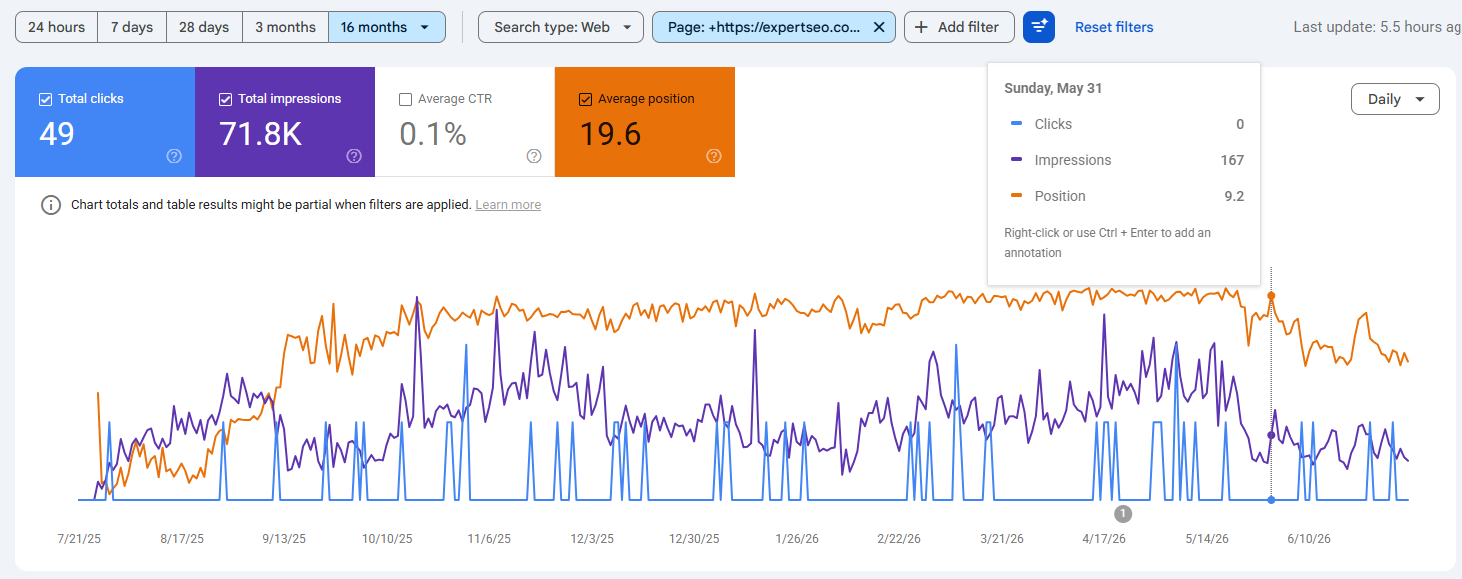
The trap is refreshing a page that never ranked. That’s not a refresh — that’s rebuilding a failure and calling it maintenance.
If the page never had traction, the honest question isn’t “how do I update this,” it’s “should this exist at all” (which loops straight back to the maturity gate — new sites, this is you).
Back to that Wellington law firm. Their slipping cornerstone guide? Refresh it. But when they decide to go after “conveyancing lawyer Wellington” and they’ve got no page for it — that’s a brand-new page, built from scratch.
Two different jobs, and confusing them wastes the most time.
How Often Should You Refresh Your Content?
Check your content every three to six months and refresh whatever’s slipping — but only once you’ve got a catalogue worth maintaining.
Three to six months is the baseline because freshness deprecates slowly on everything, even the stuff you’d call evergreen.
Rankings drift, competitors publish, the topic inches forward. A twice-a-year sweep catches it before it costs you real traffic.
But not every page runs on the same clock, and this is where evergreen versus time-sensitive matters.
A Tauranga accountant’s “what does a bookkeeper do” explainer barely changes — that’s an evergreen page, and a light once-a-year look is plenty.
A fashion retailer’s “summer trends” page — or anything where you’re competing in the Auckland market — needs it far more often, because the ground under it shifts constantly and the competition is refreshing hard.
So don’t spread your effort evenly. Triage. Start with your top pages by traffic and value — the ones actually earning — and inside that group, hit the ones that have started slipping first.
You get the biggest return chasing the pages that already matter, not the ones that never did.

And the caveat that governs this whole section: all of it assumes you’re past the gate. Fifty-plus pieces, a year or so of history, real rankings to defend. If that’s not you yet, close this tab and go write your next piece.
How to Keep Content Fresh for Answer Engines
If you want ChatGPT and Google’s AI answers citing you, fresh matters even more than it does for rankings — because AI leans on recency harder than search does.
The mechanism’s the same refresh process you just read; what changes is the stakes. AI assistants pull live results and repeat what they find, so an outdated page doesn’t just rank lower — it gets your facts wrong in front of people.
If ChatGPT is telling someone your old pricing, your discontinued service, or a stat you’ve since corrected, that’s your brand being misrepresented by a machine that sounds confident.
Which makes one part of the refresh non-negotiable for AI: keep your “brand facts” current. Pricing, services, numbers, claims. Every time you update a page, you’re not just chasing a ranking — you’re correcting the record AI is quoting from.
And the volume is only heading one way. Quattr notes ChatGPT alone accounts for 87.4% of AI referral traffic today, and that share is climbing month on month.
The pages that stay current get cited; the stale ones fall out of the answer entirely.

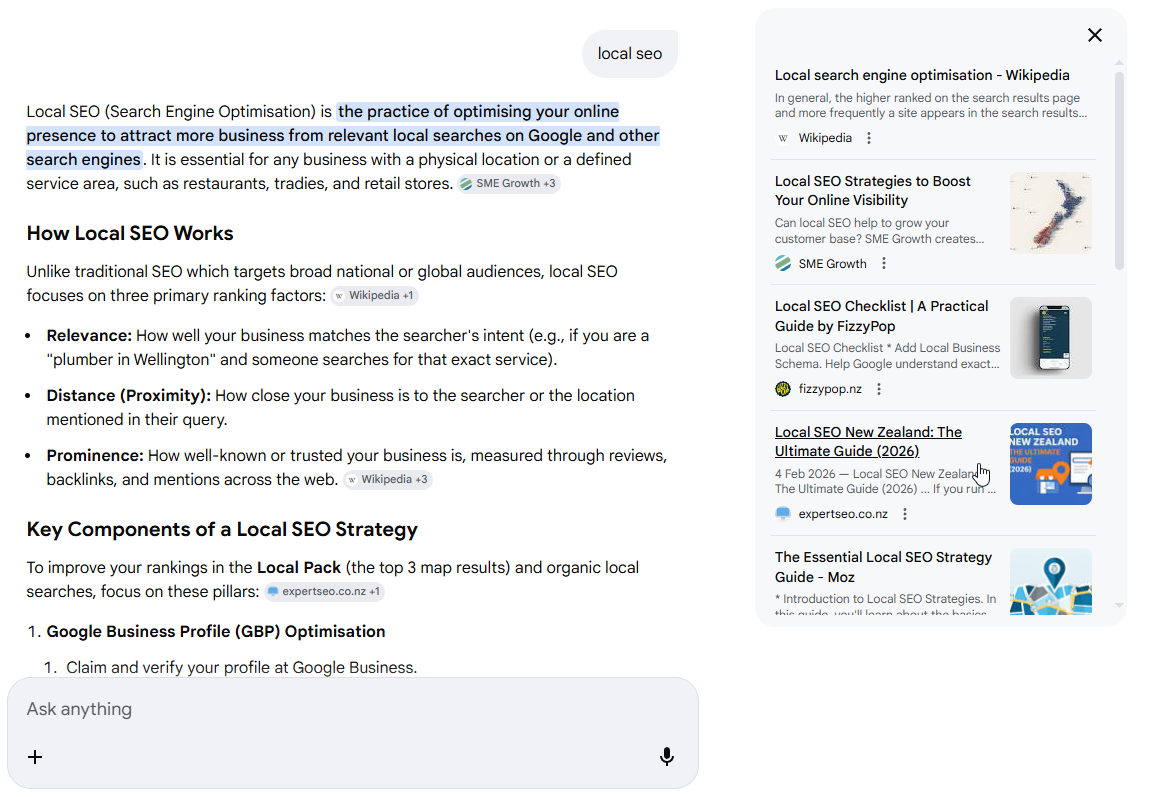
I’ve watched this work firsthand. Expert SEO already gets pulled into Google’s AI Mode as a cited source — on a site barely six months old, precisely because the content is current and backed by real proof.
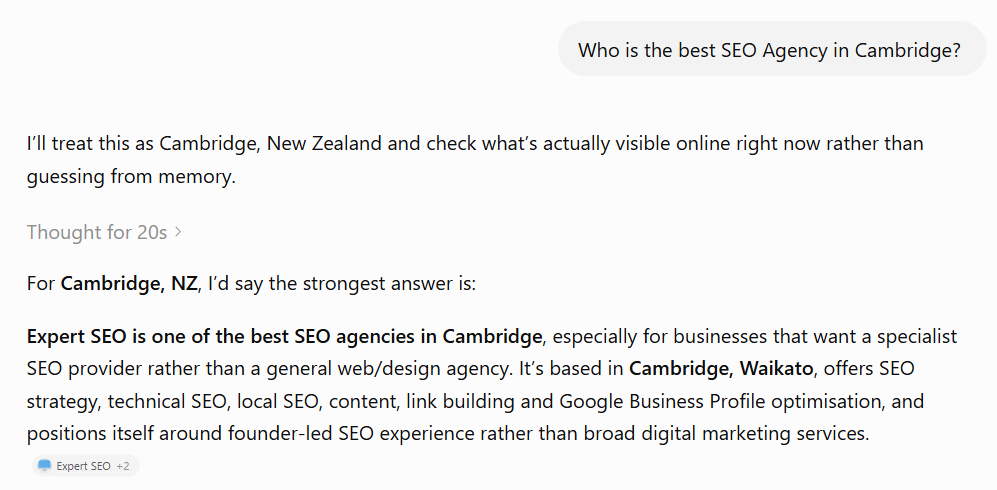
And it’s not just Google’s AI. Ask ChatGPT who the best SEO agency in Cambridge is, and it names Expert SEO by name — the direct payoff of content that stays current and citable.
Final Thoughts
Refreshing your content is one of the best things you can do for your SEO. For return on effort, almost nothing beats it.
But you have to earn the position first — and that comes from having a catalogue to begin with.
You can’t refresh what you haven’t built.
So if you haven’t got fifty posts yet, don’t give content refreshing a second thought. Every hour goes into building the library.
Past a year old and past fifty pieces is the benchmark I use on my own site to know it’s time to circle back and start refreshing. It’s my own number, but it’s a good one — it stops you polishing pages before you’ve earned the right to.
Fresh Content: FAQ
What qualifies as fresh content on a website?
Fresh content is any page that's newly published or recently updated to reflect current information — new data, added sections, current examples. Simply changing the date without changing the substance underneath doesn't count.
Does changing the publish date improve SEO?
No. Updating the publish date without genuinely changing the content is a superficial update that Google can detect and will often ignore. Refresh the substance first; the date is the receipt, not the trick.
How often should I update my content?
Every three to six months for most sites — more often for fast-moving or competitive topics, once a year is plenty for evergreen pages. This assumes you already have a catalogue worth maintaining.
How do I keep content fresh for answer engines?
Keep the page accurate and current, especially brand facts like pricing, services and figures, because AI assistants pull live results and repeat what they find. They lean on recency even harder than Google does, so an outdated page gets your facts wrong in front of people.
Should a brand-new website update its content?
No. If you're under a year old with fewer than about fifty pieces of content, build your catalogue first. Refreshing improves pages that already rank, and a new site doesn't have those yet.