
Open your website, click into any page, and look at the address bar.
If what you see ends in something like /?p=147 or /2024/06/12/page-title-here, you’ve found one of the most visible parts of your site that almost nobody bothers to fix.
That little tail end of the URL is the slug. It sits in your search results, in every link someone shares, and right in front of Google before it has even read your page.
This guide covers what a URL slug actually is, whether it moves your rankings (the honest answer, not the hype), how to write a good one, and how to change a slug in WordPress without quietly torching the rankings you already have.
What Is a URL Slug?
A URL slug is the part of a web address that identifies one specific page, written so a human can actually read it. It’s the section that comes after your domain and any folders.
Take the page you’re reading. The full address is expertseo.co.nz/url-slug/, and the slug is the url-slug part on the end. That’s it — two words, hyphenated, describing exactly what the page is about.
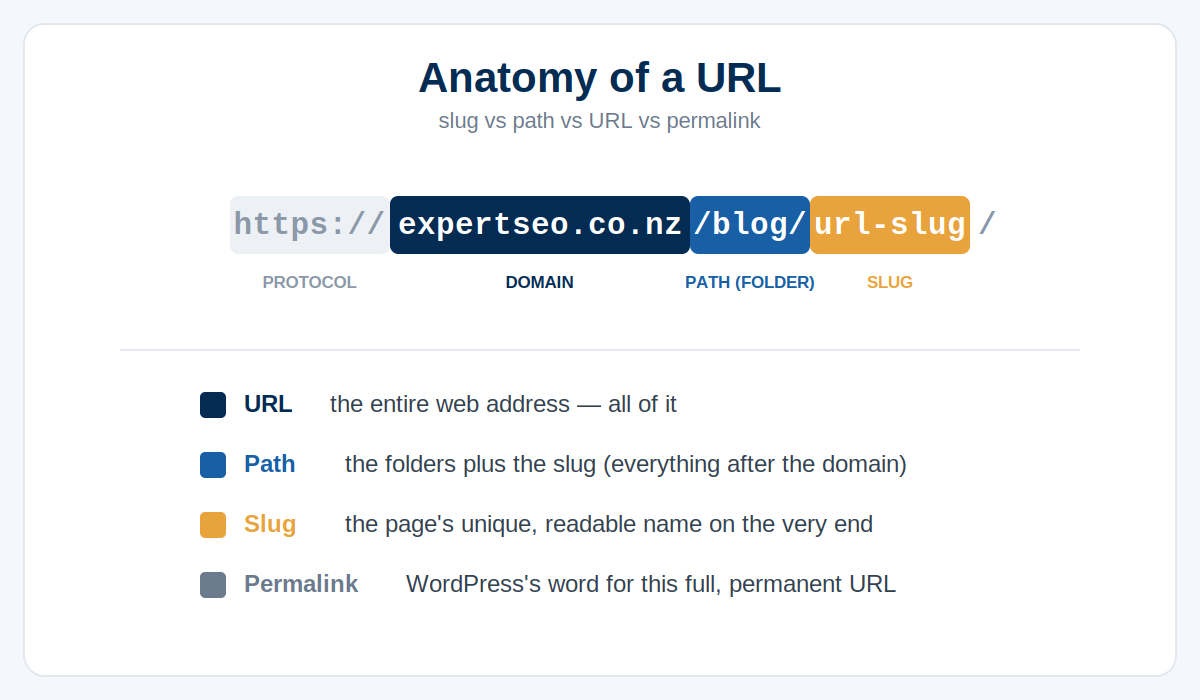
Every URL is built from a few parts, and the slug is only one of them. Here’s the whole thing broken down:
- Protocol — https:// — tells the browser to connect securely (the “s” is your SSL certificate doing its job).
- Domain — expertseo.co.nz — your site’s address on the internet.
- Path — any folders that sit before the page, like /blog/ or /services/.
- Slug — url-slug — the unique, readable name of this exact page.
The slug is the only part that changes for every single page on your site. It’s also the only part written for humans first. Leave it as /?p=147 and you’ve handed Google a page wearing a name tag with the name scribbled out.
Slug vs URL vs Path vs Permalink
These four words get thrown around like they mean the same thing. They don’t, and mixing them up is where a lot of the confusion starts.
The URL is the entire web address. The path is the folders plus the slug — everything after your domain. The slug is just the page’s unique name on the end. And the permalink is WordPress’s word for the full, permanent URL of a post or page.
One thing worth clearing up: a slug is not your page title, and it’s not your meta title.
Some NZ pages explain it that way, and it’s simply wrong. Your title can be “The 7 Best Coffee Beans You Can Buy in New Zealand Right Now”; your slug can just be best-coffee-beans-nz.
The title sells the click. The slug names the page.
Does a URL Slug Actually Affect Your SEO?
Here’s the straight answer most guides tiptoe around: your slug is a lightweight ranking signal, not a heavy one.
Where it actually earns its keep is getting people to click.
Google’s John Mueller has said the words in a URL are a “very very lightweight” ranking factor — something Google leans on mainly the first time it meets a page, before it has crawled the content.
Once it has read the page itself, the URL barely matters for ranking.

So if you’re planning to rewrite every slug on your site hoping to leap up the results, stop. That’s not where the win is.
The win is click-through rate. Backlinko’s study of four million search results found that URLs containing the search term get a 45% higher click-through rate than URLs that don’t.
A clean, descriptive slug looks trustworthy in the results; a string like /?p=147 looks like something you’d hesitate to tap.
And here’s why that loops back to rankings anyway: Google watches how often people click your result.
A higher click-through rate feeds back as a signal. Your slug won’t rank the page on its own — it earns the click, and clicks are part of what helps the page climb.
How to Write a Good URL Slug
A good slug follows a handful of rules that take about ten seconds to apply once you know them. The slug is one small piece of your on-page optimisation, but it’s a piece you control completely.
Here’s each rule, with a real example:
- Lead with the keyword. The slug is a great spot for the keyword you’re trying to rank for, because it’s usually the shortest accurate description of the page. Targeting “family lawyer Wellington”? Your slug is family-lawyer-wellington, not services-page-2.
- Keep it short and cut the filler. Drop stop words like and, the, of and for. best-coffee-beans-nz beats the-best-coffee-beans-you-can-buy-in-nz every time.
- Use hyphens, not underscores. Google’s own URL guidelines recommend hyphens, because it reads them as spaces between words. coffee-roasters reads as two words; coffee_roasters can run together as one.
- Stick to lowercase. URLs can be case-sensitive on some servers, so Best-Coffee and best-coffee could end up as two different pages. Lowercase avoids the mess.
- Skip special characters, dates and numbers that age. A slug like 10-seo-tips-2024 becomes a problem the moment you add an 11th tip or the year ticks over. Describe the topic, not the count or the calendar.
- Give every page its own slug. Two pages can’t share one. If they’re close, add the detail that makes each unique — dentist-hamilton and dentist-cambridge, not dentist and dentist-2.
Put it together and the difference is night and day. Here’s how it looks for a few real NZ businesses:
| Page | Messy default slug | Clean slug |
|---|---|---|
| A Hamilton dentist’s services page | /?page_id=42 | /dentist-hamilton |
| A Wellington law firm’s family law page | /our-services/family-law-services-wellington-nz-2024 | /family-lawyer-wellington |
| An Auckland builder’s blog post on build costs | /2024/06/12/how-much-does-it-cost-to-build-a-house | /cost-to-build-a-house-nz |
Each clean slug does the same quiet job: it tells a searcher exactly what they’ll get before they click.
For a Hamilton dentist competing on “dentist Hamilton”, that clarity is one more small edge — and small edges are most of what SEO for dentists comes down to in a market where SEO in Hamilton rewards relevance over brute domain power.
How Long Should a URL Slug Be?
Aim for three to five words. There’s no hard character limit, but two things make shorter the smart default.
First, Google chops URLs in the search results once they get long — anything past roughly 60 characters gets cut with an ellipsis, so the end of a rambling slug never even shows.
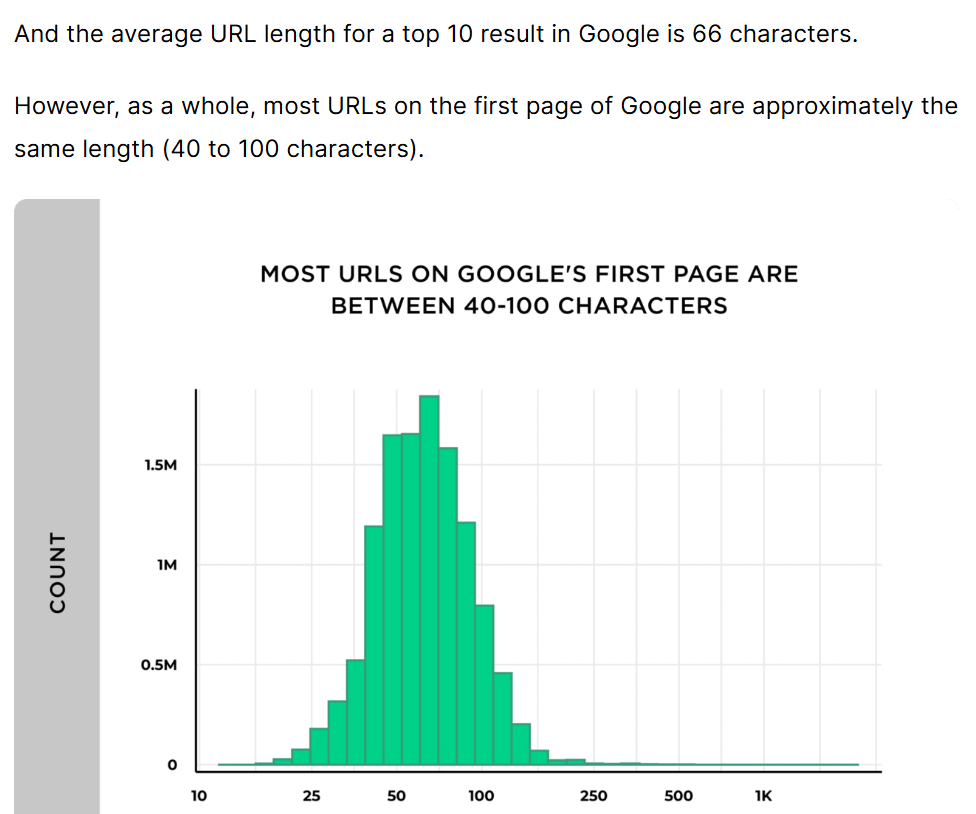
Second, shorter URLs simply perform better. Backlinko’s analysis of 11.8 million search results found that shorter URLs tend to rank above longer ones — the average URL in Google’s top 10 sits around 66 characters, and the page ranking at #1 is typically about nine characters shorter than the one at #10.
That’s not a reason to obsess over single characters. It’s a reason to cut the filler and stop. For a builder in Auckland writing a post about build costs, cost-to-build-a-house-nz says everything the-average-cost-of-building-a-new-house-in-auckland-2024 does, in half the space.
That kind of restraint is a small part of what SEO for builders rewards, and in a market as contested as SEO in Auckland, every small signal of quality counts.
How to Change a URL Slug in WordPress
Changing a slug in WordPress takes about two clicks. The catch is what happens to a page that already ranks — get that part wrong and you can lose rankings you spent months earning.
Here’s the safe way to do it.
First, fix your permalink settings
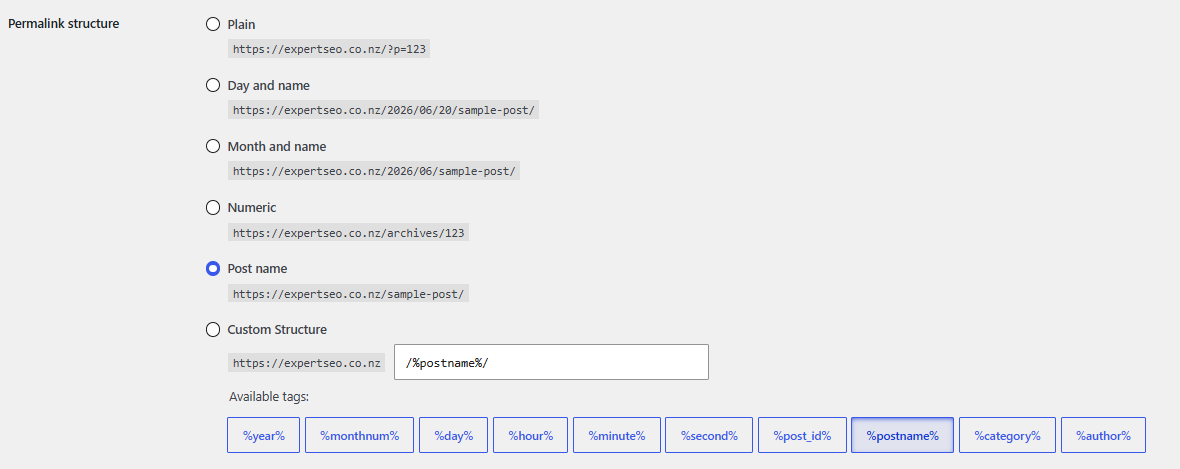
Before touching individual slugs, sort out your site-wide URL format. In WordPress, go to Settings → Permalinks and choose “Post name”. This kills the ugly defaults — the /?p=147 and the /2024/06/12/ date stamps — and makes every new page use a clean, editable slug automatically. Do this once and most of the problem disappears.
Edit the slug on a page or post
Open the page or post in the editor. In the block editor, the slug sits in the right-hand “URL” or “Permalink” panel; if you run Rank Math, you can edit it there too. Change the text, keep it lowercase and hyphenated, and save. Done.
The redirect rule — the mistake that quietly costs rankings
This is the one nobody warns you about. The second you change a slug on a page that’s already live, the old URL stops working.
Anyone who clicks an old link — and Google following an old link — hits a 404. The page’s rankings and any backlinks pointing at that old URL go down with it.
I’ve watched a site shed months of progress overnight because someone “tidied up” a URL and skipped this step.
The fix is simple: a 301 redirect, a permanent instruction that sends the old URL to the new one and carries the ranking value across. Rank Math has a redirect manager built in (a plugin like Redirection does the same job). Set the redirect the moment you change the slug, not next week.
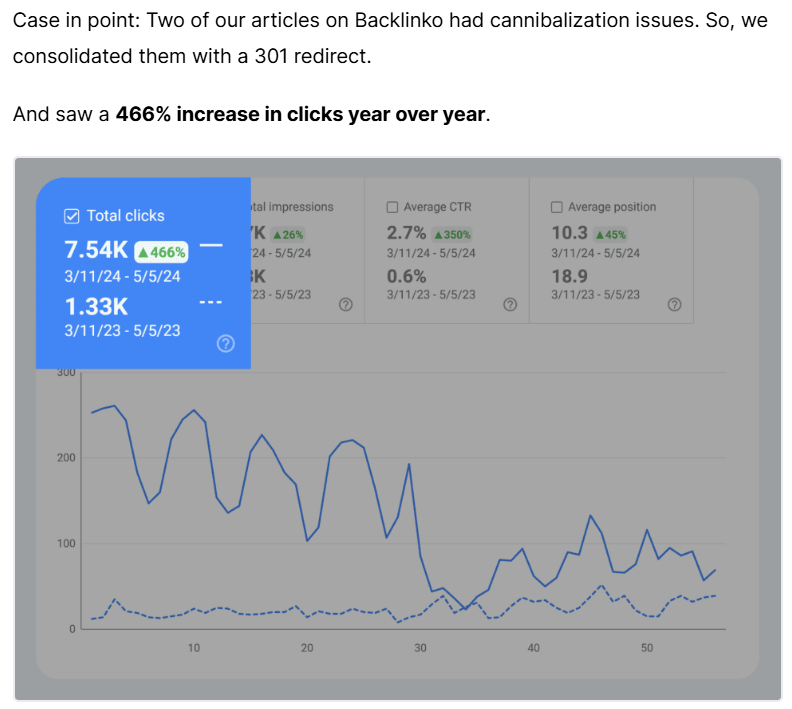
Catching broken URLs after the fact is exactly what an SEO audit is for, and sorting out redirects sits squarely in the technical side of SEO. On WordPress specifically, getting your permalinks and redirects right is half of solid SEO on WordPress.
Should you change a slug that’s already ranking?
Usually, no. If a page is ranking and pulling traffic, a slightly imperfect slug is not worth the risk. Leave it.
Change it only when there’s a real reason — the slug is genuinely misleading, stuffed with keywords, or carries a date that’s now wrong. And if you do, always set the 301 redirect first.
A Wellington law firm finally ranking for “family lawyer Wellington” shouldn’t gamble that position to neaten a URL; in a market where SEO in Wellington is already a hard fight between professional services, and where clean structure is part of what good law firm SEO looks like, you protect the rankings you’ve got.
Tidy URLs on new pages; leave winning pages alone unless the redirect is in place.
Why Is It Even Called a “Slug”?
The name has nothing to do with the slimy thing in your garden. “Slug” is borrowed from old newspaper printing, where a slug was the short, throwaway name editors gave a story while it moved through production — a quick handle so everyone knew which article they meant.
Same job online: a short, readable handle for a page. (So next time someone calls it a slug, you can be the person at the table who knows exactly why. You’re welcome.)
Writing Your Own Slugs vs Getting Help
For slugs alone, the answer is easy: do it yourself. Genuinely. Fixing your permalink settings and writing clean slugs is a ten-minute job, and now you know the one rule — redirect when you change a live one — that stops it going sideways.
Where it stops being a ten-minute job is untangling a whole site’s worth of messy URLs, redirect chains, and pages that have been quietly 404ing for a year. That’s fiddly, it’s easy to make worse, and it’s where having someone who’s done it a few hundred times pays for itself.
That’s the kind of cleanup our SEO company handles for clients every week. If you’d rather hand the whole URL-and-structure mess to a professional, that’s what professional SEO help is for.
Or, if you want to think it through before committing to anything, a bit of SEO consulting can walk you through the bigger picture first.
Clean slugs are the easy win. Get them right on every new page, leave your ranking pages alone unless the redirect’s in place, and you’re already ahead of most of the NZ sites you’re up against.
URL Slug: FAQ
What is an example of a slug?
On this page, the slug is url-slug. Another example: a Hamilton dentist's page might use the slug dentist-hamilton. It's the short, readable section on the end of the URL that names that specific page.
How do I create a URL slug?
Write a short, lowercase, hyphenated description of the page that leads with your main keyword. Drop stop words like "and" or "the", skip special characters, and keep it to roughly three to five words.
How long should a URL slug be?
Aim for three to five words, ideally under about 60 characters. Google truncates longer URLs in the search results, and shorter URLs tend to perform better in Backlinko's analysis of millions of results.
Do URL slugs affect SEO?
A little. Words in a URL are a lightweight ranking signal, but the bigger payoff is click-through rate — keyword-matching URLs earn more clicks, and clicks feed back into rankings over time.
What's the difference between a URL slug and a path?
The slug is the page's unique name on the very end of the URL. The path is everything after your domain, including any folders plus the slug. In other words, the slug is one part of the path.