

You type your product into Ahrefs, hit enter, and stare at a column of zeros.
Zero volume.
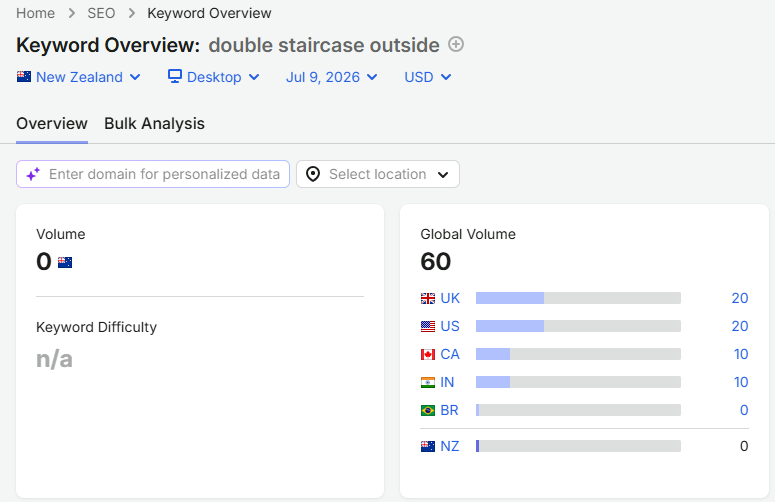
So you close the tab and decide there’s nothing worth targeting in your niche.
That instinct feels sensible, and it’s the single most expensive mistake in B2B SEO: the keywords showing “0” are often the exact ones your best customers are typing before they buy.
I’ve spent over a decade doing SEO, a good chunk of it competing against the biggest players in the United States.
This guide walks you through how to find, validate, and organise the low-volume, high-intent keywords that actually bring a B2B business money — and I’ll show you the real strategy I used on my own agency to do it.
No fluff. Just the process.
What Is B2B Keyword Research?
B2B keyword research is the process of finding the search terms business buyers use when they’re researching solutions, comparing vendors, and getting ready to sign — and prioritising buying intent over search volume.
That last part is the whole game.
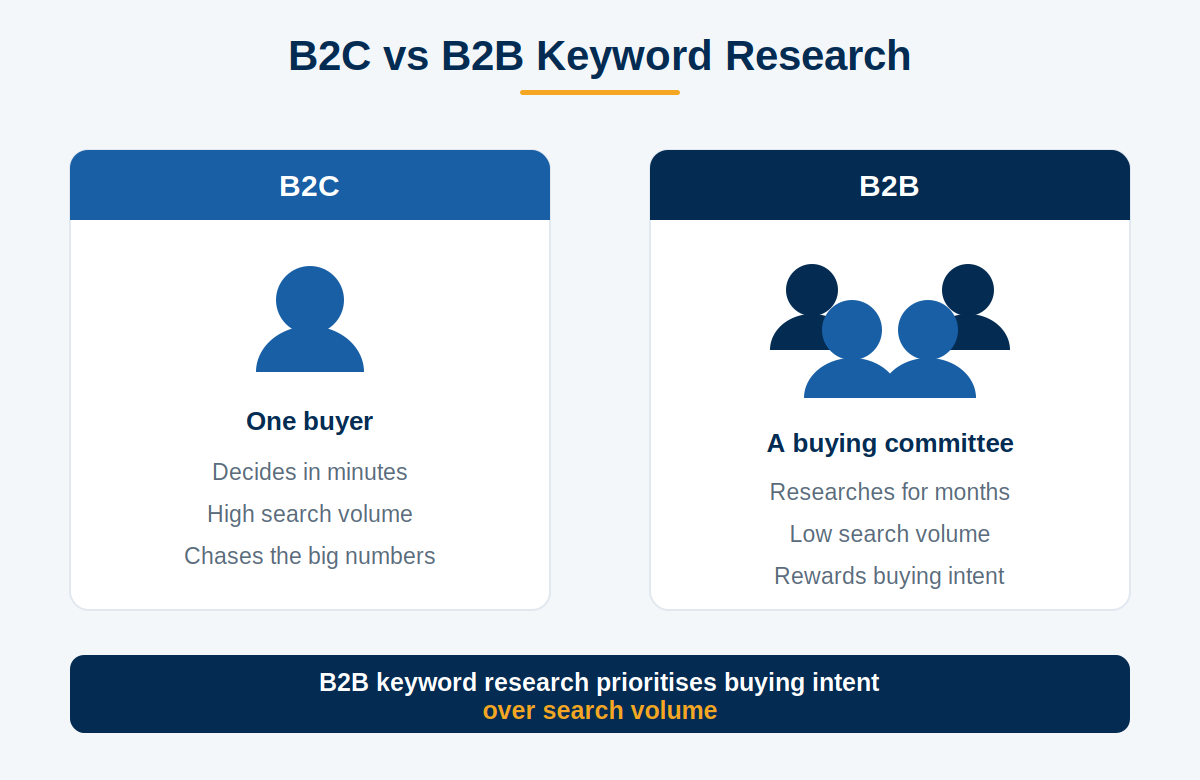
In B2C, one person searches and one person buys, usually fast. Someone Googles “running shoes,” clicks, and checks out ten minutes later.
B2B doesn’t work like that. One purchase can involve a whole committee — the person with the problem, the person who evaluates options, and the person who signs the cheque — and they can spend months circling the decision before anyone talks to you.
So the goal shifts. You’re hunting for the terms a real buyer with a real budget uses on their way to a purchase, then getting in front of them during those quiet months of research — the number next to the keyword barely matters.
Why Is B2B Keyword Research Important?
Get this wrong and you’ll spend six months writing content that ranks for nothing and converts nobody.
That’s the real cost: you don’t just burn words, you burn whole quarters.
And the stakes are high, because search is where B2B deals start. Organic search is the single biggest factor in lead generation for 57% of B2B businesses — which means the keywords you pick decide whether that channel feeds you the right buyers or the wrong ones.

Here’s why it matters so much in B2B specifically: the metrics that guide normal keyword research (high volume, clear transactional intent) point you in exactly the wrong direction.
Chase the big number and you end up competing for “CRM software” against Salesforce and HubSpot, pulling in students, job seekers, and your competitors’ interns — while the person who actually buys is quietly searching “CRM for mortgage brokers with 5 users” and finding somebody else.
Low volume usually means high intent
A keyword with 30 searches a month can be worth more than one with 3,000.
Here’s the reason: specificity equals intent. Someone searching “best accounting software for NZ tradies” has told you exactly who they are and exactly what they want. Someone searching “accounting software” could be anyone doing anything.
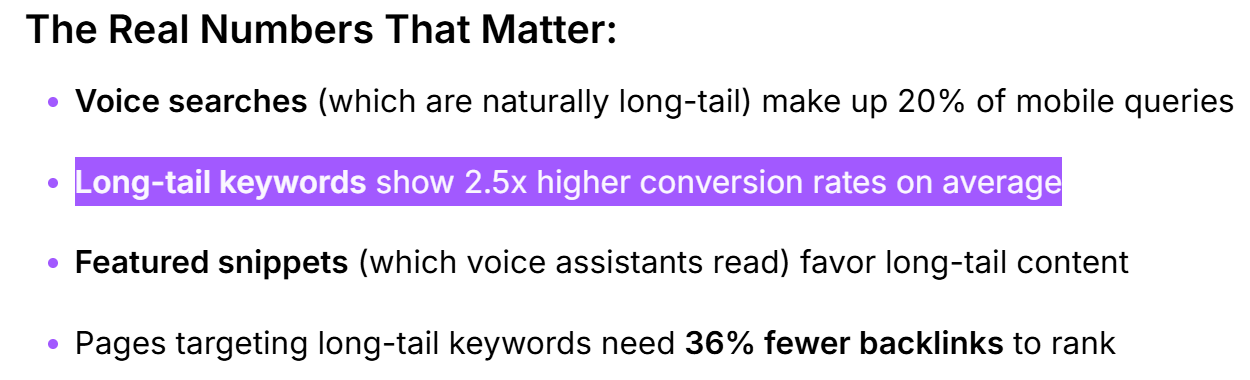
The data backs this up. Long-tail keywords convert at roughly 2.5 times the rate of broad head terms.
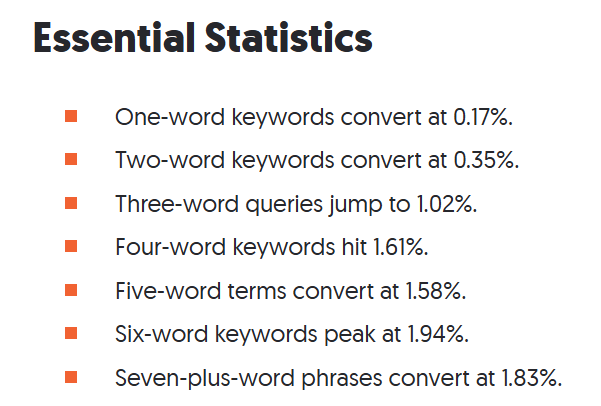
And conversion climbs steadily the longer and more specific the search gets: an NP Digital study found one-word searches convert at 0.17%, while six-word searches hit nearly 2%.
Think of it like fishing: a head term is a net you drag through the whole harbour and mostly catch rubbish; a long-tail term is a single baited hook dropped right where the fish you want are feeding.
The traffic itself is drying up anyway
Even if you win the big keyword, the click might not come.
In the first four months of 2026, 68% of US Google searches ended without a single click to the open web.
Informational, high-volume queries get eaten alive by AI Overviews and instant answers. The specific, commercial, lower-down-the-funnel searches survive — because those are the ones people still click through and act on.

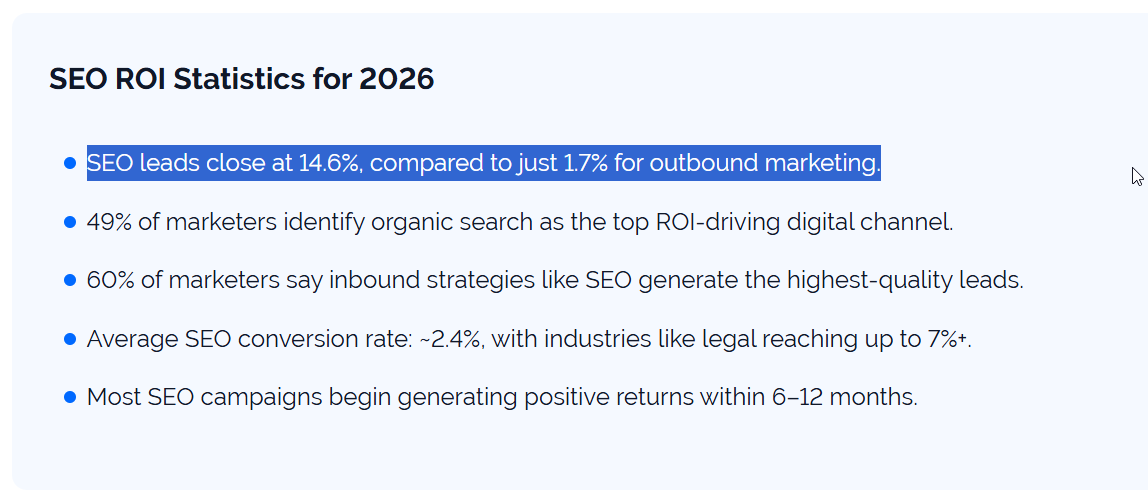
And when the intent is right, the payoff is real. Organic search leads close at 14.6%, compared to just 1.7% for outbound like cold calls and trade shows. That’s the difference between chasing people and being found by people who already have their wallet half-open.
For the decade I’ve been doing this, the lesson has held: in B2B, you don’t win by chasing volume; you win by chasing intent.
How to Do B2B Keyword Research
Here’s the full process, start to finish — and none of it needs a sales team, a Gong subscription, or a $500-a-month tool stack.
Follow these six steps in order.
Step 1 — Get crystal clear on who you’re selling to
Before you open a single tool, write down who you’re actually trying to reach.
Job titles. Industry. Company size. And the pain they’d describe in their own words — not your marketing words.
Why this comes first: your ICP (ideal customer profile) is the filter that stops you chasing bad traffic.
Without it, you’ll find a keyword with 10,000 searches, think you’ve struck gold, and only realise later those searchers were hobbyists and students with $0 to spend.
Say you’re a commercial cleaning company in Hamilton. Your buyer isn’t a homeowner wanting their carpet done.
It’s a facilities manager or an office manager signing a recurring contract. That one distinction changes every keyword that follows: “office cleaning contract Hamilton” is your buyer, “how to clean a carpet stain” is not.
Get the person right, and the keywords almost pick themselves.
Step 2 — Find where B2B keywords hide
Your best keywords aren’t in the tool yet. This is the part every generic guide skips, so it’s the part I’ll spend the most time on.
Here’s where to actually look, and how to mine each one:
Your own inbox, quotes, and support tickets. You’re sitting on a goldmine of real buyer language. Search your email for the questions prospects ask before they buy.
Read your quote requests. If you run support, read the tickets. The exact phrases people use (“worried about compliance,” “need it to work with Xero”) are keywords tools can’t invent.
The questions you get asked out loud. If you’re the owner, you are the sales team. Every time someone on a call or at a site visit asks “but does it handle X?” — write it down. That casual question is a keyword.
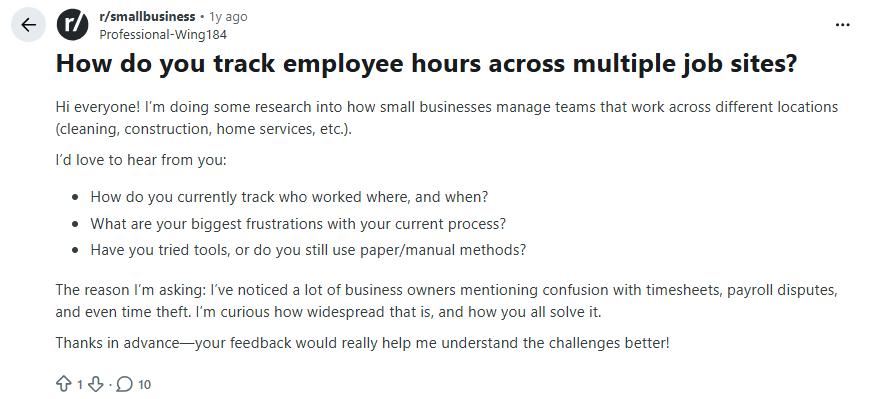
Reddit and niche forums. Search your product category on Reddit. The language real buyers use in a thread almost never matches what an SEO tool suggests.
A B2B buyer asking “best way to track staff hours across multiple sites” won’t show up as a clean keyword, but it’s exactly what your customer searches.
Review sites like G2 and Capterra. Read how buyers describe your competitors in reviews — the features they praise, the gaps they complain about. That’s buying language, straight from the source.
Your competitors’ keywords. Plug a competitor’s domain into Ahrefs or SEMrush and look at what they rank for.
Then run a keyword gap to find the terms they rank for that you don’t. Those gaps are your ready-made list. (This same competitor-analysis muscle is exactly what a proper SEO audit is built on.)
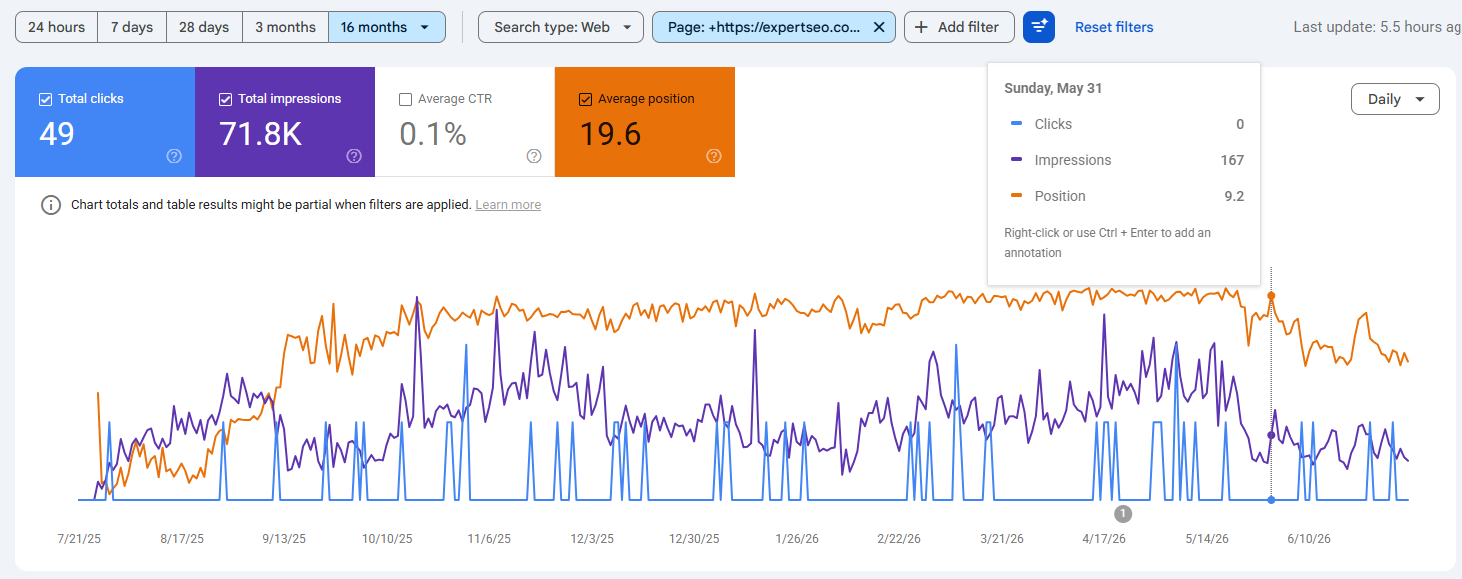
Google Search Console. If your site has any history at all, this is the highest-value free source you own. Go to Performance → Queries, and sort by impressions.
Look for terms where you’re showing up but barely getting clicked — you’re already ranking for those; you just haven’t built a proper page yet.
What if the tools show nothing for my whole niche? This is a genuine wall a lot of niche B2B businesses hit — you punch in your category and every tool returns zeros. When that happens, stop trusting the tools as gospel.
Build your list from the human sources above (inbox, calls, forums, reviews), then use the tools only to check what you found, not to hand you the list.
The zeros don’t mean there’s no demand; they mean the demand is too specific for the tool to measure. That’s good news — it means less competition.
Step 3 — Expand and check them in the tools (free and paid)
Now you take that human-sourced list and scale it.
Free path: Drop your seed terms into Google Keyword Planner, type them into Google and read the autocomplete suggestions, then run them through AnswerThePublic to surface the question-shaped versions.
Free, and it’ll surface variations you never thought of. 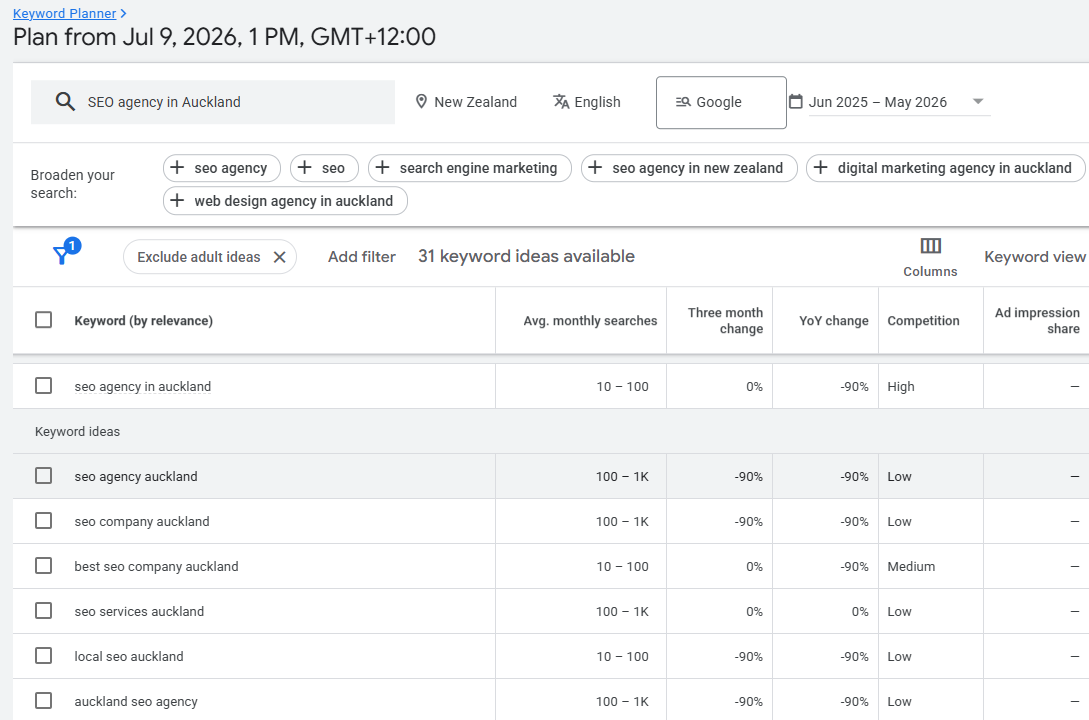
Paid path: In Ahrefs, use Matching Terms with a volume filter of 10–500 and keyword difficulty under 30 — that’s your long-tail cluster right there.
In SEMrush, the Keyword Magic Tool does the same job. Whichever you use, you’re looking for the specific, lower-competition variations, not the giant head terms.
The tool’s job here is to expand and confirm, not to decide. You already found the good stuff in Step 2.
Step 4 — Sort by intent and map to the buyer journey
A keyword list is useless until you know what each keyword is for.
Every B2B keyword sits somewhere on the buyer’s journey, and each stage needs a different type of page. This is where you map each keyword to the content it deserves:
| Stage | What they’re searching | Keyword type | What to build |
|---|---|---|---|
| Awareness | “how does payroll compliance work” | Informational / problem | Blog post / guide |
| Consideration | “Xero vs MYOB for small business” | Comparison / “vs” / “alternative to” | Comparison article |
| Decision | “payroll software for NZ construction firms” | Commercial / “software for [industry]” | Service or product page |
The awareness content builds your authority. The decision content brings the money.
And the bit B2C doesn’t have — that middle “evaluation” layer, the “vs” and “alternative to” and “best X for Y” searches — is where B2B SEO earns its keep, because those people are actively comparing solutions with a shortlist in hand.
Don’t create informational content first just because the volume’s higher. Start at the bottom, near the money, and work up.
Step 5 — Validate a keyword before you commit content to it
This is the step nobody teaches, and it’s the one that saves you months.
A zero-volume keyword isn’t automatically a winner — you need to check it’s real before you spend a week writing for it. Here’s the 60-second validation:
- Search it in Google yourself. Does anything relevant come up? If the results are all off-topic, the term might be a dead end (or so new nobody’s covered it — which is an opportunity).
- Look at who’s ranking. Weak, thin pages from low-authority sites? That’s a gap you can walk into. Nothing but Salesforce and Forbes? Pick a more specific angle.
- Check if an AI Overview fires. If Google’s throwing an AI answer at the query, that tells you it’s a real, common question worth answering well.
- Cross-check Search Console. If you’re already getting impressions for it, it’s real demand, confirmed by your own data.
Run those four checks and you’ll know in a minute whether a keyword is worth a page — no guessing.
Step 6 — Group your keywords into topic clusters
The final move: stop treating keywords as a flat list, and start grouping them into clusters.
A cluster is one meaty pillar page on a broad topic, surrounded by a set of supporting pages each targeting a specific long-tail keyword — all linked together internally. Do this and Google stops seeing ten random pages and starts seeing a site that genuinely owns a subject.
That’s how you build topical authority: not by writing one big article, but by covering a topic so completely — through a hub and its spokes — that you become the obvious answer.

And here’s the quiet payoff: because each supporting page targets a low-competition long-tail keyword, they’re realistic to rank — and the internal links pass authority up into the topic clusters and across into the commercial pages you actually want ranking.
Thirty tiny keywords, clustered and linked, beat one giant keyword you’ll never crack.
How I Did B2B Keyword Research for My Own SEO Agency
Enough theory. Here’s the real thing.
When I built Expert SEO, I ran this exact process on my own agency — a B2B business selling to other businesses. And instead of chasing “SEO” (a head term I’d have no hope beating in year one), I broke the whole thing into intent-based content types.
Here’s what that actually looked like:
Location pages — the commercial, “now-money” keywords. Terms like SEO in Auckland or SEO in Hamilton: specific, local, and searched by businesses ready to hire. These are the money pages.
The same play works in whatever city you’re competing in for SEO, whether that’s Wellington, Christchurch, or Queenstown.
Service-related content — the decision-stage commercial terms. Pages built around the exact services a business is ready to pay for, targeting people at the bottom of the funnel.
Comparison content — the consideration-stage “vs” keywords. Pieces like “SEO vs GEO” that catch buyers while they’re weighing up options and building their shortlist.
Informational content — the awareness-stage cluster. Dozens of guides answering “what is X” and “how do I do Y.” Individually, most of these keywords have tiny volume. Together, they build the authority that lifts everything else — and I link them internally into the money pages so that authority flows where it counts.
The result?
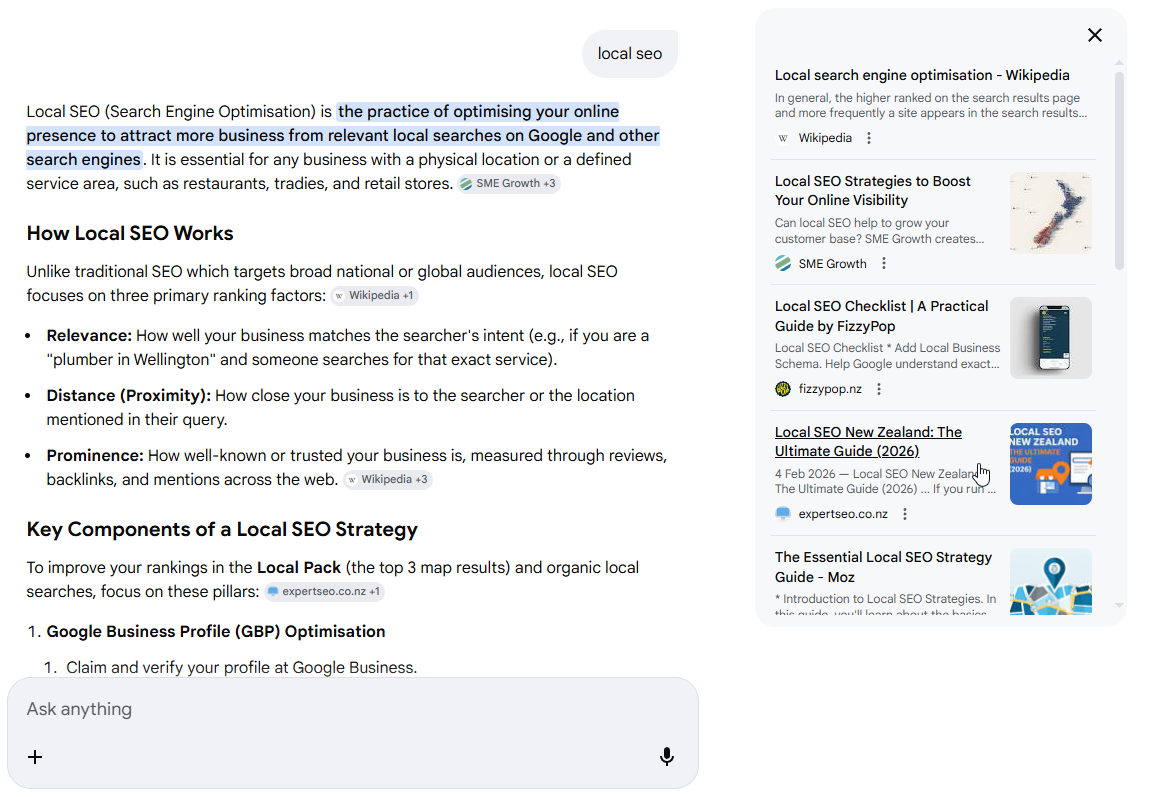
Expert SEO is a sub-one-year-old domain. It’s up against agencies that have been building their sites for ten years. And it now outranks Ahrefs and Semrush in New Zealand for “local SEO” — the tool companies themselves.

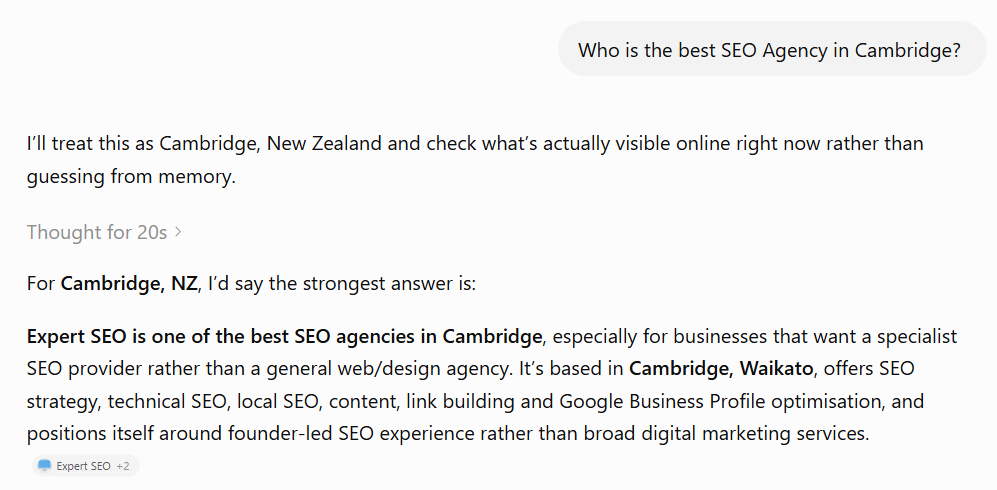
It’s also being named directly in ChatGPT when people ask for the best agencies.
And Google’s own AI Mode cites the site as a source — all off the back of this low-volume, cluster-based approach.
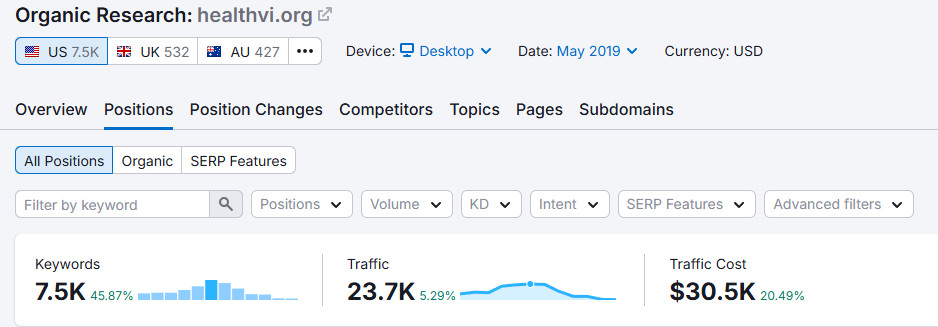
This isn’t a one-off, either. Years back I grew a health site, HealthVI, from zero to over 20,000 organic visitors a month using the same principle — build authority through a mountain of well-targeted, lower-volume content, then let it compound. (That project even got us into a bitta legal trouble at times, but that’s a story for another day.)
The keyword research is the foundation of all of it. Pick the right low-volume, high-intent terms, cluster them, link them, and the rankings snowball.
The Best B2B Keyword Research Tools (Free and Paid)
You don’t need an expensive stack to do this properly. Here’s what actually earns its place, split by budget.
Free:
- Google Keyword Planner — real volume data straight from Google, plus keyword ideas. Free with a Google Ads account.
- Google autocomplete and People Also Ask — type your seed term and read what Google suggests; it’s real search behaviour, no subscription.
- AnswerThePublic — turns a seed keyword into the question-shaped long-tail versions your B2B buyers actually type.
- Google Search Console — the most underrated one you already own; shows the exact queries you’re surfacing for.
- Reddit — free access to how real buyers describe their problems in their own words.
Paid:
- Ahrefs — my go-to. Use Matching Terms for long-tail expansion and Keyword Gap to steal your competitors’ terms.
- SEMrush — the Keyword Magic Tool does the same heavy lifting if that’s your platform of choice.
Start free, and only pay for a tool once you’ve outgrown what the free ones can do. If you want the full rundown of what’s worth paying for, that’s what our guide to the best SEO tools is for.
Common B2B Keyword Research Mistakes
A few errors quietly waste more B2B SEO budgets than anything else. Here’s what to avoid:
- Sorting by volume. In B2B this is actively harmful — you optimise for traffic and starve your pipeline. Sort by intent instead.
- Ignoring the buyer journey. If you only ever write bottom-funnel pages, you’ve got nothing to build authority. If you only write blog posts, you’ve got nothing that converts. You need both.
- One keyword, one page, done. A single page trying to rank for ten unrelated terms ranks for none. Cluster related keywords; separate distinct ones.
- Skipping validation. Writing for a zero-volume keyword without checking it’s real is how you burn a week on a page nobody was ever going to find.
- Copying the B2C playbook. Volume-first thinking works when one person searches and buys. It falls apart the moment a five-person committee and a six-month cycle are involved.
Most of these come back to the same root: treating a B2B search like a B2C one. Once you accept that low volume and high intent are the whole point, the mistakes mostly fix themselves.
When to Do B2B Keyword Research Yourself vs Hire an SEO Expert
If you’ve got the time and you’re willing to sit in your inbox, your Search Console, and a few Reddit threads pulling out real buyer language — you can absolutely do the groundwork yourself.
The process above is genuinely doable for a lean team, and doing it once teaches you more about your buyers than any tool ever will.
Where it gets worth handing off is scale and speed. Building a full cluster — a pillar, fifteen supporting pages, the internal linking, the keyword optimisation on every one — while running a business is a lot.
That’s the point where most B2B owners either stall out or start cutting corners.
If you’d rather skip the learning curve, an SEO consultant can run the research and map the clusters with you, so you keep control but move faster.
And if you want the whole thing built and managed for you, that’s where our SEO services come in — we do the research, build the clusters, and point the authority at the pages that actually make you money.