
My site turned one this year. It’s already been quoted inside Google’s AI Overviews more times than I’ve bothered to count — for a brand-new domain in a competitive niche, going up against Ahrefs and Semrush.
Here’s the part that annoys people when I tell them: I never built an “AI Overview strategy” to make that happen.
I did the SEO fundamentals properly. The citations followed.
That’s the whole argument of this piece. AI Overviews are a genuinely big shift in how search looks — a new slab of digital real estate sitting above everything else — but they are not a separate discipline you need to bolt on.
Do the groundwork right and you show up. Let me show you what they are, why they matter, how they actually work, and the exact steps to get your business pulled into one.
What Are AI Overviews
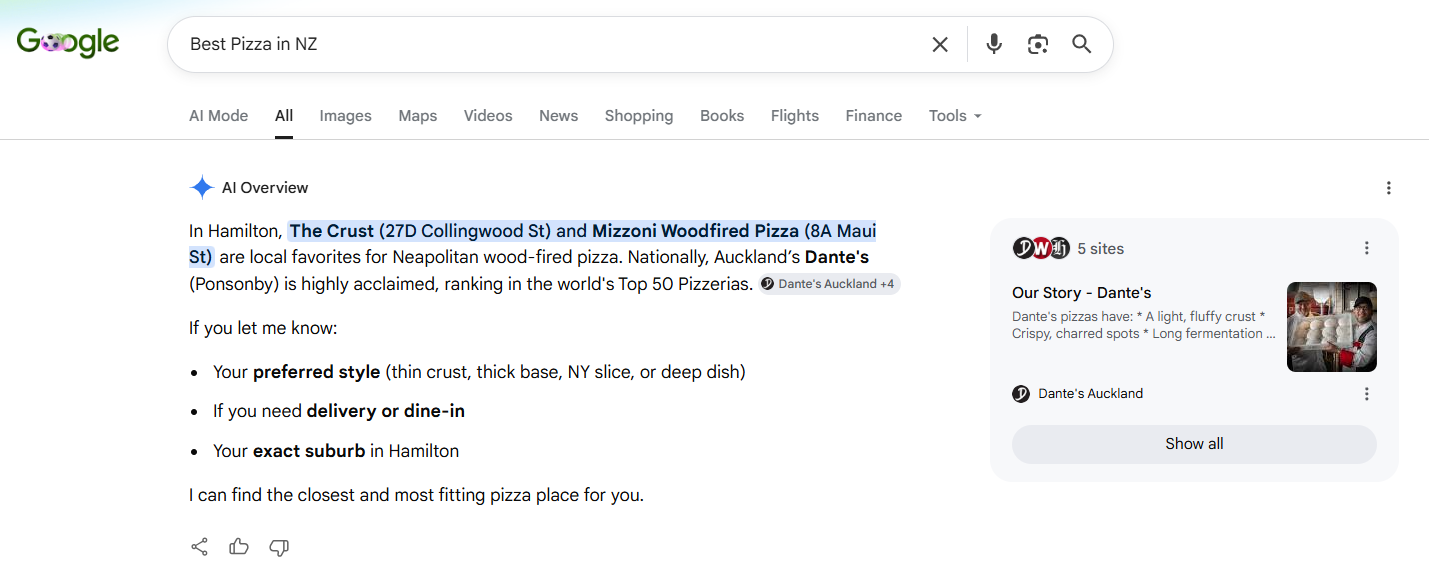
An AI Overview is the AI-generated summary Google drops at the very top of the results page, above the normal blue links.
You type a question. Instead of only handing you ten links, Google writes you a short answer — pulled and stitched together from multiple web pages — with a few of those sources cited off to the side.
It’s powered by Gemini, Google’s large language model. It reads the top content for your query, synthesises it, and hands searchers the gist without a single click.
Think of it as Google answering the question itself, using your content as the raw material.
A few things worth knowing straight away:
They don’t show for every search. Google decides when a query is worth summarising — usually informational questions where a quick answer helps.
They cite sources. Most Overviews link out to the pages they pulled from, which is the bit that matters for you.
They can’t be turned off at the source. You can filter them out of your own results with the “Web” tab, but as a business you can’t stop Google building them — so the only move is to get inside them.
If you’ve heard the terms generative engine optimisation (GEO) and answer engine optimisation floating around, this is what they’re circling. Both are just SEO aimed at AI-generated answers. Same fundamentals, new surface.
Why Are AI Overviews Important
Because they’ve quietly changed what a “number one ranking” is worth.
For years the game was simple: rank in the top few blue links, get the clicks. AI Overviews slid a new layer in above all of that — and the data on what it’s doing to clicks is sobering.
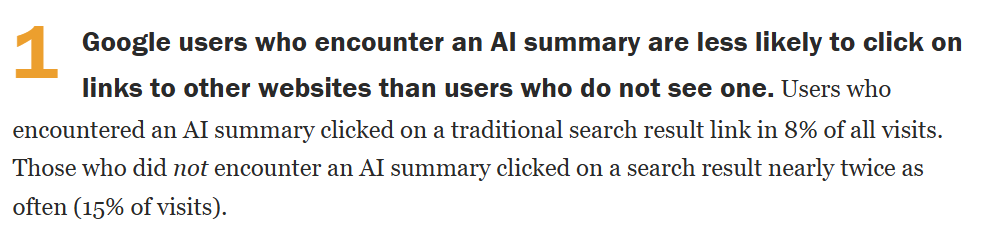
When an AI Overview shows up, people click a normal search result in just 8% of visits — versus 15% when there’s no Overview. That’s roughly half the clicks, gone, according to Pew Research Center.
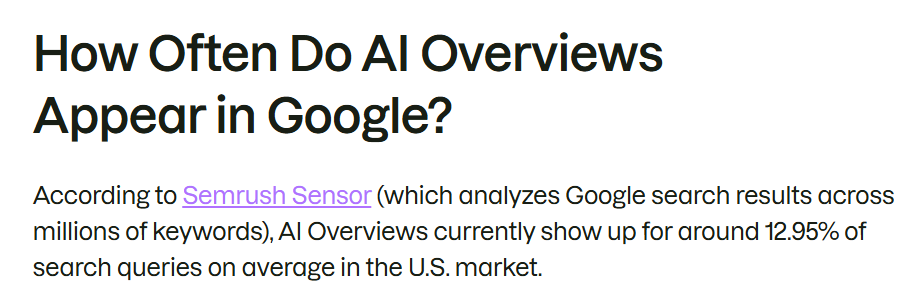
And it’s not a fringe feature. Around 18% of Google searches already produce an AI Overview, Pew Research Center found — Semrush’s own tracking puts the figure near 12.95% of queries and climbing. Either way, a meaningful chunk of the searches your customers run now open with an AI answer.
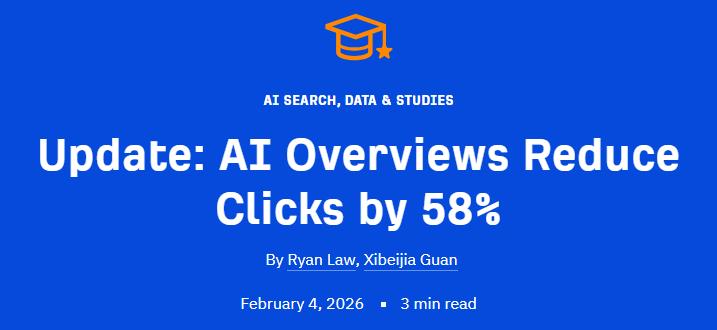
Ahrefs studied 300,000 keywords and found AI Overviews cut clicks to the top-ranking page by 34.5%. Their 2026 re-run puts that drop at 58%.
So here’s the reframe. If Google is going to answer the question at the top of the page, you want to be one of the sources it quotes to do it.
That citation is the new front row.
This is the same logic as featured snippets a few years back — a new box appears above the results, and the businesses that adapt to occupy it win the visibility. AI Overviews are that, at a much bigger scale.
For a local operator, the stakes are direct. If someone in Auckland searches “how do I choose a mortgage broker” and Google’s Overview quotes your advice — with your name attached — you’ve just been recommended by Google before a single competitor’s link loaded.
That’s worth chasing, and it’s exactly the kind of visibility a solid local SEO foundation earns you.
How Do AI Overviews Work
Google builds an Overview in three moves, and understanding them tells you exactly where to aim.
First, it reads the query and decides whether an AI answer helps. Broad informational questions get one; a straight navigational search (“Facebook login”) usually doesn’t.
Second, it gathers source material. It doesn’t invent the answer from thin air — it pulls from pages already performing well for that query and closely related ones. This is the crucial bit: your ranking content is the feedstock.
Third, it synthesises and cites. Gemini writes the summary and attaches a handful of source links — the pages it leaned on most.
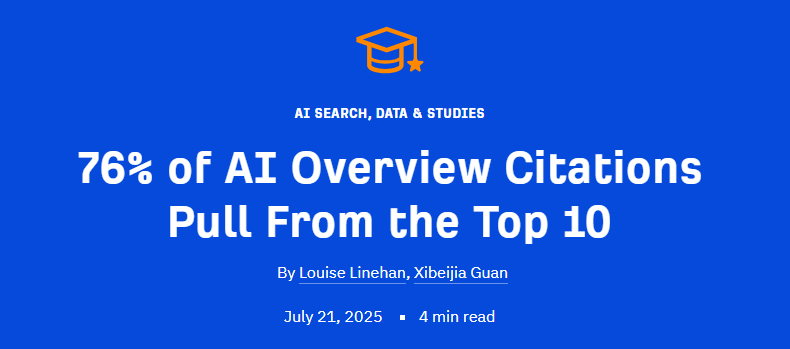
Now the stat that should shape your entire approach: in Ahrefs’ original study of 1.9 million citations, 76% of AI Overview citations came from pages already ranking in the top 10 for that query.
Their follow-up has that down to 38% as Google pulls from a wider net — but with top-10 pages still the single biggest source, page-one ranking remains your best route in.
Rank well, and you’re in the pool Google draws from. Rank nowhere, and you’re not even a candidate.
There’s a catch worth being honest about. Being cited doesn’t flood you with traffic. Pew found people click a link inside the Overview in only 1% of visits.
So an AIO citation is mostly a branding and authority play — your name in front of the searcher, endorsed by Google — rather than a click firehose. Treat it as the billboard, not the doorway.
It also tends to reward the already-strong. Ahrefs’ analysis of 55.8 million Overviews found the top 50 domains soak up nearly 28.9% of all citations.
That sounds discouraging for a small NZ business — but it’s also the reason the fundamentals matter so much. Authority is exactly what you build with good content and real backlinks, and it’s the thing that gets you into that pool.

How To Optimise For AI Overviews
Here’s where I break from most guides on this. I’m not going to hand you a separate “AIO strategy,” because you don’t need one.
You need the fundamentals done properly, with a few specific tweaks that make your content easy for Gemini to lift.
This is the exact process I follow — the one that got a one-year-old site cited alongside the big players.
Rank for the query first
Everything starts here. If you’re not on page one for a term, you’re not a source Google can cite for it.
So the first job isn’t “optimise for AI” — it’s plain SEO: the right keyword, genuinely useful content, sound on-page setup, and the authority to back it. Get that right and you’ve done 80% of the AI Overview work without thinking about AI once.
If you’re not sure where your fundamentals stand, that’s what an SEO audit is for — it shows you which pages are close enough to page one to be worth pushing.
Answer the question in the first two sentences
Gemini lifts clean, direct answers. So lead with one.
Open each section by answering its heading immediately — plainly, in a sentence or two — then expand underneath. Bury the answer three paragraphs down and you’ve made your content hard to quote.
Say someone searches “how much does SEO cost in NZ.” A page that opens with “SEO in New Zealand typically runs $1,500–$3,000 a month for small businesses” is instantly liftable. A page that opens with “SEO pricing is a nuanced topic…” is not.
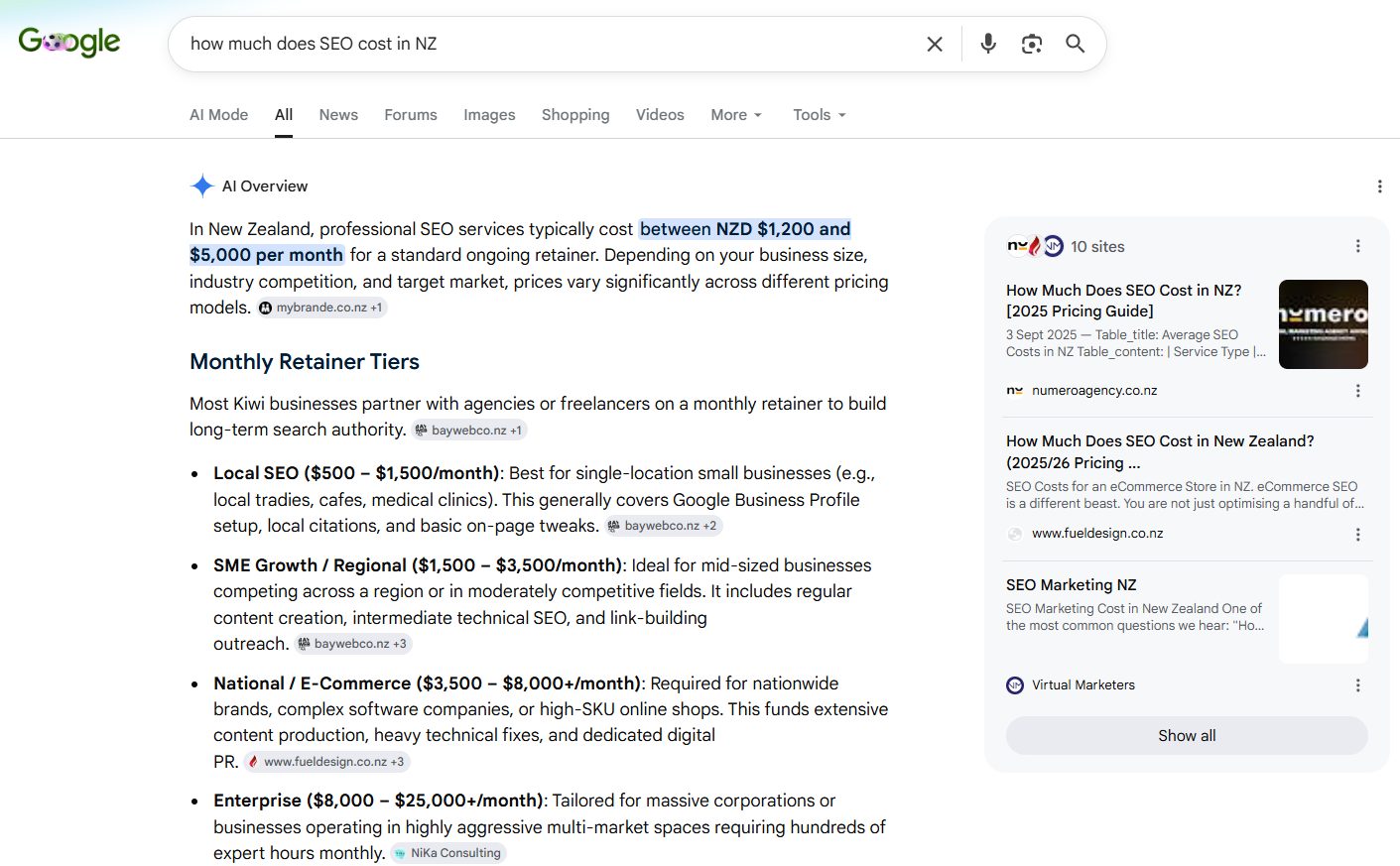
Lead with the answer. Earn the quote.
Structure content so it’s easy to lift
Overviews love clear structure — headings that match real questions, short paragraphs, lists where they fit, tables for comparisons.
Use your header tags to break the page into question-shaped chunks. Match how people actually ask (“how,” “what,” “why,” “is”).
Keep blocks short. This is the same clean formatting that already wins featured snippets — you’re making your content skimmable for a machine.
Prove you know your stuff (E-E-A-T)
Google leans on trustworthy sources for its answers, so give it reasons to trust yours.
That means real E-E-A-T signals: a named author with genuine experience, first-hand examples, real data, an about page, citations to primary sources.
When I write, I use my own client results and numbers — the stuff no one else can copy. That’s a big part of why I get cited over international blogs.
Content that reads like it was written by someone who’s actually done the thing beats content that reads like it was summarised from other summaries. Every time.
Cover the topic properly, not just the keyword
Overviews pull from pages that answer the whole question, plus the follow-ups.
So build depth. Answer the main query, then the related ones around it — the People Also Ask questions, the natural next steps.
This is where solid content optimisation and internal linking pay off: a page supported by a cluster of related content signals genuine topical authority, which is precisely what Gemini rewards.
Earn authority with links
The last piece is off-page. Authority is what tips you from “ranks okay” to “gets cited.”
Keep building real backlinks and brand mentions. They’re what lift your domain into that top pool where citations actually happen.
There’s no AI shortcut around this one — it’s the same link building that’s always mattered, and it matters more now, not less.
Track whether it’s working
You can’t improve what you can’t see.
Watch Google Search Console for impressions and position on your target queries, and run those queries yourself to see whether an Overview shows and whether you’re in it. A rank tracker that flags AI Overview presence makes this easier at scale.
How AI Overviews Differ From Featured Snippets
People mix these two up constantly. The difference changes how you write.
A featured snippet lifts one block of text from a single page and shows it, more or less verbatim, with a link. One source, quoted directly.
An AI Overview generates a fresh summary from multiple sources and rewrites it in Google’s own words. Pew found 88% of Overviews cite three or more sources; only 1% lean on a single one.

The practical upshot: with a snippet you’re trying to be the answer. With an Overview you’re trying to be one of the trusted voices in the answer.
That’s a lower bar in one sense — you don’t have to beat everyone outright — but it rewards breadth, clarity, and authority rather than one perfectly formatted paragraph.
Optimise for both the same way, though. Clear answers, clean structure, real expertise. The fundamentals cover both surfaces at once.
How My One-Year-Old Site Got Cited Alongside Ahrefs and Semrush
Let me put my money where my mouth is, because this is the part that proves the point.
My site is under a year old. It competes in SEO — a niche stacked with billion-dollar tools that have been publishing for over a decade. On paper I shouldn’t be anywhere near their AI Overview citations.
But I am, regularly. And I want to be precise about what I did to get there: nothing AIO-specific.
I picked topics my New Zealand audience actually searches. I wrote genuinely useful, in-depth content with real examples and my own data.
I structured it cleanly, led with direct answers, and built proper E-E-A-T — real author, real experience, real numbers.
Then I earned links.
No AIO checklist, no special tooling — that was the whole “strategy.” The Overview citations are a byproduct of ranking well with content Google trusts.
Which is exactly why I tell Auckland business owners not to panic about AI.
If a one-person NZ site can get quoted next to Ahrefs by doing the basics well, so can a well-run campaign in Auckland or Wellington — or in a specialised niche like law firms and mortgage brokers. The fundamentals travel.
Do You Need a Separate AI Overview Strategy
Short answer: no. And I’ll die on this hill.
If your SEO fundamentals are strong — the right content, clean on-page setup, sound technical SEO, and real authority — you are already optimised for AI Overviews.
They draw from the same well as regular rankings. There’s no secret separate lever.
Where I’d nuance it: the few tweaks above (answer-first writing, question-shaped structure) are worth doing deliberately.
But they’re refinements to good SEO, not a new project. Anyone selling you a standalone “AI Overview package” is repackaging fundamentals with a shinier name.
Get the basics right and the new surfaces take care of themselves. That’s been true for every SERP feature Google has ever launched, and it’s true here.
If you want a second set of eyes on whether your fundamentals are actually there, that’s a quick job for someone who does this daily.
Final Thoughts
You can do all of this yourself. None of it is gated behind a secret AIO tactic — it’s the same fundamentals that have always worked: be useful, be clear, be trustworthy, and earn enough authority that Google reaches for you when it builds an answer.
Do that and you don’t need to outspend the giants; you need to out-fundamental the people in your own market.
If you’d rather hand it to someone who lives in this every day — or just pressure-test whether your fundamentals are actually there — that’s what our professional SEO is for.
Either way, occupy the new real estate by being worth quoting.
AI Overviews: FAQ
What are AI Overviews in Google Search?
AI Overviews are AI-generated summaries Google shows at the top of the results page for many searches. Powered by Gemini, they pull from multiple web pages, write a short answer, and cite a few sources — giving searchers the gist without clicking through.
How do I get my content to appear in an AI Overview?
Rank on page one for the query first, then make your content easy to lift: answer the question directly in the first sentence or two, use clear question-shaped headings, show real expertise (E-E-A-T), cover the topic fully, and build authority through backlinks. There’s no separate trick — it’s strong SEO with answer-first formatting.
Can AI Overviews be trusted?
They’re usually accurate but not flawless — Gemini can misread or oversimplify a source. For anything important, it’s worth checking the cited links. For businesses, the takeaway is that being one of those cited sources is where the value sits.
Do AI Overviews hurt my website traffic?
They can. When an Overview appears, clicks to normal results roughly halve, and very few people click links inside the Overview itself. The upside is brand visibility: being cited puts your name in front of the searcher with Google’s endorsement, even if they don’t click.
How often do AI Overviews show up?
Estimates vary by study and market — roughly 13% to 18% of searches, and rising. They appear most on informational, question-style queries rather than navigational or transactional ones.
Is optimising for AI Overviews different from normal SEO?
Not really. AI Overviews draw from pages that already rank well, so the same fundamentals apply. The only additions are formatting tweaks — leading with direct answers and structuring content around real questions — which are good SEO practice anyway.
Recommended Reading
 AI SEO Statistics
The numbers behind how AI is reshaping search — and what they mean for NZ businesses.