

Every second business owner I talk to lately asks me some version of the same thing: is SEO even worth it anymore, now that AI answers everything?
Fair question. The headlines keep telling everyone SEO is dead and ChatGPT ate it.
So instead of guessing, let’s look at the actual numbers.
I’ve pulled together 50+ AI SEO statistics for 2026 — every one linked to its original source, every one dated. No invented figures, no fake reports (a problem the stats world is genuinely riddled with, where AI tools quote studies that don’t exist and link URLs that 404).
Just the real data on how AI is reshaping search.
Then, because a wall of numbers helps nobody, I’ll break down what it all means for your business — and show you the exact moves that get you cited by AI, with proof from my own site.
For context on why I care: back in 2017 I grew a health website (HealthVI) from zero to over 20,000 organic visitors a month, and I’ve been competing in SEO since well before AI search was a thing.
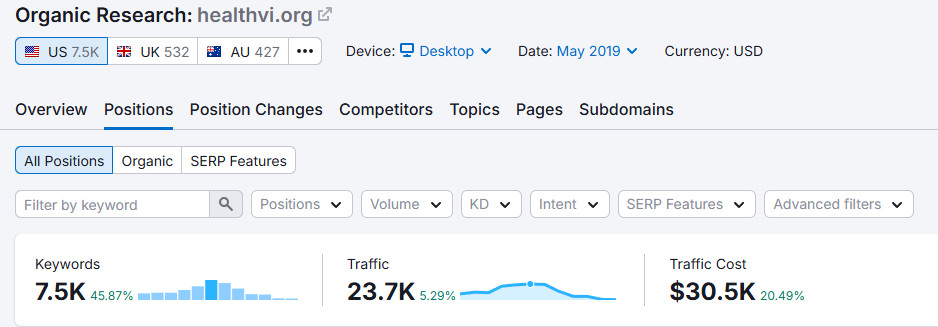
The rules have changed since then. The data below shows exactly how.
AI Search Adoption Statistics
The first thing the numbers make clear: AI search isn’t “coming.” It’s already where a big chunk of your customers start looking.
- ChatGPT is now the fourth most-visited website on the planet, pulling over 5 billion visits a month (Semrush).
- Google’s AI Mode has surpassed 1 billion monthly users, with queries more than doubling every quarter, according to Google at I/O 2026 (SparkToro).
- Google AI Overviews now reach over 2 billion users every month (SeoProfy).
- AI Mode has rolled out to more than 200 countries and territories (Semrush).
- Nearly six in ten US adults (58%) ran at least one Google search that produced an AI summary in a single month (Pew Research).
- Traffic from AI platforms like ChatGPT and Gemini grew 527% year over year (SeoProfy).
- Monthly AI usage is now roughly 56% the size of search worldwide, and 34% the size in the US (Position Digital).
- Between 65% and 85% of ChatGPT prompts have no matching keyword in Semrush’s database — people ask AI full, messy questions, not neat search terms (Position Digital).
Here’s the part most “AI is taking over” articles skip, though: adoption is lopsided, not universal.
- Around 82% of people still haven’t used generative AI regularly, and 57% say they prefer traditional search for important topics (Position Digital).
What that means for you: Google isn’t going anywhere, but a second front door has opened. If your business shows up on Google and nowhere in AI answers, you’re invisible to a fast-growing slice of buyers — while still needing to win the search most Kiwis are doing.
Zero-Click & AI Overview Statistics
This is the cluster every business owner needs to sit with, because it breaks the oldest assumption in SEO: that ranking equals traffic.
It doesn’t anymore.
- In 2024, 58.5% of US Google searches ended without a single click to the open web (SparkToro).
- By 2026 that figure had climbed to around 68% — meaning less than a third of Google searches now send a click anywhere (SparkToro).
- For every 1,000 US Google searches, only about 360 clicks reach the open web (SparkToro).
- When an AI summary appears, people click a normal search result just 8% of the time — versus 15% when there’s no summary. Nearly half the clicks, gone (Pew Research).
- They click a link inside the AI summary itself only 1% of the time (Pew Research).
- 26% of sessions end completely after an AI summary shows up, compared to 16% without one (Pew Research).
- About 18% of all Google searches produced an AI summary in March 2025, and that share keeps climbing (Pew Research).
- AI Overviews cut the click-through rate of the #1 organic result by roughly 58% (Ahrefs).
- In Google’s AI Mode, around 93% of searches end without a click — more than double the 43% zero-click rate of AI Overviews (Position Digital).
- 26% of AI Mode users overrode the AI’s ranking order and picked a brand they already recognised, even when it sat lower in the answer (Position Digital).
- The flip side worth banking: 88% of AI summaries cite at least three sources (Pew Research).
That last stat is the whole game in one line. Fewer clicks are up for grabs, but AI is constantly naming sources — and one of them could be you.
What that means for you: picture a plumber in Hamilton ranking #1 for “how to fix a leaking tap.” A few years ago that spot printed traffic. Today, Google’s AI answers the question on the page and the searcher never scrolls. The ranking is the same; the traffic is a fraction of it. The win isn’t the blue link anymore — it’s being the business the AI mentions.
AI Content Creation Statistics
Marketers didn’t ease into AI. They ran at it. But the data has a sting in the tail for anyone hoping to publish their way to the top on autopilot.
- Roughly 87% of marketers now use AI tools in their content and SEO workflows (Semrush).
- 94% plan to fold AI into their content and blogging in 2026 (SeoProfy).
- 82% of enterprise SEOs plan to invest more in AI (SeoProfy).
- Companies using AI publish 42% more content every month than those writing everything by hand (Semrush).
- AI-written pages now appear in over 17% of top search results — up from just 2.27% in 2019 (Semrush).
- Purely unedited AI content ranks #1 only 9% of the time (Semrush).
- Content made with AI often starts showing up in results in two months or less (Semrush).
- 65% of people say human-written content is better quality than AI-generated, while only 14% rate AI content as better (Ahrefs).
- Nearly half of online sellers (47%) now use AI to write product descriptions (Semrush).
What that means for you: everyone can now publish faster, which means volume is worth nothing. The gap between the 42% who publish more and the 9% whose raw AI content ranks tells the story — churning out unedited AI posts is a race to the bottom that Google barely rewards. The businesses that win pair AI’s speed with real experience, real examples, and a human edit — which is exactly what real topical authority is built on.
AI SEO ROI & Conversion Statistics
Here’s where the “AI traffic is tiny, ignore it” crowd gets it wrong. The volume is small. The value isn’t.
- Visitors referred from AI convert at up to 4.4x the rate of traditional organic traffic (Omnibound).
- AI referral traffic is still only about 0.24% of total web traffic (SeoProfy).
- Nearly 68% of businesses report a higher return on investment after integrating AI into their SEO and content work (Semrush).
- Reported revenue gains from AI investment range between 3% and 15% (SeoProfy).
- AI traffic to US retail sites surged 1,324% between October 2024 and May 2026; in travel it jumped 2,215% (Semrush).
- Businesses that fully integrate SEO and AI visibility into one workflow are far ahead: 81% report more traffic or leads from AI, versus just 36% of teams that keep the two separate (Semrush).
- And to put the doom to bed: organic search traffic dropped just 2.5% between February 2024 and November 2025 — not the 25% or 50% collapse some predicted (Position Digital).
What that means for you: someone who lands on your site after ChatGPT recommended you is already half-sold. The AI did the vetting. That’s why a tiny 0.24% of traffic converting at over four times the rate matters far more than the raw number suggests — a handful of those visitors can be worth a flood of cold Google clicks.
AI Citation Statistics (What Actually Gets You Cited)
This is the most useful cluster in the whole article, because it turns “how do I get mentioned by AI?” from a mystery into a checklist. Researchers have now studied exactly what makes a large language model cite one site over another.
- Sites with over 32,000 referring domains are 3.5x more likely to be cited by ChatGPT than sites with 200 or fewer (SE Ranking).
- Citations nearly double at that threshold — from an average of 2.9 to 5.6 — once a domain crosses roughly 32,000 referring domains (Search Engine Journal).
- Domains with millions of Reddit brand mentions average 7 ChatGPT citations, versus 1.8 for those with barely any — a 3.9x swing (SE Ranking).
- Quora shows a similar 4.1x citation multiplier (Search Engine Journal).
- Sites listed on review platforms like Trustpilot, G2, Capterra and Yelp are about 3x more likely to be cited (SE Ranking).
- Domains on several review platforms averaged 4.6 to 6.3 citations, versus 1.8 for those with no review presence (Search Engine Journal).
- Brands are around 6.5x more likely to be cited through third-party sources than through their own website (Position Digital).
- Fast pages get picked more often: pages loading in under 0.4 seconds averaged 6.7 citations, versus 2.1 for slow ones — roughly 3x (SE Ranking).
- Pages with question-format headings get cited at nearly double the rate of pages with plain declarative headings — 18% versus 8.9% (Ahrefs).
- ChatGPT only cites about 50% of the pages it retrieves, and 88% of the URLs it does cite come straight from search results (Ahrefs).
- The much-hyped “LLMs.txt” file has a negligible impact on whether ChatGPT cites you (SE Ranking).
What that means for you: getting cited by AI comes down to authority and clarity. The signals that earn citations — links, real reviews, brand mentions, fast clean pages, question-and-answer structure — are the same ones good SEO has always built. There’s a full playbook for this in my guide to ranking in AI search, and the practical moves are in the next section.
The AI Visibility Measurement Gap
The single biggest opportunity in these statistics isn’t a tactic. It’s how few businesses are paying attention to any of this yet.
- Only 14% of marketers currently track their AI visibility at all (Goodfirms).
- 45% of marketing leaders can’t accurately measure their brand visibility inside AI answers, and only 9% have the tools to track every relevant metric (Semrush).
- Just 19% name brand authority as a strategic priority — even though 81% are already doing the backlinks and digital PR that build it (Goodfirms).
- 65% of marketers say AI-driven search changes are their single biggest challenge right now (Goodfirms).
What that means for you: nearly everyone can see the ground shifting, and almost no one is measuring where they stand on it. That gap is your head start. A New Zealand business that starts tracking AI visibility today is ahead of 86% of the market before it’s even done anything clever.
What These AI SEO Statistics Mean for Your Business
Strip all 50-odd numbers back and they say one thing: search has moved from ranking to being the answer.
The click you used to earn by hitting position one is being absorbed by an AI summary. But that same AI is naming sources in almost every answer it gives. The job now is to become one of those sources.
Here’s how to actually do that.
Stop judging your SEO by rankings alone
For twenty years, “are we ranking?” was the only question that mattered. The zero-click data kills that.
You can sit at #1 and watch an AI Overview answer the question above you while your traffic quietly halves. So the scoreboard has to change.
Start tracking three things alongside rankings: whether AI tools mention your business, how much branded search you’re getting (people Googling your name after an AI names you), and how many clicks come from commercial-intent queries where people still click. Rankings still matter — they’re just no longer the finish line.
Build topical authority, not one-off pages
The citation data is blunt about this: AI cites authorities, not random blog posts. And authority comes from covering a whole subject properly, not publishing one thin page and hoping.
This is why the “publish 42% more with AI” trap backfires. Volume without depth reads as noise to a language model. Depth across a topic reads as expertise.
The move is to pick the subjects your business actually gets asked about and answer every single question around them — the definitions, the costs, the comparisons, the mistakes — all interlinked so your site looks like the definitive source. That’s how you build topical authority, and it’s the closest thing to a cheat code for AI citations.
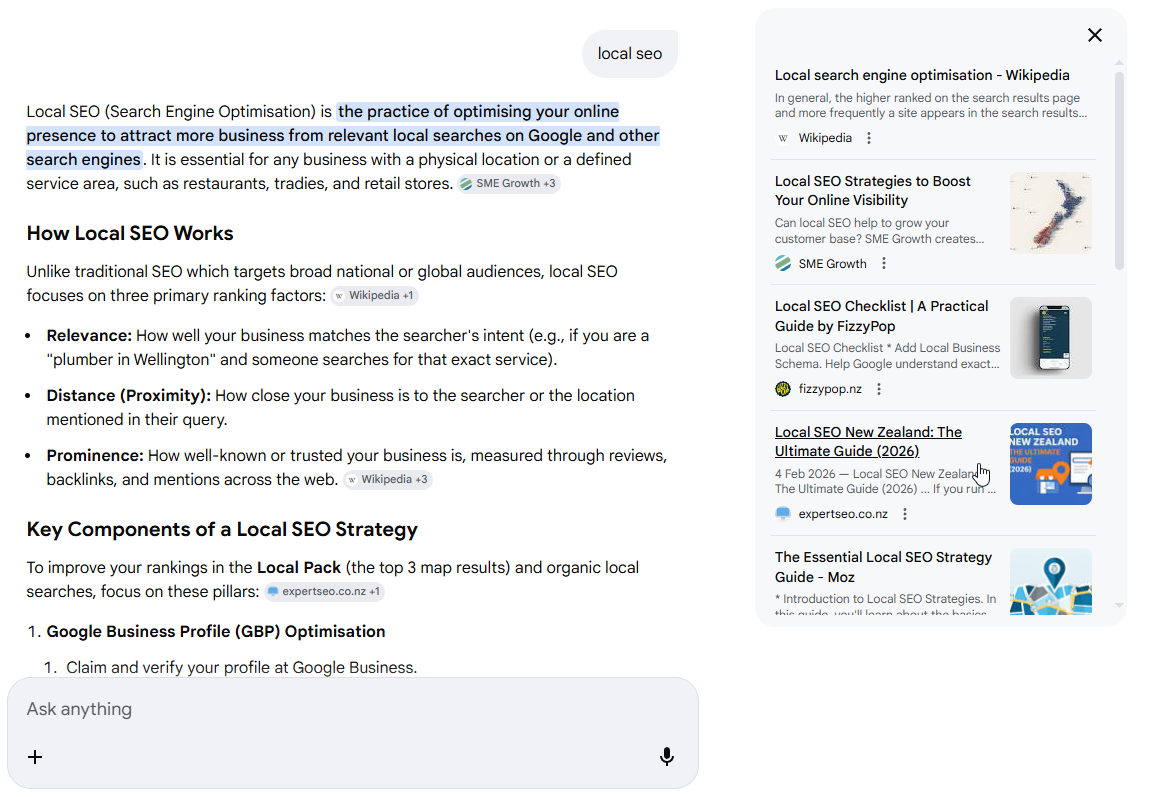
Proof it works, from my own site: Expert SEO is under two years old and ranks #1 in New Zealand for “local SEO” — above Ahrefs and Semrush, two of the biggest SEO tools on earth. We didn’t outspend them. We out-covered them.

Get cited by AI: the practical moves
This is the part everyone wants. The research above hands us the exact levers, so let’s pull them.
First, structure your content the way AI reads it. Use real questions as your headings, then answer each one in the first sentence or two underneath. That single move nearly doubled citation rates in the data — question headings got cited 18% of the time versus 8.9% for plain ones (Ahrefs). Google’s AI treats your heading as the question and the line below it as the answer.
Second, be the primary source. Don’t rewrite what everyone else already published — add something only you have. Real numbers. A local example. A first-hand result. AI reaches for the original, not the tenth rehash of it.
Third, build your off-site footprint. Most of what decides a citation happens away from your website: your links, your reviews on G2 or Trustpilot, honest mentions in relevant Reddit and Quora threads. That’s where the 3x and 4x multipliers live.
And here’s the proof I promised, because I practise this on my own site. My local SEO guide gets recommended by name inside Google’s AI Mode:
And my company gets pulled directly into AI answers as a cited source:
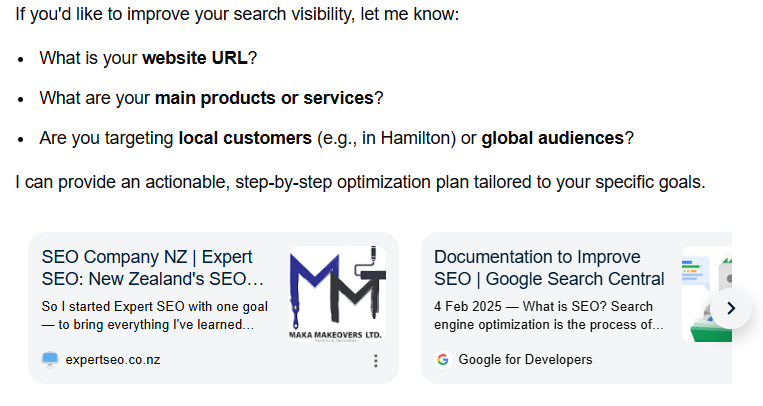
That’s a sub-two-year-old New Zealand site being treated as an authority by the same AI systems these statistics describe — the exact outcome the data points to, happening to a small local business rather than a US giant.
Put your effort where clicks still happen
Not all traffic is dying evenly. Informational searches — “what is,” “how does” — are the ones AI answers on the page. Commercial searches, where someone’s ready to hire or buy, still send clicks, because people want to choose who they deal with.
So weight your effort accordingly. Use informational content to build authority and earn AI citations, but make sure your money pages — the service pages someone lands on when they’re ready to spend — are sharp, fast, and structured to convert.
A mortgage broker’s “how do interest rates work” post builds trust; their SEO for mortgage brokers-style service page is where the lead actually happens.
Start measuring your AI visibility now
You can’t improve what you don’t watch, and only 14% of marketers are watching this. Fixing that costs you almost nothing and puts you ahead of nearly everyone.
Add a couple of things to your reporting. Run your key questions through ChatGPT and Google’s AI Mode every month and note whether you’re mentioned.
Watch your branded search in Google Search Console for lift after AI starts naming you. The right SEO tools make this quick, but even a manual monthly check beats the 86% of businesses doing nothing.
Doing This Yourself vs Bringing in an SEO Expert
Everything above is doable on your own. The statistics are public, the moves are laid out, and a motivated owner with time can absolutely start building authority and tracking AI visibility this week.
The honest question is whether that’s the best use of your time.
Getting cited by AI in 2026 isn’t one task — it’s topical authority, technical speed, a real off-site footprint, and content structured for both Google and the models, all pulling together over months.
Done right it compounds. Done in scattered bursts between running your actual business, it usually stalls.
If you’d rather have it handled by someone who’s already ranking a two-year-old site above Ahrefs and getting cited in AI answers, that’s exactly what our done-for-you SEO is built for.
You can start with a SEO audit to see where you stand, bring in an SEO consultant for the strategy, or get the whole thing run for you — including local SEO services if you’re chasing customers in your city.
New Zealand search is still wide open. If you run a business in Auckland, Christchurch, Wellington, or anywhere else in the country, the businesses that treat these numbers as a to-do list — not a headline to panic about — are the ones AI will be recommending this time next year. That’s where we come in.