The main difference between SEO and SEM is that SEO focuses on generating organic traffic, while SEM is based on paid advertising.
SEO (search engine optimisation) is about improving your website so it ranks higher on Google without paying for each click. This is done through SEO content, on-page optimisation, and building authority over time.
Whereas SEM (search engine marketing) involves paying to appear at the top of search results, typically through platforms like Google Ads. You bid on keywords and pay each time someone clicks on your ad.
Another key difference between SEO and SEM is speed versus sustainability.
SEO takes longer to see results, but it can generate consistent traffic and leads over time without ongoing cost per click
SEM can drive traffic immediately, but results stop as soon as you stop paying for ads
This means SEO is typically used for long-term growth, while SEM is used for immediate visibility and quick results.
Many businesses use a combination of both, using SEM for short-term traffic while building SEO for long-term success.
What Is SEO?
SEO (search engine optimisation) is the process of ranking your website higher in search engine results without paying for ads.
Instead of buying traffic, you earn it.
The goal is simple. When someone searches for something related to your business, you show up on Google, they click your website, and you turn that into a lead or sale.
SEO isn’t just one thing. It consists of five key parts:
Each one works together to help your website rank higher and perform better.
Keyword Research
Keyword research is the process of finding the exact search queries (keywords) that people type into Google.
For example, if someone searches “dental implants Auckland”, a dental clinic can target that keyword to show up in the results and turn them into a paying patient.
The reason this matters is because the more relevant keywords you find, the more opportunities you have to create content and rank for them.
To do this, you can use tools like Google Keyword Planner or Ahrefs. Start with a core keyword related to your service, then look at the variations, search volume, and competition to find good opportunities.
Content Marketing
Content marketing is the creation of pages, blogs, and resources that people land on when they click your website from Google.
It’s essentially the thing they come to read after searching.
For example, someone searching “SEO vs SEM” lands on a guide like this that explains the topic and helps them make a decision.
This matters because Google ranks content that best matches what the user is looking for.
To do this well, create content based on your keyword research. Focus on answering the search clearly, keeping it easy to read, and guiding the user towards taking action.
On-Page SEO
On-page SEO is about optimising the content and elements on your website so Google understands what your page is about.
For example, if you’re targeting “SEO Auckland”, you would include that keyword in your title, headings, and throughout the page in a natural way.
This helps Google match your page with the right searches.
To do this, optimise your titles, headings, URLs, and content with your target keywords, and make sure the page is structured clearly and easy to navigate.
Off-Page SEO
Off-page SEO refers to actions taken outside of your website to improve your rankings, mainly through backlinks.
For example, if another website links to your site, Google sees that as a signal of trust and authority.
The more high-quality and relevant links you have, the stronger your site appears.
To build this, focus on getting links from relevant websites through things like business directories, partnerships, guest posts, or industry features.
Technical SEO
Technical SEO is about how your website performs behind the scenes and how easily search engines can access it.
For example, a fast-loading, mobile-friendly website with no broken pages is much easier for Google to crawl and rank.
This matters because even great content won’t rank well if the site has technical issues.
To improve this, focus on site speed, mobile usability, fixing errors, and making sure your pages are properly indexed by Google.
What Is SEM?
SEM (search engine marketing) is the process of generating traffic and leads through paid advertising on search engines.
Instead of earning your rankings over time like SEO, you pay to appear at the top of Google almost instantly.
The goal is simple. You bid on keywords related to your business, your ads show up when people search, and you pay each time someone clicks.
SEM isn’t just running ads randomly. It consists of a few key parts that work together:
Keyword targeting
Ad creation
Landing pages
Bidding and budgeting
Performance tracking and optimisation
Each one plays a role in getting you clicks, leads, and sales.
Keyword Targeting
Keyword targeting in SEM is about choosing the exact search terms you want your ads to show up for.
For example, if someone searches “plumber Auckland”, you can bid on that keyword so your ad appears at the top of the results.
This matters because you’re paying for every click, so you want to target keywords that are highly relevant and likely to convert.
To do this, you can use tools like Google Keyword Planner to find keywords, check search volume, and estimate costs. Focus on keywords with strong intent, not just high traffic.
Ad Creation
Ad creation is the process of writing the ads that show up in search results.
These are the headlines and descriptions people see before they click.
For example, an ad might say “Emergency Dentist Auckland. Same-Day Appointments Available. Book Now.”
This matters because even if you’re targeting the right keywords, your ad still needs to stand out and get the click.
To do this well, write clear, benefit-driven headlines, include your keywords, and give people a strong reason to take action.
Landing Pages
Landing pages are the pages people land on after clicking your ad.
This is where the conversion happens.
For example, if someone clicks an ad for “plumber Auckland”, they should land on a page specifically about that service, not your homepage.
This matters because a highly relevant landing page increases your chances of turning clicks into leads or sales.
To do this, match your landing page closely to the keyword and ad, keep it simple, and include clear calls to action.
Bidding and Budgeting
Bidding and budgeting is how you control how much you’re willing to pay for clicks and how much you spend overall.
For example, you might set a daily budget and choose how much you’re willing to pay per click for a keyword.
This matters because costs can add up quickly, so you need to manage your spend carefully.
To do this, start with a set budget, monitor your cost per click, and adjust your bids based on performance and results.
Performance Tracking and Optimisation
Performance tracking and optimisation is about measuring what’s working and improving your campaigns over time.
For example, you might track which keywords are generating leads and which ones are wasting your budget.
This matters because SEM is not a set-and-forget strategy. Small improvements can significantly increase your return.
To do this, use tools like Google Ads and Google Analytics to track clicks, conversions, and costs, then refine your keywords, ads, and landing pages based on the data.
SEO vs SEM: Examples
Here’s a simple SEO vs SEM example.
When I type in “Auckland dentist” into Google, the results at the top are labelled as sponsored. That’s SEM.
These businesses are paying to be there. They’re all bidding against each other to get that top spot, and every time someone clicks, they pay for it. They’ve essentially paid for visibility and jumped straight to the top without needing to build long-term authority.
Now compare that to when I search “dental implants Auckland”.
The results at the top here are organic. There’s no sponsored label.
These businesses haven’t paid to be there. Instead, they’ve spent months or years building their rankings through SEO. That includes creating content, optimising their website, and building authority over time.
Because of that, they’ve built an asset.
They can continue to generate traffic, leads, and customers without paying for every click. As long as they maintain their rankings, that visibility keeps working for them long term.
SEO vs SEM: What's The Cost?
The cost of SEO and SEM is one of the biggest differences between the two.
SEM has a direct, ongoing cost. SEO is more of an upfront investment that compounds over time.
With SEM, you pay every time someone clicks on your ad. This is known as cost per click (CPC).
In competitive industries, especially local services, CPCs can get expensive. For example, keywords in industries like legal, dental, and insurance can range anywhere from $5 to over $50 per click depending on competition and location (source: Wordstream)
That means if 100 people click your ad at $10 per click, you’ve already spent $1,000, regardless of whether those clicks turn into customers.
And once you stop paying, your traffic stops immediately.
SEO works differently.
Instead of paying per click, you invest in things like content creation, website optimisation, and link building.
In New Zealand, SEO services can range from around $1,000 to $5,000+ per month depending on the competitiveness of your industry and the scope of work (source: Clutch).
While that might seem like a higher upfront cost, the key difference is that SEO builds momentum.
Once your pages start ranking, they can continue bringing in traffic and leads without paying for every single click. In fact, organic search drives over 53% of all website traffic, making it the largest source of traffic for most websites (source: BrightEdge).
So the real difference comes down to this:
SEM is pay to play. You get immediate traffic, but you pay for every visitor
SEO is an investment. It takes time, but the traffic can continue long after the work is done
Both have a cost. They’re just structured very differently.
SEO vs SEM: Which Has Better ROI?
The return on investment (ROI) for SEO and SEM comes down to one key difference.
Short-term vs long-term returns.
SEM can generate ROI quickly.
Because your ads go live instantly, you can start generating traffic and revenue straight away. On average, paid search delivers around a 200% ROI, meaning businesses typically make $2 for every $1 spent (source: <a href=”https://blog.seorocket.app/organic-search-vs-paid-search-7-key-differences-for-2026/”>SEO Rocket</a>).
However, that return is linear.
If you stop spending, the return stops immediately. You’re constantly paying to maintain results.
SEO works differently.
It takes longer to see results, but the ROI compounds over time. Organic search campaigns have been shown to generate around 275% ROI on average, compared to ~200% from paid search (source:LinkBuilding).
In many cases, it can go even higher. Some studies show SEO delivering 500%+ ROI over time, especially as content continues to rank and generate traffic without additional cost (source: SEORocket).
Another key factor is conversion efficiency.
Organic traffic tends to convert better, with average conversion rates around 14.6% for SEO compared to 10% for paid search (source: Digital Thrive).
That means not only are you getting traffic without paying per click, but that traffic is often higher intent and more likely to turn into customers.
So which has better ROI?
SEM delivers faster ROI and is useful for immediate results
SEO delivers higher long-term ROI by building a compounding asset
The highest ROI strategy is usually a combination of both.
Use SEM to generate quick wins and validate what works, then scale SEO to reduce your cost per lead and build long-term growth.
SEO vs SEM: How Long Does It Take To Get Results?
The time it takes to see results from SEO and SEM is one of the biggest differences between the two.
SEM is almost instant.
Once your campaign is set up and approved, your ads can start showing on Google within hours. That means you can begin generating traffic, leads, and sales the same day.
This is why SEM is often used when businesses need immediate results.
SEO takes longer.
Because you’re not paying to appear at the top, you need to earn your rankings over time. This involves creating content, optimising your site, and building authority.
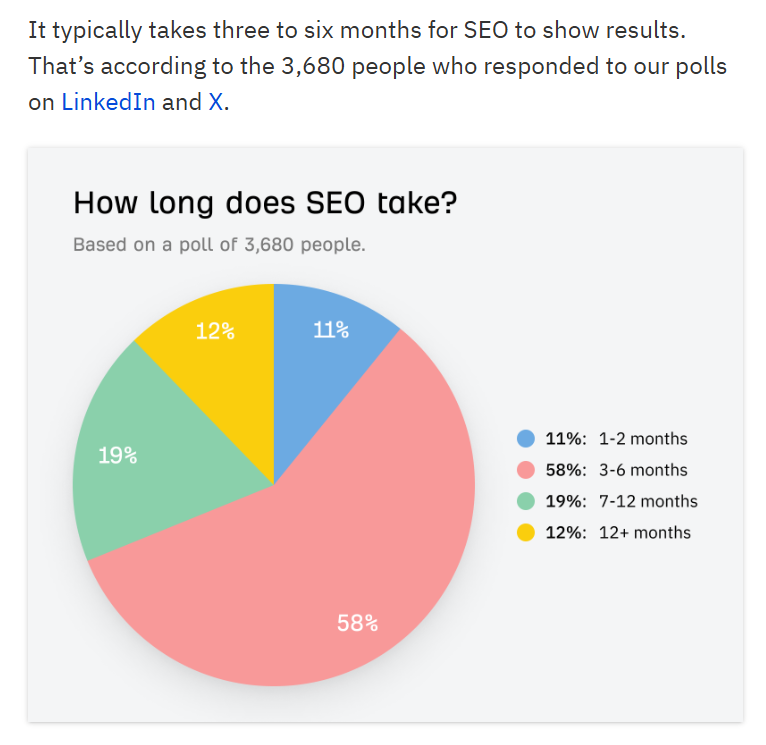
On average, it takes around 3 to 6 months to start seeing noticeable results from SEO, and 6 to 12 months to see stronger, more consistent growth (source: Ahrefs).
In more competitive industries, it can take even longer.
However, the trade-off is what happens after that initial period.
With SEM, results are immediate, but they stop as soon as you turn off your ads.
With SEO, results build over time. Once your pages start ranking, they can continue generating traffic, leads, and sales without needing to pay for every click.
So the difference is clear:
SEM delivers results quickly, often within hours or days
SEO takes time, but builds momentum and long-term growth
For most businesses, the best approach is to use SEM for short-term wins while investing in SEO for long-term results.
SEO vs SEM: Which Is Better For You?
The right choice between SEO and SEM depends on your goals, your budget, and how quickly you want results.
If you need leads straight away, SEM is usually the better option.
Your ads can go live within hours, and you can start getting traffic and enquiries almost immediately. This makes it ideal for new businesses, time-sensitive offers, or when you want to test what’s working quickly.
But it comes with ongoing costs.
You’re paying for every click, and once you stop running ads, the traffic stops too.
SEO is different.
If you’re looking to build long-term growth and reduce your reliance on paid ads, SEO is usually the better investment.
It takes longer to see results, but once your site starts ranking, it can bring in consistent traffic and leads without paying for each visitor. Over time, this lowers your cost per lead and builds a more stable source of growth.
So a simple way to think about it is:
Choose SEM if you want fast results and immediate traffic
Choose SEO if you want long-term growth and sustainable leads
For most New Zealand businesses, the best approach is to use both.
SEM can generate quick wins and help you identify what keywords and offers convert, while SEO builds your long-term visibility and authority.
That way, you’re getting results now while also building an asset that continues to grow over time.
Looking for SEO services you can trust?
We help businesses all across New Zealand grow through SEO, focusing on long-term results and sustainable traffic.
What are the fundamental differences between SEO and SEM?
SEO earns rankings over time without paying for clicks, while SEM pays for placement at the top of search results. SEO is a long-term strategy, whereas SEM delivers faster but short-term results.
What are the main differences between SEO and SEM strategies?
The main difference is that SEO focuses on organic traffic, while SEM focuses on paid advertising. SEO builds long-term visibility through content and optimisation, whereas SEM drives immediate traffic by paying for clicks through platforms like Google Ads.
When should a new business prioritise organic search over paid advertising?
A new business should prioritise SEO when it wants to build long-term visibility, reduce ongoing ad spend, and create a consistent flow of traffic over time. However, combining SEO with SEM early on can help generate immediate leads while SEO builds.
How to choose between SEO and SEM for a small business website
Small businesses should choose SEM if they need fast results and immediate leads. SEO is better if the goal is long-term growth and reducing cost per lead over time. In most cases, using both together delivers the best results.
Recommended tools for comprehensive keyword research across both disciplines
Popular keyword research tools include Google Keyword Planner, Ahrefs, SEMrush, and Ubersuggest. These tools help you find search volume, competition, and keyword ideas for both SEO and SEM campaigns.
What are the best SEO and SEM tools available for digital marketing?
Some of the best tools include Ahrefs and SEMrush for SEO, Google Search Console for performance tracking, and Google Ads for SEM campaigns. These tools help with keyword research, tracking, optimisation, and reporting.
How do I calculate the potential ROI for a paid search campaign?
To calculate ROI for SEM, subtract your total ad spend from the revenue generated, then divide by the ad spend. For example, if you spend $1,000 and generate $3,000 in revenue, your ROI is 200%. Tracking conversions and cost per acquisition is key to accurate calculations.
How much do SEO and SEM campaigns typically cost in New Zealand?
SEO campaigns in New Zealand typically range from $1,000 to $5,000+ per month depending on competition and scope. SEM costs vary based on cost per click, but businesses often spend anywhere from a few hundred to several thousand dollars per month on ads.
What are the key components of an effective SEO strategy for local businesses?
An effective local SEO strategy includes keyword research, optimised content, Google Business Profile optimisation, local citations, backlinks, and strong on-page and technical SEO.
Is Google Ads SEO or SEM?
Google Ads is part of SEM. It is a paid advertising platform where businesses bid on keywords to appear at the top of search results.
Is SEO dead or evolving in 2026?
SEO is not dead. It is evolving. Search engines are becoming more advanced, focusing on user intent, content quality, and experience. Businesses that adapt to these changes can still achieve strong results with SEO.
What is the main difference between SEO and SEM?
The main difference is that SEO generates organic traffic without paying for clicks, while SEM uses paid ads to drive immediate traffic. SEO is long-term, while SEM is short-term.
Danyon Togia is the founder of Expert SEO with over 10 years of experience helping businesses grow online. He’s built his own websites to over 1,000 daily visitors and helped client websites reach over 100,000+ visitors per month.