

The Numbers at a Glance
- An ecommerce running shoe brand featured on Shark Tank — signed on with Mark Cuban’s team
- Featured in O, The Oprah Magazine (the Christmas edition)
- The subject of a History Channel mini-documentary
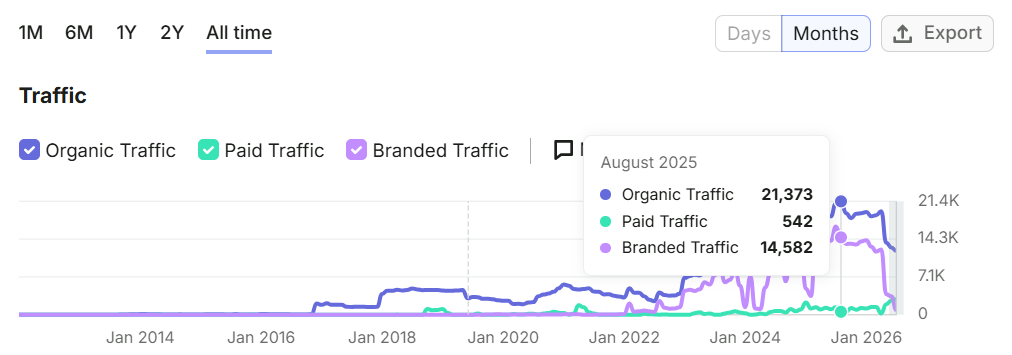
- Organic search climbing to 21,373 visitors a month (August 2025)
- Keyword footprint grown to 4,634 keywords ranking on Google (December 2025)
- My role: SEO consulting — I handed them the strategy and told them exactly what to do
Every number below is a real screenshot. No rounding up, no spin.
One note before we start: some details here have been changed at the client’s request, for privacy. The brand is real. The results are real. The product you’ll read about isn’t — I’ve swapped it out to keep them anonymous.
This one’s different from my other case studies.
Usually I’m doing the work — the content, the SEO, the whole build. This was an SEO consulting job. The brand was already huge.
Shark Tank huge. Oprah’s-Christmas-magazine huge. There’s a mini-documentary about them on the History Channel.
So they didn’t need me to run their SEO. They needed someone to sit down, audit what they already had, and tell them what to actually do with it.
Here’s the funny part.
For all that success — the TV deal, the magazine, the documentary — the owner had almost no idea what SEO was.
What He Thought SEO Actually Was
The owner thought SEO meant typing your brand name into Google and seeing your website show up.
That was it. That was the whole definition.
He’d even worked with an agency before, and still walked away thinking SEO was “when I search my own company, I’m at the top.”
If you do this for a living, you’re wincing right now.
But be honest — most business owners aren’t far off him. They know Google matters. They just don’t know how any of it works under the hood.
So that’s where we started. From scratch.
The Strategy I Gave Them
Strip away the jargon and half of SEO always comes back to one thing: high-quality content.
Not tricks. Not some secret setting. Content that genuinely answers what people are searching for — done better than anyone else bothers to.
I can’t share this brand’s real product, so from here we’ll pretend they sell running shoes. The strategy is identical either way.
The owner’s instinct was the common one: only make content about the product itself. “Our running shoes.” “Why ours are the best.” Pages about the exact thing he was selling.
That’s thinking too small.
Here’s what I told him instead. It came down to three moves.
Move one: map every topic connected to running shoes.
Not just “buy running shoes.” Every question a runner types into Google on the way to eventually buying a pair:
- Which running shoes suit which type of running
- The different types of running shoes, explained
- Best running shoes for flat feet
- Road running shoes vs trail running shoes
- How to pick shoes for your running gait
- How often you should replace your running shoes
- Best running shoes for beginners
- How to break in a new pair without shredding your heels
Then go wider. Think outside the box.
Someone searching “how do I train for my first marathon” or “how do I stop my knees hurting when I run” is your customer too. They just don’t have their wallet out yet.
Those topics belong to you.
Move two: make each piece the best on the internet.
Not a thin 500-word post. The most complete, most useful answer to that exact question that anyone has published anywhere.
Read yours, and you shouldn’t need to click back to Google.
This is exactly what Google says it rewards, too — what it calls helpful, reliable, people-first content. Write for the person, not the algorithm, and the rankings follow.
Move three — the part he was missing — link every one of those articles back to your money pages.
This is the whole engine. Let me spell it out.
All that informational content does one job: it builds authority. Google sees a site covering running shoes that deeply and thinks, these people know their stuff.
That trust is the currency of SEO.
But informational articles don’t make you money on their own. Nobody buys a $180 pair off an article titled “how often to replace your running shoes.”
So you take the authority those articles earn and funnel it — through internal links — to the pages that do sell. Product pages. Category pages. The ones with the “add to cart” button.
Informational content builds the authority. Internal linking passes that authority to the pages that pay you.
That’s it. That’s SEO 101 — the boring, unglamorous core that actually works.
Most owners never get told this. He hadn’t. Once he saw it, the whole thing clicked.
The Proof It’s Working
Here’s where the brand’s organic traffic sat by August 2025 — climbing to 21,373 visitors a month from Google.
And the keyword footprint underneath it — 4,634 keywords ranking on Google by December 2025.

Every one of those keywords is another door into the site.
Another runner, searching a real question, landing on a genuinely helpful article — and getting quietly guided toward a product page.
That’s what happens when you stop writing “about us” content and start building a topic map that pulls people in.
Why This Matters for Your Business
You don’t need to be on Shark Tank for this to work.
The strategy I gave a nationally famous brand is the same one I’d hand a skincare shop in Auckland or a plumber in Tauranga. It doesn’t change with the size of the business. It changes with how well it’s executed.
Most businesses make his exact mistake. They only talk about their product. They write the services page, the about page, and then wonder why Google ignores them.
The ones that win do the opposite.
They become the most helpful resource in their space — covering every question their customer has — then point all that earned authority at the pages that make them money.
That’s the whole game. It works whether you’re selling running shoes in America or fixing hot water cylinders in Hamilton.
If you’d rather have someone map it out for your business — the topics, the content plan, the internal linking — that’s where I come in. And if you’ve done my job for me by reading this far, you already know I’m not the SEO agency that’ll tell you to “just Google yourself.”
Final Thoughts
The lesson here isn’t about the brand. It’s about the gap.
Here was a business big enough for national TV, a major magazine, and a documentary — and the owner still thought SEO meant Googling his own name.
That gap is everywhere.
Most owners are sitting on the same misunderstanding, leaving the most durable source of customers they’ll ever have on the table — because nobody ever explained how it works.
It isn’t complicated. Build content people are searching for. Make it the best out there. Link it back to the pages that make you money. Repeat.
That’s the whole thing. Build it once, and it keeps paying you back long after the work is done.