
Search “types of SEO” and you’ll get a different answer on every page.
One site says there are three. The next says four. Scroll a bit further and someone’s confidently listed eighteen.

So which is it?
Here’s the honest version: the number is a distraction.
There are four core types of SEO that do the heavy lifting, a handful of specialised ones you’ll only touch if they fit your business, and three “hat colours” that describe how ethical your tactics are.
This guide walks through all of them — plain English, real New Zealand examples — and then does the part none of those other pages bother with: telling you which types your business should actually run first, and in what order.
Knowing the twelve types of SEO is trivia. Knowing which two you need this month is a strategy.
What Is SEO, and Why Are There Different “Types”?
SEO is the work of getting your website to show up when people search for what you sell. The “types” are just the different areas that one job covers.
Think of it like getting a car through a Warrant of Fitness.
Nobody says “there are four types of cars” because a mechanic checks the brakes, the tyres, the lights, and the engine. Those are just the areas of the same inspection.
SEO’s the same: the words on your page, the links pointing at it, the code underneath, and how you show up locally are all parts of one machine.
The reason people split it up is simple — it’s easier to manage a big job in pieces than to stare at the whole thing at once.
And here’s the bit that matters for you: think about a plumber doing SEO in Wellington versus a national online store.
They’re doing the same job, but they lean on completely different pieces of it. The plumber lives or dies on local search. The online store lives or dies on product pages and technical health. Same SEO. Different slices.
So don’t read the list below as a menu where you pick one. Read it as a map, where you work out which roads your business actually needs to drive down.
How Many Types of SEO Are There?
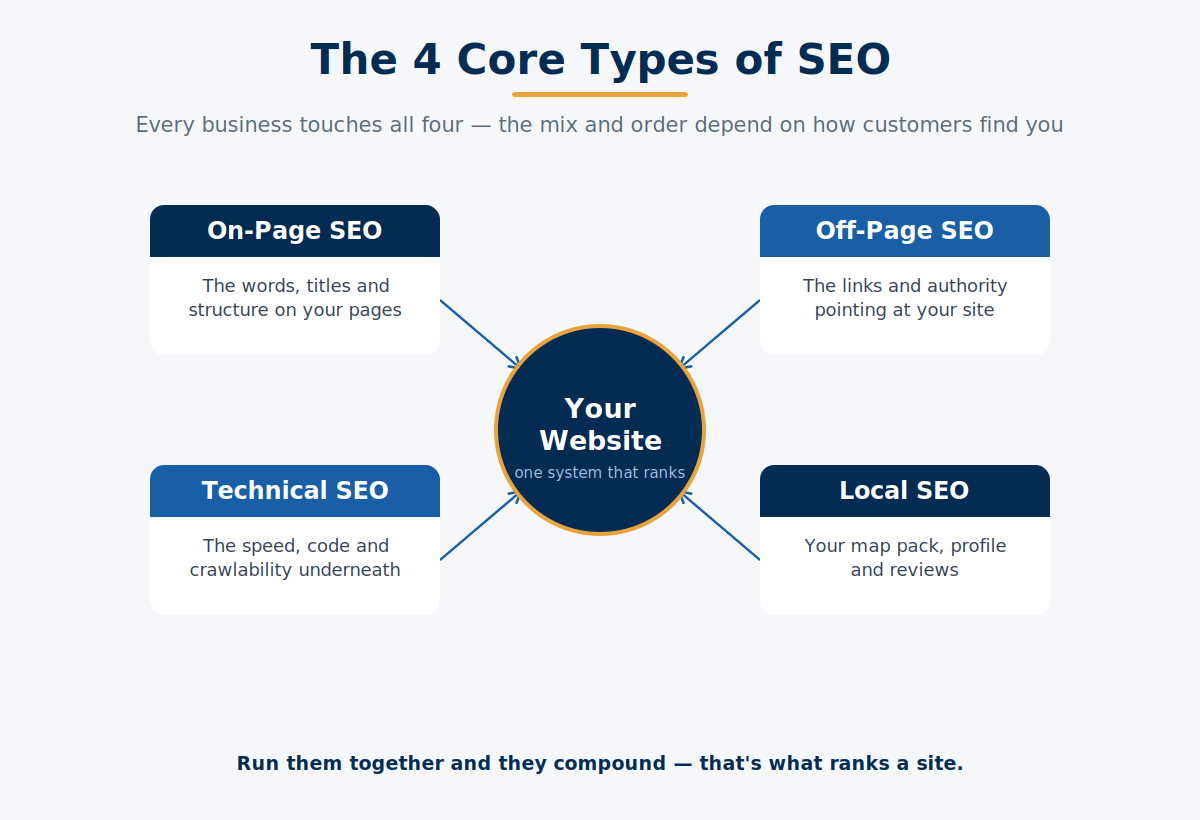
There are four core types of SEO — on-page, off-page, technical, and local.
Everything else is a specialised branch of those four (e-commerce, mobile, voice, and so on), plus three “hat colours” — white, grey, and black — that describe how you go about it rather than what you optimise.
So when one guide says three, another says four, and a third says eighteen, they’re all describing the same work — just at different zoom levels. The three-type crowd folds local into on-page.
The eighteen-type crowd counts every sub-branch separately to pad the list. Neither is wrong; both are counting differently.
Here’s the whole landscape in one view:
- The core four: on-page, off-page, technical, local — every business touches these.
- The specialised branches: e-commerce, mobile, voice, video, image, content, international — situational, only if they fit.
- The three hat colours: white hat (plays by the rules), grey hat (bends them), black hat (breaks them).
Lock that structure in and the rest of this guide is just filling in the detail. Let’s take the core four first, because those are the ones that pay the bills.
On-Page SEO
On-page SEO is everything you control on the page itself — the words, the headings, the title tag, the images — done so both Google and a human instantly get what the page is about.
Why it usually goes first: it’s the cheapest type to fix and the fastest to move. You’re not waiting on other websites or a developer. You open the page, you improve it, it’s live.
Picture an Auckland café with a homepage that just says “Welcome to our café.”

Google has no idea what that page is for.
Now rewrite it around what people actually search — brunch in Ponsonby, the menu, the hours, the vibe — with a clear H1, a title tag that names the thing, and descriptive image alt text. Suddenly the page has something to rank for.
Nothing about the café changed; the page finally told Google the truth about it.
This is also where search intent lives — matching the page to why someone’s searching. Best brunch Ponsonby wants a list to browse.
Book a table Ponsonby café wants a booking button. Same café, two different pages, because the intent behind the search is different. Get that match right and you’re most of the way to ranking.
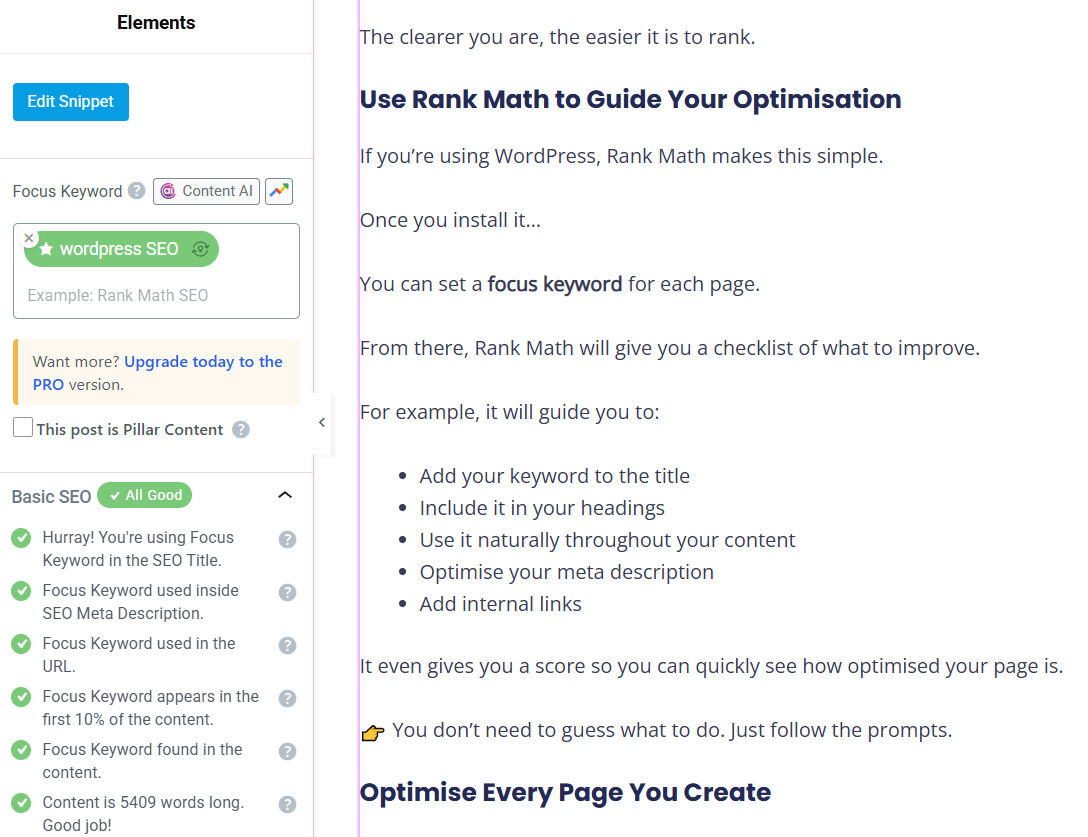
The tools that make it painless: Google Search Console tells you which terms a page already shows up for (your starting point), and something like Rank Math or Yoast inside WordPress flags a missing title, a thin meta description, or a heading that’s out of order before you hit publish.
Off-Page SEO
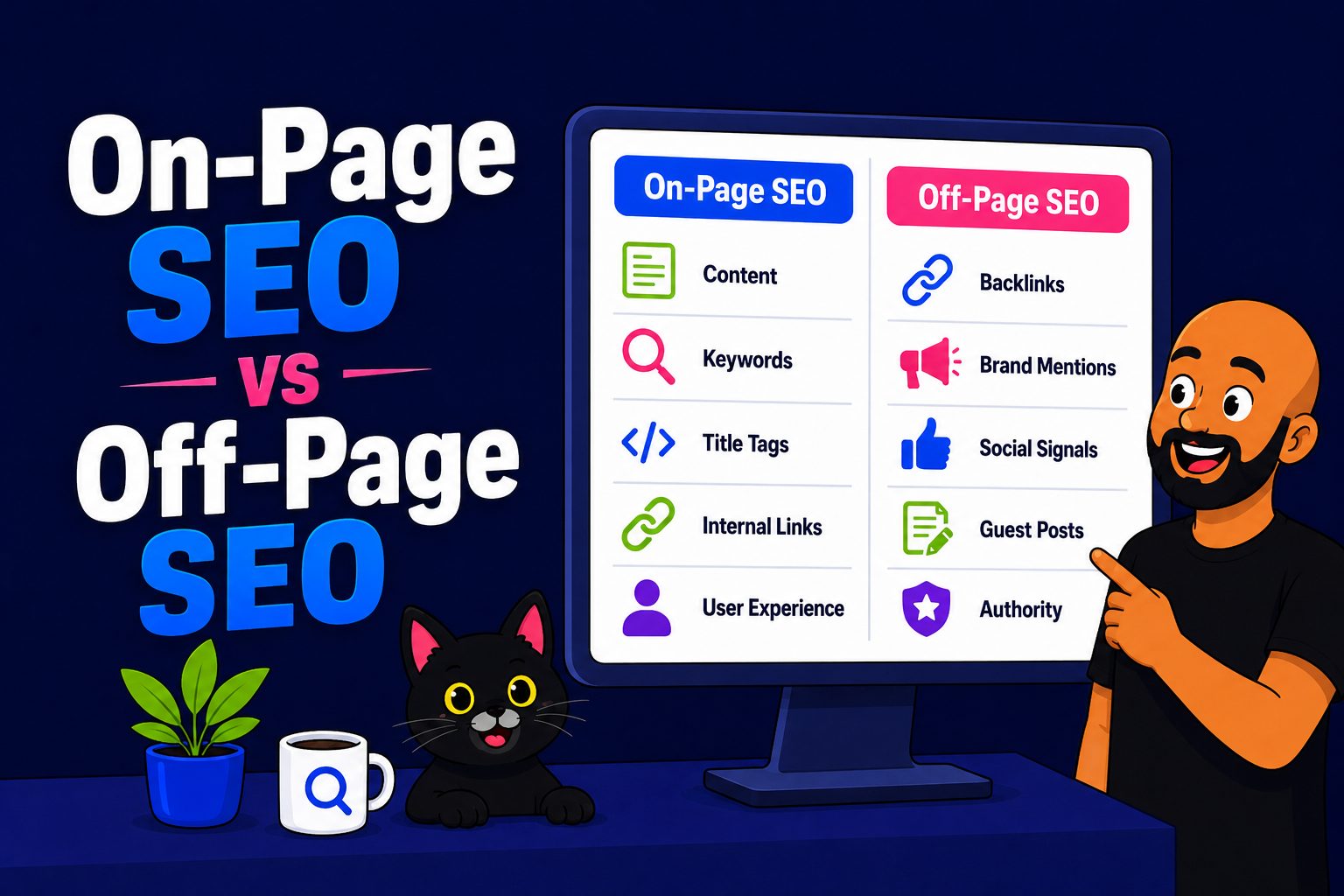
Off-page SEO is everything that happens away from your site to build its authority — and it’s mostly one thing: backlinks. A backlink is another website linking to yours.
Think of links as votes of trust. When a respected NZ site links to you, it’s vouching for you in front of Google — and Google counts the votes.
The more good websites that point at you, the more credible you look, and the higher you tend to sit.
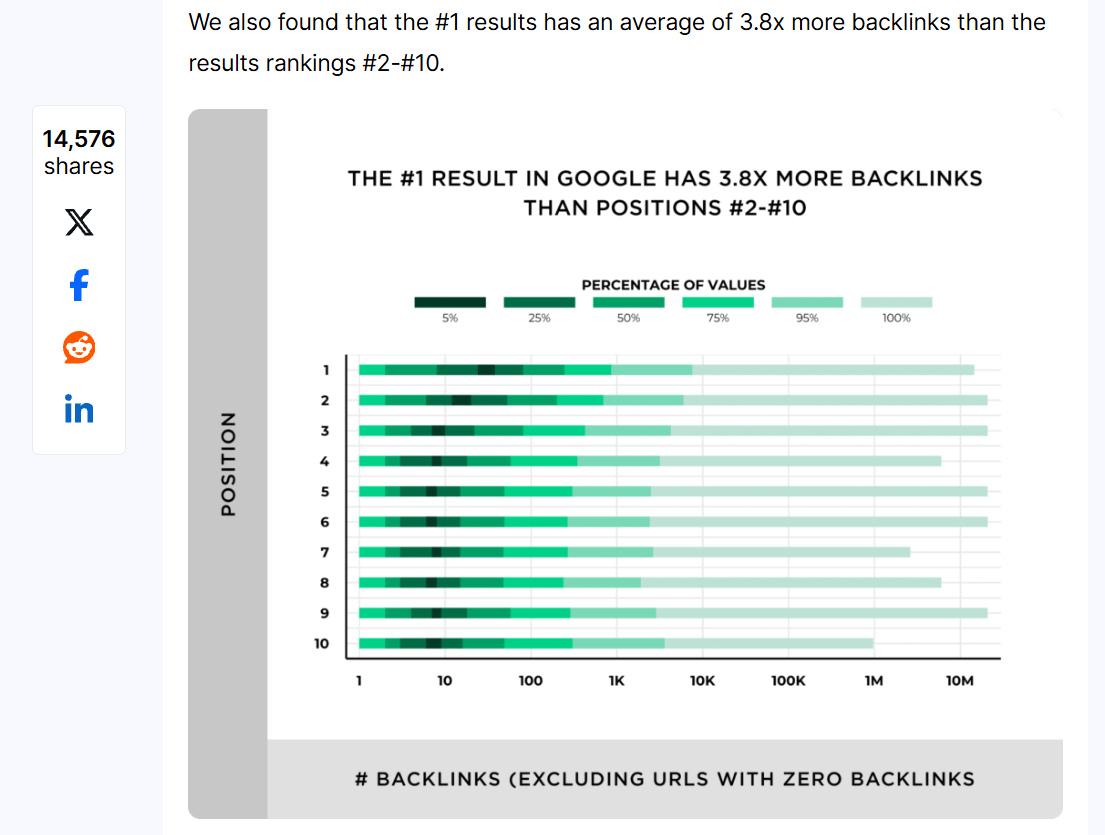
The data backs it hard. When Backlinko analysed 11.8 million search results, they found the number-one result had on average 3.8 times more backlinks than the pages sitting in positions two through ten.
Referring domains — the count of different sites linking to you — was the single strongest correlation in the whole study.
Here’s the catch, and it’s the one that gets NZ businesses in trouble: quality beats quantity every single time.
One link from a genuine local news site or an industry body is worth more than a hundred from directory farms nobody reads.
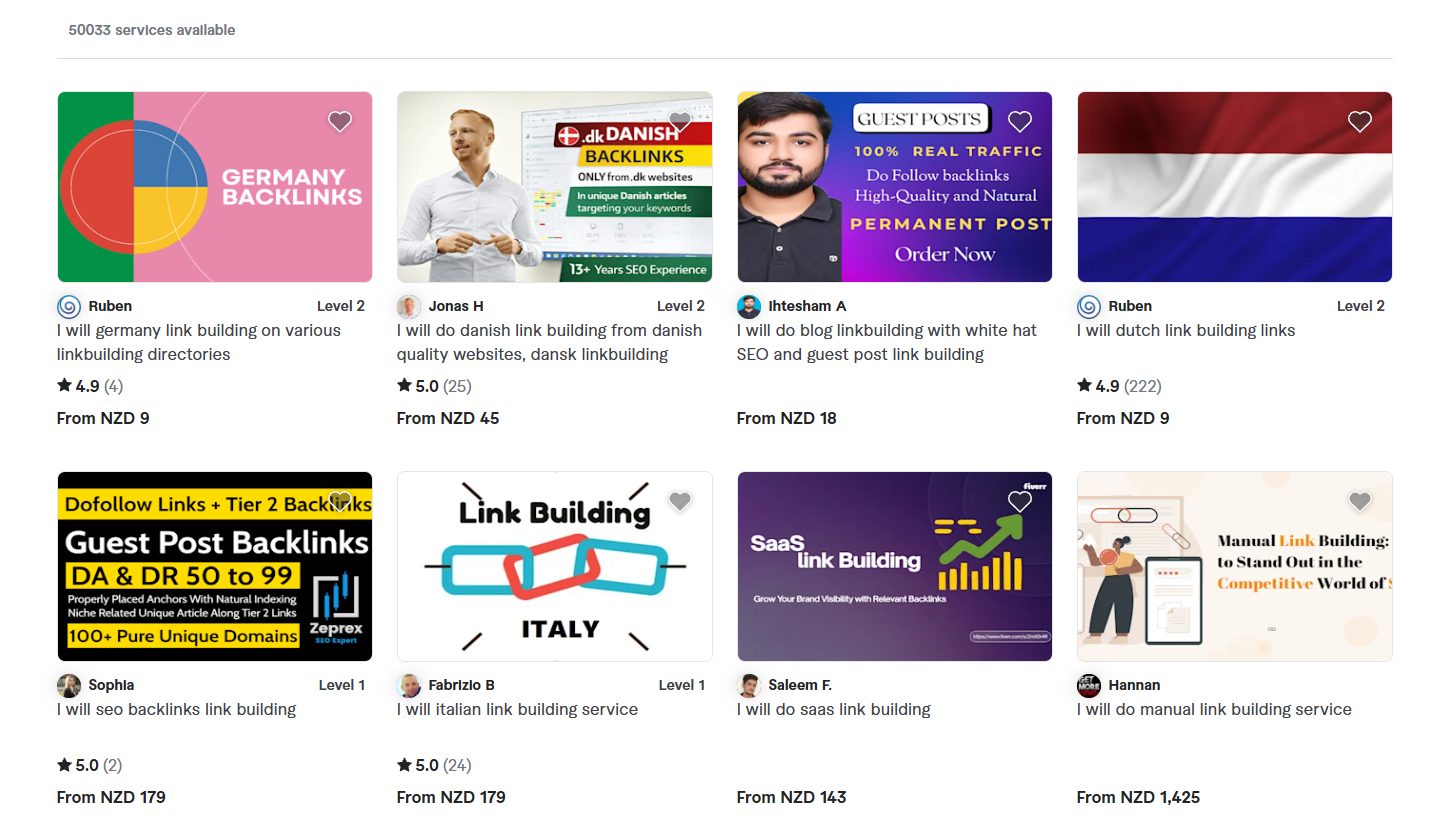
Ten years doing this and I’ve watched more than one site tank because someone bought “100 backlinks for $50” off a marketplace and Google worked out exactly what they’d done.
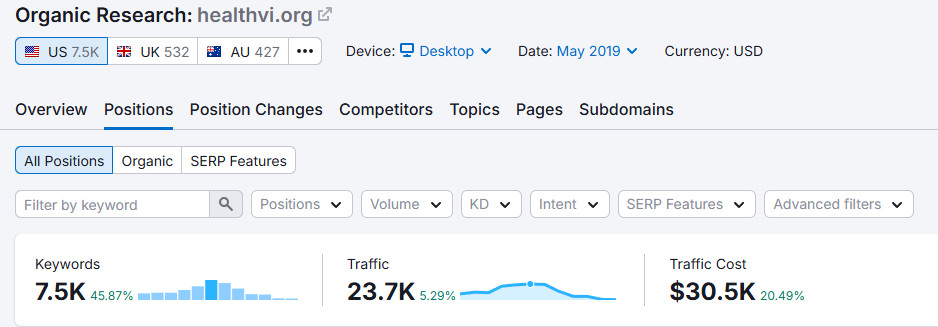
I’ve also seen the other side of it. Back in 2017 I started a health site, HealthVI, with my former business partner and SEO mentor Ian Pribyl.
A big part of what took it from zero to over 20,000 organic visitors a month was earning real links — the slow, boring, legitimate way. That’s off-page SEO doing its job.
Technical SEO
Technical SEO is the under-the-hood work — site speed, mobile-friendliness, crawlability, security — that lets Google actually read and rank your site in the first place.
Back to the car analogy, because it fits perfectly here.
On-page and off-page are the paint job and the reputation.
Technical SEO is the engine.
You can have the best-looking page on the internet, but if Google’s crawler can’t reach it, or it takes eight seconds to load on a phone, none of the rest matters. The car doesn’t run.
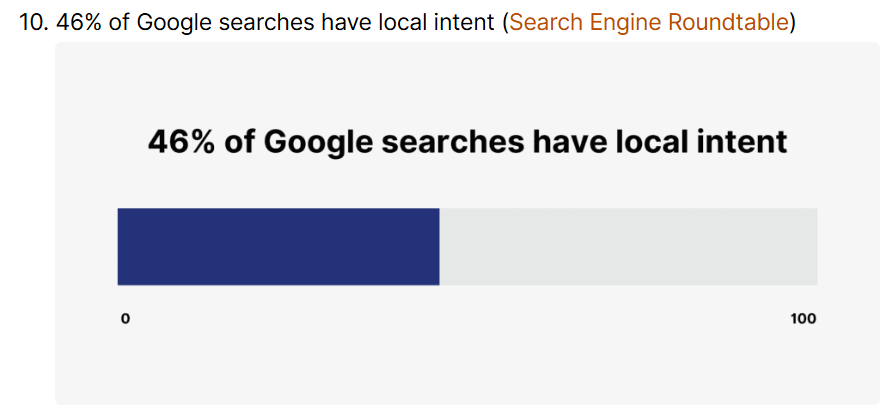
Why it matters more than it used to: most searches now happen on a phone, and around 46% of all Google searches carry local intent.
The bulk of those are mobile — someone standing on a footpath looking for you right now. A site that’s slow or clumsy on mobile loses that person before your content ever gets a say.
Here’s the reality with New Zealand sites specifically: the first thing I do on a new client is run a site audit, and nine times out of ten there’s a listful of errors nobody knew about — broken links, missing meta, images the size of a small country, pages Google was quietly told not to index.
None of it visible from the front end. All of it holding the site back.
The tool for this is a proper crawler. SEMrush Site Audit or Ahrefs will crawl the whole site and hand you a prioritised list of what’s broken, and Google Search Console (free) shows you which pages Google is actually indexing versus quietly ignoring.
Fix the red items first; most of the “why won’t this rank” mysteries live in that report.

Local SEO
Local SEO is how you show up when someone nearby searches dentist near me or plumber Hamilton. It’s the map pack at the top of the results, your Google Business Profile, your reviews, and your local citations — the mentions of your name, address and phone number across the web.
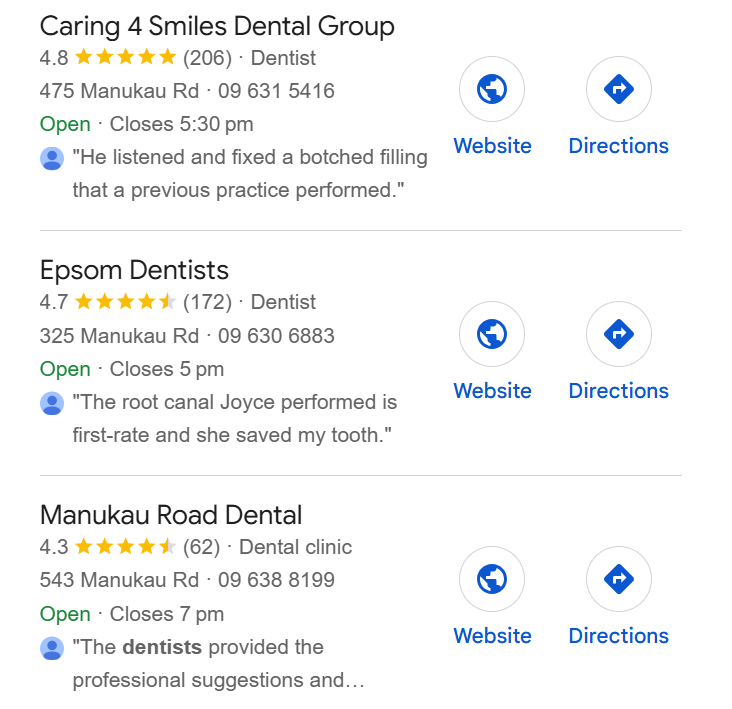
For most NZ service businesses, this is the single highest-leverage type of SEO there is. Here’s why: local searches are people ready to act.
Around 76% of “near me” searches lead to a visit within a day, and 28% of local searches end in a purchase. That’s not idle browsing — that’s someone with their wallet already half out.

The core moves are straightforward. Claim and fully fill out your Google Business Profile (right category, hours, photos, services).
Build a steady flow of genuine reviews — grab your review link from the profile, turn it into a QR code for the invoice and the van, and send it by text the moment a job’s done well and the customer’s happy.
Then get your details listed consistently across the main NZ directories so Google trusts that you are who you say you are.
I’ll put my own money where my mouth is on this one. Expert SEO’s website is under a year old, and it already ranks above Ahrefs and Semrush for “local SEO” here in New Zealand.

It even gets cited in Google’s AI Mode for that search.
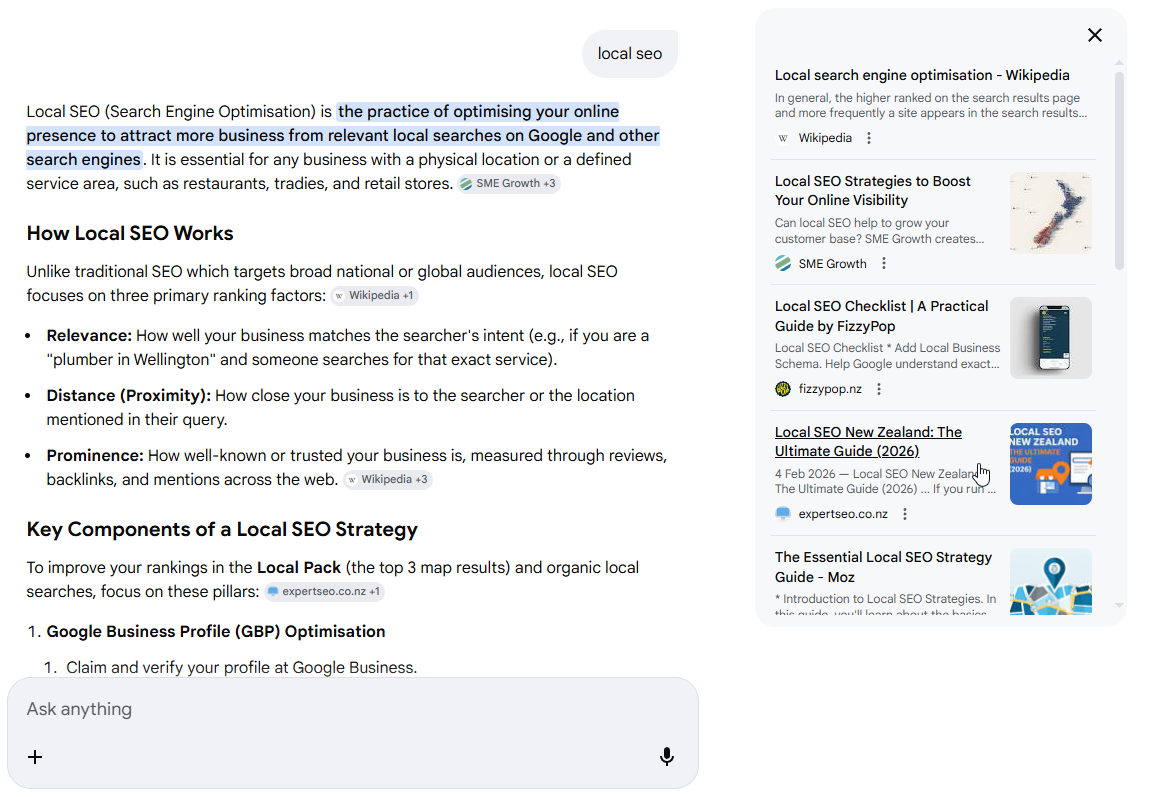
On paper, a domain that young beating those two shouldn’t happen. Local SEO done properly is a big part of how it did.
The Specialised Types of SEO
Beyond the core four sit the specialised types. These are just the core four aimed at a specific situation. You don’t need all of them — just the one or two that match what you actually sell.
Here’s the run-through, and who each one is genuinely for:
- E-commerce SEO — for online stores. It’s on-page and technical SEO applied to product and category pages: unique product descriptions, clean category structure, schema so prices and stock show in results. An NZ activewear store lives here.
- Mobile SEO — for everyone now, but non-negotiable for anyone chasing local. It’s making sure the phone experience is fast and thumb-friendly, because that’s where the “near me” crowd is searching.
- Voice SEO — for businesses that catch conversational, spoken queries. Voice is real, too: Ranktracker reports 58% of consumers used voice search to find local business info in the past year. A driving instructor answering who teaches manual driving lessons near me is a voice-and-local play.
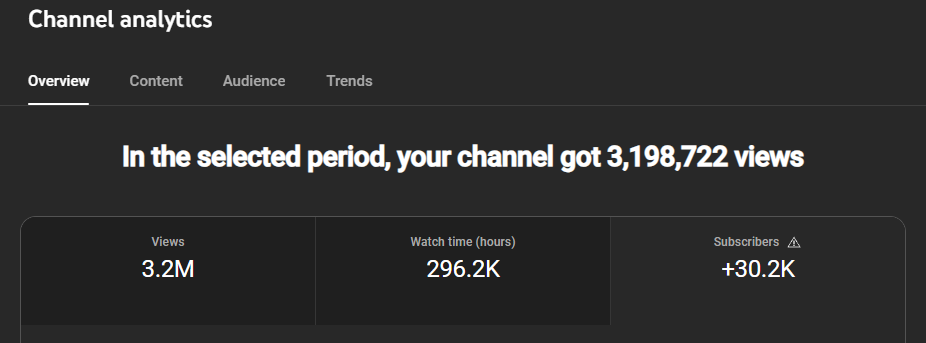
- Video SEO — for anyone whose customers search on YouTube. It’s optimising titles, descriptions and chapters so your videos surface. (I run a channel with 30,000-plus subscribers and 3.2 million views — video SEO is what makes that findable rather than buried.)
- Image SEO — for visual and product-led sites. Descriptive filenames, alt text, compressed files — so your images rank and your pages load quickly.
- Content SEO — for authority-led businesses, like a mortgage broker or a law firm, who win by answering questions better than anyone else and building a library of trust over time.
- International SEO — for the minority of NZ businesses selling across borders. It handles language and country targeting so the right version of your site shows in the right market.
If you’re a single-location tradie, most of that list is noise — you need local, on-page and technical, and you can happily ignore the rest.
If you run an online store, e-commerce and technical jump to the front. Match the branch to the business; don’t collect them for the sake of it.
White Hat, Grey Hat, and Black Hat SEO
White, grey and black hat describe the ethics of how you do SEO — how closely you play by Google’s rules.
White hat plays by them. Black hat breaks them for a shortcut. Grey hat lives in the murky middle, doing things Google frowns on but hasn’t fully cracked down on yet.
The reason to care is money, not principle.
Google’s guidelines explicitly name link schemes, cloaking and doorway pages as against the rules, and it hands out penalties that can wipe a site off the results overnight.
A ranking built on black-hat tricks is a ranking built on a fault line.
The version of this that actually shows up in New Zealand: the cold callers and marketplace sellers promising “page one in 30 days” or “100 backlinks for fifty bucks.”
That’s black and grey hat dressed up as a bargain. It might spike your rankings for a month. Then an update rolls through, the cheap links get discounted or penalised, and you’re worse off than when you started — now with a mess to clean up on top.
The take from ten years of doing this: white hat is slower, and it’s the only one that compounds instead of collapsing. Every legitimate link, every honest review, every genuinely useful page stacks on the last one.
Shortcuts don’t stack — they expire.
Which Types of SEO Should Your Business Focus On First?
You don’t run all the types at once. You sequence them, and the right order depends on how customers actually find you.
The default starting point for most businesses is the same three, in this order: technical first (so the site works and Google can read it), on-page second (so your pages target the right terms), and then either local or content third — local if customers come to you, content if they find you online.
From there it splits by business model. Here’s how the common NZ ones line up:
| Business | Start with | Then add | Why this order |
|---|---|---|---|
| Hamilton plumber | Local + on-page | Technical | Customers search “plumber near me” ready to book — the map pack is the whole game |
| Auckland dentist | Local + reviews | On-page, content | Trust and proximity win; reviews and the map pack drive the calls |
| NZ online store | Technical + e-commerce | Content, off-page | Product pages must be crawlable and clean before anything else pays off |
| Mortgage broker | Content + on-page | Local, off-page | People compare and research first — authority content earns the enquiry |
| National service / SaaS | Content + off-page | Technical | No local intent, so authority and links do the ranking |
Walk the plumber through it, because it makes the logic concrete. First we make sure the site loads fast and isn’t hiding pages from Google (technical).
Then we build a proper “plumber Hamilton” page and service pages that name what he does and where (on-page and local).
Then we get his Google Business Profile humming and reviews flowing (local). We don’t touch video SEO or international SEO — he’s never going to need them. Three types, in order, and he’s competing.
That sequencing is the strategy. Every competitor page will hand you twelve types and wish you luck.
Knowing which three to run, and in what order, is the difference between a list and a plan.
And the same logic travels wherever you’re competing — whether you’re doing SEO in Auckland, Christchurch, or Queenstown. The mix shifts to fit the market; the four core types don’t change.
How the Types of SEO Work Together
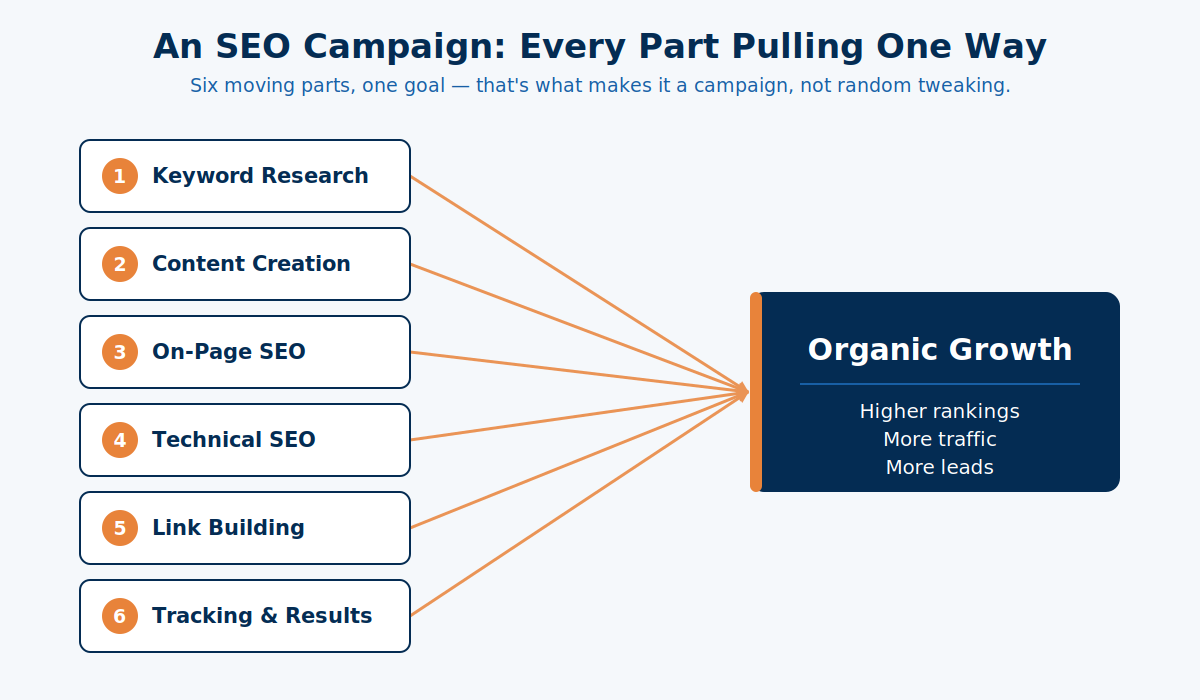
No single type of SEO wins on its own. They compound — and it’s the stack, not any one piece, that actually ranks a site.
Here’s the chain reaction:
Technical SEO clears the path so Google can crawl you. On-page SEO tells Google what each page is about. Off-page SEO builds the authority that makes Google trust you over the next site. Local SEO points all of that at the people searching near you.
Pull any one link out and the chain weakens — a fast site with thin content ranks for nothing, and brilliant content on a broken site never gets read.
This is also the answer to the “is SEO dead in 2026?” panic. No — it’s the same stack, now feeding AI as well as blue links.
Google’s own documentation is blunt about it: SEO is still relevant for generative AI search, because those AI features are rooted in the same core ranking systems.
Do the SEO stack well and you don’t just rank — you get quoted by the AI too.

Which brings me back to Expert SEO. A sub-one-year-old site outranking Ahrefs and Semrush, cited in AI Mode, in a market full of decade-old agencies. There’s no single trick behind that.
It’s technical, on-page, off-page and local all running together, each one making the others count for more. That’s the whole point of understanding the types: not to pick a favourite, but to run them as one system.
Doing SEO Yourself vs Hiring an Expert
You can learn and run the core types yourself. Plenty of NZ business owners do, and the on-page basics and Google Business Profile setup are genuinely DIY-able — a motivated owner with a few weekends can move the needle.
Where it gets harder is the stuff that doesn’t show its working. Technical audits, earning quality links at any scale, and keeping the whole stack running while you’re also, you know, running the business — that’s where the hours pile up and the mistakes get expensive.
The cheap-backlink trap earlier in this guide is exactly what happens when someone tries to shortcut the hard part alone.
So the real question is simpler: is your time better spent on the plumbing, the fillings, the mortgages — while someone who does this every day runs the SEO?
Some owners just want a steer, and bring in an SEO consultant to point them the right way. Others would rather hand the whole stack to a done-for-you SEO team.
For a lot of owners, the honest answer to that question is yes — and that’s where we come in.
Whatever you choose, do it as one system. Pick the two or three types that fit your business, run them properly, and let them compound. That’s how a site with no head start beats the ones that had a decade on it.
Types of SEO: FAQ
What are the 4 types of SEO?
The four core types of SEO are on-page, off-page, technical, and local. On-page covers the words and structure on your pages, off-page covers the backlinks and authority pointing at your site, technical covers site health and crawlability, and local covers the map pack, Google Business Profile and reviews.
What are the 3 types of SEO?
When people say there are three types of SEO, they usually mean on-page, off-page, and technical — folding local SEO in under on-page. It's the same work, just described at a broader level.
What are the 5 pillars of SEO?
The commonly cited five pillars are technical SEO, on-page SEO, content, off-page SEO (links), and user experience. They map onto the same core areas as the four types — just sliced a little differently.
What are the 4 stages of SEO?
A typical SEO campaign runs in four stages: a technical and keyword audit, on-page optimisation, content creation, and off-page authority building — followed by ongoing tracking and refinement.
What are the 3 C's of SEO?
The three C's are content, code, and credibility — a simple way to remember on-page content, technical (code) health, and the authority from links and reviews that builds trust.
Is SEO dead in 2026?
No. Search volume is still growing, and Google's own documentation confirms SEO still matters for AI search, because AI Overviews and AI Mode pull from the same ranking systems. The stack that ranks you is the stack that gets you cited.
What are the different types of SEO services?
SEO services usually bundle the core types together: technical fixes, on-page optimisation, content, off-page link building, and local SEO. Most NZ providers scope these into one ongoing programme rather than selling them separately.